Author: admin

  • 6 Data Strategies for Multi-Channel Digital Success

    6 Data Strategies for Multi-Channel Digital Success

    Most marketing teams believe more data automatically leads to better decisions. This is a fallacy. The typical marketing department has access to dozens of data streams but uses them to create prettier reports, not to fundamentally change strategy. Effectively using data for multi-channel digital strategies requires a disciplined framework for turning noise into signal. The goal isn’t to collect more data, but to connect the right data points to specific channel execution, moving from vanity metrics to actions that generate attributable revenue. This means building a system where a customer’s click on a social ad correctly informs the content they see on your website moments later.

    To identify the most effective methods, we analyzed a range of approaches based on their ability to provide actionable insights, their integration complexity, and their impact on campaign ROI. Our methodology ranked each strategy by its capacity to move beyond channel-specific metrics and contribute to a unified view of the customer. We prioritized techniques that enable small teams to make smarter decisions without requiring a dedicated data science department, focusing on real-world applicability over theoretical perfection.

    Young man writing data points and strategies on a glass board for a CDP
    Young man writing data points and strategies on a glass board for a CDP (Photo by DiggityMarketing on pixabay)

    Unify Customer Data with a CDP

    A Customer Data Platform (CDP) is the foundational layer for any serious multi-channel strategy. It’s not just another analytics tool; it’s a centralized system that ingests, cleans, and consolidates customer data from every single touchpoint, from your website and mobile app to your CRM and point-of-sale system. This creates a persistent, unified customer profile, often called a “golden record,” that serves as the single source of truth for every interaction. Without a CDP, your marketing teams are operating with fragmented, incomplete pictures of the customer, leading to disjointed experiences and wasted ad spend. For instance, your email team might be sending discount offers to a customer who just made a full-price purchase via a social ad because their systems don’t talk to each other.

    By implementing a CDP like Segment or Tealium, you can track a user’s entire journey. You can see that a user first discovered your brand through an organic search, later clicked a retargeting ad on Facebook, visited three product pages, and then finally converted through an email campaign. This unified view is critical. A CDP is the engine that powers a superior, consistent experience across all your channels by ensuring every channel has the same, up-to-the-minute information about each customer.

    • Best for: Businesses with multiple online and offline touchpoints struggling to create a single customer view.
    • Watch out for: Implementation can be complex and requires developer resources to ensure all data sources are correctly tracked.

    Measuring ROI and Attribution Across Channels
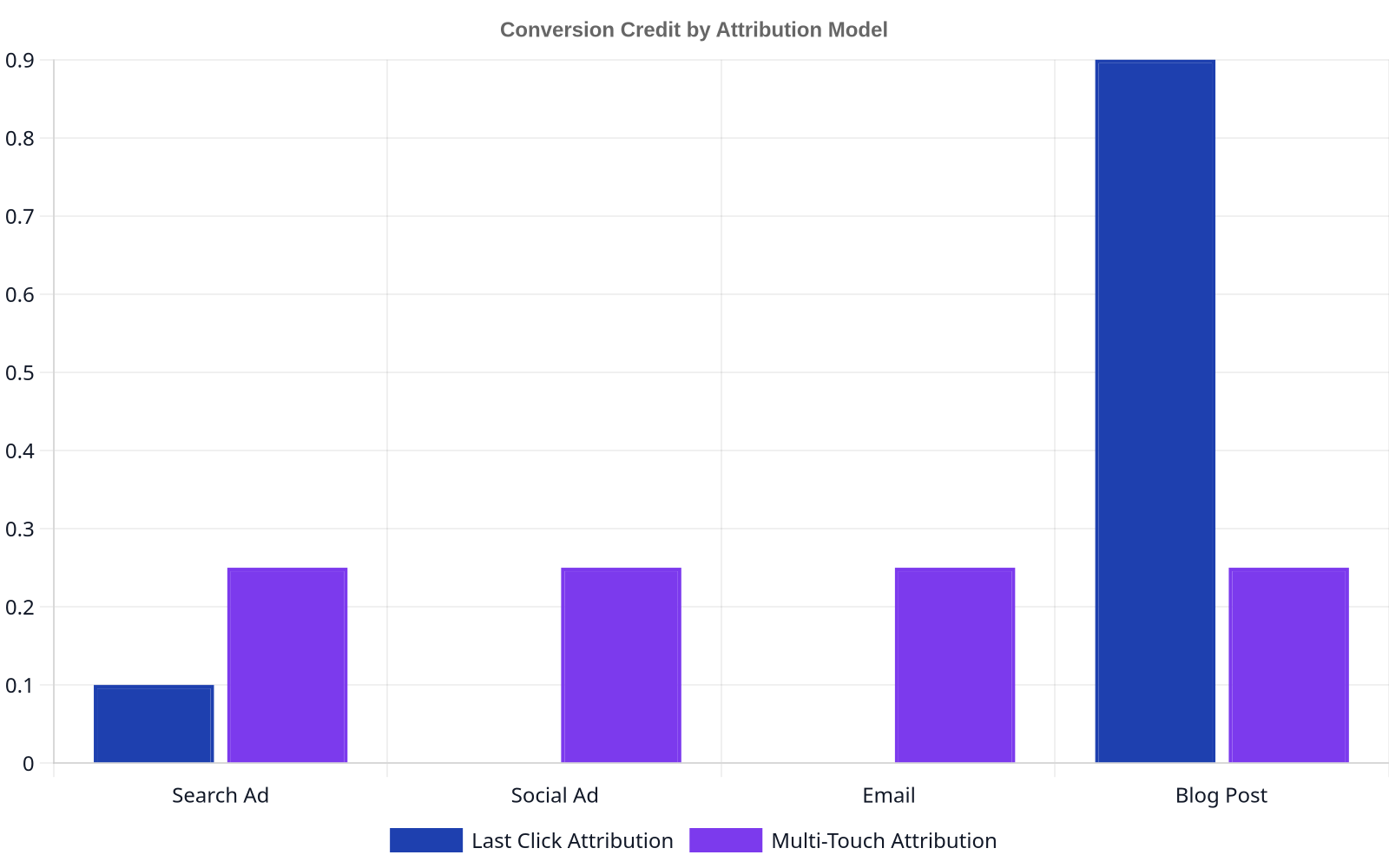
    Bar chart comparing conversion credit assigned to different marketing channels (Search Ad, Social Ad, Email, Blog Post) under two attribution models: Last Click (where Blog Post gets most credit) and Multi-Touch (where credit is more evenly distributed).
    Attribution Model Comparison: Last Click vs. Multi-Touch

    Once your data is unified, the next critical step is to measure what’s actually working. Over-relying on last-click attribution is a common and costly mistake in digital marketing. It incorrectly gives credit for a conversion to the very last touchpoint, ignoring all preceding interactions that built awareness and consideration. This leads to poor budget allocation, typically overvaluing channels like branded search and email while undervaluing top-of-funnel activities like social media and display ads. A more sophisticated approach involves using data-driven, multi-touch attribution models.

    Models like linear, time-decay, or position-based attribution distribute credit more equitably across the entire customer journey. For example, a position-based model might assign a portion of the credit to the first touch, a portion to the last touch, and distribute the remaining credit among the interactions in the middle. Tools like Google Analytics 4 (GA4) and dedicated platforms like Ruler Analytics or LeadsRx are designed for this. By analyzing which channels consistently appear in converting paths, you can make smarter decisions. Gartner research indicates that marketers who adopt multi-touch attribution can improve their marketing ROI by reallocating their budgets to what truly influences customers.

    • Best for: Companies that have a long consideration cycle and multiple touchpoints before a conversion.
    • Watch out for: There is no single “perfect” attribution model. The best model depends on your business, and it’s often wise to compare insights from several models.

    Understanding Cross-Channel Customer Journeys
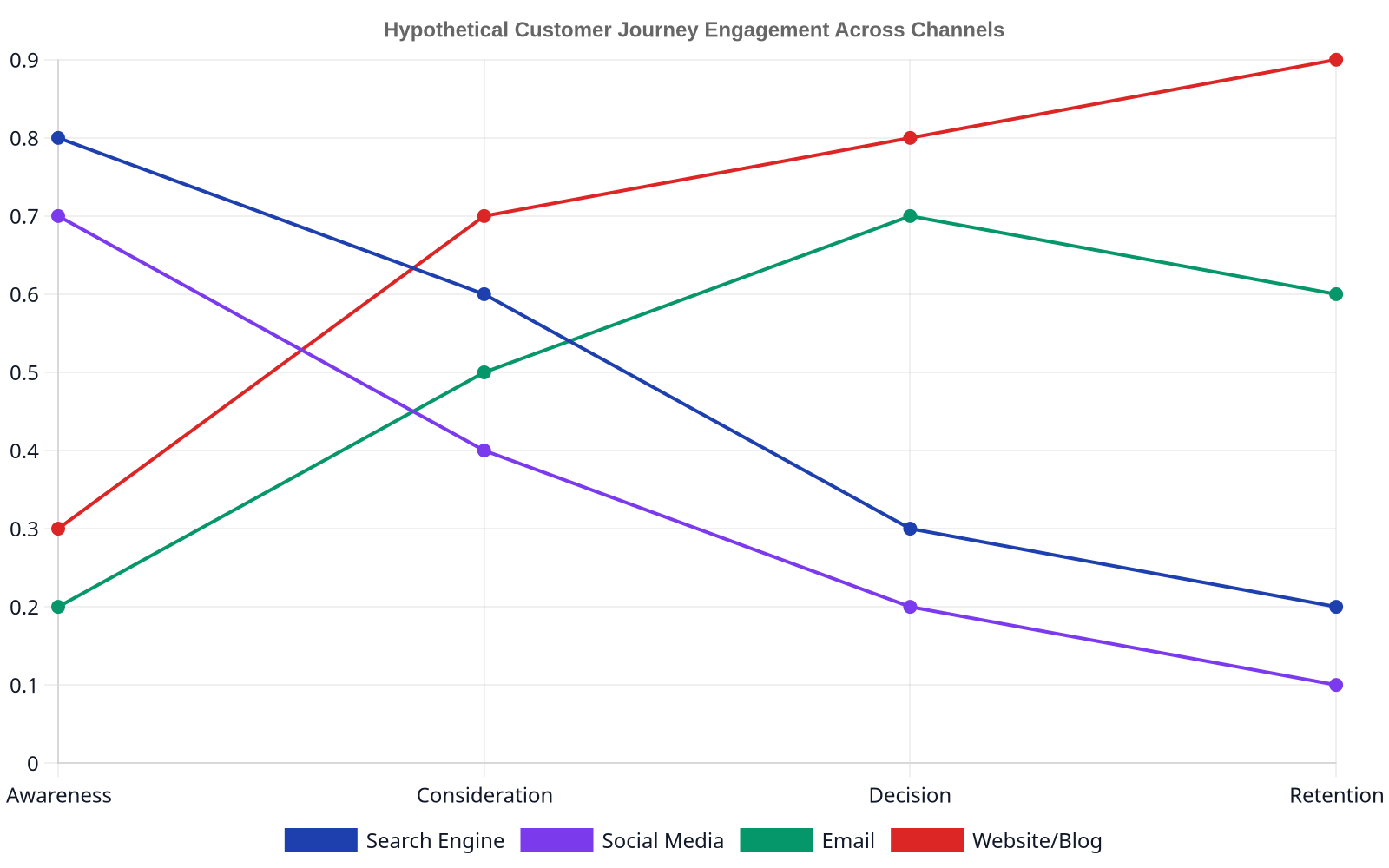
    Line chart showing hypothetical customer engagement levels across various digital channels (Search Engine, Social Media, Email, Website/Blog) at different stages of the customer journey (Awareness, Consideration, Decision, Retention), with engagement peaking on different channels at different stages.
    Customer Journey Touchpoints by Channel

    Creating a unified customer profile and implementing proper attribution are technical wins, but they must translate into a deeper understanding of customer behavior. This means moving beyond simple channel performance metrics and mapping out the actual paths customers take. You need to identify the most common sequences of interactions. Do customers typically discover you on Instagram, then sign up for your newsletter, then convert from a promotional email? Or do they read a blog post from an organic search, get retargeted on LinkedIn, and then request a demo?

    Don’t just measure channel performance in silos. Map the handoffs between channels to understand how your marketing ecosystem truly works together.

    Tools like GA4’s path exploration reports allow you to visualize these journeys. By analyzing these paths, you can spot both friction points and opportunities. For example, you might discover a significant drop-off when users move from your mobile app to your website to complete a purchase, indicating a poor user experience at that handoff. Conversely, you might find that users who watch a specific video on your YouTube channel are twice as likely to convert, signaling an opportunity to promote that video more heavily. This qualitative analysis of quantitative data provides the “why” behind the numbers, enabling you to optimize the entire journey, not just individual channels. This is part of a holistic approach that includes services like keyword research and content creation to ensure you’re present at each stage.

    • Best for: Marketers looking to optimize the user experience and improve conversion rates by understanding how customers interact with their brand over time.
    • Watch out for: It’s easy to get lost in the data. Focus on the most common and most valuable paths first, rather than trying to analyze every possible permutation.

    Businessman presenting data charts on a screen to colleagues in a modern meeting room
    Businessman presenting data charts on a screen to colleagues in a modern meeting room (Photo by konkapo on pixabay)

    Personalize Experiences with Dynamic Content

    With unified data and a clear understanding of the customer journey, you can deliver truly personalized experiences. This goes far beyond using a customer’s first name in an email. Dynamic content involves tailoring the messaging, offers, and even the imagery on your website, ads, and emails based on a user’s past behavior, demographics, and real-time actions. For example, an e-commerce site can show a returning visitor products related to their previous purchases on the homepage. A B2B company can change the call-to-action on its landing page based on whether the visitor is from a small business or a large enterprise.

    Platforms like Optimizely, VWO, and the personalization features within marketing clouds like HubSpot make this possible. They use the data from your CDP to segment audiences and apply rules for content delivery. This is no longer a “nice-to-have” feature; it’s a core expectation. By connecting your data, you can stop showing generic content and start having a one-on-one conversation with each customer, at scale.

    • Best for: Businesses with a diverse customer base and product catalog where personalization can significantly lift conversion rates.
    • Watch out for: Over-personalization can feel creepy. Ensure your efforts are genuinely helpful, not just a demonstration of the data you’ve collected.

    Allocating Budget Based on Data Insights
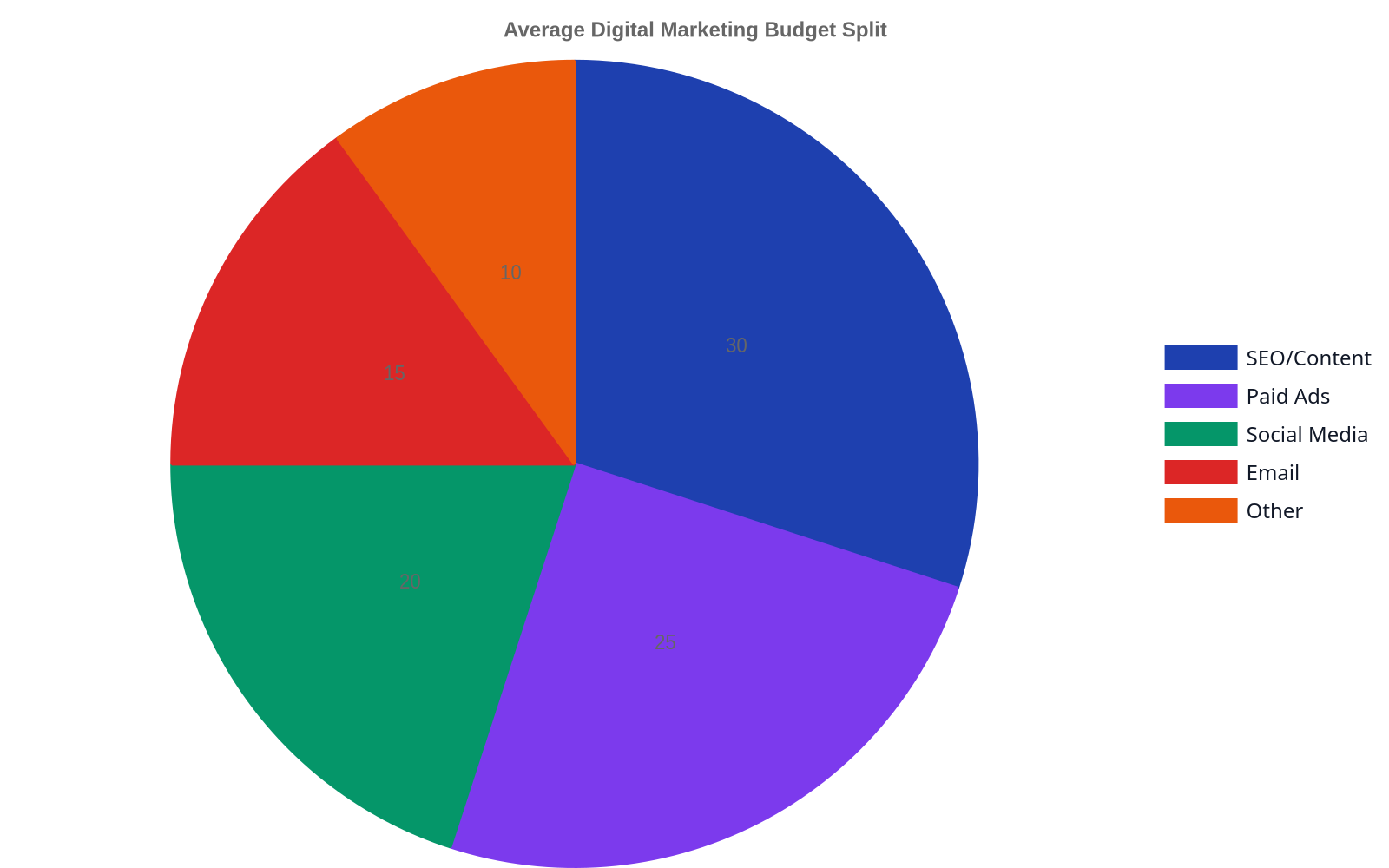
    Pie chart illustrating a hypothetical average digital marketing budget allocation: SEO/Content 30%, Paid Ads 25%, Social Media 20%, Email 15%, and Other 10%.
    Typical Multi-Channel Marketing Budget Allocation

    One of the most powerful applications of a unified data strategy is optimizing your marketing budget. Instead of allocating funds based on historical precedent or gut feelings, you can use performance data to invest in the channels and campaigns that deliver the best returns. This is an iterative process of measuring, analyzing, and reallocating. For example, your multi-touch attribution model might reveal that while your Google Ads campaigns have a high last-click conversion rate, your podcast sponsorships are a critical first touch for your most valuable customers. This insight would justify shifting more budget toward podcasting, even if its direct, last-click ROI appears low.

    This data-driven approach allows you to be more agile. If you launch a new campaign on TikTok and your real-time dashboards show it’s driving high-quality traffic to your site, you can double down on that investment immediately instead of waiting for a quarterly review. Some companies take this even further with marketing mix modeling (MMM), a statistical analysis that determines the effectiveness of marketing campaigns by factoring in external variables like seasonality and economic conditions. While complex, MMM provides a highly accurate picture of ROI. As we’ve seen with clients like Wolverine Assemblies, getting this allocation right is key to sustainable growth.

    • Best for: Growth-stage companies looking to maximize the efficiency of their marketing spend and scale quickly.
    • Watch out for: Don’t completely defund channels that appear to be underperforming without first understanding their role in the broader customer journey. Some channels are for assists, not goals.

    The goal is not to find the one “best” channel. The goal is to fund a portfolio of channels that work in concert, with each one playing a specific role in the customer journey.

    Predictive Analytics for Proactive Marketing

    While historical data tells you what happened, predictive analytics tells you what is likely to happen next. By applying machine learning models to your customer data, you can forecast future trends and behaviors. This allows you to move from reactive to proactive marketing. For instance, you can build a model to identify customers who are at a high risk of churning. Instead of waiting for them to cancel their subscription, you can proactively reach out with a special offer, helpful content, or a customer support check-in.

    Another common application is lead scoring. A predictive model can analyze the attributes and behaviors of past converted leads to assign a score to new incoming leads, allowing your sales team to prioritize their efforts on those most likely to close. Firms that use predictive analytics are more likely to report significant revenue growth. This is because they aren’t just optimizing past performance; they are actively shaping future outcomes. This advanced use of data separates market leaders from the rest, turning marketing into a predictable revenue engine.

    • Best for: Subscription-based businesses and companies with large customer databases where forecasting churn and lifetime value is critical.
    • Watch out for: Predictive models require large amounts of clean, high-quality data to be accurate. Garbage in, garbage out is especially true here.

    Comparison of Multi-Channel Data Strategies

    Strategy Primary Goal Complexity Key Tools
    Unified Customer Data (CDP) Create a single, persistent view of the customer. High Segment, Tealium, mParticle
    Multi-Touch Attribution Accurately measure the ROI of each channel. Medium Google Analytics 4, Ruler Analytics, LeadsRx
    Customer Journey Mapping Understand how users interact across touchpoints. Medium Google Analytics 4, Mixpanel, Heap
    Dynamic Content Personalization Deliver tailored experiences in real-time. High Optimizely, VWO, HubSpot
    Data-Driven Budget Allocation Optimize marketing spend based on performance. Medium Datorama, Supermetrics, Internal Dashboards
    Predictive Analytics Forecast future customer behavior and outcomes. Very High Custom Python/R models, SageMaker, BigQuery ML

    Using data for multi-channel digital strategies is a journey of maturity. It starts with breaking down data silos to create a single customer view and evolves into a sophisticated system of measurement, personalization, and prediction. By implementing these strategies, you build a powerful and efficient marketing engine that creates better customer experiences and drives measurable growth. Our approach at Rank My Website simplifies this process, handling everything from keyword research and daily articles to building out a robust internal linking structure that ensures your content performs across all stages of the funnel.

    FAQ

    What is the first step to creating a data-driven multi-channel strategy?

    The foundational first step is to consolidate your customer data. Before you can analyze journeys or personalize experiences, you must break down the data silos between your marketing, sales, and service platforms. Implementing a Customer Data Platform (CDP) is the most effective way to create a single, unified view of each customer that all your other tools can use.

    How does a Customer Data Platform (CDP) differ from a CRM?

    A CRM (Customer Relationship Management) system is primarily for managing direct interactions with customers, like sales calls and support tickets. It mostly stores data that a company employee inputs. A CDP, on the other hand, is designed to automatically ingest data from all sources, including anonymous website visitors and behavioral data from your app or ads. The CDP then cleans and unifies this data to create a comprehensive profile that can be sent to other tools, including your CRM.

    What is multi-touch attribution?

    Multi-touch attribution is a method of marketing measurement that evaluates the impact of each touchpoint in a customer’s journey, giving credit to multiple channels that contributed to a conversion. Models include linear, time-decay, and position-based, all of which provide a more nuanced view of channel performance.

    Do I need a data scientist to use these strategies?

    For foundational strategies like implementing a CDP or setting up multi-touch attribution in Google Analytics 4, you don’t necessarily need a data scientist. Many of these platforms are becoming more user-friendly. However, for more advanced applications like building predictive churn models or conducting marketing mix modeling, a data science skill set becomes essential for accurate and reliable results.

    How much data do I need to start with predictive analytics?

    There isn’t a magic number, but predictive models require a significant volume of historical data to be accurate. You need enough data points for the model to identify statistically significant patterns. For a churn model, this could mean thousands of examples of both churned and non-churned customers. If you have a small user base or have only been collecting data for a short time, you may need to wait until you have a more robust dataset.

    Related reading

  • Rebuild Your Content Workflow With AI: A 7-Step Method

    Rebuild Your Content Workflow With AI: A 7-Step Method

    Most teams think adopting AI in their content workflow is about replacing writers with bots. They’re wrong. Integrating AI effectively is about creating a superhuman editor, a data-driven strategist, and a tireless production assistant, all working in concert. Implementing AI transforms a content creation workflow from a linear, manual slog into a dynamic, scalable engine for growth, with some companies reporting significantly faster production cycles. By the end of this tutorial, you will know how to methodically rebuild your content process around AI to increase speed, quality, and quantifiable business impact.

    Prerequisites

    Before you start, ensure you have the following:

    • Clear business goals: What do you want to achieve? More traffic, better leads, higher conversion rates? Define success first.
    • An existing content process: You need a baseline to improve. Even a simple, documented workflow is a starting point.
    • A designated AI champion: One person on your team who will own the research, testing, and implementation of new tools.
    • A modest budget: While many AI tools have free tiers, be prepared to invest in platforms that deliver measurable ROI. A budget for a small team can be a realistic starting point.
    • An open mind: The biggest prerequisite is a willingness to challenge old assumptions and experiment.
    Two people mapping a content workflow with sticky notes on a whiteboard
    Two people mapping a content workflow with sticky notes on a whiteboard (Photo by Walls.io on pexels)

    1. Map Your Existing Content Workflow

    The first step isn’t to buy a dozen AI tools. It’s to understand what you already do. Most manual content processes are surprisingly inefficient when you write them down. Document every single action, from initial idea to final publication and promotion.

    A typical workflow might look like this:

    1. Ideation: Brainstorming topics in a weekly meeting.
    2. Keyword Research: Manually searching terms in a tool like Ahrefs or Semrush.
    3. Outlining: Creating a structure in a Google Doc.
    4. Drafting: Writing the first version of the article.
    5. Editing: Reviewing for grammar, style, and clarity.
    6. SEO Optimization: Checking keyword density, meta descriptions, and alt text.
    7. Visuals: Sourcing stock photos or creating simple graphics.
    8. Publication: Uploading to your CMS (like WordPress).
    9. Promotion: Sharing on social media and to an email list.

    For each step, note the person responsible and the average time it takes. This baseline is your source of truth for measuring improvement.

    2. Identify High-Impact AI Intervention Points

    With your workflow mapped, look for the biggest bottlenecks. Where does work pile up? Which steps are the most tedious and time-consuming? These are your prime targets for AI intervention.

    Don’t try to automate everything at once. Start with a few areas where AI can provide the biggest immediate lift. Based on our experience with clients like Wolverine Assemblies, the highest-impact areas are often:

    • Ideation & Research: Manual keyword research and topic clustering can take significant time. AI can do it quickly.
    • First Draft Generation: AI can produce a structured, well-researched draft from an outline, potentially reducing writing time.
    • Content Optimization: AI tools can instantly analyze top-ranking content and provide specific recommendations for improvement, a task that used to require manual SERP analysis.

    One study found that AI can lead to a reduction in production time, primarily by compressing these early-stage tasks.

    The real question is not whether AI belongs in your process. It is how to use it without losing the creative edge that makes your work recognizable.

    3. Select and Integrate the Right AI Tools

    Now you can go shopping. Based on your intervention points, select tools designed for those specific tasks. The market is crowded, but tools generally fall into a few categories:

    • Generative Writing Platforms (e.g., Jasper, Copy.ai): Excellent for creating first drafts, ad copy, and social media updates. They are best used for speed and overcoming writer’s block.
    • SEO & Content Optimization Suites (e.g., SurferSEO, Clearscope): These tools analyze search results to help you optimize your content against what’s already ranking. They provide data-driven checklists for writers.
    • Multimodal AI Tools (e.g., Midjourney, Descript): For creating images from text prompts or editing audio and video by editing a transcript. These are essential for modern, rich-media content.
    • All-in-One Platforms: Systems like Rank My Website integrate the entire workflow, from keyword research and content generation to on-page SEO and automated publishing, creating a single source of truth.

    Start small. Pick one tool for your biggest bottleneck. Run a pilot project on a few pieces of content to measure its impact against your baseline. For instance, if drafting an article took 8 hours, does using an AI writer reduce that to 3? Track your results.

    4. Redefine Roles and Train Your Team

    AI doesn’t replace your content team; it changes their jobs. A writer becomes an editor and a prompter. An editor becomes a quality assurance specialist and strategist. This is a critical step that many organizations miss, leading to failed adoption.

    Provide formal training on the specific tools you’ve chosen. But more importantly, train your team on the new workflow and mindset. Their focus shifts from manual execution to strategic oversight.

    • Writers: Instead of staring at a blank page, they now refine AI-generated drafts, add unique insights, fact-check, and inject brand voice. Their value is in the creative polish, not the initial assembly.
    • Editors: They ensure factual accuracy, check for AI-induced biases, and guarantee the final piece meets quality standards. They are the guardians of your brand’s credibility.
    • SEOs: They can shift from tedious keyword analysis to higher-level strategy, like identifying new content pillars and optimizing for user intent across the entire buyer journey. Platforms that automate keyword research and internal linking are particularly valuable here.

    Upskilling is non-negotiable. For developers, marketers, and creative professionals, understanding how to leverage AI effectively isn’t optional anymore: it’s competitive necessity.

    Hands type on a laptop displaying an AI automation interface with a brain graphic
    Hands type on a laptop displaying an AI automation interface with a brain graphic (Photo by konkapo on pixabay)

    5. Implement a Multimodal Content Workflow

    Your workflow isn’t just about blog posts. Modern content strategy is multimodal, involving text, images, video, and audio. An AI-driven workflow can create and repurpose content across these formats with stunning efficiency.

    Here’s a practical example:

    1. Start with a Pillar Article: Use AI to research and draft a comprehensive article on a core topic (e.g., “How to Choose a 3PL Provider”).
    2. Generate a Video Script: Feed the article into an AI tool and ask it to generate a YouTube video script summarizing the key points.
    3. Create a Voiceover: Use an AI voice generator to create a high-quality audio track from the script.
    4. Produce the Video: Combine the voiceover with stock footage and AI-generated images using a tool like Descript.
    5. Create Social Media Snippets: Ask your AI assistant to pull shareable quotes, stats, and key takeaways from the original article, formatted for LinkedIn, Twitter, and Facebook.
    6. Generate an Email: Have AI write an email newsletter summarizing the article and linking to the new video.

    From one piece of initial effort, you have now generated an article, a video, social posts, and an email campaign. This is how you achieve the increased content output that some AI adopters report.

    6. Establish an Ethical AI and Quality Assurance Framework

    AI makes mistakes. It can invent facts, reflect hidden biases from its training data, and produce generic, soulless content. Without a strong human-led QA process, you risk damaging your brand’s credibility.

    Your AI-assisted workflow must include a formal QA stage. Create a checklist:

    • Factual Accuracy: Is every claim, statistic, and name verifiable? Are sources cited correctly? An AI-generated claim about a 14% increase in worker productivity needs to be checked against its source.
    • Originality: Run every AI-assisted draft through a plagiarism checker like Copyscape. While most models are designed to produce original text, errors can happen.
    • Brand Voice: Does this sound like us? AI is good at mimicking tone, but it often needs a human to add specific analogies, anecdotes, and opinions that define your voice.
    • Ethical Review: Does the content inadvertently perpetuate stereotypes or biased viewpoints? Is it inclusive? This is a uniquely human judgment call.

    This isn’t about slowing down the process; it’s about ensuring the speed and scale AI provides doesn’t come at the cost of quality and trust.

    7. Measure, Analyze, and Optimize for ROI

    Finally, you must measure the business impact. Refer back to the baseline you established in Step 1. Your goal is to calculate the Return on Investment (ROI) of your new workflow.

    Key metrics to track include:

    • Production Metrics:

    * Content Velocity: How many pieces of content are you producing per month, pre- and post-AI? * Time-to-Publish: How many days does it take from idea to live post? * Cost-per-Piece: Calculate the total cost (tool subscriptions + team hours) divided by the number of assets produced.

    • Performance Metrics:

    * Organic Traffic: Is the new content ranking and driving traffic? * Conversion Rate: Are more visitors taking the desired action (e.g., signing up, requesting a demo)? One publisher saw conversions improve after implementing AI-driven personalization. * Keyword Rankings: Are you ranking for more target keywords?

    Use this data to justify the investment and identify the next bottleneck to optimize. Calculating this isn’t just a reporting exercise; it’s how you build a business case for deeper integration and a truly autonomous content engine. For more detail, a guide on seo roi measurement can provide a deeper financial framework.

    Troubleshooting Common AI Workflow Issues

    • Generic-Sounding Content: This is the most common complaint. Fix: Focus on better prompting. Instead of “write a blog post about X,” provide detailed outlines, specify the tone of voice, include target keywords, and ask the AI to take on a specific persona (“Act as a senior content strategist with 12 years of experience…”). The majority of the value comes from refining the AI’s output, not just accepting the first draft.
    • Team Resistance: Some team members may fear AI will make their roles obsolete. Fix: Frame AI as an assistant, not a replacement. Showcase how it eliminates their most tedious tasks (like formatting citations or transcribing interviews) so they can focus on more creative, strategic work. Involve them in the tool selection and workflow design process.
    • Inaccurate or Fabricated Information: AI models can “hallucinate” facts and sources. Fix: This is non-negotiable: implement a rigorous human fact-checking step for every piece of content. Never trust an AI’s claims without verification, especially for statistics, dates, and proper nouns. A comprehensive guide from ListMyAI emphasizes this human-in-the-loop approach.

    By following these steps, you can systematically transform your content creation workflow from a manual, cost-heavy process into a scalable, efficient, and high-impact growth engine. The future of content isn’t about humans versus AI; it’s about humans with AI, achieving results neither could alone.

    FAQ

    How does AI transform the content ideation stage?

    AI transforms ideation by analyzing massive datasets of competitor content, search trends, and audience questions in seconds. Instead of brainstorming in a vacuum, you can use AI tools to generate hundreds of topic ideas based on keyword gaps, predict traffic potential, and cluster related topics into content pillars. This moves ideation from a subjective guessing game to a data-driven strategic process.

    What are the main challenges when integrating AI into a content workflow?

    The three biggest challenges are: 1) Ensuring consistent quality and avoiding generic output, which requires skilled human oversight and editing. 2) Managing team adoption and upskilling employees to work with AI tools rather than resisting them. 3) Mitigating the risk of factual inaccuracies or “hallucinations,” which necessitates a strict fact-checking process before publication.

    Can AI completely automate a content creation workflow?

    No, not to a high standard. While you can automate large portions of the workflow, from initial keyword research and drafting with services that handle daily articles to publishing, high-quality, trustworthy content still requires human strategy, creativity, and final approval. The most effective workflows are hybrid models where AI handles the heavy lifting and humans provide the strategic direction, nuanced editing, and ethical oversight.

    How do you measure the ROI of an AI-powered content workflow?

    You measure ROI by comparing a clear “before” and “after.” First, benchmark your manual workflow: track cost-per-article, time-to-publish, and monthly output. After implementing AI, track the same metrics. Then, correlate those production improvements with business outcomes like increased organic traffic, keyword rankings, and lead conversions. The ROI is the net financial gain from these performance improvements minus the cost of the AI tools and training.

    What is a multimodal AI workflow?

    A multimodal workflow uses AI to create and repurpose content across different formats (text, image, video, audio) from a single source. For example, you start with an AI-assisted blog post, then use other AI tools to automatically generate a video script, social media posts, and even a podcast episode from that original text. This approach maximizes the reach and value of each core content idea with minimal additional effort.

  • Cost-Effective SMB SEO: Where Every Dollar Delivers Results

    Cost-Effective SMB SEO: Where Every Dollar Delivers Results

    Small business SEO costs can vary significantly, with retainers for competent agencies or freelancers often ranging from a few hundred to several thousand dollars per month. For cost-effective SEO tips for an SMB, focus first on local SEO, technical fundamentals, and high-quality content. You can also explore automated SEO services for budget-friendly options. These efforts can provide a strong return on investment, delivering tangible results without the large monthly retainers that larger corporations might pay. The key isn’t spending more; it’s about spending smarter on foundational activities that drive sustainable growth.

    Understanding the Cost of SEO for SMBs

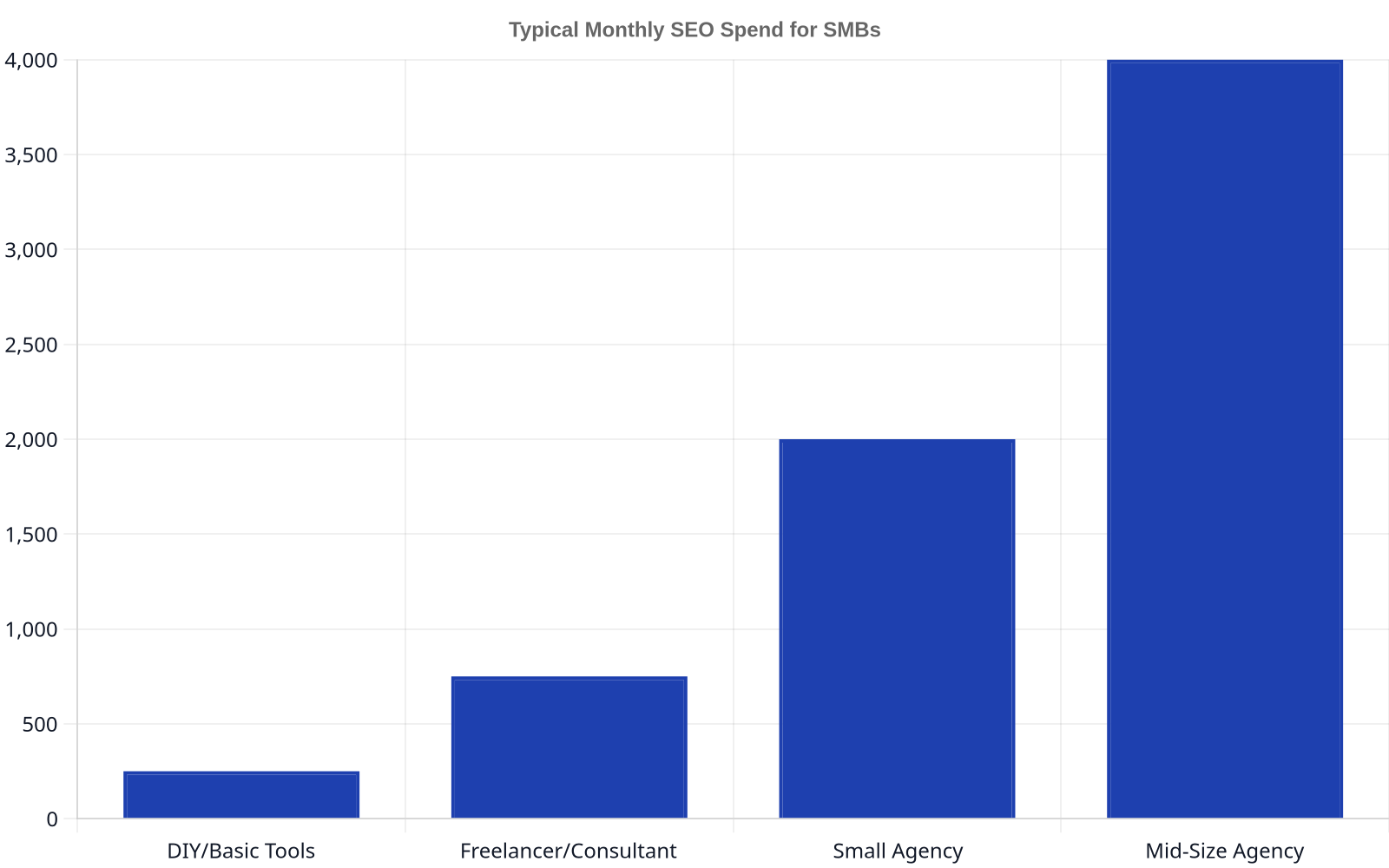
    Bar chart showing typical monthly SEO spend for SMBs. DIY/Basic Tools at $250, Freelancer/Consultant at $750, Small Agency at $2000, Mid-Size Agency at $4000.
    Typical Monthly SEO Spend for SMBs

    Many business owners hear “SEO” and immediately think of a massive, uncontrollable expense. That isn’t the reality. The cost of SEO is a direct function of the scope and speed you require. A B2B manufacturer like Wolverine Assemblies targeting a niche national audience will have a different budget and strategy than a local bakery competing in a single zip code. While a comprehensive agency retainer can be substantial, many SMBs find success with much leaner budgets. The key is to understand what you’re paying for.

    A typical monthly SEO retainer breaks down into a few core components. The exact mix will vary, but you are generally paying for time and expertise applied to a specific set of tasks. Here’s a common breakdown of what’s included in a monthly SEO plan and the typical costs associated with each line item for a small business in 2026.

    Service Component Typical Monthly Cost (USD) What Drives the Cost Higher?
    Technical SEO Audit & Fixes A variable amount (often one-time) Site size, platform complexity (e.g., custom builds), existing penalty recovery.
    Content Creation (Blog Posts) Article length, research depth, subject matter expertise required.
    Local SEO Management (GMB) Number of locations, competitiveness of the local market.
    Link Building / Digital PR Target authority of links, number of links built per month, outreach tactics.
    Keyword Research & Strategy Niche competitiveness, number of product/service categories.
    Reporting & Analytics Granularity of reporting, custom dashboard setup, number of goals tracked.
    Person budgeting at a table with money, notebook, and pen for SEO costs
    Person budgeting at a table with money, notebook, and pen for SEO costs (Photo by https://kaboompics.com/ on pexels)

    What Moves the Price of SEO?

    Four main variables determine where your business will fall within that typical monthly cost range. Understanding these drivers helps you set a realistic budget and negotiate more effectively with agencies or freelancers.

    • Competition Level: Are you a roofer in a major metro area like Dallas, or do you sell specialized industrial equipment nationally? The more businesses are competing for the same keywords, the more effort (and budget) is required to rank. Ahrefs’ Keyword Difficulty score is a good proxy for this; higher scores demand more resources.
    • Business Goals & Speed: Ranking for “best coffee shop in Austin” in a shorter timeframe requires a much more aggressive, and therefore expensive, strategy than a plan to gradually increase organic leads. A faster timeline means more content, more outreach, and more intensive technical work packed into a shorter period.
    • Geographic Targeting: A single-location plumber has a much smaller battlefield than an e-commerce store shipping nationwide. National or international campaigns are inherently more complex and costly. A 2021 BrightLocal study showed that even within local SEO, pricing varies significantly based on the number of locations a business has.
    • Current Website Health: Is your site brand new with zero authority, or is it an established domain with a history of content? A site with existing technical issues, a manual penalty from Google, or a thin content profile will require significant upfront work just to establish a healthy baseline. This “cleanup” phase adds to the initial cost.

    Measuring SEO ROI: What to Expect

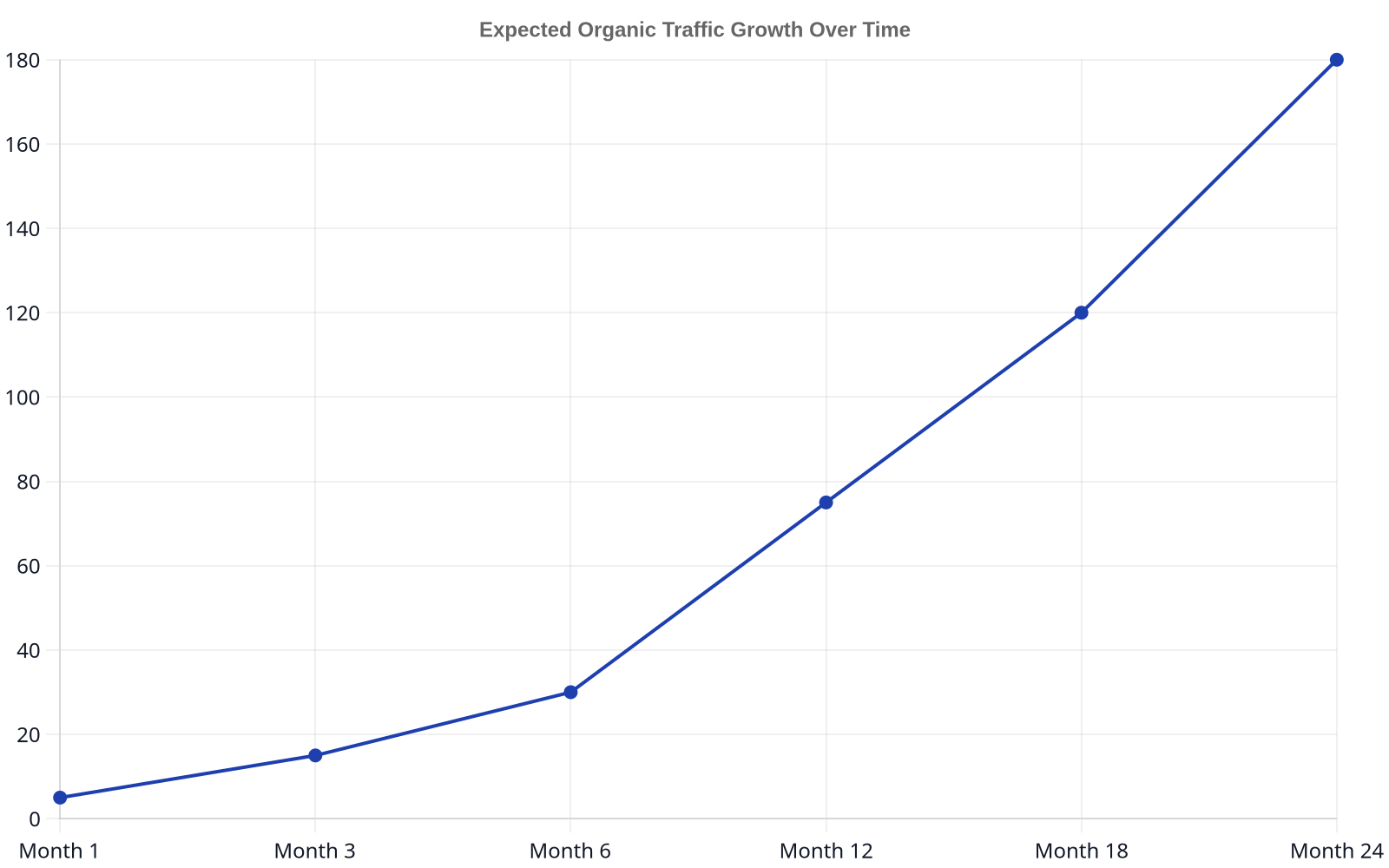
    Line chart showing expected organic traffic growth percentage over 24 months. Starting at 5% in Month 1, increasing to 180% by Month 24.
    Expected Organic Traffic Growth Over Time

    SEO is not a light switch. It is an investment that compounds over time. Unlike paid ads, where traffic stops the moment you stop paying, the content and authority you build through SEO can generate traffic and leads for years. Most SEO campaigns take 4-6 months to show significant, measurable results in traffic and rankings. This is because it takes time for Google to crawl and index new pages, for backlinks to be recognized, and for your site to build topical authority.

    Investing in SEO is like planting a tree. You don’t get shade the next day. But with consistent care, it grows into a valuable asset that provides benefits long after the initial effort.

    Don’t measure success solely by keyword rankings. The real metrics that matter are increases in qualified organic traffic, leads, and sales. Connect your website analytics to your business goals. For an e-commerce site, that means tracking organic revenue. For a B2B service provider, it’s about tracking form submissions and phone calls from organic visitors.

    Cost-Effective SEO Strategies: Where to Focus Your Budget

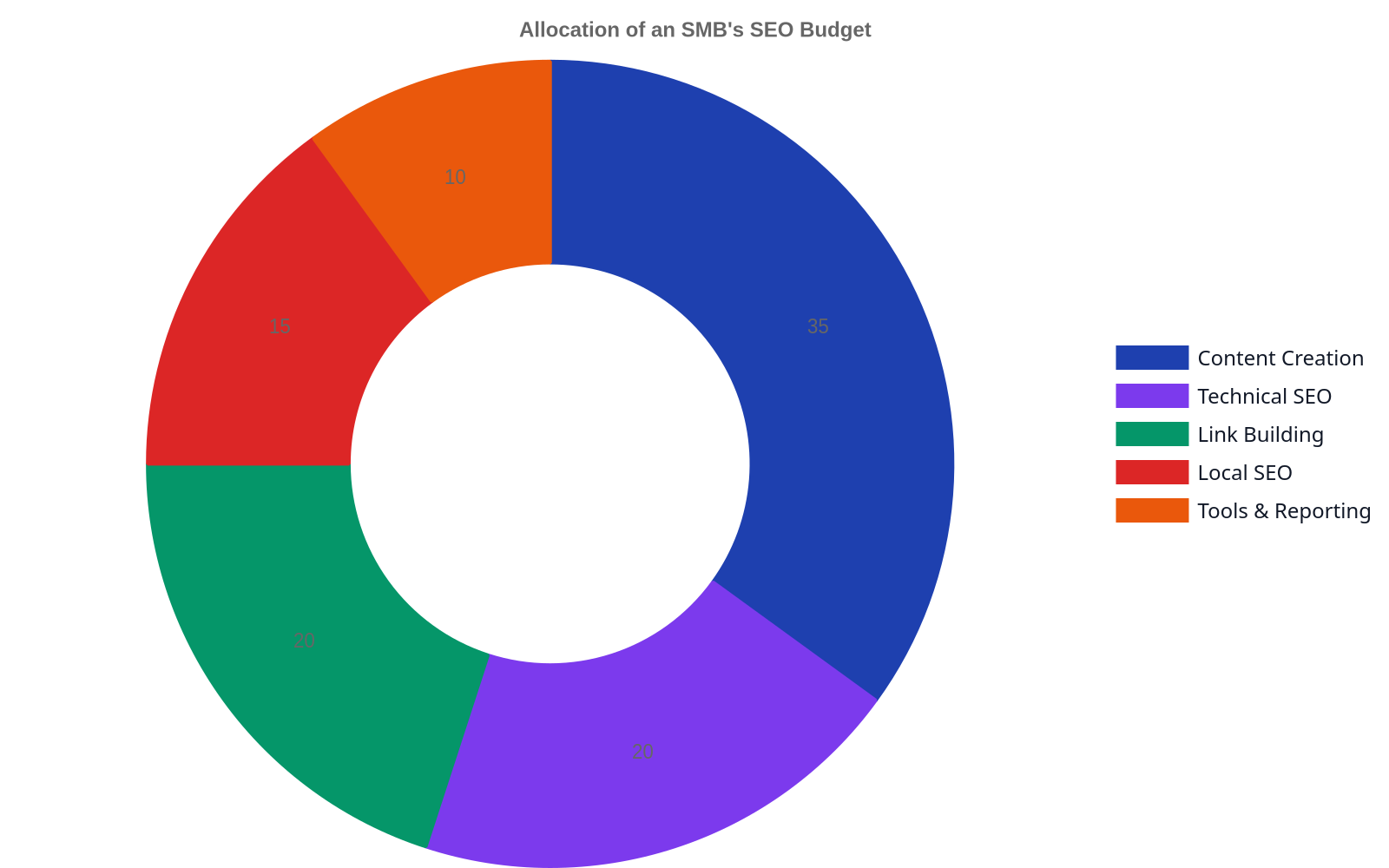
    Doughnut chart showing an example allocation of an SMB's SEO budget: Content Creation 35%, Technical SEO 20%, Link Building 20%, Local SEO 15%, Tools & Reporting 10%.
    Allocation of an SMB’s SEO Budget

    The goal for an SMB isn’t to do all the SEO things; it’s to do the right things. When every dollar counts, you must be ruthless in prioritizing tasks that have the highest potential return. Here’s where to focus a limited budget for maximum impact.

    1. Master Your Local Search Presence

    For any business with a physical location or service area, this is non-negotiable and offers the best bang for your buck. Claim and fully optimize your Google Business Profile (GBP). This means high-quality photos, accurate hours, a local phone number, and encouraging customer reviews. According to Google, searches for “local” and “business” have grown exponentially, and a well-managed GBP is your ticket to appearing in those valuable map pack results.

    2. Create Genuinely Helpful Content

    Instead of churning out generic blog posts, focus on answering the most common questions your customers ask. Use a tool like AnswerThePublic or simply talk to your sales team. A single, comprehensive article that solves a real problem for your target audience is worth more than ten thin, keyword-stuffed posts. This approach builds topical authority and attracts high-intent visitors. This is the core of modern content strategy, moving towards ai content autonomous systems that can scale this kind of high-value production.

    3. Fix Your Technical Foundation

    Your website needs to be fast, secure, and mobile-friendly. These are table stakes for SEO in 2026. Use Google’s free PageSpeed Insights tool to check your site’s performance. A slow site frustrates users and hurts your rankings. Simple fixes like compressing images, enabling browser caching, and upgrading your web hosting can provide a significant boost for a relatively small one-time cost.

    A confident man in a suit stands in a modern restaurant, representing business leadership
    A confident man in a suit stands in a modern restaurant, representing business leadership (Photo by Tumisu on pixabay)

    4. Build a Smart Internal Linking Structure

    This is one of the most powerful and underutilized free SEO tactics. A solid internal linking strategy helps Google understand the relationships between your pages and spreads authority throughout your site. Every time you publish a new blog post, look for opportunities to link to older, relevant content using descriptive anchor text. At Rank My Website, we’ve seen how proper internal linking can significantly lift the performance of key pages without building a single new backlink.

    FAQ

    How much should an SMB spend on SEO in 2026?

    This allows for foundational work like local SEO, content creation, and technical monitoring.

    Can I do SEO myself for free?

    Yes, you can absolutely do SEO yourself using free tools and resources. Focus on optimizing your Google Business Profile, writing helpful content that answers customer questions, and ensuring your site is mobile-friendly. The main “cost” of DIY SEO is your time, and the learning curve can be steep.

    What are the most common hidden SEO costs?

    These are not always included in a basic SEO retainer.

    How long does it take for cost-effective SEO to work?

    You should expect to see measurable progress in traffic and leads within 4 to 6 months. While small wins like improved local rankings can happen faster, significant organic growth is a long-term strategy. Anyone promising page-one rankings in weeks is not being realistic.

    Is paying for backlinks a good idea?

    No, directly paying for backlinks is against Google’s Webmaster Guidelines and can lead to penalties. A legitimate SEO service focuses on earning links through high-quality content and outreach, a service often referred to as digital PR. This is a critical distinction that protects your site’s long-term health.

  • 5 Automation Strategies for Agencies Scaling SEO Profitably

    5 Automation Strategies for Agencies Scaling SEO Profitably

    Most SEO agencies don’t have a traffic problem; they have a math problem. The traditional model of trading hours for dollars hits a hard ceiling. You can only hire so many analysts and write so much content before your margins evaporate. The solution isn’t just hiring faster; it’s changing the operational calculus entirely. For scaling SEO for agencies with automation, the key is to shift from manual execution to building systems that deliver results with minimal human intervention per client, allowing you to grow revenue without proportionally growing headcount.

    This list evaluates the most effective automation strategies for SEO agencies, ranked by their impact on scalability and profitability. I’ve prioritized methods that address the biggest time-sinks: content production, technical audits, reporting, and client management. The ranking is based on a combination of potential time savings, the ability to service more clients with the existing team, and the impact on delivering consistent, measurable results. We’re not just looking for shortcuts; we’re looking for force multipliers.

    Two people discuss content and user flow on a whiteboard with diagrams
    Two people discuss content and user flow on a whiteboard with diagrams (Photo by Christina Morillo on pexels)

    1. Automated Content Generation & Optimization

    Content is the single biggest bottleneck for most SEO agencies. It’s time-consuming to research, expensive to write, and difficult to scale, especially across dozens of clients with different niches. Automated content generation, when done correctly, solves this. It’s not about churning out soulless, keyword-stuffed articles. It’s about creating a system that can produce high-quality, SEO-optimized drafts that a human editor can then refine and approve. Platforms like Rank My Website are built on this principle, handling everything from initial keyword research to the creation of daily articles directly from your keyword list.

    This approach transforms your content workflow from a chaotic, freelance-driven process into a predictable production line. An agency that once struggled to produce 20 articles a month can suddenly generate 200 with the same team, just by shifting their role from writers to editors and strategists. The focus moves from manual labor to quality control and strategic oversight. The best systems also integrate on-page SEO, ensuring every piece is optimized for target keywords, meta descriptions, and internal linking structures from the first draft. As a result, agencies can take on more clients without a linear increase in their content team.

    • Best for: Agencies struggling with content production volume and consistency across multiple clients.
    • Watch out for: Platforms that produce low-quality, unreadable content or require extensive editing, defeating the purpose of automation. Creating content that resonates with the audience is a top challenge, and poor automation only makes this worse.

    2. Programmatic Technical SEO Audits

    Technical SEO audits are a critical but repetitive task. Manually crawling a site, checking for broken links, monitoring site speed, and identifying indexation issues for every new client is a black hole for billable hours. Programmatic audits automate this entire process. Tools like Ahrefs, Semrush, and Screaming Frog can be scheduled to run crawls on a weekly or monthly basis, automatically flagging new issues without any manual intervention. This moves the agency from a reactive “run an audit when the client asks” model to a proactive, continuous monitoring system.

    By setting up automated alerts for critical issues like 404 errors, server downtime, or major drops in Core Web Vitals scores, you can fix problems before the client even notices them. This not only saves hundreds of hours per year but also dramatically improves the perceived value of your service. For example, you can set a rule to get a Slack notification if a client’s homepage load time exceeds three seconds. For an agency managing 30 clients, this replaces 30 manual checks with one automated, exception-based workflow. This level of proactive management is simply impossible to achieve at scale without automation.

    • Best for: Agencies that want to offer proactive, high-value technical SEO without dedicating a full-time analyst to running manual crawls.
    • Watch out for: Over-reliance on tool-generated reports without human interpretation. An audit might flag “low word count” on a contact page, which is an issue a human analyst would know to ignore. Google’s own documentation emphasizes managing crawl budget, a strategic task that automated tools support but don’t fully replace.

    The goal of automation isn’t to replace the SEO strategist. It’s to build a machine that the strategist can drive, freeing them from the engine room to focus on navigating.

    3. Automated Client Reporting & KPI Tracking

    No client enjoys a dense spreadsheet, and no account manager enjoys spending a full day each month copying and pasting data into a PowerPoint deck. Automated reporting is one of the fastest wins for any agency looking to scale. Tools like Google Data Studio (now Looker Studio), DashThis, and AgencyAnalytics connect directly to your data sources (Google Analytics, Google Search Console, Ahrefs, etc.) and populate beautiful, interactive dashboards that are always up-to-date. This ends the monthly reporting fire drill for good.

    The real power comes from creating a master template. You can design one comprehensive dashboard and then clone it for each new client, simply swapping out the data source. This ensures every client receives a consistently branded, professional report without any duplicative effort. This system not only saves dozens of hours per month but also improves client retention by providing transparent, on-demand access to performance data. The conversation with the client shifts from “What did you do last month?” to “What do these trends tell us about our strategy for next quarter?”, which is precisely where an agency should demonstrate its value. This is a crucial step for any agency looking to properly start measuring seo roi.

    • Best for: Agencies spending more than 5-10 hours per month on manual reporting or struggling to demonstrate value to clients consistently.
    • Watch out for: “Data-vomit” dashboards that show every metric possible without telling a story. A good automated report focuses on the key performance indicators (KPIs) that matter to that specific client’s business goals. As a report from Gartner highlights, linking marketing metrics to business outcomes is essential for executive buy-in.
    Two people using a laptop and phone to analyze data for programmatic SEO audits
    Two people using a laptop and phone to analyze data for programmatic SEO audits (Photo by fauxels on pexels)

    4. Automated Rank Tracking and SERP Monitoring

    “Where do we rank for [keyword]?” is the oldest question in SEO. Answering it manually is a fool’s errand. SERPs are personalized, localized, and constantly in flux. Automated rank tracking is non-negotiable for any agency. Tools like SE Ranking, AccuRanker, and ProRankTracker provide daily, accurate tracking across different locations and devices (desktop vs. mobile), giving you a true picture of your client’s visibility. For an agency, this means you can track thousands of keywords for hundreds of clients with zero manual effort.

    Beyond simple position tracking, advanced automation here involves SERP feature monitoring. Are you winning or losing featured snippets? Are competitors suddenly appearing in “People Also Ask” boxes for your target terms? Automated systems can alert you to these changes, turning rank tracking from a passive reporting metric into an active strategic input. For example, getting an alert that a competitor just won the featured snippet for a high-value keyword is an actionable insight that allows you to immediately go and re-optimize your page to win it back. This proactive, data-driven approach is a hallmark of a scalable agency.

    • Best for: All SEO agencies. This is a foundational, non-negotiable piece of the agency tech stack.
    • Watch out for: Getting obsessed with daily rank fluctuations. The trend over weeks and months is what matters. Analyzing 11.8 million search results shows that while many factors correlate with high rankings, the key is a holistic, long-term strategy, not reacting to minor daily shifts.

    You don’t scale an agency by doing more of the same work, just faster. You scale by building systems that make entire categories of manual work obsolete.

    5. Automated Backlink Outreach and Prospecting

    Link building is arguably the most challenging part of SEO to scale. Traditional, manual outreach is incredibly time-intensive and has a notoriously low success rate. While full automation can lead to spammy, ineffective campaigns, automating the prospecting and initial contact stages is a massive efficiency gain. Using tools like Hunter.io or Pitchbox, you can automatically find contact information for a list of target websites and use templates to send personalized initial outreach emails. One person can manage the workload that would previously require a small team.

    This isn’t about “spray and pray.” It’s about building a scalable workflow. For example, you can use Ahrefs to find all the sites linking to a competitor’s broken page (a “broken link building” strategy), export that list, use Hunter.io to find the editors’ email addresses, and use Pitchbox to send a templated email suggesting your client’s resource as a replacement. The human element comes in when a prospect replies. The strategist then takes over to build the relationship and secure the link. This semi-automated approach maintains the quality of human interaction while eliminating the thousands of manual clicks involved in prospecting and data entry, including for your clients like Wolverine Assemblies.

    • Best for: Agencies that have a proven link-building strategy but are struggling to execute it at the volume required for a growing client roster.
    • Watch out for: Generic, unpersonalized outreach templates. Even with automation, the email needs to feel like it came from a human who has actually looked at the target website.

    Comparison of SEO Automation Strategies

    Strategy Primary Benefit Key Tools Implementation Difficulty
    Content Generation Massive time savings, scalable production Rank My Website, Jasper Medium (Requires editorial oversight)
    Technical Audits Proactive issue detection, improved client retention Ahrefs, Semrush, Screaming Frog Low
    Client Reporting Eliminates manual reporting, improves transparency Looker Studio, DashThis Low to Medium
    Rank Tracking Accurate, daily performance data at scale SE Ranking, AccuRanker Low
    Backlink Prospecting Increased outreach volume, improved efficiency Pitchbox, Hunter.io Medium

    FAQ

    Is SEO automation just for large agencies?

    No, it’s arguably even more critical for small agencies and solopreneurs. Automation is what allows a small team to compete with a large one. By automating tasks like reporting, technical audits, and content drafting, a small agency can deliver results that are on par with or better than larger competitors who rely on manual headcount.

    Does using automated content hurt SEO?

    Poorly implemented automated content absolutely can hurt your SEO. If you are just generating and publishing unedited, low-quality articles, Google will likely see it as spam. However, using automation to create a high-quality first draft that a human editor refines, fact-checks, and enhances is a powerful and effective strategy. The final published piece must meet E-E-A-T (Experience, Expertise, Authoritativeness, and Trustworthiness) standards, regardless of how the first draft was created.

    What’s the first thing an agency should automate?

    Client reporting. It provides the biggest and most immediate return on time saved. It requires no complex strategic changes and instantly frees up hours that can be reinvested into higher-value work for clients. Setting up a Looker Studio (formerly Data Studio) template is a one-time project that pays dividends every single month for every single client.

    How much does it cost to automate SEO?

    Costs vary widely. Some tools, like Looker Studio, are free. Others, like Ahrefs or Semrush, can cost several hundred dollars per month. A full-stack automation platform like Rank My Website offers a comprehensive solution that combines many of these functions. The key is to analyze the cost of the tool versus the cost of the manual hours it saves.

    Can automation replace our agency’s SEO experts?

    No, automation is a tool to empower experts, not replace them. It handles the repetitive, data-gathering tasks so that your human experts can focus on strategy, interpretation, and client relationships. An automated tool can tell you that a ranking dropped; an expert tells you why it dropped and what to do about it. The future of agency work is a hybrid model where humans and automation work together.

    How does automation help with client acquisition?

    By systematizing your service delivery, you create a predictable and scalable fulfillment model. This allows you to confidently take on more clients without worrying that your quality of service will drop. When you can show prospects a polished, automated report and a clear, efficient process for content and technical SEO, your agency appears more professional and capable, making it an easier sell.

    Will clients think we’re cutting corners with automation?

    Only if you frame it that way. Don’t talk about “automation” as a way to save yourself time. Talk about it as a way to provide them with more value. Frame it as “proactive monitoring” instead of “automated audits.” Call it “live performance dashboards” instead of “automated reports.” The result of automation is a better, faster, and more data-driven service, which is a benefit for the client.

  • Measuring SEO ROI Effectively: Quantifying Search Profitability

    Measuring SEO ROI Effectively: Quantifying Search Profitability

    Is your SEO budget a black hole? You pour money in, things seem to happen—traffic goes up, rankings shift—but you can’t quite connect it to actual revenue. This isn’t just a reporting problem; it’s a trust problem. Measuring SEO ROI effectively is the only way to prove that your investment generates more value than it costs. It quantifies the financial return from all activities designed to improve organic search visibility, turning abstract metrics like “traffic” into concrete business outcomes like profit and customer lifetime value.

    What is SEO ROI?

    Search Engine Optimization (SEO) ROI is a performance metric that calculates the profitability of your organic search marketing efforts. It directly compares the money earned from SEO against the money spent. A positive ROI means your SEO activities, from content creation to technical fixes, are generating more revenue than they cost. To truly understand and maximize this, learn how to measure seo performance beyond vanity metrics. Since organic search accounts for over 50% of all site traffic for many businesses, understanding this return is not optional; it’s fundamental to sustainable growth.

    Calculating it isn’t just about justifying your marketing spend to a skeptical CFO. It’s about making smarter decisions. It tells you which campaigns are working, which keywords are driving valuable customers, and where to allocate your next dollar. Without this data, you are essentially guessing, a strategy that rarely works when 75% of users never scroll past Google’s first page.

    How to Calculate SEO ROI

    The fundamental formula for SEO ROI is straightforward:

    (Revenue from SEO – Cost of SEO Investment) / Cost of SEO Investment

    To get a percentage, you multiply the result by 100. For example, if you generated $50,000 in revenue from an SEO investment of $10,000, your ROI is 400%. (($50,000 – $10,000) / $10,000) = 4.

    Let’s break down a realistic scenario for a lead-generation B2B company:

    1. Track Conversions: You use Google Analytics to track form submissions for “Request a Demo.” Each submission is a lead.
    2. Assign Value: You know from sales data that your lead-to-customer close rate is 10%, and the average customer lifetime value (LTV) is $5,000. Therefore, the value of one organic lead is $500 (10% of $5,000).
    3. Measure Organic Leads: Over a quarter, organic search drove 50 demo requests. The total value is $25,000 (50 leads x $500/lead).
    4. Calculate Costs: Your SEO investment for the quarter was $7,500 (agency fees, content, tools).
    5. Calculate ROI: (($25,000 – $7,500) / $7,500) x 100 = 233% ROI.

    This specific, defensible number transforms the conversation from “SEO seems to be helping” to “SEO generated a 233% return last quarter.”

    What is SEO ROI not?

    Many teams get bogged down by confusing SEO ROI with intermediate performance indicators. Measuring SEO ROI effectively means distinguishing the destination from the signposts along the way.

    • It is not just traffic. An increase in organic visitors is a positive signal, but it isn’t revenue. If that traffic comes from irrelevant keywords and has a 99% bounce rate, its business value is zero. Traffic is a means to an end, not the end itself.
    • It is not just rankings. Ranking #1 for a high-volume keyword feels great, but it’s a vanity metric if that term has no commercial intent. Ranking for “what is a widget” is different from ranking for “buy widget online.” The latter directly contributes to ROI; the former is top-of-funnel brand awareness, which is much harder to tie to immediate sales.
    • It is not a short-term metric. Unlike paid search, where you can see returns in hours, SEO is a long-term investment. It can take 6-12 months to see significant results. Trying to calculate a meaningful ROI after 30 days is a recipe for disappointment. Instead, focus on tracking leading indicators like ranking improvements and traffic growth in the early months before substantial revenue appears.

    Don’t confuse the inputs of your SEO strategy with the outputs. The number of backlinks you build is an input. The revenue generated from the traffic those links create is the output. Focus on the output.

    Key Metrics for Measuring SEO ROI

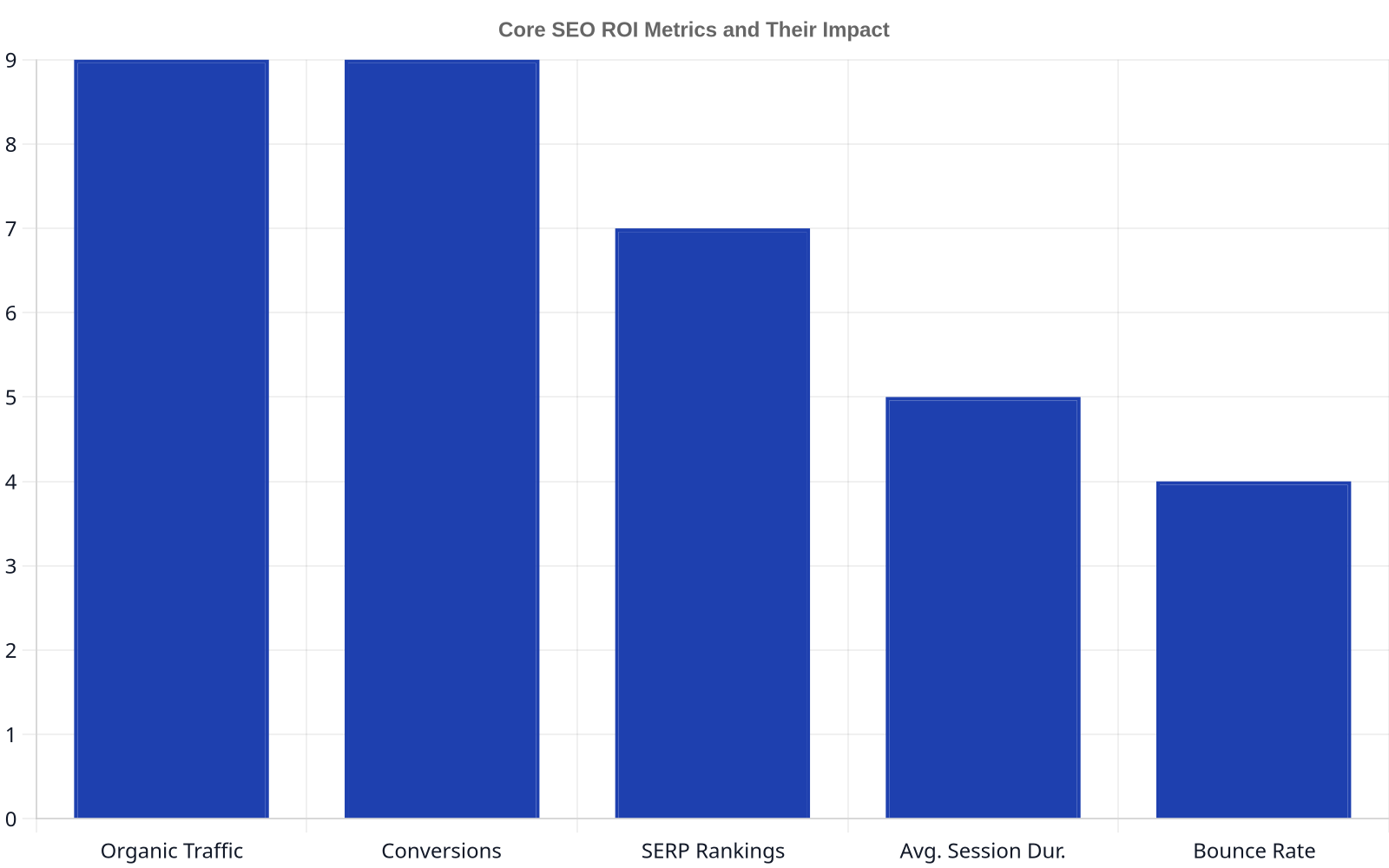
    Bar chart showing relative impact of SEO ROI metrics: Organic Traffic and Conversions are highest (9), followed by SERP Rankings (7), Average Session Duration (5), and Bounce Rate (4).
    Core SEO ROI Metrics and Their Impact

    To arrive at a final ROI number, you must track the components that feed into it. These are the core metrics that connect your activities to financial outcomes.

    • Organic Conversions: This is the most critical metric. It’s the number of desired actions (purchases, sign-ups, form submissions) completed by users who arrived from organic search. This requires properly configured goal tracking in a tool like Google Analytics.
    • Assisted Conversions: A user might first discover your site via organic search, leave, and then come back a week later through a paid ad to convert. Attribution models beyond simple last-click, like data-driven or time-decay, help give SEO its proper credit in the customer journey.
    • Organic Traffic & Click-Through Rate (CTR): While not a direct ROI metric, growing traffic to your key commercial pages is a prerequisite for growing conversions.
    • Lead Quality: For B2B, not all leads are equal. Integrating your CRM (like Salesforce or HubSpot) with your analytics allows you to track which organic keywords are producing leads that turn into actual sales, not just tire-kickers.

    What is a good SEO ROI?

    There is no single magic number for a “good” SEO ROI. It depends heavily on your industry, profit margins, and business model. However, a common benchmark often cited is a 5:1 ratio, or 400% ROI. For every dollar you invest, you get five dollars back in revenue.

    For a high-margin software business, a 10:1 ratio might be the goal. For a low-margin e-commerce retailer, a 3:1 ratio could be considered a major success. The important thing is that the ROI is significantly positive and outperforms other marketing channels. If your paid search campaigns average a 300% ROI, your SEO efforts should be aiming to meet or exceed that over time.

    This is why we focus on a full suite of services—from foundational keyword research and internal linking to producing daily articles—to maximize that return for clients like Wolverine Assemblies. By controlling the whole process, we can directly influence the inputs that create a powerful, profitable output.

    FAQ

    Why is measuring SEO ROI important?

    Measuring SEO ROI is important because it proves the financial value of your search optimization efforts to stakeholders. It transforms SEO from a cost center into a documented revenue driver, allowing you to justify budgets, make smarter strategic decisions, and demonstrate the tangible business impact of your work.

    What are the main challenges in measuring SEO ROI?

    The biggest challenges are the long feedback loop (it can take 6-12 months to see results), attributing conversions accurately in a multi-channel customer journey, and isolating the impact of SEO from other marketing activities. This is why using advanced attribution models and tracking metrics over a sufficient time period is crucial.

    How do you measure ROI for content that doesn’t directly sell?

    For top-of-funnel content like blog posts, you measure ROI through indirect value. This includes tracking assisted conversions, growth in branded search volume over time, new email newsletter sign-ups, or the value of backlinks acquired. You can assign a value to each of these micro-conversions to calculate a more holistic return.

    What tools are best for tracking SEO ROI?

    A combination of tools is necessary. Google Analytics 4 is essential for conversion and traffic analysis. An SEO platform like Semrush or Ahrefs is needed for tracking keyword rankings and backlinks. Finally, CRM software like Salesforce or HubSpot is vital for connecting organic leads to final sales revenue.

    How often should you report on SEO ROI?

    While leading indicators like traffic and rankings should be monitored weekly or monthly, a full ROI analysis is best performed on a quarterly or semi-annual basis. This timeframe is long enough to smooth out short-term fluctuations and capture the delayed impact of SEO work on revenue.

  • AI Content in 2026: The Shift to Autonomous Infrastructure

    AI Content in 2026: The Shift to Autonomous Infrastructure

    Most conversations about AI content are focused on the wrong thing: the generator. People obsess over whether GPT-5 will write a “better” blog post than Claude 4. This is like debating which company makes a better hammer while someone else is building a nail gun. The future of AI content 2027 isn’t about a slightly better text generator. It’s about the integrated infrastructure—the nail gun—that automates the entire SEO content lifecycle, from keyword analysis to performance tracking. By 2027, standalone AI writers will be a commodity; the winning platforms will be the ones that provide a complete, autonomous content engine for businesses.

    The State of AI Content Generation in 2026
    As of 2026, we’re living in the era of sophisticated generative models. Tools built on large language models (LLMs) like OpenAI’s GPT-4 series and Anthropic’s Claude 3 family can produce human-like text that is, on the surface, often indistinguishable from junior-level marketing copy. They can summarize documents, adopt specific tones, and draft articles on nearly any topic you provide.

    However, these tools are fundamentally prompt-response systems. They are reactive. You give them an input (a topic, a keyword, an outline), and they provide an output. This process still requires significant human oversight, including:

    • Fact-checking and verification: LLMs are notorious for “hallucinations,” or fabricating information with complete confidence.
    • Editing for originality and insight: The default output is often generic, pulling from the statistical average of its training data. It lacks novel ideas or proprietary viewpoints.
    • SEO optimization: A human still needs to ensure the content aligns with search intent, includes relevant entities, and is structured correctly for on-page ranking factors.
    • Integration: The content must be manually moved from the AI tool to a CMS, formatted, and published.

    These tools are powerful assistants, but they are not autonomous systems. They are calculators for words, not strategic partners.

    How AI Content Tools Work: A Technical Deep Dive

    To understand where we’re going, it’s crucial to understand the mechanics of today’s best-in-class AI content platforms. They don’t just feed a keyword into a generic LLM. They follow a multi-step workflow designed to mimic the process of a human SEO content strategist.

    Step 1: SERP Analysis and Intent Modeling

    It starts with the keyword. The system analyzes the top-ranking pages for the target query to understand search intent. Is the user looking for a definition (informational), a list of products (commercial), or a how-to guide (transactional)? The AI deconstructs the structure, headings, and common themes of the top results to create a model of what Google is currently rewarding for that specific keyword.

    Step 2: Outline and Brief Generation

    Using the SERP analysis, the platform generates a detailed content brief. This isn’t just a list of H2s. It includes target word count, key entities and topics to cover (based on NLP analysis of competitor content), and questions to answer (pulled from “People Also Ask” boxes and forums). This structured brief becomes the master blueprint for the generative model, providing guardrails to keep it on topic and aligned with search intent.

    Step 3: Layered Drafting and Refinement

    The AI then drafts the article section by section, often using different prompts for the introduction, body, and conclusion to ensure a logical flow. Advanced systems may use multiple AI models or fine-tuned versions to handle different parts of the draft. The goal is to move beyond a single, monolithic text block and build the article in a more structured, layered way. This is where a service that manages the entire workflow, including crucial steps like keyword research, adds tremendous value beyond simple text generation.

    Current Limitations of AI Content Generation

    Mindmap illustrating the key limitations of AI content generation, including accuracy, lack of nuance, ethical concerns, hallucinations, repetitive content, and bias in data.
    Key Limitations of AI Content Generation

    Despite the progress, today’s AI content tools have a clear ceiling. They are excellent at synthesizing existing information but fundamentally incapable of creating net-new knowledge. This creates several critical limitations for businesses trying to build genuine authority.

    The E-E-A-T Wall

    Google’s Search Quality Rater Guidelines emphasize Experience, Expertise, Authoritativeness, and Trustworthiness (E-E-A-T). AI, by its nature, has no firsthand experience. It cannot review a product, visit a location, or interview a subject matter expert. Google’s own guidance on AI content makes it clear that quality and helpfulness are what matter, regardless of how the content is produced. The problem is that current AI struggles to generate the unique insights that signal true expertise and experience.

    The Originality Paradox

    LLMs are trained on vast datasets of existing internet content. Their function is to predict the next most likely word, making them statistically inclined toward common knowledge and established ideas. They are designed to be derivative. Asking an LLM to be truly “original” is a contradiction in terms. It can combine ideas in novel ways, but it cannot generate a truly groundbreaking insight or a piece of proprietary research. A 2023 paper on autonomous AI agents highlights that while agents can execute tasks, their knowledge base is still constrained by their underlying models, limiting true discovery.

    The real value of an AI content system isn’t replacing writers. It’s about automating the 90% of the content process that isn’t writing—the research, the structuring, the optimization, the publishing, and the linking.

    The Lack of Strategic Connectivity

    A single blog post, no matter how well-written, does little on its own. Its value comes from its place within a larger content ecosystem. Standalone AI tools have no concept of your overall content strategy. They don’t know which other articles to link to, what topic clusters you’re trying to build, or how this new post supports your business goals. This is why a fully managed service that handles internal linking as part of a cohesive strategy is essential for turning content into a growth engine, a lesson we’ve seen applied successfully with clients like Wolverine Assemblies.

    The Future of AI Content: Predictions for 2027

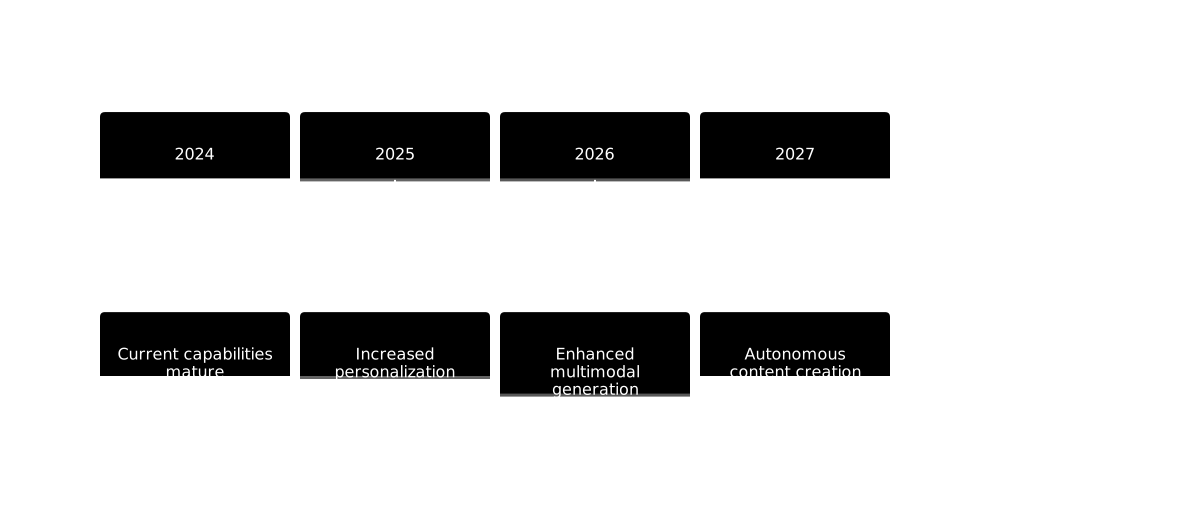
    Timeline showing the projected evolution of AI content: current capabilities mature in 2024, increased personalization in 2025, enhanced multimodal generation in 2026, and autonomous content creation in 2027.
    Projected Evolution of AI Content (2024-2027)

    The future of AI content 2027 is defined by a move away from standalone tools and toward integrated, agentic systems. These systems will be less about generating text and more about managing the entire content workflow, transforming SEO from a manual process into an automated one.

    From Generative Models to Agentic Systems

    By 2027, the focus will be on AI “agents” that can perform multi-step tasks autonomously. An SEO content agent would look something like this:

    1. Monitor: It continuously analyzes your site’s keyword rankings and your competitors’ content.
    2. Identify: It identifies a content gap or an opportunity for a new article based on performance data and strategic goals.
    3. Research: It performs a “live” analysis of the current SERP, pulling in the latest information, data, and sources.
    4. Strategize: It determines the optimal article format, outline, and internal linking opportunities based on your existing content library.
    5. Create: It generates the full content package—text, relevant images, and even video snippets.
    6. Publish: It pushes the content directly to your CMS, correctly formatted with all on-page SEO elements in place.
    7. Analyze: It tracks the article’s performance (rankings, traffic, conversions) and decides on future updates or optimizations.

    This is a fundamental shift from a writer’s tool to a fully autonomous content manager. This is one of the key next-gen SEO strategies that will separate winning programs from the laggards.

    Hyper-Personalization and Multimodality

    Content will move beyond one-size-fits-all articles. AI will enable the creation of content that adapts to the user. Imagine a blog post that reconfigures itself based on a visitor’s industry, technical expertise, or previous engagement with your site. The line between web content and a software-like experience will blur.

    Furthermore, content will become truly multimodal. Instead of just writing text, AI systems will generate a complete asset package: the article, a series of social media posts to promote it, a short animated explainer video for YouTube, and an audio version for a podcast feed. This is where the concept of ai content creation in 2026 is already heading, but by 2027 it will be the standard.

    Content Infrastructure as the Moat

    If every business has access to powerful generative models, the models themselves are no longer a competitive advantage. The advantage—the moat—will be the infrastructure that connects AI to your specific business data and workflows.

    This means a platform that:

    • Integrates with your product database to create automated product description updates.
    • Connects to your CRM to generate case studies based on customer data.
    • Understands your first-party analytics to identify content opportunities no one else can see.

    This is the difference between renting a power tool and owning a fully automated factory. The factory is the infrastructure.

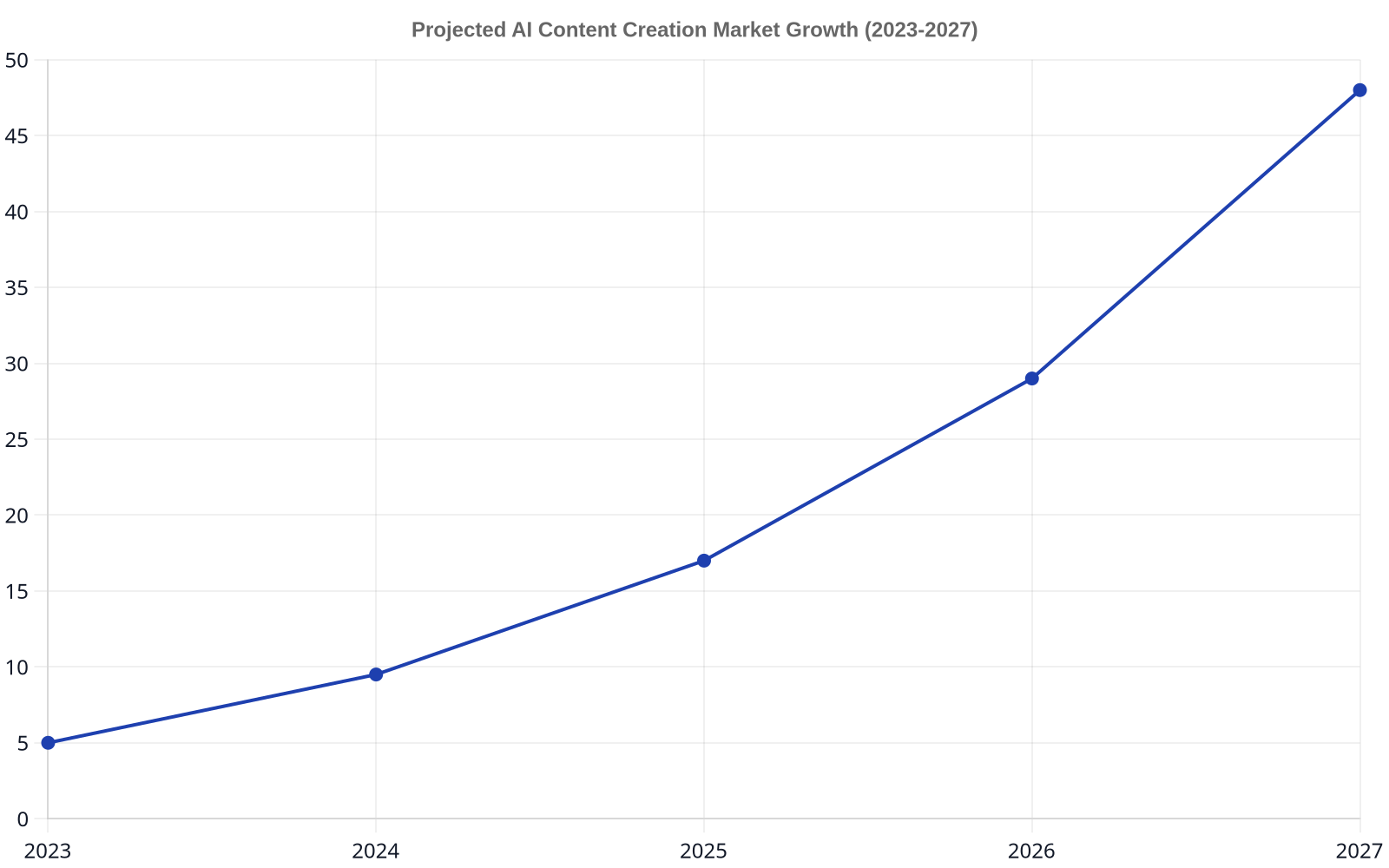
    AI Content Creation Market Growth

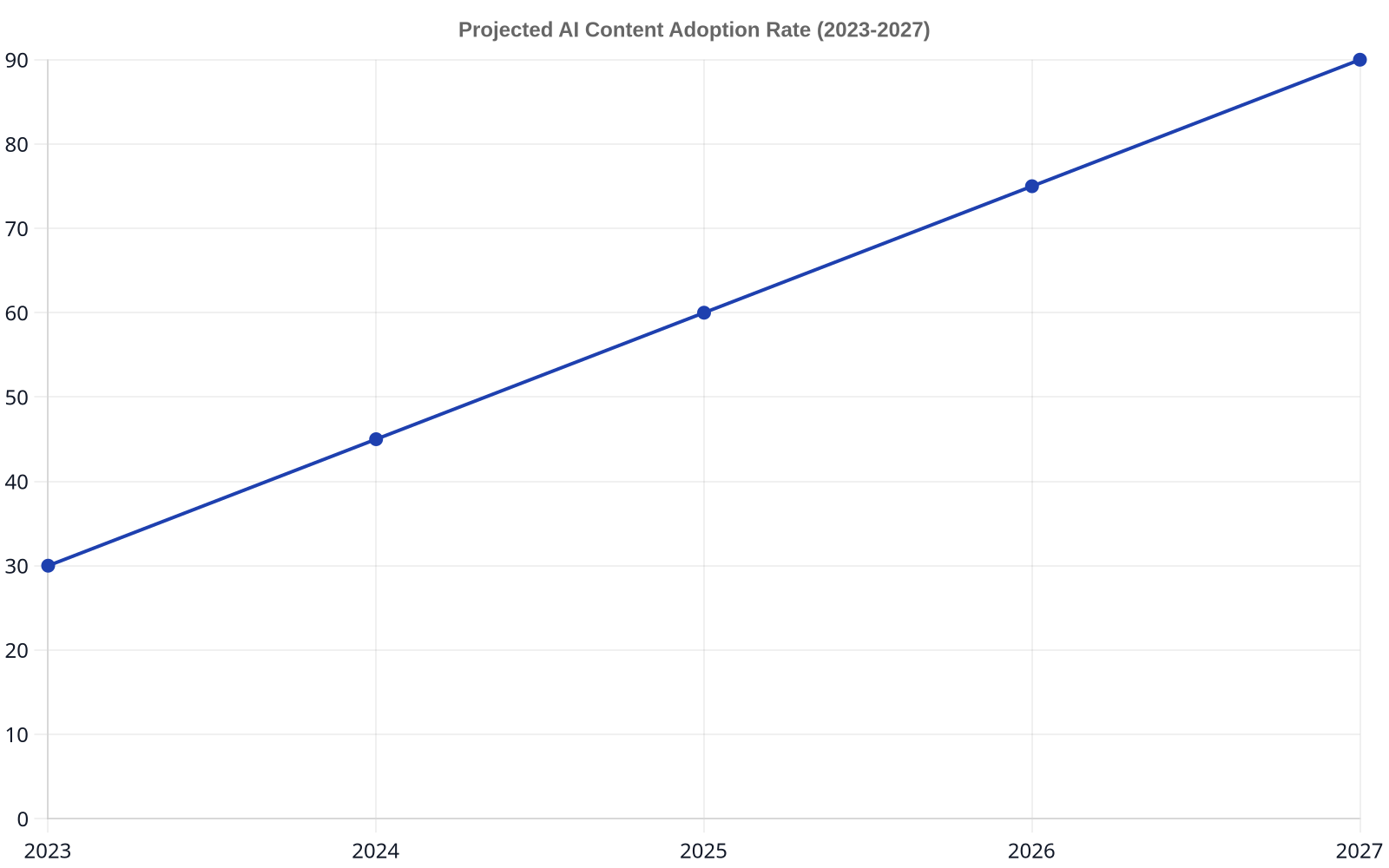
    A line chart showing the projected growth of the AI content creation market from 2023 to 2027, with market size in billions of dollars. The market is projected to grow from 5 billion in 2023 to 48 billion in 2027.
    Projected AI Content Creation Market Growth (2023-2027)

    The shift toward integrated AI content infrastructure is mirrored in market growth projections. The focus of investment and value creation is moving up the stack from raw model providers to end-to-end application platforms. According to a report from Grand View Research, the global generative AI market is on a steep trajectory, projected to reach $109.37 billion by 2030. This growth isn’t just in the LLMs themselves but in the specialized software that applies them to solve specific business problems like SEO content automation.

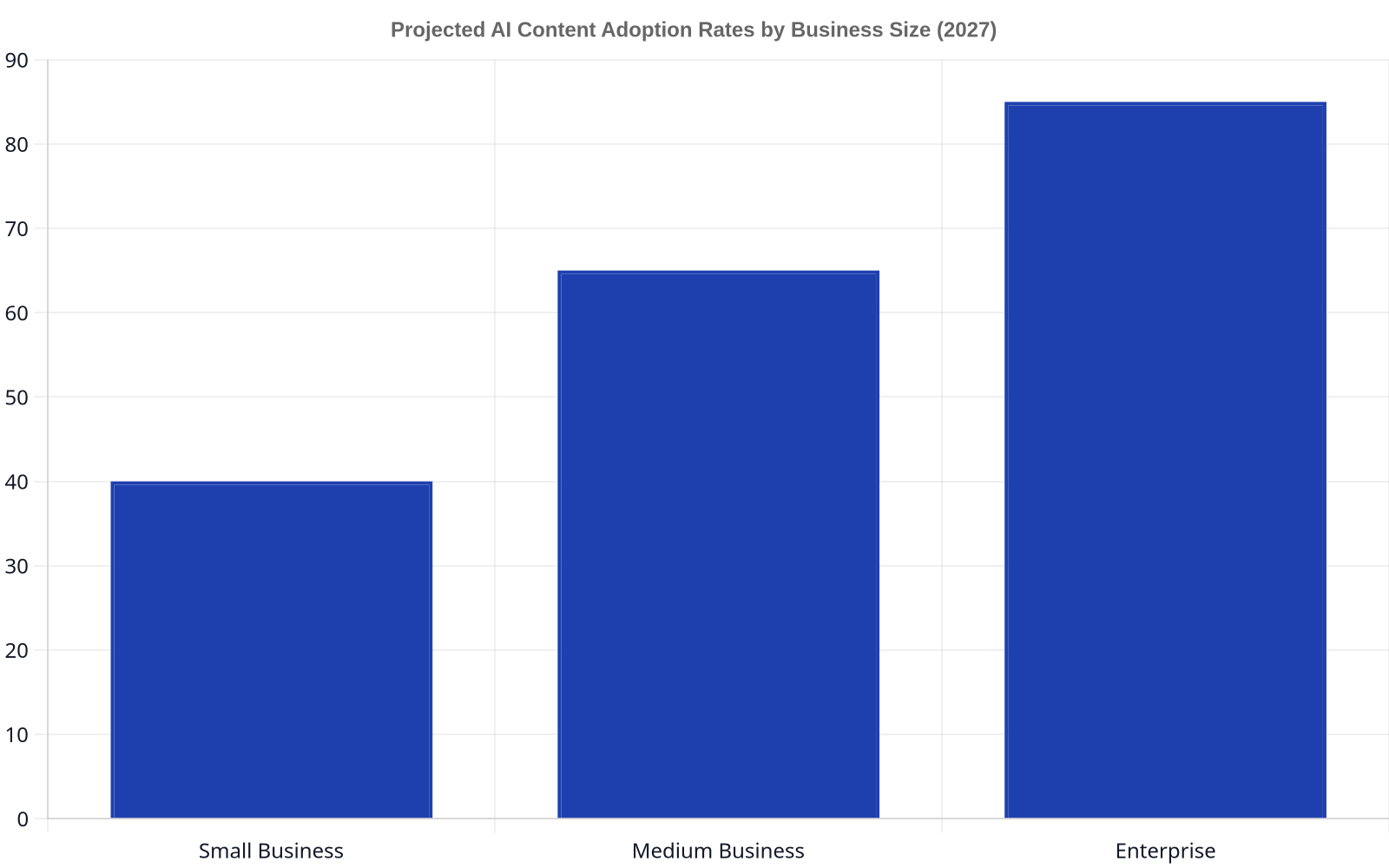
    AI Content Adoption Rates

    A bar chart illustrating the projected AI content adoption rates by business size in 2027. Small businesses are projected at 40%, medium businesses at 65%, and enterprises at 85% adoption.
    Projected AI Content Adoption Rates by Business Size (2027)

    Adoption will not be uniform across all business segments. While large enterprises may have the resources to build custom in-house solutions, small and medium-sized businesses (SMBs) will be the primary drivers of growth for SaaS platforms that offer a complete, managed service. By 2027, the ability to deploy a full-funnel content strategy without a dedicated in-house team will be the key driver of adoption for SMBs, who often face the greatest resource constraints according to the Content Marketing Institute’s research.

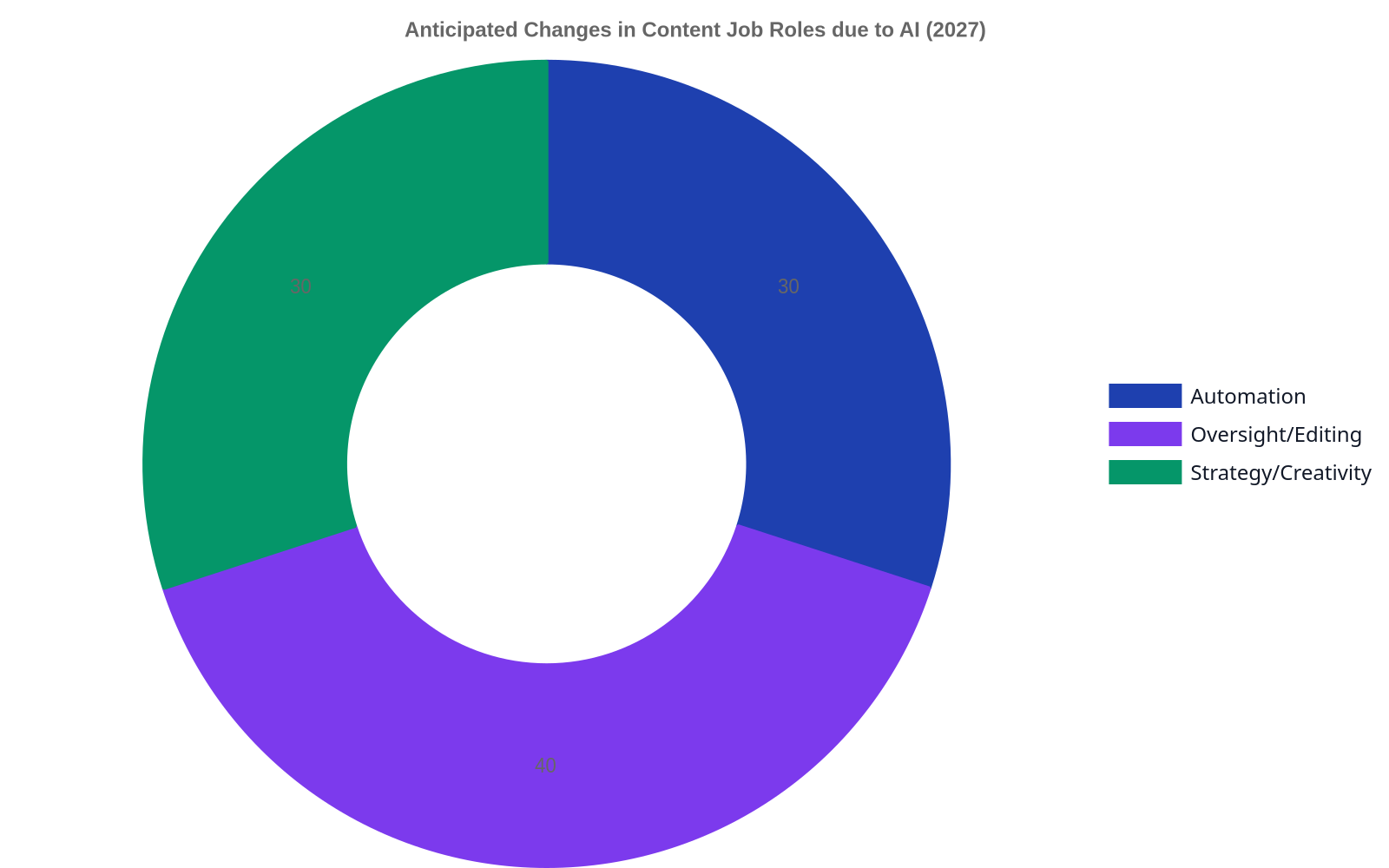
    Impact of AI on Content Roles

    A doughnut chart showing the anticipated changes in content job roles due to AI by 2027. 30% of tasks are expected to be automated, 40% will involve oversight and editing, and 30% will focus on strategy and creativity.
    Anticipated Changes in Content Job Roles due to AI (2027)

    The rise of AI content agents will not eliminate the need for human content professionals. Instead, it will radically shift their roles. Repetitive, low-value tasks like writing generic definitions or summarizing articles will be fully automated.

    This frees up human experts to focus on higher-value activities:

    • Strategy: Defining the goals, target audiences, and brand voice that guide the AI.
    • Oversight: Reviewing and approving the strategic direction proposed by AI agents.
    • Original Research: Conducting interviews, running surveys, and analyzing proprietary data to create the unique insights AI cannot.
    • Community Building: Engaging with the audience in forums, on social media, and at events—the human connection part of branding.

    The role of a “content writer” will evolve into a “Content Strategist” or “AI Content Orchestrator.” Your job won’t be to write the article; it will be to manage the system that does.

    Stop thinking about how to write articles faster. Start thinking about how to build a machine that creates, publishes, and optimizes content for you. That’s the strategic shift required for 2027.

    2026 vs. 2027: The Evolution of AI Content Systems

    To make this shift concrete, let’s compare the common approach today with the infrastructure-first model of the near future.

    Feature 2026 Approach: Standalone Generator 2027 Approach: Integrated Infrastructure
    Core Unit The Article The Content Engine
    Primary Task Writing a single piece of content Managing the entire content lifecycle
    Human Role Writer / Editor / Promoter Strategist / System Orchestrator
    Input A keyword or a prompt Business goals and performance data
    Output A block of text in a Google Doc A published, optimized, and internally linked article on your CMS
    Data Source Public internet training data Public data + private, first-party business data
    Key Metric Words per minute / Cost per word Organic traffic growth / Lead generation
    Strategic Focus Content Velocity System Autonomy

    How to Prepare Your Content Strategy for 2027

    Waiting until 2027 to adapt is a recipe for being left behind. The groundwork for building a content engine needs to be laid now. If your current SEO efforts feel like a constant struggle, it might be that your model is the problem, a common issue for many struggling with SEO agency challenges.

    Here are three actionable steps you can take today:

    1. Treat Content as a System, Not a Series of Campaigns. Start mapping your entire content process, from idea to archive. Identify the bottlenecks, the manual data entry, and the repetitive tasks. This is the workflow you will eventually automate. This includes planning for things like daily articles to maintain momentum.
    2. Build Your First-Party Data Moat. Your unique data is your ultimate defense against generic AI content. Start consolidating it. This includes customer insights from your CRM, product usage data, and performance analytics from your own website. This proprietary information will become the fuel for your content engine, producing insights your competitors cannot replicate.
    3. Prioritize Technical and On-Page SEO. An autonomous content system requires a technically sound foundation. Ensure your site has a clean architecture, fast load times, and structured data implemented correctly. The AI can create the world’s best content, but it will fail if your site isn’t optimized for Google to crawl and understand it efficiently.

    Building this foundation is not about buying another AI writer. It’s about architecting an intelligent system. It’s a shift in mindset from creating content to building an engine that creates content for you.

    FAQ

    Will AI replace content writers by 2027?

    No, but it will fundamentally change the role. AI will automate the commodity aspects of content creation, such as drafting and summarizing. This will elevate the human role to focus on strategy, original research, proprietary data analysis, and brand storytelling—tasks that require genuine experience and critical thinking. The job title may change from “writer” to “content strategist” or “AI orchestrator.”

    How will Google’s ranking algorithms adapt to advanced AI content?

    Google has been consistent that its focus is on rewarding helpful, reliable, people-first content, not on how it’s produced. As AI content becomes more sophisticated, Google’s algorithms will likely become even more adept at identifying signals of genuine expertise and experience (E-E-A-T), such as unique insights, novel data, and evidence of firsthand use. Generic, unedited AI content will likely perform poorly.

    What’s the difference between a generative AI model and an AI content agent?

    A generative AI model (like GPT-4) is a reactive tool that creates text based on a specific prompt you provide. An AI content agent is an autonomous system that can perform a sequence of tasks without direct human intervention. For example, it could identify a keyword opportunity, research the topic, write the article, publish it to your website, and track its performance, all as part of a single, predefined workflow.

    Is it worth investing in AI content tools now or waiting until 2027?

    Waiting is a mistake. The key is to invest in the right kind of tool. Instead of focusing on simple text generators, businesses should look for platforms that are building toward an integrated content infrastructure. By adopting a system-based approach now, you can begin organizing your workflows, cleaning up your data, and establishing the technical SEO foundation necessary to take full advantage of the autonomous agents of 2027.

    The future of AI content isn’t a magical writing robot that will solve all your problems. It’s an infrastructure play. It’s about building an automated, intelligent system that consistently executes a winning SEO strategy. The companies that start building that engine today—focusing on process, data, and technical excellence—are the ones who will dominate the search results of 2027. This is the core philosophy behind Rank My Website: providing an automated engine to grow your organic traffic, not just another tool to write articles.

  • Small Business SEO: Building a Predictable Engine for Growth

    Small Business SEO: Building a Predictable Engine for Growth

    SEO Solutions for Small Businesses Explained

    Most small businesses treat SEO like a lottery ticket—a random assortment of keywords and blog posts they hope will one day hit the jackpot. This is fundamentally wrong. An SEO solution for a small business is a system for improving your website’s visibility on search engines like Google to attract more qualified customers. It combines technical optimization, content creation, and local signals to generate organic traffic and leads without paying for every single click. It’s not about tricks; it’s about building a predictable engine for growth.

    What Exactly is Small Business SEO?

    Search Engine Optimization (SEO) is the practice of increasing the quantity and quality of traffic to your website through organic search engine results. For small businesses, this practice is hyper-focused. It isn’t about ranking for broad, global terms. It’s about being the top answer for a customer searching for “best pizza delivery near me” or “emergency plumber in [Your Town]”. To achieve this efficiently, many small businesses leverage specific small business seo tools.

    Unlike enterprise SEO that might involve massive teams and multi-million dollar budgets, small business SEO is about precision and efficiency. It prioritizes actions that directly impact local visibility and purchase intent. This means a heavy emphasis on your Google Business Profile, local customer reviews, and content that answers the specific questions your community is asking. It’s less about abstract brand awareness and more about making the phone ring.

    The Benefits of SEO for Small Businesses

    Bar chart showing the typical increase in organic traffic, conversion rates, and brand awareness for small businesses that implement SEO compared to those that don't.
    Impact of SEO on Small Business Growth

    Investing in a coherent SEO strategy provides tangible returns that compound over time. Unlike paid advertising, where the traffic stops the moment you stop paying, SEO builds a lasting digital asset. According to a 2023 BrightLocal study, 98% of consumers used the internet to find information about local businesses. If you’re not visible, you’re not an option.

    Key benefits include:

    • High-Quality Traffic: You attract users actively searching for your products or services, leading to higher conversion rates.
    • Increased Credibility: Ranking high on Google builds trust. Users perceive top results as more authoritative and reliable.
    • Cost-Effectiveness: Over the long term, the cost-per-acquisition from organic search is significantly lower than from paid channels.
    • Competitive Advantage: Outranking your local competitors means you capture market share they are leaving on the table.

    Key SEO Strategies for Small Businesses

    Bar chart illustrating the relative impact of key SEO strategies for small businesses, including local SEO, content marketing, keyword research, and link building, rated on a scale of 1 to 10.
    Impact of Key SEO Strategies

    An effective SEO solution is built on four pillars. Neglecting any one of them is like trying to build a stool with three legs.

    1. Technical SEO: This is the foundation. Your site must be fast, secure (HTTPS), and mobile-friendly. Search engines need to be able to crawl and index your site without hitting errors. Google’s emphasis on Core Web Vitals means user experience is a direct ranking factor. A slow, confusing website will not rank, no matter how great the content is.
    2. Content Creation: Your website must be the single best answer to your customers’ questions. This goes beyond just service pages. It means creating helpful blog posts, guides, and FAQs. A platform that automates the creation of high-quality content, such as daily articles, can systematically cover the topics your customers care about, establishing your authority.
    3. Local SEO: This is non-negotiable for any business with a physical location or service area. It starts with a fully optimized Google Business Profile and expands to managing online reviews, building local citations (mentions of your business name, address, and phone number), and creating location-specific pages on your website.
    4. Authority Building (Link Building): Authority is measured by who links to you. Earning high-quality backlinks from other reputable local businesses, industry blogs, or news sites acts as a vote of confidence in your favor. This is often the most challenging part of SEO, but it’s critical for competitive niches.

    SEO isn’t a cost center; it’s an asset you build. Every piece of content, every backlink, is digital real estate that appreciates over time.

    Common SEO Challenges for Small Businesses

    Pie chart illustrating common SEO challenges for small businesses, showing percentages for time/resource constraints, technical knowledge gaps, budget limitations, and difficulty measuring ROI.
    Top SEO Challenges for Small Businesses

    While the principles are straightforward, execution is where many businesses struggle. The most common hurdles are a lack of time, limited budget, and insufficient technical expertise. Many small business owners are juggling marketing along with a dozen other responsibilities. They know SEO is important but can’t dedicate the consistent hours required for tasks like keyword research and content production.

    This often leads them down the path of cheap SEO services that promise impossible results, ultimately wasting both time and money. The key is to find a solution—whether a tool, an agency, or a consultant—that aligns with your business goals and provides transparent reporting on what actually matters.

    Debunking Common SEO Myths

    Misinformation is rampant in the SEO industry. Let’s clear up a few dangerous myths.

    • Myth: SEO is a one-time project. Reality: SEO is a continuous process. Search engine algorithms change, competitors update their sites, and customer behavior evolves. It requires ongoing maintenance and improvement.
    • Myth: You have to be #1 for a major keyword. Reality: This is an outdated and expensive goal. It’s far more profitable to rank for multiple, specific long-tail keywords that show clear purchase intent. Chasing a vanity rank for a broad term is a waste of resources.
    • Myth: SEO is all about gaming the algorithm. Reality: The era of “tricks” is long over. Modern SEO is about creating a great user experience and providing valuable information. Trying to manipulate rankings with keyword stuffing or shady link schemes is the fastest way to get penalized by Google.

    Chasing the #1 rank for a broad term is vanity. Driving three customers for a specific, high-intent phrase is sanity.

    How to Measure SEO Success

    To understand if your SEO efforts are working, you must track the right metrics. Forget fixating on a single keyword ranking. Success is measured by business impact.

    Key Performance Indicators (KPIs) for small business SEO should include:

    • Organic Traffic: An increase in visitors coming from search engines.
    • Keyword Portfolio Growth: The total number of relevant keywords for which you rank, not just a handful of “money” terms.
    • Local Pack Visibility: How often you appear in the map-based results for local searches.
    • Organic Conversion Rate: The percentage of organic visitors who complete a desired action, like filling out a form, making a purchase, or calling your business. Tracking this is essential for proving ROI.

    How to Choose SEO Services

    When evaluating an SEO provider or platform, demand transparency and a focus on business goals. Be wary of anyone who makes guarantees; no one can promise a #1 ranking on Google. A credible partner will focus on their process and the KPIs they will track to demonstrate progress.

    Ask for case studies or examples of their work. For instance, we were able to achieve significant organic growth for our client Wolverine Assemblies by focusing on a consistent content and authority-building strategy. A good provider should be able to share similar success stories. According to a 2023 industry report from Aira, the average cost for SEO services can vary wildly, so focus on the value and ROI, not just the lowest price.

    Further reading

    FAQ

    How long does SEO take to show results?

    For a new website or campaign, it typically takes 4-6 months to start seeing meaningful results. SEO is a long-term strategy, and initial efforts are focused on building a solid technical foundation and content base. Results build exponentially over time.

    Can I do SEO myself?

    Yes, but it requires a significant time commitment to learn and execute properly. Tools can help automate parts of the process, like creating content with Rank My Website, but it still requires strategic oversight. For most busy owners, a hybrid approach or a fully managed solution is more realistic.

    How much does small business SEO cost?

    Costs vary dramatically, from a few hundred dollars per month for basic tools or local citation management to several thousand for a comprehensive agency retainer. The right investment depends on your market, competition, and business goals. The key is to view it as an investment in a revenue-generating asset.

    What is the most important part of SEO for a local business?

    For a local business, a fully optimized and active Google Business Profile (GBP) is the most critical element. It is your digital storefront on Google and directly impacts your visibility in local search and on Google Maps. It’s the highest-impact starting point.

    Is SEO better than paid ads?

    They serve different purposes and work best together. Paid ads (PPC) deliver immediate results but stop when you stop paying. SEO delivers sustainable, long-term traffic that grows over time. A healthy marketing mix often includes both, using SEO for foundational growth and PPC for targeted campaigns.

  • SEO Challenges: Your Agency’s Model, Not Google, Is the Problem

    SEO Challenges: Your Agency’s Model, Not Google, Is the Problem

    The most significant of all SEO challenges for marketing agencies isn’t Google’s latest update, but their own labor-intensive, task-based service model. Agencies are stuck selling hours for manual processes like keyword research and link building, creating a treadmill of reporting that fails to prove scalable value. The only way to break this cycle is to shift from being a service provider to a technology partner, implementing automated content systems that deliver consistent outcomes, not just completed tasks.

    The Top 3 SEO Challenges Agencies Face Today

    Bar chart showing the top challenges for SEO agencies. Algorithm Changes has an impact score of 8.5, Client Expectations 7.8, and Talent Shortage 6.2.
    Top Challenges for SEO Agencies

    For years, agencies have structured their SEO offerings around a checklist of manual actions. This model is fundamentally broken. It creates friction, drains margins, and keeps agencies in a permanently defensive position with their clients. According to a 2024 survey by Ahrefs, the top challenge for agencies is “attracting and retaining clients,” which is a direct consequence of a failure to demonstrate clear, scalable value.

    1. Unsustainable Labor Costs: The core of the traditional agency model is billing for time. You charge for a strategist to perform keyword research, an analyst to build links, and a writer to produce a blog post. This model directly caps your profitability. You can only make more money by hiring more people or charging higher hourly rates, both of which make you less competitive. Your margins are perpetually squeezed between rising talent costs and client pressure on budgets.
    2. The ROI Reporting Treadmill: How much of your team’s non-billable time is spent creating reports to justify your existence? Agencies are trapped in a cycle of trying to draw a straight line from “we acquired 3 backlinks this month” to “your revenue increased by 4%.” This is a losing game. 76% of CEOs want marketing to be 100% ROI-focused, yet the connection between discrete SEO tasks and financial outcomes remains notoriously difficult to prove.
    3. Scalability vs. Customization: The third major hurdle is the false dichotomy between scalable services and bespoke strategy. To be profitable, you need to standardize your process. But clients pay you for a custom strategy tailored to their unique business. This tension means you either lose money creating hyper-customized plans for small accounts or you deliver a generic service that gets mediocre results, leading to client churn.

    Stop selling hours. Start selling outcomes. The future of agency SEO is not about manually pulling levers; it’s about building the machine that pulls them automatically.

    Why Traditional SEO Metrics Aren’t Enough Anymore

    Line chart showing the evolving focus on SEO metrics from 2015 to 2024. Keyword Rank Focus decreases, Organic Traffic Focus increases, and Conversion Rate Focus significantly increases over time.
    Evolution of Key SEO Metrics

    The reporting treadmill is fueled by outdated metrics. For a decade, agencies have sent clients monthly reports showing keyword ranking improvements, domain authority scores, and the number of backlinks built. While not useless, these metrics are proxies for success, not success itself. They represent activities, not outcomes. Clients are becoming more sophisticated; they don’t care about a “position 3” ranking for a vanity keyword if it doesn’t drive qualified traffic and conversions.

    This is a symptom of focusing on individual components rather than the health of the overall system. A high Domain Authority score from Moz is meaningless if your site architecture is a mess and users can’t find what they need. This reflects a broader shift in the core seo ranking factors for 2026, where signals related to user experience and topical authority are becoming just as important as the classic pillars of keywords and links.

    Instead of reporting on isolated metrics, the conversation needs to shift to business impact:

    • Instead of “Rankings Increased”: Show “Growth in non-branded organic traffic to conversion-focused pages.”
    • Instead of “Backlinks Built”: Show “Increase in referral traffic from authoritative domains.”
    • Instead of “Articles Published”: Show “Expansion of topical authority, leading to a 15% increase in keyword footprint.”

    This shift in focus requires a new operational model—one that isn’t built around completing a set number of tasks each month.

    Beyond the Basics: Embracing AI for Agency Efficiency

    Doughnut chart showing typical agency time allocation before AI integration. Manual Tasks take 35%, Strategic Planning 30%, Client Reporting 20%, and AI-Powered Tasks (currently) 15%.
    Agency Time Allocation (Before AI vs. With AI)

    Most agencies view AI as a tool to do the same old tasks, just faster. They use it to generate a first draft of a blog post or to brainstorm a list of keywords. This is a failure of imagination. It’s like buying a Formula 1 car and only driving it to the grocery store. According to a 2024 Deloitte report, while 79% of marketing and creative industry professionals anticipate GenAI to transform their roles, many are still stuck at the task-automation level.

    True transformation comes from using AI to build an automated content engine. At Rank My Website, we see this firsthand. Instead of just writing faster, we build systems that handle the entire content lifecycle on autopilot. This includes not just generating daily articles but also optimizing them, creating the internal linking structure, and publishing them directly to a client’s site. The human element shifts from manual labor to high-level strategy and quality control.

    Your most valuable strategist shouldn’t be spending their day hunting for keyword variations. Their job is to interpret the results from a system that does the hunting for them.

    This model resolves the core tensions of the agency model. It’s inherently scalable, as the system does the heavy lifting. It makes ROI self-evident through a constant stream of optimized content and resulting traffic growth, not a backward-looking report. And it allows your team to provide immense strategic value, advising clients on which topics to target and how to interpret the business results the system is generating. You finally get to sell the strategy that clients have always wanted.

    The Real Solution: From Service Provider to Technology Partner

    To solve the persistent SEO challenges for marketing agencies, you must change your identity. Stop being a “full-service SEO agency” and start being a technology partner that installs and manages a content generation system. Instead of selling a dozen discrete services, you sell one cohesive system that produces the outcome: organic traffic growth.

    This isn’t a theoretical model. It’s how modern software-enabled companies operate. We’ve seen it work for clients like Wolverine Assemblies, who benefit from a consistent, automated content pipeline rather than a series of one-off projects. This approach turns SEO from a cost center based on manual labor into a predictable, scalable growth channel. Leading firms are already moving toward AI-powered, customer-obsessed SEO, which requires a systems-thinking approach.

    Your agency can lead this transition. Propose a model where you build an automated content engine for your clients. Your team’s expertise is the secret sauce that configures and guides the system. You’re no longer selling hours; you’re selling a growth machine. This is how you escape the reporting treadmill, scale profitably, and finally align your work directly with the business outcomes your clients demand.

    Ready to transform your agency’s SEO offering? At Rank My Website, we provide the platform that lets you become a technology partner for your clients. Generate SEO-optimized content from keywords, publish it to their sites, and use built-in on-page tools to drive consistent rankings. Grow your clients’ organic traffic on autopilot.

    Frequently Asked Questions

    What is the biggest SEO challenge for agencies in 2026?

    The primary challenge is the outdated, labor-intensive business model. Agencies that sell hours for manual tasks face shrinking margins, scalability problems, and a constant struggle to prove ROI. The solution is shifting to a systems-based approach using automation.

    How does an automated content system solve the ROI problem?

    Instead of trying to connect discrete tasks (like building 5 backlinks) to revenue, a content system consistently publishes optimized articles, builds topical authority, and grows organic traffic. The value is demonstrated through sustained growth in traffic and leads, which are metrics CEOs understand, rather than activity reports. The connection to ROI becomes much clearer and more direct.

    Will AI and automation replace the need for SEO strategists at agencies?

    No, it changes their role for the better. Automation handles the repetitive, low-value tasks like keyword research, first drafts, and internal link placement. This frees up human strategists to focus on high-value work: overall content strategy, competitive analysis, interpreting results, and advising clients on how to turn traffic into revenue. Their role becomes more strategic and less tactical.

    How can a small agency compete with larger ones on SEO?

    Smaller agencies can compete by being more agile and adopting a technology-forward model faster than larger, more bureaucratic competitors. Instead of trying to match a large agency’s headcount, a small agency can use a platform like Rank My Website to deliver superior results through automation, offering a more efficient and scalable solution.

    What is the first step to shifting my agency to this new model?

    Start with one client as a pilot. Instead of their standard monthly retainer, propose a project to build an automated content engine. Use a platform that handles keyword research, content generation, and publishing. Focus the reporting on traffic growth and keyword footprint expansion. Use the success of this pilot to create a case study and transition other clients.

    How is this different from just using an AI writer?

    AI writers are tools that assist with a single task: writing. An automated content system is a comprehensive platform that manages the entire workflow. It includes keyword research, clustering, article generation, automated internal linking, and direct publishing to the CMS. It’s the difference between a power drill and a fully automated assembly line.

  • 7 Next-Gen SEO Strategies for 2026: Beyond Keywords & Backlinks

    7 Next-Gen SEO Strategies for 2026: Beyond Keywords & Backlinks

    Your 2027 SEO Playbook Is Wrong: 7 Next Gen Strategies to Actually Implement

    Forget everything you think you know about ranking. The old playbook of stuffing keywords and chasing backlinks is a ghost. The best next gen SEO strategies for 2027 focus on optimizing for AI-driven search experiences, mastering entity-based content modeling, and treating user experience as a primary ranking signal. This involves a shift from keyword repetition to building topical authority through structured data and varied content formats. Success in 2027 means adapting to generative AI answers, prioritizing technical performance metrics like Core Web Vitals, and creating content that serves user intent so well it becomes the cited source. To truly succeed, it’s time to stop chasing trends and focus on foundational strategies.

    How We Ranked These Strategies

    This isn’t a list of vague predictions. We analyzed the trajectory of SEO by focusing on three concrete sources of truth: patent filings from Google that reveal their technological direction, feature adoption rates across enterprise-level marketing platforms, and the bleeding-edge tactics discussed in private mastermind groups. We weighted each strategy based on its potential for disruptive impact and its alignment with where search engines are clearly investing their resources. What remains is a practical guide for what to do now to prepare for 2027.

    1. Generative Experience Optimization (GEO)

    For years, the goal was Position #1. Now, the goal is to be the authoritative source cited directly within a generative AI answer. Generative Experience Optimization, or GEO, is the practice of structuring your content to be the ideal raw material for models like Google’s Search Generative Experience (SGE). This means less focus on conversational fluff and more on dense, factual, and clearly delineated information. Your content needs to answer questions so definitively that the AI has no choice but to use it.

    This requires a profound shift in how we write. Instead of writing an article about a topic, you write a definitive resource that can be programmatically parsed. Use clear headings, bulleted lists, and tables. Explicitly state definitions, specifications, and processes. A 2023 study by Authoritas on SGE’s early impact found that links within the AI-generated answers saw significant click-through, proving that being part of the generative experience is the new frontier for traffic.

    • Best for: Businesses in informational, data-heavy verticals (finance, health, technical B2B) where factual accuracy is paramount.
    • Watch out for: Over-optimizing for a single AI model. The principles of clear, structured data are universal, but the exact implementation may differ between Google, Perplexity, and others.

    2. Entity-First Content Architecture

    Google doesn’t think in keywords; it thinks in entities. An entity is a distinct and well-defined thing or concept: a person, a place, a product, a company. An entity-first strategy is about building your content around these concepts, not just the strings of text people type into a search bar. It’s the difference between writing an article about “best car insurance” and building a comprehensive topic cluster around the entity of “Automobile Insurance,” covering sub-entities like “Liability Coverage,” “Collision Coverage,” and specific providers.

    Building an entity-first architecture involves using structured data (Schema.org is non-negotiable) to explicitly tell search engines what your content is about. You must also build deep, interconnected webs of content that demonstrate your authority on the entire topic, not just one keyword. This is the foundation of building real topical authority. The goal is for Google to see your site not as a collection of pages, but as a knowledge base. This is why a core SEO service must include building out these deep topic clusters.

    • Best for: Any business aiming for long-term authority and defensible rankings in a competitive niche.
    • Watch out for: Mistaking a list of related blog posts for a true topic cluster. A real entity architecture requires deliberate planning and structured internal linking to create a semantic map of your expertise.

    Stop chasing keywords that will be obsolete tomorrow. Start building a knowledge graph about your domain that Google can understand and trust as an entity-based authority.

    The Rise of AI in SEO

    Bar chart showing projected AI adoption in SEO workflows for 2024 and 2027 across content creation, keyword research, technical SEO, and analytics. Significant growth is projected for all areas.
    Projected AI Adoption in SEO Workflows

    Artificial intelligence isn’t just for writing articles anymore. The next generation of SEO leans on AI for technical analysis, predictive forecasting, and workflow automation. Platforms can now perform automated keyword research, identifying opportunities based on competitive gaps and semantic relevance at a scale no human team can match. For example, some systems can generate hundreds of contextually relevant daily articles to build out topic clusters with shocking speed.

    This isn’t about replacing the strategist; it’s about amplifying their impact. Imagine using AI to predict the ranking potential of a content piece before you even write it, or to automatically identify and fix toxic backlinks. A 2024 report from Gartner highlights that by 2026, over 50% of complex marketing tasks will be automated through AI. For SEOs, this means offloading the repetitive work to focus on high-level strategy, like building relationships for backlinks or analyzing the complex needs of customers like our client in the industrial assemblies space, wolverine-llc.com.

    • Best for: Agencies and in-house teams looking to scale their output and focus human expertise on high-value strategic tasks.
    • Watch out for: Relying on “black box” AI tools without understanding their methodology. Always demand transparency in how an AI tool arrives at its conclusions, whether for keyword suggestions or technical audits.

    User Experience (UX) as a Ranking Factor

    Line chart showing the increasing impact of Core Web Vitals on search engine rankings from 2021 to a projected 2027, indicating a steady rise in their importance.
    Impact of Core Web Vitals on Rankings

    Google’s obsession with user experience is not new, but its ability to measure it is becoming terrifyingly precise. Core Web Vitals (CWV) were just the beginning. The rollout of Interaction to Next Paint (INP) as a replacement for First Input Delay (FID) in March 2024 signals a deeper focus on a page’s total responsiveness throughout the user’s visit, not just on the first interaction.

    For 2027, this means UX is not a “nice to have”—it’s a foundational element of technical SEO. A slow, clunky page that is packed with amazing content will lose to a fast, intuitive page with merely good content. Google’s own data has shown that a site that meets the Core Web Vitals thresholds is 24% less likely to have users abandon the page. Your developers and your SEOs can no longer live in separate silos; they must work together to ensure the user’s journey is fluid and fast.

    • Best for: E-commerce, media sites, and any business where on-page engagement is a critical business metric.
    • Watch out for: Focusing only on the three Core Web Vitals. True UX optimization considers the entire user journey, from initial load to final conversion, including mobile usability and intuitive navigation.

    5. Programmatic Internal Linking

    For a site with thousands of pages, manual internal linking is an impossible task. You will miss opportunities and create an inconsistent site architecture. Programmatic internal linking uses rules and automation to build a powerful, contextually relevant web of links across your entire domain. This can be as simple as a script that automatically links a product name to its product page every time it’s mentioned in a blog post, or as complex as an AI-driven system that identifies semantic relationships between articles to suggest or create links.

    This strategy ensures that link equity flows efficiently throughout your site, signals the relationship between content to search engines, and improves user navigation. For large-scale publishers or e-commerce sites, a well-executed programmatic linking strategy is one of the most powerful and scalable SEO levers you can pull. It turns your archive of content from a liability into a constantly compounding asset. This is a far cry from just hiring a junior employee to “add three internal links” to every new post.

    • Best for: Large e-commerce stores, publishers, and enterprise-level websites with thousands or millions of pages.
    • Watch out for: Creating spammy, unnatural linking patterns. The rules must be sophisticated, ensuring links are contextually relevant and genuinely useful to the reader, not just placed for bots.

    An internal link isn’t just a blue line of text. It’s a vote of confidence from one page on your site to another. A messy internal linking structure is like having a team that doesn’t trust itself.

    Shifting Content Formats and Consumption

    Pie chart illustrating the projected content consumption by format in 2027, with video leading, followed by interactive content, audio, and text.
    Projected Content Consumption by Format (2027)

    The 2,000-word blog post is not dead, but it’s no longer the only game in town. Content consumption is fragmenting across video, audio, and interactive experiences. Optimizing for 2027 means creating content in the format your audience prefers and ensuring it’s discoverable via search. This includes producing short-form video for YouTube Shorts and TikTok, launching a podcast to capture the audio audience, and creating interactive tools like calculators or quizzes that answer a user’s need directly.

    Voice search is a key part of this trend. While the dream of “one-in-four searches will be voice” hasn’t fully materialized, the use of voice assistants for specific, answer-seeking queries continues to grow. That the voice assistant market will reach $90 billion by 2028. Optimizing for this means structuring content in a natural language, Q&A format that aligns with how people actually speak, not just how they type. Think about how you can become the definitive answer for a spoken query in your niche.

    • Best for: Brands targeting younger demographics or those in niches where visual or audio content provides more value than text (e.g., cooking, fitness, music).
    • Watch out for: Spreading yourself too thin. It’s better to master one new format that aligns with your audience than to produce mediocre content across five different platforms.

    7. Mastering the Zero-Click Search

    Over two-thirds of all Google searches now end without a click to a third-party website, according to analysis by SparkToro founder Rand Fishkin. The user gets their answer from a featured snippet, a knowledge panel, a “People Also Ask” box, or an AI-generated summary. Crying foul about this won’t bring the clicks back. The winning strategy for 2027 is to dominate these SERP features.

    Winning in a zero-click world means structuring your content to be the source for these features. Use How-to and FAQPage schema to explicitly format instructions and questions. Provide concise, direct answers at the top of your articles before elaborating. The goal is brand visibility and authority, even without a click. When your brand name consistently appears as the source for answers, you build trust that pays dividends later, even if it doesn’t result in a session today. It’s a long-term play that separates a simple website from a genuine authority.

    • Best for: Any business that relies on answering common questions, from SaaS companies explaining features to local businesses listing hours of operation.
    • Watch out for: Sacrificing in-depth content for snippet-bait. You still need comprehensive, high-quality pages to serve as the foundation from which search engines can pull these snippets.

    Summary of Next Gen SEO Strategies

    Strategy Primary Goal Effort to Implement Key Tooling
    Generative Experience Optimization Become the cited source in AI answers High Content structuring, factual density
    Entity-First Content Build topical authority around concepts High Schema.org, Topic cluster mapping
    AI in SEO Automate and scale technical tasks Medium AI-powered SEO platforms
    UX as a Ranking Factor Improve user engagement & speed Medium Performance monitoring, INP tracking
    Programmatic Internal Linking Scale site architecture & link equity High (Technical) Custom scripts, SEO automation tools
    Shifting Content Formats Reach audience on new platforms Medium Video/audio production, voice search tools
    Zero-Click Search Mastery Dominate SERP features for visibility Medium Schema markup, concise answer formatting

    Ultimately, the future of organic search is about providing demonstrable, structured, and technically sound value. The era of shortcuts is over. The coming years will reward the organizations that invest in building genuine authority and a seamless user experience, using AI not as a crutch, but as an amplifier for smart, human-led strategy. Rank My Website is designed to automate the heavy lifting of this process, allowing you to focus on the strategy that matters.

    FAQ

    What is the difference between entity SEO and keyword SEO?

    Keyword SEO focuses on optimizing a page for a specific search query or phrase. Entity SEO is a more advanced approach that focuses on building content around a well-defined topic or concept (the “entity”). It uses structured data and interconnected content to prove to search engines that you have deep authority on the entire subject, not just a single keyword. It’s a strategy for building a knowledge graph, not just a list of pages.

    How do I optimize for Google’s SGE (Search Generative Experience)?

    Optimization for SGE, or GEO, involves making your content easily digestible for AI models. This means writing with extreme clarity, using factual and data-rich sentences, and structuring your content with clear headings, lists, and tables. Answer questions directly and concisely. The goal is to make your page the most logical and authoritative source for the AI to cite in its generated answer.

    Will AI replace SEO professionals?

    No, AI will not replace skilled SEO professionals; it will amplify them. AI is incredibly powerful for automating repetitive and data-intensive tasks like technical audits, opportunity analysis, and even content production. However, it still requires human oversight for high-level strategy, creative problem-solving, and understanding nuanced user intent. The SEOs who thrive will be those who master AI tools to become more efficient and strategic.

    Is it still worth investing in long-form blog content in 2027?

    Yes, but its purpose has evolved. Long-form content is less about capturing a single keyword ranking and more about serving as the foundational pillar of your entity-based authority. A comprehensive, in-depth guide is the raw material from which search engines can extract featured snippets, populate “People Also Ask” boxes, and inform generative AI answers. It proves your expertise, even if many users never read the full article.

    What’s more important: technical SEO or content?

    This is a false choice; they are two sides of the same coin. The best content in the world will fail if it’s on a slow, broken, and insecure website that search engines can’t crawl. Conversely, a technically perfect website with thin, low-value content will never rank for competitive terms. In 2027, success requires a holistic approach where technical performance and content quality are given equal priority.

    How can I measure the ROI of these advanced strategies?

    Beyond traditional metrics like organic traffic and keyword rankings, the ROI of next-gen strategies can be measured by tracking “unclicked impressions” or brand mentions within SERP features like SGE and featured snippets. Look at the growth of your overall topical authority—are you ranking for a wider basket of related terms? Also, monitor user engagement metrics like time on site and conversion rates, which are often improved by a better UX and more relevant content.

  • AI Content Trends 2027: Why Infrastructure Beats Automation

    AI Content Trends 2027: Why Infrastructure Beats Automation

    The Only AI Content Generation Trend for 2027 That Actually Matters

    Everyone is asking the wrong question about AI content. They ask how fast it will get, or how cheap it will become. They’re missing the point. The most significant of all AI content generation trends for 2027 isn’t about replacing human writers with cheap, voluminous output. It’s about AI becoming the invisible infrastructure for proving authenticity and delivering hyper-relevant experiences.

    By 2027, the key trend in AI content generation will not be speed or volume, but the shift towards AI as infrastructure for verifying human expertise and creating hyper-personalized, trustworthy digital experiences. The focus will move from simple text generation to complex, auditable systems that blend human authorship with AI-driven distribution and personalization. This pivot is driven by declining trust in unvetted AI output and the demand from sophisticated audiences like Gen Z for authenticity and interactive content formats.

    AI Is No Longer a Tool—It Is Infrastructure

    For the past few years, marketers have treated AI as a tool—a sophisticated word processor or a clever intern. You open a platform like ChatGPT or Jasper, give it a command, and it spits out text. By 2027, this model will be obsolete. AI is moving from an application you run to the infrastructure on which your entire content ecosystem operates.

    Think of it like electricity. You don’t think about “using electricity” to run your office; it’s the foundational utility that makes everything possible. Soon, AI will be the same for content. It will be baked into your CMS, your CRM, and your analytics platforms, creating a cohesive system that doesn’t just generate content but personalizes its delivery at a scale of one. This integration of content, search, and purchase into a single user journey is the real objective. The AI will know a user’s history, predict their needs, and assemble a content experience for them in real-time. This isn’t about writing a single blog post; it’s about dynamically building an entire information environment for each user.

    The “Human-Made” Premium in a Deluge of AI

    A pie chart showing the projected content creation ownership split in 2027: 40% AI-Generated, 35% Human-Edited AI, and 25% Human-Created.
    Content Creation Ownership Split
    A line graph showing the projected increase in AI content adoption rate from 30% in 2023 to 90% in 2027.
    Projected AI Content Adoption Rate (2023-2027)

    As the internet becomes flooded with mediocre, AI-generated noise, a paradoxical trend will solidify: the value of verifiably human-created content will skyrocket. Audiences, particularly younger demographics like Gen Z and Gen Alpha, are already adept at sniffing out inauthenticity. They crave connection, not just information. A study based on 200 international surveys highlights the rising demand for real-life experiences and the power of fandom-led marketing, where audiences co-create brand narratives.

    The future of content isn’t human-versus-machine. It’s human-plus-machine, where AI handles the scale and the plumbing, leaving humans to provide the one thing the machine can’t: lived experience and a credible point of view.

    This is where trust and reputation become your most valuable assets. Closed communities, whether on Discord, Slack, or private forums, will become even more critical centers of influence. Brands won’t be able to just barge in with AI-generated platitudes. They will need to earn trust through genuine participation and by showcasing real expertise. Provably human insights will act as the ultimate differentiator, commanding higher engagement and loyalty.

    Enter Synthetic Media and the Phygital Experience

    Text and static images are just the beginning. The next frontier is synthetic media—AI-generated video, audio, and interactive experiences. By 2027, we can expect to see AI-powered avatars hosting product demos, personalized video messages sent to millions of customers, and interactive narratives that change based on user input. These aren’t just novelties; they are powerful tools for creating engaging, memorable content.

    This trend also fuels the rise of “phygital” experiences, which merge the physical and digital worlds. Imagine a retail store where you can scan a QR code to interact with an AI stylist that knows your past purchases, or a trade show booth that offers a personalized virtual reality experience based on your LinkedIn profile. The growth of synthetic media is not just about creating deepfakes; it’s about building entirely new ways for audiences to interact with brands and information.

    The New Gatekeepers: Auditing, Ethics, and Accuracy

    This AI-driven future is not without its perils. The potential for misinformation, bias, and a complete erosion of public trust is enormous. Acknowledging this is not pessimism; it’s a prerequisite for responsible strategy. As AI becomes infrastructure, a new set of roles and responsibilities will emerge. The focus will shift from creation to curation and verification.

    In an information economy, trust is the only currency that matters. An AI can generate a million words a minute, but it can’t build a decade of reputation.

    This is where the real work will be. We will need AI Content Auditors to ensure factual accuracy and mitigate bias. We need to develop robust strategies for watermarking AI content and maintaining transparency. At Rank My Website, our process isn’t just about producing daily articles for clients. Our initial keyword research is an investigative process to understand user intent and validate the information needed, a crucial step for industrial clients like wolverine-llc.com where accuracy is non-negotiable. The regulatory landscape for AI is already taking shape, and companies that ignore the ethical implications do so at their own peril.

    How AI Infrastructure Reshapes SEO

    So, what does this mean for search? By 2027, search engine algorithms will have evolved to aggressively reward authenticity and penalize undifferentiated AI content. The simple act of stuffing keywords into AI-generated articles will be the fastest way to get de-indexed. Instead, Google and other engines will double down on signals that are difficult to fake.

    This is where understanding the move towards entity-based strategy is critical. Search engines will look for evidence of real-world expertise: consistent and verifiable author information, unique data sets, and content that demonstrates deep, specialized knowledge. They will analyze how content is being discussed in trusted online communities and how it connects to a larger knowledge graph. Simply publishing content won’t be enough; you’ll need to prove its authority and the credibility of its source. This means that a well-defined and executed content strategy, much like some of the core SEO trends for 2027, will become more important than ever.

    Ultimately, the AI content generation trends for 2027 are less about the tech itself and more about how we choose to use it. The smart play isn’t to build a content factory that churns out endless articles. It’s to build a system of trust, using AI as the infrastructure to amplify credible human voices and deliver genuinely valuable experiences. The machines won’t win; the strategists who understand this will.

    Frequently Asked Questions

    What does “AI as infrastructure” mean for content?

    It means AI will no longer be a standalone tool for writing but the underlying system that powers all content operations. It will be deeply integrated into your CMS, CRM, and analytics, enabling real-time personalization, automated distribution, and dynamic content assembly for individual users rather than broad segments.

    Will AI make human content creators obsolete by 2027?

    No, but it will fundamentally change their role. The demand for low-level content generation will decrease, but the value of high-level human expertise, critical thinking, and unique perspective will increase significantly. Creators will shift from writing every word to acting as editors, strategists, and subject matter experts who guide AI systems and provide the authentic insights that machines cannot.

    How will AI content generation affect SEO in 2027?

    It will make SEO more challenging and more focused on rewarding true authority. Search engines will become better at detecting generic AI content and will prioritize signals that are hard to fake, such as author credibility, unique data, and engagement within trusted communities. According to a Goldman Sachs report, while AI will boost productivity, its impact on specific job tasks will vary, pushing SEO professionals towards more strategic, less automatable work.

    What are the biggest ethical concerns with AI content?

    The primary concerns are the spread of misinformation, the potential for baked-in algorithmic bias, lack of transparency, and intellectual property issues. Without strong ethical guidelines and auditing processes, AI can be used to create convincing but false narratives at an unprecedented scale, eroding public trust. Establishing clear standards for transparency and accountability is crucial.

    How can a business prepare for these future AI trends?

    Start by focusing on building authority and trust, not just content volume. Invest in your human experts and highlight their credibility. Begin treating your content as part of a larger, integrated system, not as a series of one-off campaigns. Finally, develop an internal policy on the ethical use of AI, focusing on transparency, accuracy, and adding genuine value rather than just cutting costs.