
Most conversations about AI content are focused on the wrong thing: the generator. People obsess over whether GPT-5 will write a “better” blog post than Claude 4. This is like debating which company makes a better hammer while someone else is building a nail gun. The future of AI content 2027 isn’t about a slightly better text generator. It’s about the integrated infrastructure—the nail gun—that automates the entire SEO content lifecycle, from keyword analysis to performance tracking. By 2027, standalone AI writers will be a commodity; the winning platforms will be the ones that provide a complete, autonomous content engine for businesses.
The State of AI Content Generation in 2026
As of 2026, we’re living in the era of sophisticated generative models. Tools built on large language models (LLMs) like OpenAI’s GPT-4 series and Anthropic’s Claude 3 family can produce human-like text that is, on the surface, often indistinguishable from junior-level marketing copy. They can summarize documents, adopt specific tones, and draft articles on nearly any topic you provide.
However, these tools are fundamentally prompt-response systems. They are reactive. You give them an input (a topic, a keyword, an outline), and they provide an output. This process still requires significant human oversight, including:
- Fact-checking and verification: LLMs are notorious for “hallucinations,” or fabricating information with complete confidence.
- Editing for originality and insight: The default output is often generic, pulling from the statistical average of its training data. It lacks novel ideas or proprietary viewpoints.
- SEO optimization: A human still needs to ensure the content aligns with search intent, includes relevant entities, and is structured correctly for on-page ranking factors.
- Integration: The content must be manually moved from the AI tool to a CMS, formatted, and published.
These tools are powerful assistants, but they are not autonomous systems. They are calculators for words, not strategic partners.
How AI Content Tools Work: A Technical Deep Dive
To understand where we’re going, it’s crucial to understand the mechanics of today’s best-in-class AI content platforms. They don’t just feed a keyword into a generic LLM. They follow a multi-step workflow designed to mimic the process of a human SEO content strategist.
Step 1: SERP Analysis and Intent Modeling
It starts with the keyword. The system analyzes the top-ranking pages for the target query to understand search intent. Is the user looking for a definition (informational), a list of products (commercial), or a how-to guide (transactional)? The AI deconstructs the structure, headings, and common themes of the top results to create a model of what Google is currently rewarding for that specific keyword.
Step 2: Outline and Brief Generation
Using the SERP analysis, the platform generates a detailed content brief. This isn’t just a list of H2s. It includes target word count, key entities and topics to cover (based on NLP analysis of competitor content), and questions to answer (pulled from “People Also Ask” boxes and forums). This structured brief becomes the master blueprint for the generative model, providing guardrails to keep it on topic and aligned with search intent.
Step 3: Layered Drafting and Refinement
The AI then drafts the article section by section, often using different prompts for the introduction, body, and conclusion to ensure a logical flow. Advanced systems may use multiple AI models or fine-tuned versions to handle different parts of the draft. The goal is to move beyond a single, monolithic text block and build the article in a more structured, layered way. This is where a service that manages the entire workflow, including crucial steps like keyword research, adds tremendous value beyond simple text generation.
Current Limitations of AI Content Generation

Despite the progress, today’s AI content tools have a clear ceiling. They are excellent at synthesizing existing information but fundamentally incapable of creating net-new knowledge. This creates several critical limitations for businesses trying to build genuine authority.
The E-E-A-T Wall
Google’s Search Quality Rater Guidelines emphasize Experience, Expertise, Authoritativeness, and Trustworthiness (E-E-A-T). AI, by its nature, has no firsthand experience. It cannot review a product, visit a location, or interview a subject matter expert. Google’s own guidance on AI content makes it clear that quality and helpfulness are what matter, regardless of how the content is produced. The problem is that current AI struggles to generate the unique insights that signal true expertise and experience.
The Originality Paradox
LLMs are trained on vast datasets of existing internet content. Their function is to predict the next most likely word, making them statistically inclined toward common knowledge and established ideas. They are designed to be derivative. Asking an LLM to be truly “original” is a contradiction in terms. It can combine ideas in novel ways, but it cannot generate a truly groundbreaking insight or a piece of proprietary research. A 2023 paper on autonomous AI agents highlights that while agents can execute tasks, their knowledge base is still constrained by their underlying models, limiting true discovery.
The real value of an AI content system isn’t replacing writers. It’s about automating the 90% of the content process that isn’t writing—the research, the structuring, the optimization, the publishing, and the linking.
The Lack of Strategic Connectivity
A single blog post, no matter how well-written, does little on its own. Its value comes from its place within a larger content ecosystem. Standalone AI tools have no concept of your overall content strategy. They don’t know which other articles to link to, what topic clusters you’re trying to build, or how this new post supports your business goals. This is why a fully managed service that handles internal linking as part of a cohesive strategy is essential for turning content into a growth engine, a lesson we’ve seen applied successfully with clients like Wolverine Assemblies.
The Future of AI Content: Predictions for 2027
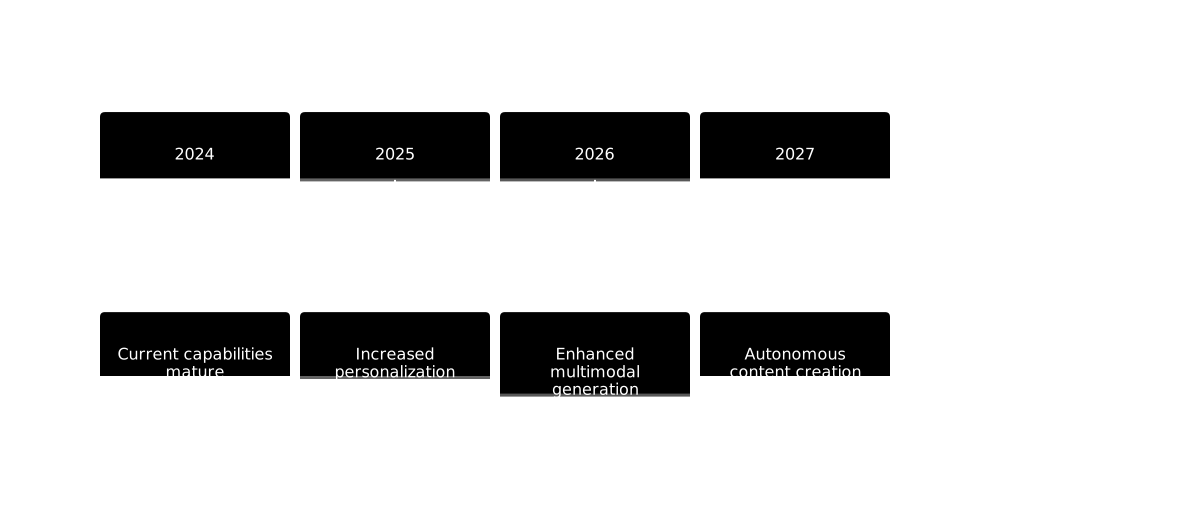
The future of AI content 2027 is defined by a move away from standalone tools and toward integrated, agentic systems. These systems will be less about generating text and more about managing the entire content workflow, transforming SEO from a manual process into an automated one.
From Generative Models to Agentic Systems
By 2027, the focus will be on AI “agents” that can perform multi-step tasks autonomously. An SEO content agent would look something like this:
- Monitor: It continuously analyzes your site’s keyword rankings and your competitors’ content.
- Identify: It identifies a content gap or an opportunity for a new article based on performance data and strategic goals.
- Research: It performs a “live” analysis of the current SERP, pulling in the latest information, data, and sources.
- Strategize: It determines the optimal article format, outline, and internal linking opportunities based on your existing content library.
- Create: It generates the full content package—text, relevant images, and even video snippets.
- Publish: It pushes the content directly to your CMS, correctly formatted with all on-page SEO elements in place.
- Analyze: It tracks the article’s performance (rankings, traffic, conversions) and decides on future updates or optimizations.
This is a fundamental shift from a writer’s tool to a fully autonomous content manager. This is one of the key next-gen SEO strategies that will separate winning programs from the laggards.
Hyper-Personalization and Multimodality
Content will move beyond one-size-fits-all articles. AI will enable the creation of content that adapts to the user. Imagine a blog post that reconfigures itself based on a visitor’s industry, technical expertise, or previous engagement with your site. The line between web content and a software-like experience will blur.
Furthermore, content will become truly multimodal. Instead of just writing text, AI systems will generate a complete asset package: the article, a series of social media posts to promote it, a short animated explainer video for YouTube, and an audio version for a podcast feed. This is where the concept of ai content creation in 2026 is already heading, but by 2027 it will be the standard.
Content Infrastructure as the Moat
If every business has access to powerful generative models, the models themselves are no longer a competitive advantage. The advantage—the moat—will be the infrastructure that connects AI to your specific business data and workflows.
This means a platform that:
- Integrates with your product database to create automated product description updates.
- Connects to your CRM to generate case studies based on customer data.
- Understands your first-party analytics to identify content opportunities no one else can see.
This is the difference between renting a power tool and owning a fully automated factory. The factory is the infrastructure.
AI Content Creation Market Growth
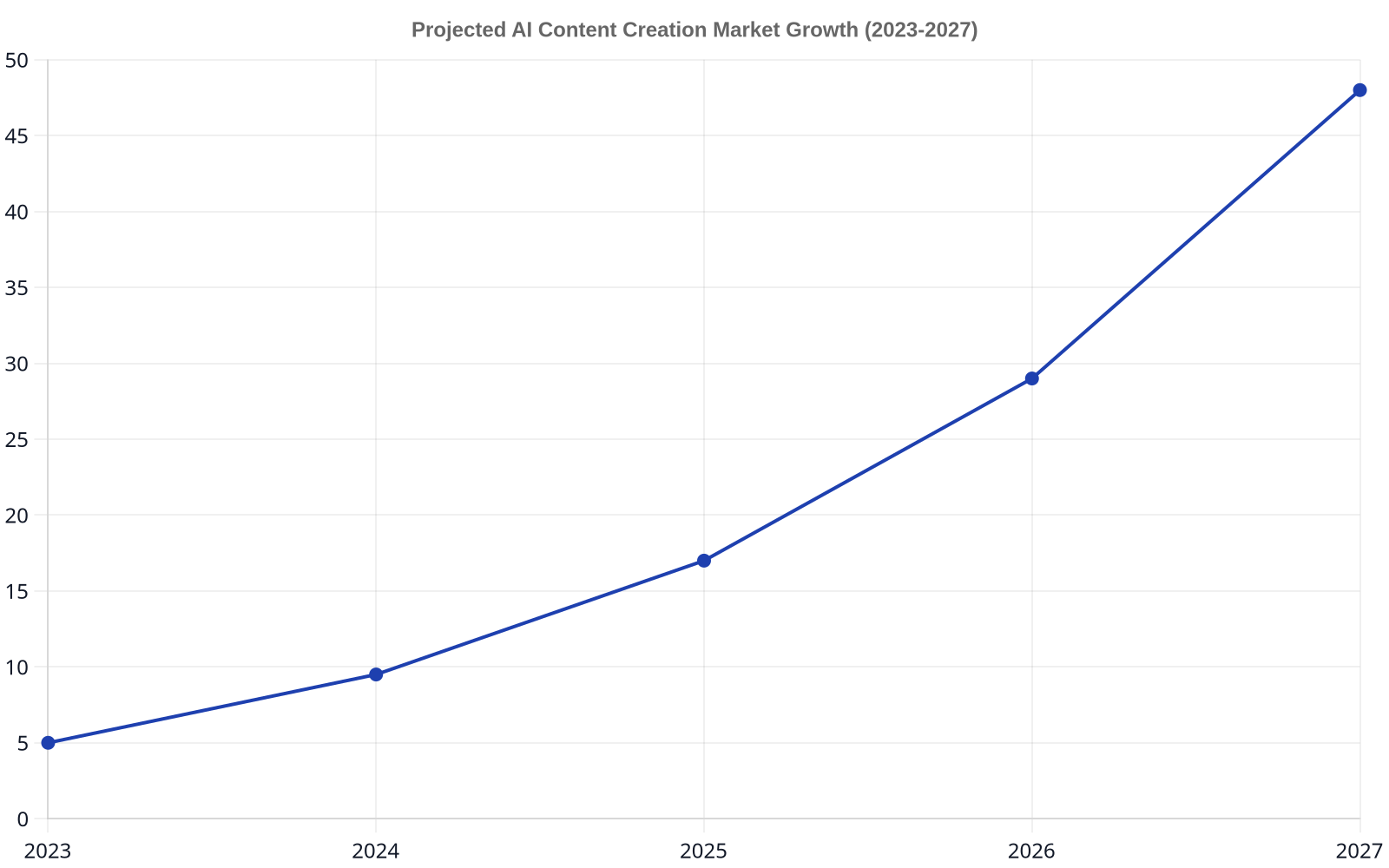
The shift toward integrated AI content infrastructure is mirrored in market growth projections. The focus of investment and value creation is moving up the stack from raw model providers to end-to-end application platforms. According to a report from Grand View Research, the global generative AI market is on a steep trajectory, projected to reach $109.37 billion by 2030. This growth isn’t just in the LLMs themselves but in the specialized software that applies them to solve specific business problems like SEO content automation.
AI Content Adoption Rates
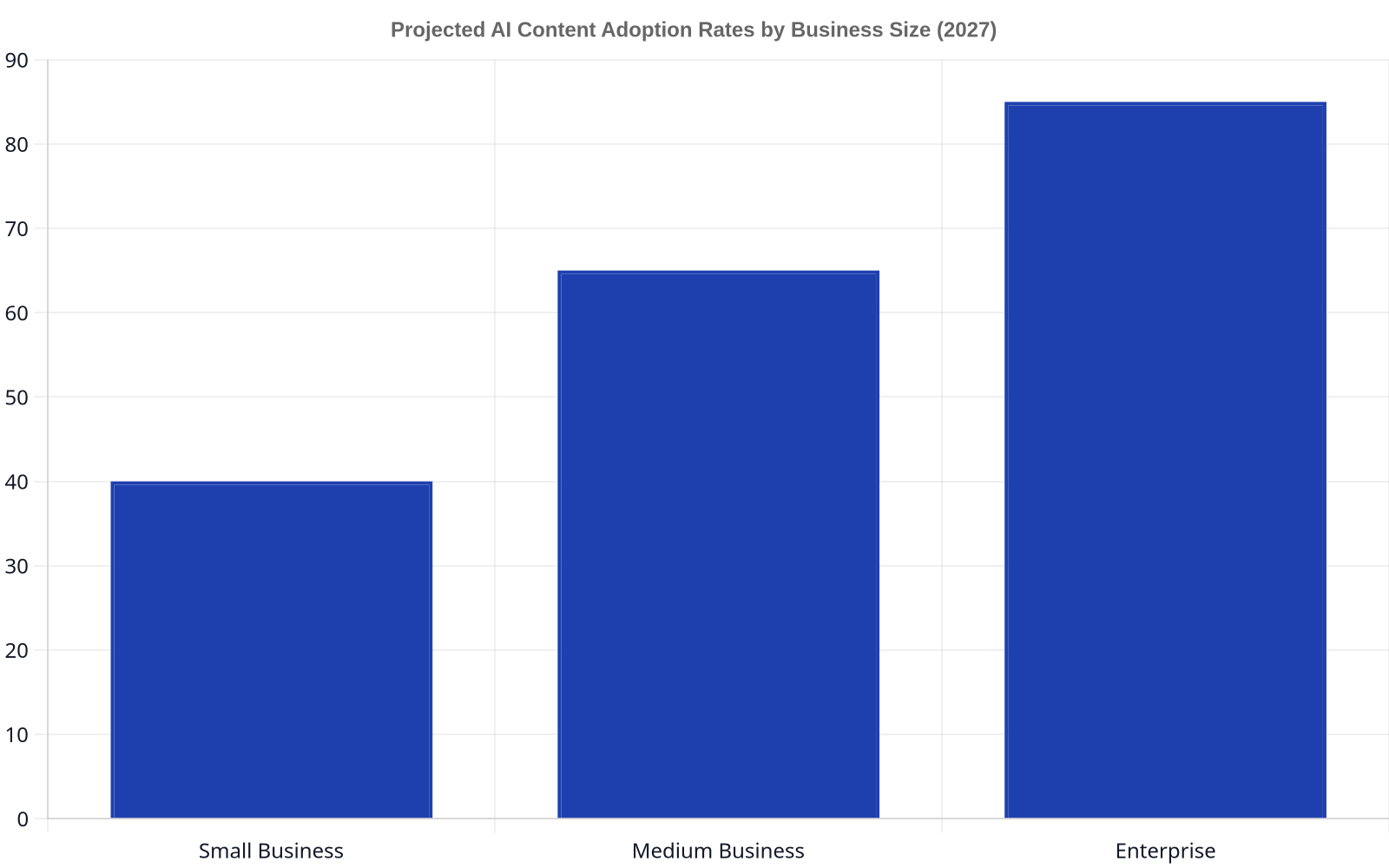
Adoption will not be uniform across all business segments. While large enterprises may have the resources to build custom in-house solutions, small and medium-sized businesses (SMBs) will be the primary drivers of growth for SaaS platforms that offer a complete, managed service. By 2027, the ability to deploy a full-funnel content strategy without a dedicated in-house team will be the key driver of adoption for SMBs, who often face the greatest resource constraints according to the Content Marketing Institute’s research.
Impact of AI on Content Roles
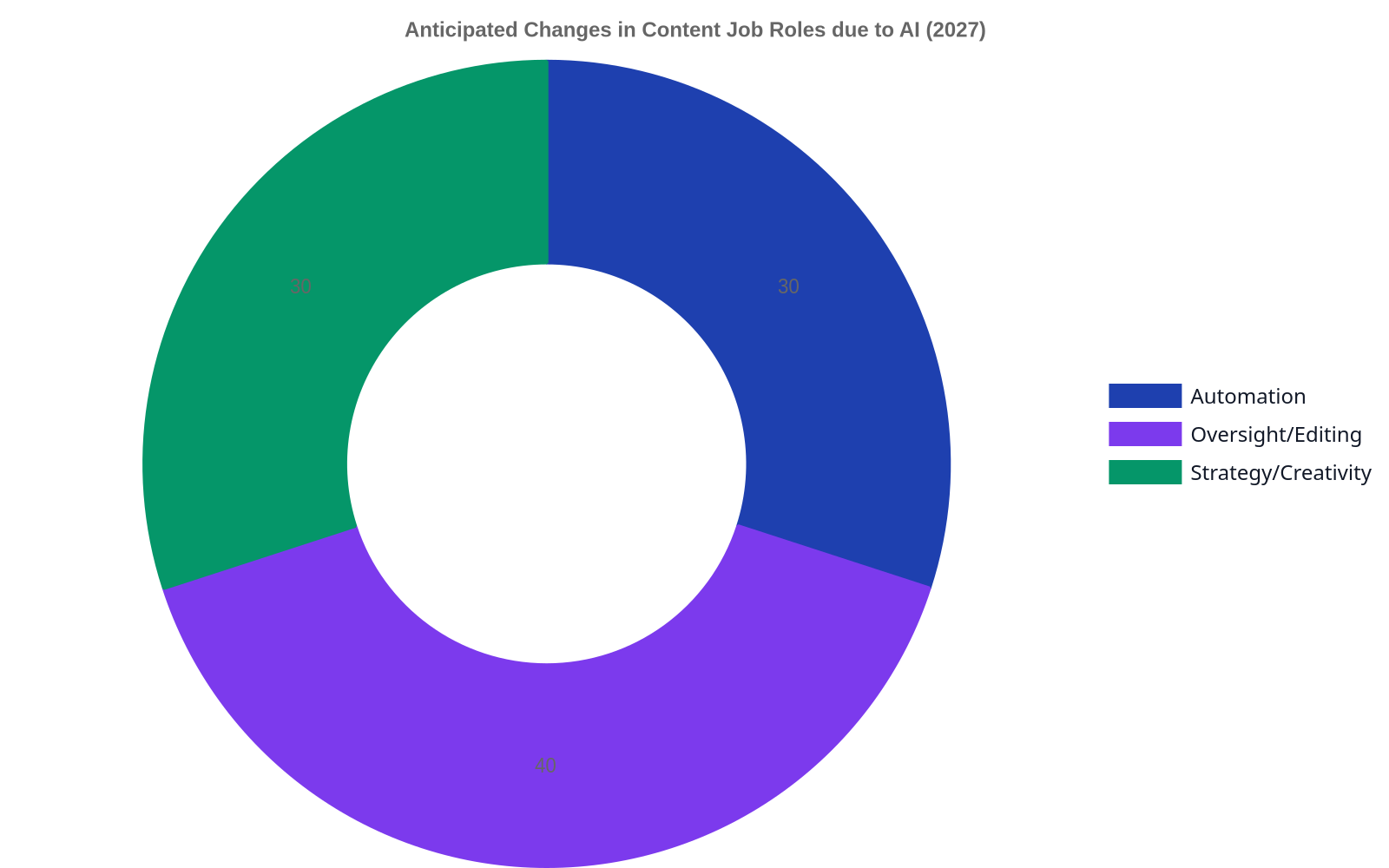
The rise of AI content agents will not eliminate the need for human content professionals. Instead, it will radically shift their roles. Repetitive, low-value tasks like writing generic definitions or summarizing articles will be fully automated.
This frees up human experts to focus on higher-value activities:
- Strategy: Defining the goals, target audiences, and brand voice that guide the AI.
- Oversight: Reviewing and approving the strategic direction proposed by AI agents.
- Original Research: Conducting interviews, running surveys, and analyzing proprietary data to create the unique insights AI cannot.
- Community Building: Engaging with the audience in forums, on social media, and at events—the human connection part of branding.
The role of a “content writer” will evolve into a “Content Strategist” or “AI Content Orchestrator.” Your job won’t be to write the article; it will be to manage the system that does.
Stop thinking about how to write articles faster. Start thinking about how to build a machine that creates, publishes, and optimizes content for you. That’s the strategic shift required for 2027.
2026 vs. 2027: The Evolution of AI Content Systems
To make this shift concrete, let’s compare the common approach today with the infrastructure-first model of the near future.
| Feature | 2026 Approach: Standalone Generator | 2027 Approach: Integrated Infrastructure |
|---|---|---|
| Core Unit | The Article | The Content Engine |
| Primary Task | Writing a single piece of content | Managing the entire content lifecycle |
| Human Role | Writer / Editor / Promoter | Strategist / System Orchestrator |
| Input | A keyword or a prompt | Business goals and performance data |
| Output | A block of text in a Google Doc | A published, optimized, and internally linked article on your CMS |
| Data Source | Public internet training data | Public data + private, first-party business data |
| Key Metric | Words per minute / Cost per word | Organic traffic growth / Lead generation |
| Strategic Focus | Content Velocity | System Autonomy |
How to Prepare Your Content Strategy for 2027
Waiting until 2027 to adapt is a recipe for being left behind. The groundwork for building a content engine needs to be laid now. If your current SEO efforts feel like a constant struggle, it might be that your model is the problem, a common issue for many struggling with SEO agency challenges.
Here are three actionable steps you can take today:
- Treat Content as a System, Not a Series of Campaigns. Start mapping your entire content process, from idea to archive. Identify the bottlenecks, the manual data entry, and the repetitive tasks. This is the workflow you will eventually automate. This includes planning for things like
daily articlesto maintain momentum. - Build Your First-Party Data Moat. Your unique data is your ultimate defense against generic AI content. Start consolidating it. This includes customer insights from your CRM, product usage data, and performance analytics from your own website. This proprietary information will become the fuel for your content engine, producing insights your competitors cannot replicate.
- Prioritize Technical and On-Page SEO. An autonomous content system requires a technically sound foundation. Ensure your site has a clean architecture, fast load times, and structured data implemented correctly. The AI can create the world’s best content, but it will fail if your site isn’t optimized for Google to crawl and understand it efficiently.
Building this foundation is not about buying another AI writer. It’s about architecting an intelligent system. It’s a shift in mindset from creating content to building an engine that creates content for you.
FAQ
Will AI replace content writers by 2027?
No, but it will fundamentally change the role. AI will automate the commodity aspects of content creation, such as drafting and summarizing. This will elevate the human role to focus on strategy, original research, proprietary data analysis, and brand storytelling—tasks that require genuine experience and critical thinking. The job title may change from “writer” to “content strategist” or “AI orchestrator.”
How will Google’s ranking algorithms adapt to advanced AI content?
Google has been consistent that its focus is on rewarding helpful, reliable, people-first content, not on how it’s produced. As AI content becomes more sophisticated, Google’s algorithms will likely become even more adept at identifying signals of genuine expertise and experience (E-E-A-T), such as unique insights, novel data, and evidence of firsthand use. Generic, unedited AI content will likely perform poorly.
What’s the difference between a generative AI model and an AI content agent?
A generative AI model (like GPT-4) is a reactive tool that creates text based on a specific prompt you provide. An AI content agent is an autonomous system that can perform a sequence of tasks without direct human intervention. For example, it could identify a keyword opportunity, research the topic, write the article, publish it to your website, and track its performance, all as part of a single, predefined workflow.
Is it worth investing in AI content tools now or waiting until 2027?
Waiting is a mistake. The key is to invest in the right kind of tool. Instead of focusing on simple text generators, businesses should look for platforms that are building toward an integrated content infrastructure. By adopting a system-based approach now, you can begin organizing your workflows, cleaning up your data, and establishing the technical SEO foundation necessary to take full advantage of the autonomous agents of 2027.
The future of AI content isn’t a magical writing robot that will solve all your problems. It’s an infrastructure play. It’s about building an automated, intelligent system that consistently executes a winning SEO strategy. The companies that start building that engine today—focusing on process, data, and technical excellence—are the ones who will dominate the search results of 2027. This is the core philosophy behind Rank My Website: providing an automated engine to grow your organic traffic, not just another tool to write articles.