Author: admin

  • What SEO Solution Best Fits Your Startup Stage and Goals?

    What SEO Solution Best Fits Your Startup Stage and Goals?

    Best SEO Solutions for Startups: A 2026 Guide

    Most SEO “solutions” for startups are just repackaged enterprise services with a smaller price tag and a much longer contract. They treat you like a small corporation, not a startup that needs to prove traction yesterday. The best SEO solution for a startup is an integrated system that prioritizes scalable content creation, technical soundness, and measurable impact on customer acquisition cost, often showing meaningful results within 6 to 12 months. This means focusing on channels that build long-term assets, not just short-term traffic spikes.

    This article ranks different types of SEO solutions not by their own marketing claims, but by their suitability for specific startup stages and goals. We evaluated each category based on a weighted analysis of deployment speed, budget requirements, scalability, and the level of in-house expertise required. The focus is on what delivers tangible business results, like qualified leads and lower CAC, not just vanity metrics like rankings.

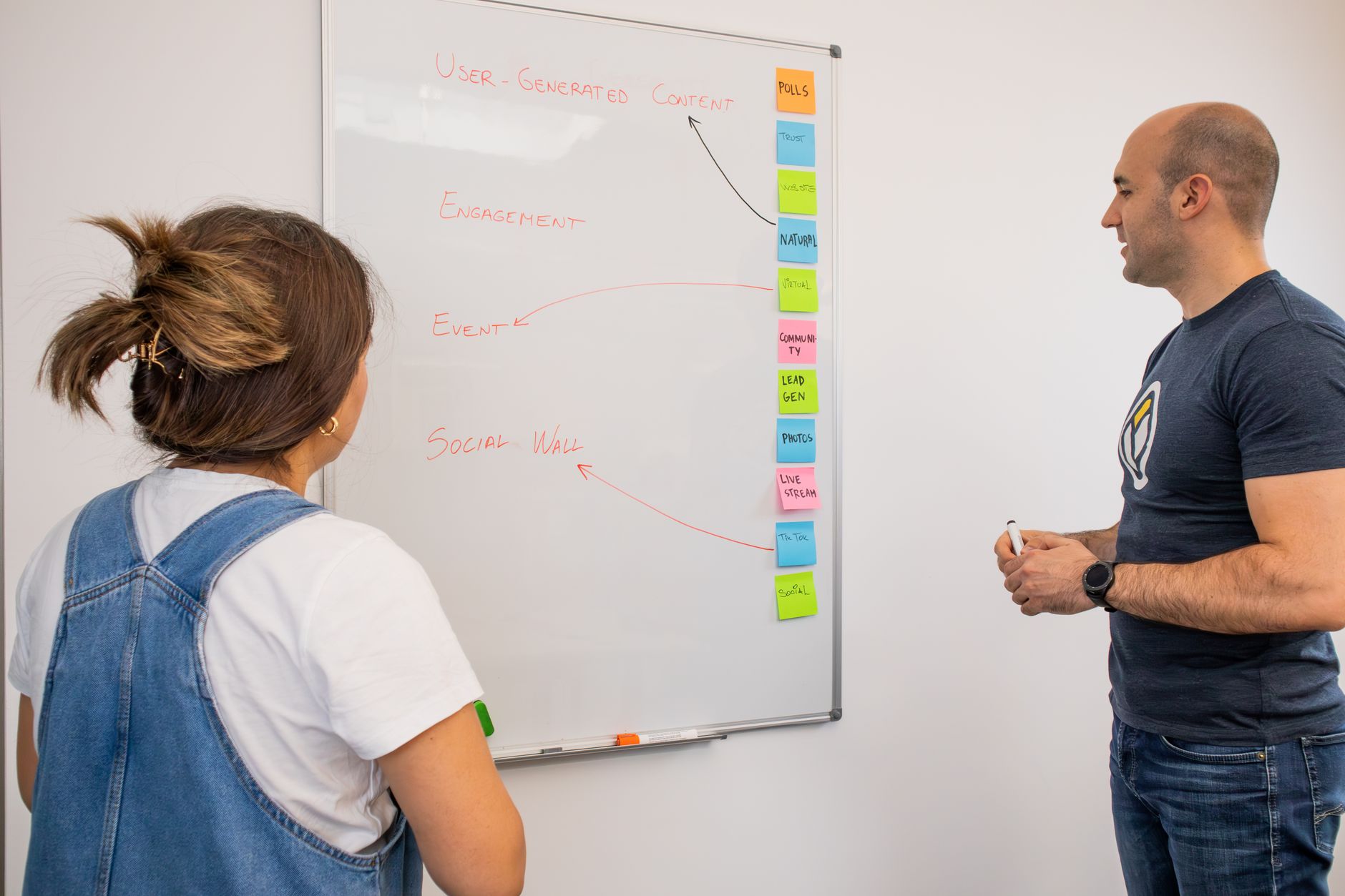
    Two startup professionals plan tasks with sticky notes on a clear whiteboard
    Two startup professionals plan tasks with sticky notes on a clear whiteboard (Photo by airfocus on unsplash)

    Understanding the Startup SEO Landscape
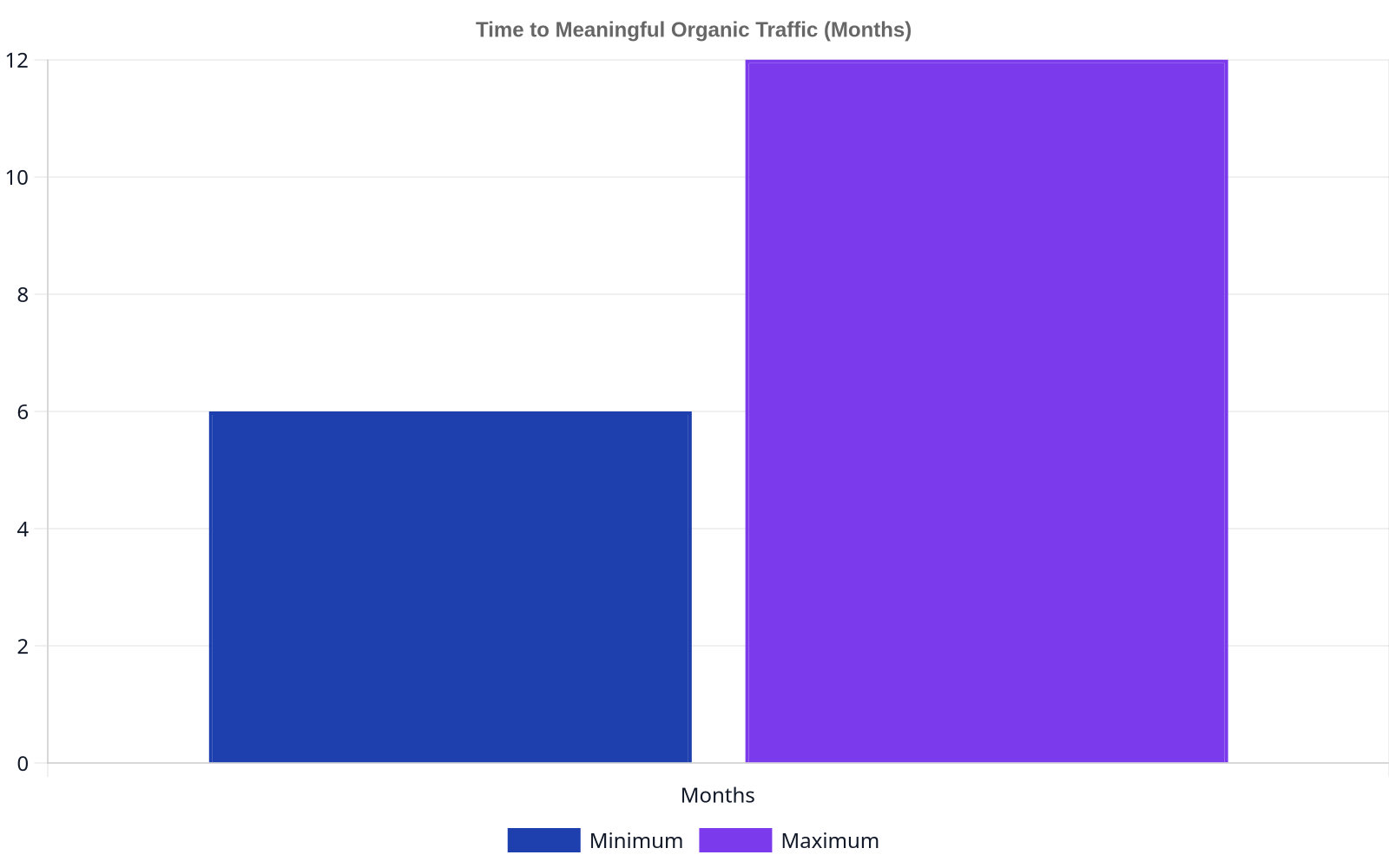
    Bar chart showing that startups can expect to wait between 6 and 12 months to see meaningful organic traffic from SEO efforts.
    Typical Time to See Meaningful Organic Traffic

    Search engine optimization for a startup is fundamentally different from SEO for an established company. You have no domain authority, no brand recognition, and likely a very small team. Your primary challenge is creating credibility and visibility from scratch. A successful startup SEO strategy has four core components: technical SEO, on-page SEO, content creation, and link building. While established companies might focus on defending existing rankings, startups must be aggressive, finding and dominating niche topics to build an initial foothold before expanding.

    Many founders fall for SEO myths, like believing results are instantaneous or that it’s a one-time setup. The reality is that you should expect 6 to 12 months before meaningful organic traffic materializes. This timeline is a test of strategic patience. Another common misconception is that SEO is “free.” While you don’t pay per click, the investment in tools, talent, and content is significant. Your goal isn’t just traffic; it’s building a predictable, cost-effective engine for growth.

    In-House SEO Team

    Building an in-house SEO team means hiring a specialist or a small group of marketers to handle all aspects of your organic search strategy. This includes everything from keyword research and content writing to technical audits and link acquisition. This model gives you complete control and allows the team to develop a deep, nuanced understanding of your product, customers, and market. They become a core part of your growth engine, deeply integrated with product and sales teams.

    An in-house team can be incredibly powerful for a Series A or later startup with predictable revenue and a clear product-market fit. The direct feedback loop between SEO efforts and business outcomes is invaluable. However, it’s also the most expensive and slowest option to stand up. Finding, hiring, and retaining top-tier SEO talent is a major challenge, and the overhead in salaries and tools can be substantial.

    • Best for: Series A and later startups with stable funding and the need for deep product integration.
    • Watch out for: High costs, long hiring cycles, and the risk of knowledge concentration in one or two key employees.

    Traditional SEO Agency

    A traditional SEO agency is a third-party firm you hire to manage your SEO. Most offer a package of services, including audits, keyword research, content creation, and monthly reporting. For a startup, this can seem like a convenient way to access expertise without the overhead of full-time hires. Agencies bring experience from working with multiple clients, which can provide broader industry insights.

    However, the agency model is often a poor fit for early-stage startups. You are often one of many clients, and the team working on your account may have limited context about your specific business challenges. The strategies can be generic, and the communication overhead can be significant. The typical retainer model also means you pay the same fee whether you get great results or poor ones, and quality can vary dramatically between agencies. Many startups find themselves “stuck in the middle,” paying for a service that isn’t tailored enough to move the needle.

    The proliferation of terms like GEO, AEO, and AI SEO can be confusing, but this often reflects a marketing trend rather than a fundamental shift in practice. Many agencies simply relabel traditional SEO services without updating their methods, leading to a perception that the field is splitting into these distinct lanes.

    • Best for: Startups that need a predictable, if sometimes generic, set of SEO tasks executed and have the budget for a monthly retainer.
    • Watch out for: Cookie-cutter strategies, lack of deep business integration, and long contract lock-ins.

    Three people discussing a startup's 2021 export growth plan with a blackboard
    Three people discussing a startup’s 2021 export growth plan with a blackboard (Photo by Thirdman on pexels)

    SEO Freelancers & Consultants

    Hiring an SEO freelancer or consultant offers a middle ground between a full-time employee and a large agency. You get specialized expertise for a specific project or on a fractional basis, which can be more budget-friendly. A good consultant can provide high-level strategy, conduct a technical audit, or lead a link-building campaign without the long-term commitment of an agency retainer or the high cost of an in-house hire.

    This model is excellent for startups that have some in-house marketing capabilities but need to fill a specific knowledge gap. The key is finding the right person. The freelancer market is flooded with low-quality providers, and a bad hire can do more harm than good by building toxic links or providing outdated advice. Vetting is critical. Look for a proven track record with startups in a similar industry or stage. This approach requires more hands-on management from the founder or marketing lead.

    • Best for: Pre-seed and Seed stage startups needing targeted expertise for a specific SEO task (e.g., technical audit, initial strategy).
    • Watch out for: Inconsistent quality, potential for being a low priority for the freelancer, and the need for strong internal project management.

    AI-Powered SEO Automation Platforms

    The newest category of solutions involves AI-powered platforms that automate key parts of the SEO workflow. These platforms, like Keyworth, are designed to handle the most time-consuming aspects of content-led SEO at scale. Instead of just providing data, these tools actively generate SEO-optimized articles, handle keyword research, build internal links, and even publish content directly to your site. This allows a very small team (or even a single person) to execute a content strategy that would otherwise require several full-time employees.

    This approach is a powerful fit for early-stage startups that need to create a large volume of high-quality content to establish topical authority quickly. By automating the heavy lifting of content production, like generating daily articles, it frees up the team to focus on higher-level strategy, customer interviews, and promotion. It’s a way to build a valuable, long-term content asset without the massive upfront cost of an in-house team or the generic approach of a traditional agency. Some clients, like Wolverine Assemblies, have found this model effective for building their online presence.

    An automated platform isn’t a magic button for traffic. It’s a force multiplier for your strategy, turning your insights about the customer into a high-volume, high-quality content machine.

    • Best for: Startups from pre-seed to Series A that need to build organic traffic through scalable content creation without a large marketing team.
    • Watch out for: The need for a clear content strategy to guide the AI; the platform executes, but you must provide the strategic direction.

    The Cost of Quality Startup SEO
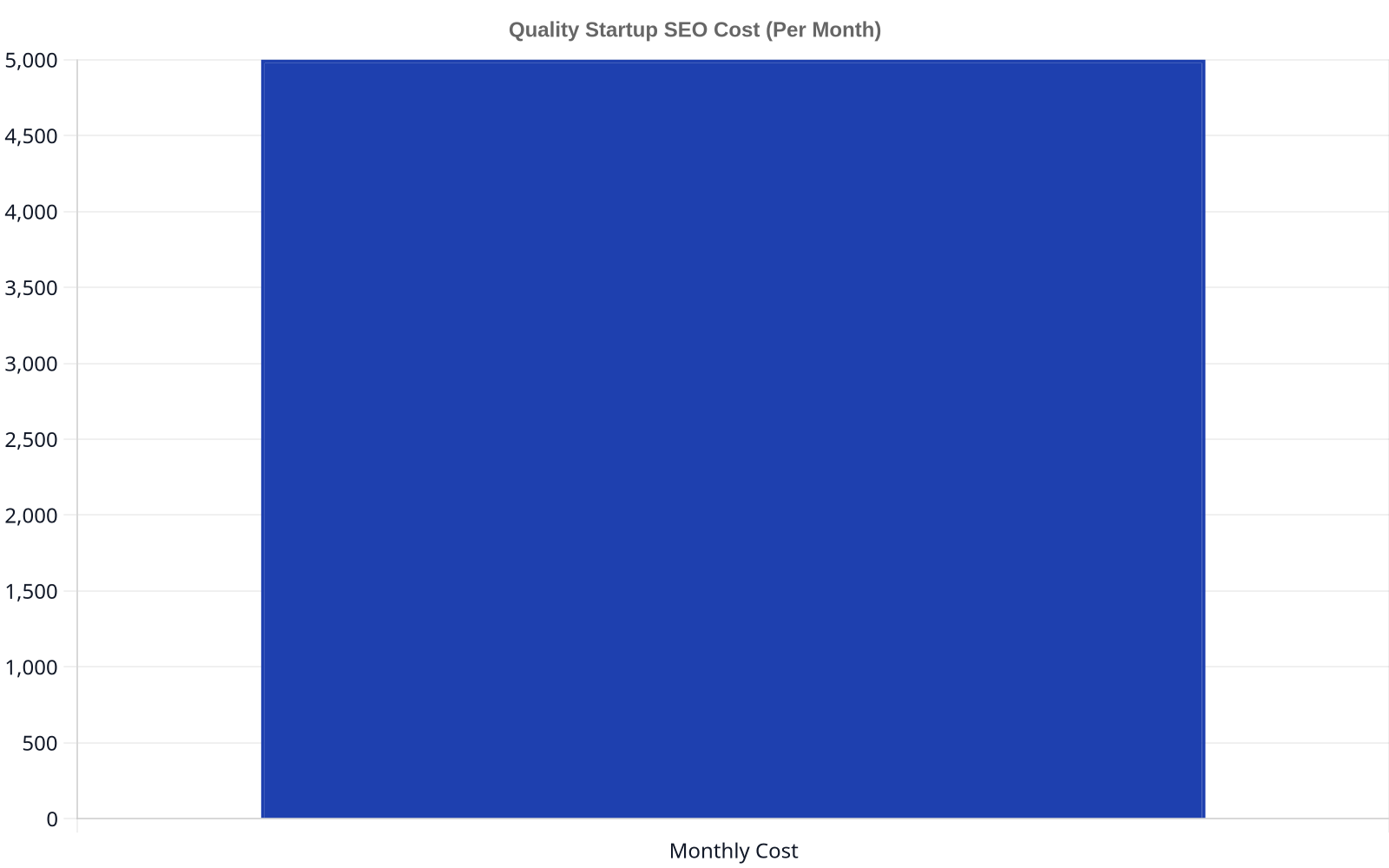
    Bar chart illustrating that quality startup SEO starts at a minimum of $5,000 per month.
    Minimum Monthly Investment for Quality Startup SEO

    Budgeting is a major concern for any startup, and SEO is an area where you often get what you pay for. While you can find cheap services on freelance marketplaces, they are unlikely to produce meaningful business results and may even harm your site’s reputation. For professional, results-oriented work, a quality SEO investment typically starts at around $5,000 per month. This investment covers the expertise, tools, and time required to develop and execute a strategy that can compete in today’s crowded search landscape.

    This figure can represent a retainer with a good agency, the salary for a junior in-house marketer plus tools, or the subscription for a high-end automation platform plus a content strategist’s time. The key is to see it as an investment in building a core business asset: a predictable, low-cost channel for acquiring new customers. The goal is to drive your overall Customer Acquisition Cost (CAC) down over time as organic traffic and conversions grow.

    Startup SEO Solutions: Comparison Table

    Solution Type Typical Cost (Monthly) Best For Stage Key Advantage Major Drawback
    In-House Team $10,000 – $25,000+ Series A+ Deep integration, full control Very high cost, slow to build
    Traditional Agency $5,000 – $15,000 Seed, Series A Access to expertise, less management Generic strategies, poor ROI
    Freelancer/Consultant $2,000 – $8,000 Pre-seed, Seed Specialized skills, flexible Inconsistent quality, requires management
    AI Automation Platform $1,000 – $7,000 Pre-seed, Seed, Series A Scalable content, high ROI Requires strategic direction

    FAQ

    Why is SEO important for startups?

    SEO is crucial for startups because it builds a sustainable, long-term channel for customer acquisition. Unlike paid advertising, where traffic stops when you stop paying, SEO creates a durable asset of content and authority that generates “free” traffic and leads over time. For new businesses with limited brand recognition, ranking for problems your customers are searching for is one of the most effective ways to build visibility and credibility. The top three Google positions capture most clicks, making visibility there a primary goal.

    How long does startup SEO take to show results?

    Setting realistic expectations is vital. While you might see some early movement in long-tail keywords within 3-4 months, most experts agree you should plan for a longer timeline. You can typically expect 6 to 12 months before meaningful organic traffic and a measurable impact on your business goals. The exact timeline depends on your industry competitiveness, budget, and the intensity of your strategy.

    How much should a startup budget for SEO?

    The minimum investment for quality startup SEO that can compete effectively is around $5,000 per month. This budget could cover a modest agency retainer, a junior in-house hire with a toolset, or a subscription to a powerful automation platform coupled with strategic oversight. Anything significantly less is likely to result in slow or negligible results.

    What are the most important metrics to track for startup SEO?

    While keyword rankings and traffic are easy to track, they don’t tell the whole story. Startups should focus on business-impact metrics. These include the number of qualified leads from organic search, the organic traffic to conversion rate, and, most importantly, the Customer Acquisition Cost (CAC) for the organic channel. Tracking how SEO reduces your blended CAC over time is the ultimate measure of its success.

    What is E-E-A-T and why does it matter for startups?

    E-E-A-T stands for Experience, Expertise, Authoritativeness, and Trustworthiness. It’s a framework Google uses to assess content quality. For a startup with no existing brand, E-E-A-T is your path to credibility. You demonstrate it by publishing genuinely helpful, expert-driven content, securing backlinks from reputable sites, showcasing author expertise (like author bios), and making it easy to see who is behind the company. It’s how you prove to Google and to users that you are a legitimate, trustworthy source of information.


    Related reading

  • 6 Digital Marketing Platforms with Robust SEO Features

    6 Digital Marketing Platforms with Robust SEO Features

    Most “all-in-one” digital marketing platforms are masters of none. They promise a single dashboard for everything from email to social to SEO, but the reality is often a suite of shallow, underpowered tools. A digital marketing platform with SEO features must provide deep, actionable insights for keyword research, rank tracking, and backlink analysis, not just surface-level vanity metrics. The right platform integrates these SEO components directly into your content and CRM workflows, allowing you to prove marketing ROI from first click to final conversion. It should connect keyword performance directly to the content it powers.

    This guide ranks the top platforms by evaluating the depth and integration of their SEO toolsets. We analyzed them based on four core criteria: the quality of their keyword research tools, the accuracy of their rank tracking, the comprehensiveness of their backlink analysis, and how well these features integrate with broader marketing functions like content creation and analytics. Our ranking prioritizes platforms that offer professional-grade SEO capabilities, not just a token “SEO” tab.

    Computer screen displays "Digital Marketing" text on a desk with blurred people behind it
    Computer screen displays “Digital Marketing” text on a desk with blurred people behind it (Photo by Mikael Blomkvist on pexels)

    1. HubSpot Marketing Hub

    HubSpot has evolved from an inbound marketing pioneer into a comprehensive CRM platform where its SEO tools are a core, integrated component. Unlike standalone tools, HubSpot’s SEO features are wired directly into its content creation, social media, and email marketing tools. You can research a keyword, write and optimize a blog post around it, schedule its promotion, and track its performance all within the same environment. The platform’s topic cluster tool is a standout, providing a visual framework for organizing content around core pillar pages and sub-topics, which is a practical way to execute a modern content strategy. For businesses already invested in the HubSpot ecosystem, the value is immense.

    The integration with its CRM is where the platform truly separates itself. You can track a lead from the specific blog post and keyword that brought them to your site all the way through their journey to becoming a customer. This closed-loop reporting is the gold standard for demonstrating the revenue impact of your SEO efforts, a notoriously difficult task with disconnected tools. It answers the “so what?” of ranking for a keyword by connecting it directly to sales, a feature that justifies its premium pricing for many B2B companies like Wolverine Assemblies.

    • Best for: B2B companies that need to tie SEO performance directly to lead generation and sales revenue within a single, integrated CRM platform.
    • Watch out for: The per-contact pricing model can become prohibitively expensive as your database grows. The SEO tools, while well-integrated, may lack the raw crawling power and index size of specialized tools like Ahrefs for deep technical audits.

    2. Semrush

    Semrush is less an “all-in-one” platform that happens to have SEO tools and more a dominant SEO platform that has aggressively expanded into other marketing disciplines. Its origins as a competitive intelligence tool are still evident in its powerful domain and keyword analytics. You can pull a competitor’s entire keyword profile, see their top-performing content, and analyze their backlink strategy in minutes. The keyword database is one of the largest on the market, providing granular data on search volume, intent, and difficulty that is critical for making informed content decisions.

    Where Semrush shines is its sheer breadth of features. It offers over 50 tools covering everything from a local SEO listing management service to a content marketing platform with a built-in optimizer and plagiarism checker. This makes it an excellent choice for marketing agencies and in-house teams who need a versatile toolkit. While the user interface can feel overwhelming due to the sheer volume of options, the data quality is consistently high. It functions as a Swiss Army knife for digital marketers who need to quickly pivot between SEO, PPC, and content analysis.

    • Best for: Marketing agencies and experienced in-house teams that require a comprehensive, data-rich toolkit for competitive analysis, keyword research, and PPC campaigns.
    • Watch out for: The “projects” system and its associated limits can be confusing and restrictive. The cost can add up quickly if you need multiple user seats or access to the more specialized toolkits (like Semrush .Trends or Local).

    3. Ahrefs

    For years, Ahrefs has been the undisputed leader in backlink analysis. Its link index is arguably the most active and comprehensive available, making it an indispensable tool for link building campaigns and competitive research. If you need to understand exactly who is linking to a competitor’s page and how they acquired that link, Ahrefs is the gold standard. However, it has rapidly built out its other SEO features to become a legitimate all-around platform. Its “Keywords Explorer” is a powerful tool for ideation, offering unique reports like “Also talk about” to ensure content is comprehensive. A recent study by Backlinko analyzing 11.8 million search results confirmed the strong correlation between comprehensive content and higher rankings, a principle Ahrefs’ tools help you implement.

    The “Site Audit” tool is another key strength, providing one of the most thorough and user-friendly technical SEO crawlers on the market. It visualizes site structure and pinpoints issues from broken links to missing schema markup. While Ahrefs has added features for rank tracking and content analysis, its core identity remains rooted in deep SEO data. It appeals to the practitioner who wants the best possible data for backlinks and technical analysis and is willing to accept a less integrated experience with other marketing channels like email or social media. It doesn’t try to be a CRM; it tries to be the best SEO data provider.

    • Best for: SEO specialists and content marketers who prioritize best-in-class backlink analysis and technical site auditing capabilities.
    • Watch out for: It lacks the native CRM integration of HubSpot or the broad PPC and social tools of Semrush. The user-based pricing model introduced in recent years has been a point of contention for agencies and larger teams.

    4. SE Ranking

    SE Ranking has carved out a significant market share by offering a surprisingly robust feature set at a much more accessible price point. It’s a compelling digital marketing platform with SEO features for small businesses, freelancers, and agencies who need a capable tool without the enterprise-level price tag. Its core functionalities, including keyword rank tracking, site audits, and backlink monitoring, are solid and reliable. The accuracy of its rank tracker, which updates daily, is particularly noteworthy for its price bracket.

    The platform includes a comprehensive marketing plan that provides a step-by-step SEO checklist, making it ideal for beginners or business owners who are managing their own marketing. It guides you through initial keyword research, on-page optimization, and off-page strategy. While it may not have the massive data indexes of Semrush or Ahrefs, it covers all the essential bases effectively. The platform’s white-labeling features are also a major draw for agencies looking to provide branded SEO reports to clients without the high cost associated with other platforms, a key consideration for white label seo services.

    • Best for: Small to medium-sized businesses, startups, and marketing agencies seeking a cost-effective, all-in-one SEO and digital marketing solution.
    • Watch out for: Its backlink index and competitor research tools are less comprehensive than those of Ahrefs or Semrush. Power users may find the depth of data and analysis options limited for complex enterprise-level projects.

    5. Google Search Console

    No list of essential SEO tools would be complete without Google’s own free platform. Google Search Console (GSC) is the single source of truth for how your site performs on Google. It’s not a competitor to the paid platforms; it’s a mandatory complement. The data comes directly from Google, so it’s the most accurate information you can get on impressions, clicks, click-through rate (CTR), and average keyword positions. GSC is the definitive tool for understanding how Google sees your site, submitting sitemaps, and identifying crawling or indexing issues.

    The Performance report is invaluable for finding “striking distance” keywords, those for which you rank on page two. By identifying these terms in GSC and creating or optimizing content for them, you can achieve quick ranking wins. The platform is also critical for monitoring Core Web Vitals, Google’s user experience metrics that are a confirmed ranking factor. A recenthighlighted the increasing importance of these user experience signals. While it offers no competitor data, no backlink analysis of other sites, and no keyword research tools, the data it does provide is non-negotiable for any serious SEO strategy.

    • Best for: Every website owner, without exception. It is the foundational tool for monitoring your site’s health and performance in Google’s search results.
    • Watch out for: It provides no information about other search engines or competitors. The data is limited to the last 16 months, and the interface offers limited filtering and analysis capabilities compared to paid tools.

    The biggest mistake marketers make is treating SEO as a separate activity. A modern digital marketing platform doesn’t just report on rankings; it integrates keyword data into the very first step of content creation.

    6. Keyworth

    While traditional platforms provide tools for analysis, Keyworth is an AI-powered platform designed for execution. It automates the entire SEO content lifecycle, from keyword research to generating and publishing optimized articles daily. This shifts the focus from manually analyzing data to automatically producing the assets that actually generate traffic. For businesses without a dedicated content team or those struggling to produce content at scale, it provides a direct path to growing organic traffic. The platform functions as an automated content engine that also handles critical off-page signals, including building backlinks and establishing internal linking structures.

    Keyworth is built for businesses that see SEO and content as a primary growth driver but lack the resources to manage the complex, time-consuming workflows involved. Instead of providing you with a list of keywords to target, it targets them for you by creating a constant stream of high-quality, relevant daily articles. This approach is fundamentally different from the analytical toolsets of other platforms. It’s a managed solution that delivers the outcome (traffic growth) rather than just the tools. By automating the most labor-intensive parts of SEO, it allows companies to compete on content volume and quality without a massive in-house team, an approach aligned with the future of digital marketing.

    • Best for: Businesses of all sizes that want to automate their content creation and SEO workflows to generate organic traffic without significant manual effort.
    • Watch out for: It is not a manual analysis tool. Teams that want deep, granular control over every aspect of their SEO data and campaigns may prefer a traditional platform like Semrush or Ahrefs.
    Hands hold a business report with various charts, comparing data on a phone and laptop
    Hands hold a business report with various charts, comparing data on a phone and laptop (Photo by fauxels on pexels)

    Summary Comparison

    Platform Key SEO Feature Best For Pricing Model
    HubSpot Integrated CRM & Topic Clusters B2B companies needing closed-loop reporting Tiered, based on marketing contacts
    Semrush Competitive Analysis & Keyword Research Agencies and experienced marketing teams Tiered, based on features and user seats
    Ahrefs Backlink Index & Site Audit Tool SEO specialists and content teams Tiered, based on usage and user seats
    SE Ranking All-in-One Affordability & Rank Tracking SMBs and startups on a budget Tiered, based on keywords tracked and features
    Google Search Console First-Party Performance Data All website owners (it’s free) Free
    Keyworth Automated Content Creation & Publishing Businesses focused on execution and traffic growth Flat-rate subscription for automated services

    Choosing the Right Platform for Your Business

    Selecting the right digital marketing platform with SEO features depends entirely on your business model, budget, and internal resources. An e-commerce business might prioritize a platform with strong technical SEO and site audit features to manage thousands of product pages, while a B2B service company would benefit more from HubSpot’s ability to connect keyword performance to leads in its CRM. An important finding from a SNHU analysis on marketing strategies is that tool selection must align with core business objectives, not just feature lists.

    Don’t fall for the trap of the “all-in-one” solution that does everything poorly. It’s often more effective to build a “best-in-breed” stack, combining a powerful, free tool like Google Search Console with one or two specialized paid platforms that excel at the functions you need most. For some, that might be the deep analysis of Ahrefs. For others, it might be the automated execution of Keyworth. The goal isn’t to have the most tools; it’s to have the right ones that directly contribute to your growth.

    Further reading

    FAQ

    What is a digital marketing platform with SEO features?

    A digital marketing platform with SEO features is a software suite that combines tools for search engine optimization (like keyword research, rank tracking, and site audits) with broader marketing functions such as content creation, social media management, email marketing, or customer relationship management (CRM). The key is the integration between these functions.

    Do I need an all-in-one platform or specialized SEO tools?

    This depends on your team and needs. All-in-one platforms like HubSpot are great for integrating SEO with sales and marketing, providing clear ROI tracking. Specialized tools like Ahrefs offer deeper, more powerful data for specific SEO tasks like backlink analysis. Many businesses use both: a specialized tool for deep analysis and an integrated platform for workflow and reporting.

    How much do these platforms typically cost?

    Costs vary dramatically. Google Search Console is free. Enterprise platforms like HubSpot can cost several thousand dollars per month, depending on the size of your contact database.

    What are the most critical SEO features to look for?

    The three most critical features are: 1) A comprehensive keyword research tool to find and analyze search terms. 2) An accurate rank tracker to monitor your performance for target keywords. 3) A backlink analysis tool to examine your profile and your competitors’. Beyond these, look for a technical site audit tool and strong reporting capabilities.

    How does AI impact these digital marketing platforms?

    AI is having a huge impact. It’s being used to generate content suggestions, predict keyword difficulty, automate technical site audits, and even write entire articles. Platforms like Keyworth are built around AI to automate the entire SEO content workflow, moving beyond simple analysis to active content generation and optimization. This is a key trend to watch in the coming years and a core benefit of AI content generation for SEO.

    Can I just use free tools for my SEO?

    You can start with free tools, and every business must use Google Search Console. However, relying solely on free tools puts you at a significant disadvantage. Paid platforms provide essential competitive data, more powerful analytics, and workflow efficiencies that are nearly impossible to replicate with a collection of free options. The investment in a paid tool typically pays for itself through time saved and better results.

  • 5 Leading Marketing SaaS Solutions for Real Growth

    5 Leading Marketing SaaS Solutions for Real Growth

    Most lists reviewing marketing SaaS are just affiliate link farms dressed up as advice. They rank tools based on commission payouts, not on performance, leaving you with a bloated tech stack and an empty pipeline. The best marketing SaaS solution is the one that fits your team’s specific workflow, technical maturity, and growth stage. For a startup, that might be a single platform for everything; for a scale-up, it’s about specialized tools that integrate cleanly. True value comes from how a solution amplifies your strategy, not from a brand name or a laundry list of features.

    Our methodology isn’t based on affiliate fees. We ranked these solutions based on a weighted model that prioritizes demonstrated success and user validation. The criteria included a Leadership Experience Score (25%), an Average Review Score (20%) from B2B software review platforms, and the quality of their Notable Clients (30%). This approach filters out the hype and focuses on what actually delivers results in SaaS marketing.

    Person working at a desk with two computer monitors displaying data and code
    Person working at a desk with two computer monitors displaying data and code (Photo by StartupStockPhotos on pixabay)

    The Unique Marketing Challenges for SaaS

    Marketing a SaaS product isn’t like selling a physical item. You’re selling a service, a relationship, and a solution to an ongoing problem. The sales cycle can be long, customer lifetime value (CLV) is paramount, and the product itself is constantly evolving. This creates a unique set of challenges.

    Unlike a one-time purchase, SaaS marketing must focus on acquiring and retaining users who will pay a subscription fee for months or years. This is why metrics like Monthly Recurring Revenue (MRR), Churn Rate, and CLV are the north stars for any SaaS marketer. Furthermore, the marketing team must work in lockstep with the product team. New features need a go-to-market strategy, and user feedback from marketing channels is critical for the product roadmap. This deep integration is non-negotiable for growth.

    The best SaaS marketing isn’t a separate function that just generates leads. It is a growth engine woven into the product, the sales process, and the customer success journey.

    1. HubSpot Marketing Hub

    HubSpot has become a dominant force by providing an all-in-one platform that covers nearly every aspect of inbound marketing. From CRM and email marketing to content management and social media scheduling, it aims to be the central nervous system for a company’s growth efforts. Its strength lies in its integration; every tool talks to every other tool, creating a unified view of the customer journey. This makes it particularly powerful for businesses that want to align their sales and marketing teams around a single source of truth.

    The platform is built around the concept of the “flywheel”attracting, engaging, and delighting customers to create a self-sustaining growth loop. While the feature set is vast, the user interface is generally regarded as intuitive, with a significant amount of educational resources available through the HubSpot Academy. However, this comprehensive approach comes at a cost, and the price can escalate quickly as you add more contacts or move up to higher tiers with more advanced functionality.

    Best for: Small to mid-sized businesses that need a single, integrated platform to manage all their marketing, sales, and service activities and are willing to build their processes around the HubSpot methodology.
    Watch out for: Costs can become substantial, and you can get locked into their ecosystem, making it difficult to switch to a more specialized, best-in-class tool for a specific function later on.

    2. G2

    While not a marketing execution tool in the same vein as HubSpot, G2 has become a critical marketing channel for B2B SaaS companies. It’s one of the largest and most trusted software marketplaces, reportedly attracting 21 million monthly visitors looking for authentic user reviews. Getting your SaaS product listed and actively managing your presence on G2 can be a powerful lead generation strategy. It’s a primary destination for buyers in the evaluation stage of their journey, and a strong profile with positive, recent reviews provides essential social proof.

    Marketing on G2 involves more than creating a listing. It requires a proactive strategy to encourage happy customers to leave reviews, responding to both positive and negative feedback, and using the platform’s paid features to generate intent data and target in-market buyers. G2’s reporting can provide valuable insights into which companies are researching your product category or viewing your competitors, allowing you to get ahead of the sales cycle.

    Best for: B2B SaaS companies of all sizes that need to build trust, generate high-intent leads, and gain a competitive edge by using user-generated reviews and buyer intent data.
    Watch out for: It’s a pay-to-play environment for advanced features. Without a paid plan, your ability to capture leads and access intent data is severely limited. Success also depends on having a customer base willing to write reviews.

    3. Marketo Engage

    Acquired by Adobe, Marketo Engage is a powerhouse of marketing automation, built for the complexities of the enterprise. This is the platform for organizations with long, multi-touch sales cycles, complex lead scoring models, and the need for deep personalization at scale. Marketo offers sophisticated capabilities for email marketing, lead management, revenue attribution, and account-based marketing (ABM). Its integration with Salesforce is considered best-in-class, making it a top choice for B2B companies that have standardized on the Salesforce ecosystem.

    Hands typing on a laptop displaying a marketing dashboard with various analytics
    Hands typing on a laptop displaying a marketing dashboard with various analytics (Photo by konkapo on pixabay)

    Marketo is not a tool for the faint of heart. It requires significant technical expertise to set up and manage effectively. There is a steep learning curve, and most companies need at least one dedicated administrator to run the platform. It’s a tool designed for specialists. But for large organizations that invest the resources, Marketo provides a level of control and scalability that few other platforms can match, enabling highly tailored customer journeys that can drive substantial revenue.

    Best for: Enterprise B2B SaaS companies with dedicated marketing operations teams, complex sales cycles, and a need for powerful, scalable, and highly customizable marketing automation.

    Watch out for: High cost, significant implementation complexity, and a steep learning curve. This is not a tool for small businesses or teams without dedicated technical resources.

    4. Keyworth

    For SaaS companies whose growth is tied to organic search, the challenge is often one of scale. Creating high-quality, SEO-optimized content consistently is a major bottleneck. Keyworth addresses this directly as an AI-powered platform designed to automate SEO content creation. Where other tools help you manage content, Keyworth helps you create it, from initial keyword research to publishing full-length articles.

    The platform automates the entire SEO content workflow. We handle the keyword research to identify what your customers are searching for, generate daily articles to build topical authority, and manage internal linking to distribute page rank effectively. This allows SaaS marketing teams to focus on strategy and product marketing, rather than getting bogged down in the content production treadmill, a model proven with clients like Wolverine Assemblies. By automating the foundational work of SEO, Keyworth enables businesses to build organic traffic and establish a strong online presence without a massive in-house content team.

    Best for: SaaS businesses of all sizes that rely on organic search for lead generation and want to scale their content production efficiently. Also ideal for marketing agencies looking to streamline client SEO.
    Watch out for: The platform is focused specifically on SEO content automation. Companies looking for a broader, all-in-one marketing suite will need to integrate it with other tools for functions like email marketing or social media management.

    5. Capterra

    Similar to G2, Capterra (owned by Gartner) is another heavyweight in the B2B software review space. With a massive directory of over 113,200 software listings, it’s an essential channel for discovery. For many SaaS buyers, their research journey starts on a site like Capterra. A presence here is table stakes. The site uses a straightforward, user-friendly interface that allows buyers to compare software side-by-side based on features, pricing, and user ratings.

    What differentiates these platforms often comes down to their audience and traffic sources. Capterra, being part of the Gartner Digital Markets family (which also includes Software Advice and GetApp), has a massive reach. The platform’s model is primarily pay-per-click (PPC), where software vendors bid for placement on category pages. This can be an effective, if expensive, way to generate leads, but it requires careful budget management and conversion tracking to ensure a positive ROI.

    Best for: SaaS companies targeting small to medium-sized businesses, who are looking for a high-volume source of leads and are prepared to invest in a competitive PPC bidding environment.
    Watch out for: Lead quality can be variable, and the PPC model can become very expensive for competitive keywords. You are renting traffic, not building a long-term asset as you do with SEO.

    Don’t just buy a tool. Invest in a solution that either automates a tedious process, delivers a unique data advantage, or fundamentally improves your customer’s experience.

    The Rise of AI and Product-Led Growth

    The entire landscape of SaaS marketing is being reshaped by two major forces: artificial intelligence and Product-Led Growth (PLG). AI is not just a feature anymore; it’s becoming the engine behind hyper-personalization, predictive analytics, and content generation. Platforms that effectively use AI to automate tasks and provide deeper insights are creating a significant competitive advantage. As an AI-powered platform, Keyworth is built on this principle, automating the full SEO content pipeline.

    At the same time, PLG is shifting the focus of marketing from “selling to” to “helping.” In a PLG model, the product itself is the primary driver of customer acquisition, conversion, and expansion. Marketing’s role becomes less about gating content behind forms and more about driving users to experience the product’s value firsthand through free trials or freemium models. The best marketing solutions are adapting to this shift, providing tools that support user onboarding, track in-product behavior, and identify opportunities for upselling based on usage.

    Summary of Leading Marketing SaaS Solutions

    Solution Core Focus Ideal Company Size Key Strength
    HubSpot Marketing Hub All-in-One Inbound Marketing Small to Mid-Sized Fully integrated platform, unified customer view
    G2 B2B Software Marketplace & Reviews All Sizes High-intent lead generation, social proof, buyer intent data
    Marketo Engage Enterprise Marketing Automation Large Enterprise Scalability, deep customization, Salesforce integration
    Keyworth AI-Powered SEO Content Automation All Sizes Scaling SEO content creation, automating keywords and articles
    Capterra B2B Software Directory & PPC Small to Mid-Sized High-volume lead generation through PPC

    Further reading

    FAQ

    What is a SaaS marketing solution?

    A SaaS marketing solution is a software platform designed to help companies market their own software-as-a-service products. These tools address the unique challenges of SaaS, such as managing recurring revenue models, reducing customer churn, and using product usage data for marketing campaigns.

    How do I choose the right SaaS marketing agency?

    Choosing the right agency involves evaluating their track record with SaaS companies. Ask for case studies with specific growth metrics (e.g., MRR growth, reduced churn, trial-to-paid conversion rates). Look for an agency that understands SaaS KPIs and has a methodology that aligns with your growth strategy, whether it’s content-led SEO, account-based marketing, or product-led growth.

    What are the most important KPIs in SaaS marketing?

    The most critical KPIs in SaaS marketing are Customer Acquisition Cost (CAC), Customer Lifetime Value (CLV), Monthly Recurring Revenue (MRR), Annual Recurring Revenue (ARR), and Churn Rate. The ratio of CLV to CAC is especially important for measuring the long-term profitability of your marketing efforts.

    How is marketing for SaaS different from other industries?

    SaaS marketing is different because you are selling an ongoing service, not a one-time product. This makes customer retention as important as customer acquisition. The marketing cycle doesn’t end at the sale; it continues through onboarding, adoption, and renewal. It also often involves a “try-before-you-buy” model (freemium or free trial), which makes the product itself a key marketing tool.

    What is a SaaS Management Platform (SMP)?

    According to Gartner, SaaS management platforms (SMPs) are defined as “software tools that aim to help organizations discover, manage, optimize and automate the SaaS application life cycle from one centralized console.” They help companies control their own SaaS stack, manage spending, and ensure security compliance.

    What role does content marketing play in SaaS growth?

    Content marketing is crucial for SaaS growth, especially in B2B. It helps educate potential customers, builds trust, and is the foundation of SEO for generating organic leads. By providing valuable content that solves a reader’s problem, a SaaS company can establish itself as a thought leader and attract high-intent users who are actively looking for a solution like theirs.

    Related reading

  • Not All Content Automation Solutions Are Built Equal

    Not All Content Automation Solutions Are Built Equal

    Most companies think content automation is just a machine that spits out blog posts. They see it as a slightly more advanced version of a word processor, a tool for producing volume. This is a fundamental misunderstanding. Effective content automation isn’t about replacing writers; it’s about building a system that can out-execute a much larger team by automating everything around the writing: keyword research, content briefs, internal linking, performance analytics, and distribution. A good system doesn’t just write; it compounds.

    The best content automation solution for a business is a platform that integrates SEO, generation, and analytics into a single workflow. For most small to medium-sized businesses, this means choosing a solution that automates not just content creation, but also the critical and time-consuming tasks of keyword research and internal linking. It must provide measurable results through organic traffic growth, not just a folder full of generated articles. These platforms help businesses grow organic traffic without needing a large in-house SEO team.

    Content Automation Solutions for Business: 2026 Head-to-Head

    Feature Keyworth Solution B Solution C
    AI Content Generation Yes, SEO-optimized Partial Limited
    Keyword Research Integrated Add-on No
    Automated Publishing Yes Manual Sync No
    Image/Link Generation Yes No No
    SEO Optimization Built-in Manual review Post-production
    Pricing Model Subscription Tiered Usage-based
    Key Features of Leading Content Automation Solutions

    Choosing the right content automation solution for your business is a strategic decision, not just a software purchase. The market is flooded with tools that promise AI magic, but the reality is that success comes from a system that aligns with your specific operational needs and growth goals. A tool that’s perfect for a solo blogger is a non-starter for a B2B SaaS company, and a platform built for enterprise marketing teams will be overkill for a small business.

    I’ve spent 12 years in this field, and I’ve seen the entire lifecycle from rudimentary content spinners to the sophisticated AI platforms we have today. The key is to look past the hype and evaluate these tools based on the jobs they actually automate and the business outcomes they enable.

    A flowchart showing the content automation process from keyword research to analytics.
    A flowchart showing the content automation process from keyword research to analytics. (Photo by DiggityMarketing on pixabay)

    To help you decide, I’m comparing four distinct categories of content automation tools. This isn’t an exhaustive list of every product, but a comparison of the dominant approaches you’ll encounter.

    Feature Keyworth Jasper AI HubSpot Marketing Hub Zapier
    Primary Use Case Fully automated SEO content engine for organic growth. AI writing assistant for marketing copy and blog posts. All-in-one marketing platform with content tools. Workflow automation connecting disparate apps.
    Pricing Model Flat monthly fee for a set number of articles. Per-seat, usage-based tiers. Tiered based on contacts and features. Tiered based on tasks and update frequency.
    Best Feature End-to-end automation from keyword to published post. Brand voice and template library. Integration with CRM and sales tools. Unmatched flexibility with 6,000+ app integrations.
    Watch Out For Focused on SEO content, not general marketing tasks. Requires significant human direction and editing. High cost and complexity for smaller teams. Can become complex and expensive to maintain.

    Keyworth: The Automated SEO Content Engine

    Keyworth represents a new category of content automation solution that goes beyond just writing. It’s a fully managed platform designed to operate as a complete SEO content engine for a business. The core premise is simple: you define the goals, and the platform handles the entire workflow, from identifying high-value keywords to publishing optimized articles daily.

    This is the approach we use. Our system automates the most labor-intensive parts of SEO, including the keyword research needed to find topics with traffic potential, the creation of daily articles to build authority, and the crucial process of building a smart internal linking structure. We even help clients like Wolverine Assemblies by automating this entire process.

    Strengths

    • End-to-End Automation: Keyworth’s primary advantage is its scope. It’s not just a writing tool. It’s a system that handles strategy (keyword selection), creation (AI-driven articles), optimization (internal links), and publishing. This makes it ideal for businesses that need to scale their organic traffic but lack a dedicated SEO department.
    • Focus on Business Outcomes: The platform is engineered to generate organic traffic, not just content. By tying every article back to a specific, researched keyword and automatically building a network of internal links, it focuses on the metrics that actually drive business growth. Per Ahrefs, 90.63% of content gets no traffic from Google. Keyworth is designed to solve for this by ensuring every piece of content is part of a deliberate SEO strategy.
    • Low Operational Overhead: Because it’s a managed solution, it requires minimal day-to-day input from the user. This is a significant contrast to tools that require you to constantly feed them prompts, edit drafts, and manually build your content strategy.

    Weaknesses

    • Niche Focus: Keyworth is purpose-built for SEO content. It’s not the right tool for generating social media updates, ad copy, or internal company memos. If you need a general-purpose writing assistant, this isn’t it.
    • Less Creative Control: The trade-off for automation is a degree of creative control. While the output is high-quality and optimized, it’s not a tool for teams that want to hand-craft every sentence and agonize over phrasing. It’s for teams that want to scale and trust the system.

    Jasper AI: The AI Writing Assistant

    Jasper AI (formerly Jarvis) is arguably the most well-known AI writing assistant. It functions as a powerful tool to augment a human writer, helping them overcome writer’s block, generate ideas, and produce copy for various formats, from blog posts to product descriptions.

    Unlike Keyworth, Jasper is a tool for a writer or marketer, not a replacement for a content workflow. You provide the prompts, the direction, and the strategic framework. Jasper then executes on those commands, generating text based on its training data and any brand voice information you’ve provided.

    Strengths

    • Versatility: Jasper offers a vast library of templates for almost any marketing need: Facebook ads, Google ad headlines, email newsletters, and long-form blog posts. Its flexibility is its greatest strength.
    • Brand Voice Features: You can train Jasper on your company’s style guide and existing content to produce copy that more closely matches your brand’s tone. This helps reduce the amount of editing required to make the content usable.
    • Strong Community and Integrations: Jasper has a large, active user base and integrates with many popular tools like SurferSEO and Grammarly, allowing it to fit into an existing content creation process.

    Weaknesses

    • Requires Human Direction: Jasper is a tool that needs a skilled operator. It doesn’t do the strategic work for you. You still need to perform your own keyword research, develop the content brief, and structure the article. The output can be generic or factually incorrect without significant human oversight and editing. According to a 2023 study, 60% of marketers are concerned about AI content accuracy.
    • Can Be Expensive at Scale: The pricing is typically per-seat and based on word count. For a team producing a high volume of content, the costs can quickly escalate, potentially exceeding that of a more integrated solution.

    Automation that only creates content is a half-solution. It’s like an automated factory that makes car parts but doesn’t assemble the car. You’re still left with the most complex part of the job.

    HubSpot Marketing Hub: The All-in-One Platform

    HubSpot Marketing Hub isn’t a dedicated content automation tool in the same way as Keyworth or Jasper. It’s a comprehensive marketing platform that includes content creation and automation as part of a much larger suite of tools for CRM, sales, and customer service. Its content features are deeply integrated with its core CRM database.

    With HubSpot, content automation is tied to lead generation and nurturing. You can use its AI tools to help write blog posts or emails, but the real power comes from using workflows to trigger personalized content delivery based on a user’s behavior or CRM properties. For example, you can automatically send a case study to a prospect after they visit a specific pricing page.

    Strengths

    • Deep CRM Integration: The ability to connect content directly to a specific contact in your database is HubSpot’s killer feature. It allows for highly personalized marketing that can guide a user through the entire customer lifecycle.
    • Comprehensive Toolset: For companies that want a single platform to manage their entire marketing and sales process, HubSpot is a powerful option. It provides analytics, a CMS, email marketing, and social media management all under one roof.

    Weaknesses

    • High Cost and Complexity: HubSpot is an enterprise-grade platform, and it comes with a corresponding price tag. The costs can be prohibitive for small businesses, and the platform’s complexity requires a significant investment in training and setup. Many businesses pay for features they never use.
    • Content Generation is an Add-on, Not the Core: While HubSpot has added AI writing tools, its primary focus is not on scaled, SEO-driven content creation. The content tools are a feature, not the central purpose of the platform. You still need to supply the complete content strategy. A 2023 report by Semrush highlights that content strategy is a major challenge for 51% of marketers, a gap HubSpot doesn’t fully automate.

    Zapier: The DIY Automation Connector

    Zapier isn’t a content tool at all, yet it can be used to build a powerful, custom content automation solution. It’s an integration platform that allows you to connect different web applications and create automated workflows, or “Zaps.”

    For example, you could create a Zap that triggers whenever a new topic idea is added to a Trello board. The Zap could then send that topic to a GPT-4 model via an API call to generate a draft, which is then saved to a Google Doc and a notification is sent to your editor in Slack. This allows you to chain together best-in-class tools for each step of the process. The Zapier platform connects over 6,000 apps, giving you almost limitless flexibility.

    Strengths

    • Infinite Flexibility: With Zapier, you can build a workflow that perfectly matches your team’s existing tools and processes. You are not locked into the feature set of a single platform.
    • Cost-Effective Start: For simple workflows with a low number of tasks, Zapier can be very inexpensive. You’re paying for the “glue” between apps, not the full functionality of an all-in-one platform.

    Weaknesses

    • High Technical and Maintenance Burden: Building a Zapier-based content automation system is a software development project. It requires technical expertise to set up and, more importantly, to maintain. When one app in the chain updates its API, your entire workflow can break. It’s fragile.
    • No Centralized Strategy: Like Jasper, this approach provides no strategic guidance. It automates tasks, but not the intelligence behind the content plan. The quality of the output is entirely dependent on the quality of the logic you build into your Zaps.
    A decision tree helping a user choose a content automation solution based on team size and goals.
    A decision tree helping a user choose a content automation solution based on team size and goals. (Photo by Walls.io on pexels)

    Use-Case Verdicts: Which Solution is Right for Your Business?

    Your choice of content automation solution depends entirely on your business goals, team structure, and technical resources. There is no single “best” platform, only the best fit for a specific context.

    Choose Keyworth if…

    Your primary goal is to increase organic search traffic and generate leads through your website. You are a small to medium-sized business that lacks a large, in-house SEO or content team. You want a “done-for-you” solution that handles the entire process from keyword strategy to publishing, allowing you to focus on your core business. You value consistent, daily output and a system that compounds its own results through strategic internal linking.

    Choose Jasper AI if…

    You have a content team that needs to increase its output and efficiency. You already have a strong content strategy and keyword research process in place. Your team needs a versatile tool to help with a wide variety of writing tasks, from blog posts to social media copy, and you have the resources to edit and fact-check all AI-generated content.

    Choose HubSpot if…

    Your business is already invested in the HubSpot ecosystem or is looking for a single, integrated platform for marketing, sales, and CRM. Your primary goal is to use content for lead nurturing and sales enablement, with a heavy focus on personalization tied to user data. You have a substantial budget and the internal resources to manage an enterprise-level software platform.

    Choose Zapier if…

    You have a highly specific, unique content workflow that no off-the-shelf platform can accommodate. You have in-house technical talent (or a budget for it) who can build and maintain a system of connected APIs. You want to hand-pick best-in-class tools for each stage of the content process and are comfortable with the maintenance overhead that this entails.

    Ultimately, the right content automation solutions business will align with your company’s strategic objectives. Are you trying to automate tasks for your existing team, or are you trying to automate an entire business function? The answer to that question will point you to the right solution.

    FAQ

    What is the main difference between content automation and marketing automation?

    Content automation focuses specifically on the creation, management, and optimization of content itself, such as blog posts and articles. Its goal is often SEO and traffic growth. Marketing automation is a broader term for software that automates marketing tasks in general, such as email campaigns, social media posting, and lead nurturing workflows. A marketing automation platform might include some content automation features, but it’s not its sole purpose.

    Can AI completely replace human content creators?

    No, not in any meaningful strategic capacity. While AI can generate text, it cannot replicate the human ability to form a coherent strategy, understand a nuanced audience, or create truly original insights. The best approach is to use automation to handle the repetitive, scalable tasks (like initial drafting, keyword research, and data analysis) so that human creators can focus on high-level strategy, editing, and creative direction.

    How do you measure the ROI of content automation?

    The primary metrics for measuring the ROI of a content automation solution for business are organic traffic growth, keyword rankings, and lead generation. You should track the increase in non-branded search traffic, the number of new keywords your site ranks for in the top 10 positions, and the volume of qualified leads generated from your content. Secondary metrics include time saved for your content team and the cost per article compared to manual creation.

    What are the biggest challenges when implementing content automation?

    The most common challenges are poor strategy, lack of human oversight, and choosing the wrong tool. Automation without a clear strategy leads to producing a high volume of content that nobody reads. Relying too heavily on AI without human editing can result in factually incorrect or off-brand content. Choosing a tool that is too simple or too complex for your needs will lead to frustration and poor adoption.

    How long does it take to see results from content automation?

    For SEO-focused content automation, you should expect to wait 4-6 months to see significant results. Building organic authority with search engines is a cumulative process. While you may see some initial traffic, the compounding effects of consistent publishing and strategic internal linking take time to build. Be wary of any solution that promises instant #1 rankings.

    Related reading

  • Choose an Advanced Keyword Tool by Business ROI, Not Features

    Choose an Advanced Keyword Tool by Business ROI, Not Features

    Stop buying keyword tools based on their feature lists. You’re focusing on the wrong things (the number of keywords, the flashy visualizations) and missing the one metric that actually matters: the cost to acquire a customer. An advanced keyword research tool isn’t a magic box of terms; it’s a system for modeling the commercial intent of your entire market. The right tool helps you find not just any keywords, but the specific queries that lead to profitable action, mapping them to content that builds your authority and drives conversions. By the end of this guide, you will have a complete, step-by-step process for evaluating and choosing a tool that fits your business model, not just one with the longest feature list.

    Man in plaid shirt analyzing flowcharts and wireframes on a whiteboard
    Man in plaid shirt analyzing flowcharts and wireframes on a whiteboard (Photo by Christina Morillo on pexels)

    Prerequisites: What You Need Before You Start

    Before you spend a single dollar on a new subscription, you need to have your own house in order. A powerful tool in the hands of someone without a clear strategy is just a way to generate confusing reports. Don’t start the free trials until you have these three things sorted.

    • A Defined Customer Profile: Who are you trying to reach? What are their pain points? If you can’t answer this, no keyword tool can. For example, our work with clients like Wolverine Assemblies requires us to understand the specific needs of tier-one automotive suppliers, not just general manufacturing.
    • Basic SEO Knowledge: You should understand the difference between informational, navigational, and transactional intent. You need to know what a content cluster is and why search volume isn’t the most important metric. Without this foundation, the data from an advanced tool is meaningless.
    • A Content Workflow: Who will use the tool’s outputs? Who writes the content? How does it get published? A tool only provides the blueprint; you need the construction crew ready to act on it. A system for creating daily articles, for example, is critical for turning research into rankings.

    Step 1: Define Your Use Case and Budget

    The first step isn’t to look at tools. It’s to look at your own business. What specific job will this tool perform? “Finding keywords” is too vague. A better answer is, “I need to identify long-tail transactional keywords for my e-commerce store to build product-led blog posts,” or “I need to analyze my competitor’s top-performing pages to find content gaps.”

    Your use case dictates the features you need. An agency managing 20 clients has different needs than a solo blogger. Be specific about your primary goals:

    • Competitive Analysis: Do you need to see what keywords your competitors rank for but you don’t?
    • Content Gap Analysis: Do you need to find topics your audience is searching for that you haven’t covered?
    • PPC Campaign Planning: Are you primarily looking for data to inform Google Ads bids?
    • SERP Analysis: Do you need to understand the top-ranking pages for a given query in detail (e.g., their word count, backlink profile, schema)?

    Once you define the job-to-be-done, set a realistic budget. Advanced tools can range from $100/month for a single user to well over $1,000/month for enterprise plans. Most marketers spend between $100 and $500 per month on their tool stack. Don’t just buy the most expensive option assuming it’s the best; align the price with the value you expect to get.

    Hand drawing a strategic flowchart on a whiteboard, outlining budget and plans for a tool
    Hand drawing a strategic flowchart on a whiteboard, outlining budget and plans for a tool (Photo by Christina Morillo on pexels)

    Step 2: Analyze Data Sources and Accuracy

    Not all keyword data is created equal. A tool’s value is a direct function of the quality of its data. Most tools get their raw search volume estimates from the Google Keyword Planner, which is a solid baseline. However, advanced tools enrich this data in several ways. When evaluating a tool, ask these questions:

    • Where does the volume data come from? Is it just Google’s data, or is it blended with other sources like clickstream data? Clickstream data, which comes from panels of real users, can provide a more accurate picture of user behavior than Google’s often-bucketed estimates. Ahrefs provides a good explanation of how they use clickstream data to refine their metrics.
    • How often is the database updated? A keyword database that’s only updated quarterly is useless for spotting new trends. Look for a tool that updates its core database at least monthly, if not more frequently.
    • How do they calculate keyword difficulty? This is one of the most opaque and proprietary metrics. Some tools, like Moz, use a simple Page Authority/Domain Authority model. Others use a more complex analysis of the top-ranking pages’ backlink profiles. Understand the methodology, because a “difficulty” score of 40 in one tool is not the same as in another.

    Don’t get hung up on a tool’s absolute search volume numbers. The relative volume and difficulty scores within a single tool are far more important for prioritizing your efforts.

    Step 3: Evaluate “Advanced” Features Beyond Volume

    This is where the “advanced” part of the name comes in. If you just need search volume and a difficulty score, Google’s own planner is sufficient. When you buy an advanced keyword research tool, you’re paying for features that allow for more sophisticated analysis.

    Look for these specific capabilities:

    • SERP Analysis: The tool should show you the top 10-20 results for any keyword and provide key metrics for each URL: estimated traffic, number of referring domains, word count, and more. This is essential for gauging the real effort required to rank.
    • Content Gap/Keyword Gap: This feature lets you enter your domain and a few competitor domains to see which keywords they rank for that you don’t. This is the fastest way to generate a high-intent list of content ideas.
    • Keyword Clustering: This is a critical feature that many basic tools lack. Instead of just giving you a list of 1,000 keywords, a clustering feature groups them semantically. For example, it would group “how to change a tire,” “steps to change a flat tire,” and “replace a flat tire” together. This is how you build topic clusters and demonstrate authority to Google. It transforms your process from a simple list into a connected keyword research workflow.
    • Historical Data: Can you see if a keyword is growing or declining in popularity? Access to trend data over several years is crucial for avoiding fads and investing in topics with lasting power. The Internet Archive’s Wayback Machine can be a manual, if clunky, way to see how SERPs have changed over time, but a good tool integrates this kind of historical view directly.

    Step 4: Test with Real-World Scenarios During a Trial

    Never buy a tool without using a free trial. And don’t just poke around aimlessly. Go into the trial with 2-3 specific scenarios based on the use cases you defined in Step 1.

    Here are some examples:

    1. The “New Product Launch” Test: Imagine you’re launching a new product, like a smart thermostat. Use the tool to build a list of 20 high-intent keywords for the launch campaign. How easy is it to find long-tail transactional terms like “buy smart thermostat for dual zone HVAC” versus just “smart thermostat”?
    2. The “Competitor Raid” Test: Pick your top competitor. Use the tool’s keyword gap feature to find 5-10 keywords they rank for on page 1 where you are not even in the top 100. How quickly can you identify these opportunities?
    3. The “Content Cluster” Test: Pick a broad “head” term like “project management software.” Can you use the tool to identify 3-4 subtopics for a content cluster (e.g., “Gantt chart features,” “Kanban board integrations,” “team collaboration tools”)? How intuitive is the clustering or “Parent Topic” feature?

    Document your experience. Did the user interface feel intuitive? Was the data exportable in a useful format (e.g., CSV)? A tool that has great data but is impossible to use is a bad investment.

    Step 5: Consider Integrations and Workflow Automation

    An advanced tool shouldn’t be an island. It needs to fit into your broader marketing and content stack. At Keyworth, our platform is built on the idea that keyword research is just the first step; it needs to connect directly to content creation, internal linking, and publication. While you may not need a fully automated solution, you should consider how the tool’s data will flow into other systems.

    Check for key integrations:

    • Google Search Console & Google Analytics: Can the tool pull in your site’s actual performance data (impressions, clicks, CTR) to help you find keywords you’re already ranking for but could improve?
    • Project Management Tools (e.g., Trello, Asana, Jira): Can you export keyword lists or content briefs directly into your team’s workflow? This saves dozens of hours of manual data entry. Zapier’s list of integrations is a good place to see what kinds of automated connections are possible between different marketing tools.
    • Content Optimization Tools (e.g., SurferSEO, Clearscope): Does the tool have a native integration or an easy export process to send your target keyword into a content editor that provides NLP-based recommendations?

    Automation is where you get real ROI. The goal is to create a system where a discovered keyword opportunity can be researched, assigned, written, and published with minimal friction. This is how you scale content production and win in SEO in 2026.

    FAQ

    How much should I budget for a keyword research tool?

    For a true advanced tool with features like competitive gap analysis and keyword clustering, expect to budget between $100 and $300 per month for a standard plan. Always start with a free trial to ensure the tool meets your specific needs before committing.

    Is Google Keyword Planner enough for professional SEO?

    No, it is not. While the Google Keyword Planner is an essential tool for PPC advertisers and a good starting point for search volume estimates, it lacks the critical features needed for professional SEO. It has no competitive analysis, no backlink data, no SERP analysis features, and its keyword suggestions are often too broad.

    How do I measure the ROI of a keyword research tool?

    Measure the ROI by tracking the organic traffic and conversions generated from the content you create based on the tool’s data. For an e-commerce business, you can track revenue from organic search for pages targeting keywords found with the tool. For a B2B business, track the number of qualified leads generated from blog posts and landing pages that were built around your new keyword strategy.

    What’s the difference between search volume and clicks?

    Search volume is the number of times a keyword is searched for in a given month. Clicks are the number of times users actually click on a search result. These numbers are often very different. Many searches are answered directly in the SERP (e.g., “what is the weather”), resulting in zero clicks. Advanced tools often provide both metrics, and “clicks” is usually a better indicator of a keyword’s traffic potential.

    How important is the keyword difficulty score?

    It’s important for prioritization, but it should not be taken as an absolute truth. A difficulty score is a proprietary metric that differs between tools. Use it to compare the relative difficulty of keywords within the same tool. A “KD 20” keyword is likely easier to rank for than a “KD 50” keyword in that specific tool’s ecosystem. Always pair the difficulty score with a manual review of the SERP.

    Can’t I just use an all-in-one automated platform instead?

    Yes, for many businesses, an all-in-one platform is a more efficient choice. Instead of buying and trying to integrate multiple point solutions for keyword research, content creation, and link building, a platform like Keyworth automates the entire workflow. This approach is often more cost-effective and allows you to focus on strategy rather than the mechanics of using ten different tools.

    Related reading

  • How to Get a 3.3X Revenue Boost with E-commerce SEO

    How to Get a 3.3X Revenue Boost with E-commerce SEO

    Your Guide to an E-commerce SEO Subscription Service

    Choosing the wrong SEO approach is more than a sunk cost; it’s a direct transfer of market share to your competitors. An e-commerce SEO subscription service is a model where you pay a recurring fee for continuous search engine optimization, including content, technical fixes, and link building. For a mid-sized online store, a six-month delay caused by a bad agency hire can mean losing out on a potential 3.3X increase in organic revenue, a figure we’ve seen happen. This isn’t just about rankings; it’s about predictable, compound growth that a one-off project can never deliver.

    E-commerce SEO isn’t a one-and-done task. It’s a process of constant adjustment. Search engine algorithms change, competitors launch new products, and customer search behavior shifts. A subscription model is built for this reality, providing sustained effort that builds momentum over time, unlike project-based work that often stops just as the results are beginning to compound.

    A pie chart showing e-commerce market share with a magnifying glass on one segment
    A pie chart showing e-commerce market share with a magnifying glass on one segment (Photo by RDNE Stock project on pexels)

    1. Scope of Work: What’s Actually Included?

    This is the most critical criterion. A vague proposal of “SEO services” is a red flag. You need to know exactly what tasks will be performed, how often, and who is responsible. For e-commerce, the service must cover four key areas: technical SEO, on-page optimization (product and category pages), content creation, and off-page authority building.

    A great subscription service specifies deliverables. At Keyworth, for instance, our plans are built on a foundation of automated keyword research and the generation of daily articles to build topical authority. We also manage the crucial but often-neglected task of building a strategic internal linking structure. Ask a potential provider to detail their process for everything from optimizing faceted navigation to acquiring backlinks. The goal is to find a partner who sees your store not as a single project but as a dynamic asset requiring constant upkeep and improvement.

    2. The Role of AI and Automation

    Any SEO service in 2026 not using AI is already obsolete. The sheer scale of e-commerce requires automation to be competitive. From discovering thousands of long-tail keywords to optimizing product descriptions across a vast catalog, AI provides a significant advantage. Ask providers how, specifically, they use AI in their workflow. Are they using it just for brainstorming, or is it deeply integrated into their content production and technical analysis?

    AI’s real value is in its ability to execute at a scale and speed no human team can match. For example, a system that can generate dozens of SEO-optimized blog posts per month creates an immense authority signal for search engines. This content machine is what drives some of the most dramatic growth stories, such as a +232% organic traffic increase. An effective ecommerce seo subscription service uses AI not as a gimmick, but as the core engine for generating results.

    The debate isn’t about human vs. AI. The winning formula is AI for execution at scale, guided by human strategy. Any service that hasn’t figured this out is selling you an outdated model.

    3. Performance Measurement and ROI

    How will you know if your investment is paying off? A proper service provides clear, regular reporting that ties their activities directly to business outcomes. This means going beyond vanity metrics like keyword rankings and focusing on what matters: organic traffic, conversion rates, and, most importantly, revenue.

    Your provider should help you configure analytics to track these KPIs from day one. You should see reports that show a clear correlation between the content being published or the technical fixes being implemented and the subsequent growth in organic performance. Reputable providers will show case studies with hard numbers, like achieving a 1,175% increase in organic revenue for a client. Insist on seeing this level of proof and a clear plan for how they will report on the metrics that matter to your bottom line.

    Three wooden blocks spelling "SEO" on an orange background with a laptop in soft focus
    Three wooden blocks spelling “SEO” on an orange background with a laptop in soft focus (Photo by Atlantic Ambience on pexels)

    4. Customization and Scalability

    Your business isn’t static, and your SEO service shouldn’t be either. A rigid, one-size-fits-all subscription is a common problem. What happens when you launch a new product line or expand into a new market? The service should be able to adapt.

    Look for providers that offer different tiers or customization options. Can you scale up the volume of content creation during a key selling season? Can you add a focus on a specific area, like video SEO or international search, as your needs evolve? A good subscription is structured for partnership. For instance, as a client like wolverine-llc.com grows its industrial assemblies business, its content and keyword strategy must evolve with it. The subscription should facilitate this growth, not hinder it with a restrictive contract.

    5. Technical SEO Expertise (The Overlooked Criterion)

    Many store owners focus on keywords and content, which are vital, but they often overlook the technical foundation of their site. This is a massive mistake. Technical SEO issues like slow page speed, improper canonicalization of product variants, or a messy site structure can completely sabotage even the best content strategy. Page speed is a confirmed ranking factor for both desktop and mobile searches.

    This gets overlooked because it’s complex and less visible than a blog post. But its impact is enormous. Ask potential providers to conduct a preliminary technical audit. How do they handle challenges unique to e-commerce, such as faceted navigation and crawl budget optimization? A true expert will discuss schema markup for products, reviews, and FAQs to enhance your listings in the SERPs. A service that glosses over technical details is only doing half the job.

    Questions to Ask Before You Commit

    Copy and paste these questions in your next call with a potential SEO provider:

    1. What specific deliverables are included each month (e.g., number of articles, backlinks, technical reports)?
    2. How do you use AI and automation in your process, from keyword research to content publishing?
    3. Can you show me a case study of an e-commerce client where you tracked and achieved a specific revenue growth target?
    4. What does your reporting look like? How often will we receive it, and what metrics does it focus on?
    5. How is your subscription structured? What are the options for scaling the service up or down?
    6. Describe your process for conducting a technical SEO audit for an e-commerce site.
    7. How do you handle keyword research and mapping for both product pages and informational content?
    8. What is your strategy for building high-quality backlinks relevant to my industry?
    9. What is the onboarding process like, and how long does it typically take to see initial results?
    10. Who will be my primary point of contact, and what is your communication frequency?

    Red Flags to Watch For

    • Guaranteed Rankings: No one can guarantee a #1 ranking. As stated by Google’s own documentation, such promises are a clear sign of a questionable service.
    • Vague Deliverables: If the contract says “SEO optimization” without specifics, walk away.
    • Focus on Vanity Metrics: Obsessing over keyword rankings for a few terms instead of overall organic traffic and revenue.
    • One-Size-Fits-All Packages: A provider that doesn’t ask about your specific goals, business model, or competitive landscape.
    • Lack of E-commerce Experience: SEO for a local plumber is fundamentally different from SEO for an online store with 10,000 SKUs. A 2022 analysis by BrightEdge showed that over 53% of all trackable website traffic comes from organic search, and for e-commerce, that channel is make-or-break.
    Hands type on a laptop displaying an ecommerce product inventory spreadsheet with stock levels
    Hands type on a laptop displaying an ecommerce product inventory spreadsheet with stock levels (Photo by Gorilla ROI Data Connector on unsplash)

    A Simple Decision Framework

    Choosing the right service isn’t about finding the cheapest option; it’s about maximizing your ROI. Use this scorecard to weigh your options:

    • If your priority is rapid growth and market penetration: Weight AI & Automation (Criterion 2) and Scope of Work (Criterion 1) the highest. You need a content and optimization engine that can operate at scale.
    • If you are in a highly competitive niche: Weight Technical SEO Expertise (Criterion 5) and Performance Measurement (Criterion 3) the highest. Technical advantages and data-driven decisions will be your edge.
    • If you are a startup with a fluctuating budget: Weight Customization & Scalability (Criterion 4) highest. You need a partner who can adapt to your changing resources and priorities.

    Don’t just pick a service. Pick a growth partner. An ecommerce seo subscription service is an investment in a predictable pipeline of customers. The right one will pay for itself many times over, with some firms seeing over $588M in SEO revenue generated for clients. The wrong one will leave you wondering why your competitors are pulling ahead.

    FAQ

    What is an e-commerce SEO subscription service?

    An e-commerce SEO subscription service is a recurring service model where a business pays a monthly or annual fee for ongoing search engine optimization. This typically includes a comprehensive package of services such as technical SEO, content creation, keyword management, and link building tailored specifically for online stores.

    How is a subscription different from a one-time project?

    A subscription provides continuous, sustained effort designed to build momentum and adapt to changes over time. A one-time project has a defined start and end, often addressing a specific issue like a site migration or a single campaign. E-commerce SEO requires constant attention, making the subscription model a better fit for long-term growth.

    How much do e-commerce SEO services cost?

    Costs vary widely based on the scope of work, the size of your catalog, and the competitiveness of your industry. A small business might pay a few thousand dollars per month, while a large enterprise could invest tens of thousands. The key is to evaluate the cost against the potential return on investment. Some agencies have driven over 34M+ e-commerce transactions through their efforts, justifying a significant investment.

    How long does it take to see results from e-commerce SEO?

    While you might see some initial improvements in a few months, significant results from a quality SEO strategy typically take 6 to 12 months. SEO is a long-term investment. Early results might include better rankings for long-tail keywords, while major gains in traffic and revenue from competitive terms take longer to materialize.

    Can AI really handle all of my e-commerce SEO?

    AI is exceptionally powerful for scaling tasks like content creation, keyword discovery, and technical analysis. At Keyworth, we use AI as the engine for producing daily articles and managing internal linking. However, the best approach combines AI’s scale with human strategic oversight. A human expert should still be setting the direction, interpreting the data, and making high-level decisions.

    Related reading

  • Which On-Page SEO Checker Suits Your Business Best?

    Which On-Page SEO Checker Suits Your Business Best?

    The Best On-Page SEO Checker Software in 2026 (And What Actually Matters)

    Most on-page SEO advice is a rehash of the same tired checklist from 2015. Title tag, H1, keyword density. Done. This is why so many pages with “perfect” on-page scores never rank. The best on-page SEO checker software isn’t a simple pass/fail grading tool; it’s a diagnostic instrument that reveals structural, semantic, and user experience issues that algorithms actually care about. It helps you see the page the way a search engine does. The best on-page SEO checker software for most businesses is one that integrates content generation, technical audits, and rank tracking, providing a holistic view of performance. Tools like Ahrefs offer deep technical analysis, while platforms like Keyworth automate the entire content lifecycle, from keyword research to publishing optimized articles.

    Our Ranking Methodology

    To cut through the marketing noise, we ranked this list of on-page SEO checker software based on a weighted score across four specific criteria. First, Technical Audit Depth (40%): the tool’s ability to crawl a site and identify a wide range of issues beyond basic meta tags, such as internal link structures, schema validation, and Core Web Vitals performance. Second, Content Optimization & AI Features (30%): how well the software assists in creating and refining content that aligns with search intent, including NLP analysis and SERP-based recommendations. Third, Integration & Workflow (20%): its ability to connect with other tools like Google Analytics and its overall usability for teams. Finally, Pricing & Value (10%): the cost relative to the feature set, particularly for small to medium-sized businesses. All tools were evaluated using their full-featured trial versions in March 2026.

    A person's hand points to an agile project management dashboard on a laptop
    A person’s hand points to an agile project management dashboard on a laptop (Photo by Jakub Zerdzicki on pexels)

    Top On-Page SEO Checker Software Options

    Bar chart comparing the presence (1) or absence (0) of six key on-page SEO features across four hypothetical on-page SEO checker software tools. Features include real-time analysis, content score, keyword density check, readability analysis, internal link suggestions, and competitor analysis.
    On-Page SEO Checker Software: Feature Availability

    1. Keyworth

    Keyworth is a different breed. Instead of just checking pages, it creates and optimizes them for you. It’s an AI-powered platform designed to automate the entire SEO content workflow. It starts with keyword research, generates SEO-optimized daily articles, builds out internal linking structures, and even assists with acquiring backlinks. This makes it less of a checker and more of a complete, automated content and on-page SEO engine. For businesses without a dedicated SEO team, this is the most direct path from zero to a high-performing content strategy.

    The platform’s on-page capabilities are baked into its content creation process. Every article it generates is designed from the ground up to meet on-page SEO best practices, aligning with a specific keyword and user intent. This proactive approach prevents on-page issues before they ever happen, rather than just diagnosing them after the fact. It’s a compelling model for businesses that value efficiency and want to focus on their core operations, not on manually tweaking meta descriptions for hours each week.

    • Best for: Businesses without a dedicated SEO team that need to automate the entire content creation and optimization workflow.
    • Watch out for: It’s not a standalone technical SEO crawler for deep site audits; its strength is in content generation and optimization.
    • Sourced Stat: According to a 2023 report from Gartner, 30% of outbound marketing messages from large organizations will be synthetically generated by 2025, signaling a massive shift toward automated content.

    2. Ahrefs

    Ahrefs is a powerhouse in the SEO world, and its Site Audit tool is a cornerstone of its offering. It’s one of the most comprehensive crawlers on the market, capable of digging deep into your website’s architecture to uncover hundreds of potential on-page and technical SEO issues. The tool checks for everything from broken links and improper redirects to missing Hreflang tags and slow-loading pages. Its “On page” report gives you a fast overview of title tags, meta descriptions, word count, and canonicals for every page.

    What sets Ahrefs apart is how it connects on-page factors to off-page metrics. You can see how your internal linking strategy affects the “URL Rating” of your pages or how on-page optimizations impact organic traffic and keyword rankings, all within one interface. A 2022 analysis by SparkToro found a clear correlation between sites that appear in more searches and their domain authority, a metric Ahrefs is famous for. This integrated view is invaluable for understanding the real-world impact of your changes. It’s a professional-grade tool for SEOs who need to manage large, complex websites and diagnose nuanced technical problems.

    • Best for: SEO professionals and agencies that need a deep, technical site crawler with robust backlink and keyword data.
    • Watch out for: The sheer volume of data can be overwhelming for beginners, and it comes with a premium price tag.
    • Sourced Stat: Ahrefs’ crawler processes up to 8 billion pages a day, making it one of the most active and comprehensive crawlers after Google itself.

    3. Semrush

    Semrush provides a suite of tools that is just as expansive as Ahrefs, with its own take on on-page SEO analysis. Its “On Page SEO Checker” tool is particularly effective because it doesn’t just give generic advice. Instead, it analyzes your page against the top-10 ranking rivals for your target keywords. This provides actionable, SERP-based recommendations for content length, semantic keywords to include, backlink sources to pursue, and even user experience signals. It’s a direct, competitive approach to on-page optimization.

    An on-page checker that doesn’t analyze the current SERP for your target keyword is just a glorified spellchecker. It’s blind to the competitive context where ranking actually happens.

    The platform’s Site Audit tool is also excellent, flagging over 140 technical and on-page issues. It integrates directly with Google Analytics, allowing you to prioritize pages that have high traffic but poor on-page metrics, a quick win for many sites. Semrush presents this data in a clean, task-oriented dashboard, making it easier for marketing managers and small business owners to take action without needing deep technical expertise.

    • Best for: Marketers who want actionable, SERP-based recommendations for improving existing content and outranking specific competitors.
    • Watch out for: Some of its most powerful features, like the competitive analysis, are limited in lower-tier plans.
    • Sourced Stat: As noted by Backlinko in their extensive Semrush platform review, its competitive intelligence features are a key differentiator, providing insights into competitor strategies that few other tools can match.

    4. SurferSEO

    SurferSEO is laser-focused on one thing: helping you create and optimize content that ranks. While other tools bundle this with technical audits and backlink analysis, Surfer dedicates its entire feature set to on-page and content factors. Its primary tool, the Content Editor, analyzes the top-ranking pages for your target keyword and builds a dynamic brief. It provides recommendations on everything from word count and heading structure to important terms to include (based on TF-IDF and NLP analysis).

    This approach turns on-page SEO from a technical checklist into a creative, data-driven writing process. The “Audit” feature allows you to run this same analysis on existing pages, identifying content gaps and optimization opportunities compared to current top performers. For content teams and copywriters, this is an incredibly intuitive way to ensure every piece of content is built on a solid on-page foundation. A Search Engine Journal article highlights how NLP is transforming SEO, and SurferSEO is a prime example of a tool that makes this technology accessible.

    • Best for: Content writers, editors, and marketers who are primarily focused on creating and optimizing written content to rank.
    • Watch out for: It lacks the deep technical crawling capabilities of Ahrefs or Semrush; it’s a content tool first and foremost.
    • Sourced Stat: SurferSEO’s NLP algorithms analyze over 500 on-page signals to generate its recommendations, providing a highly detailed roadmap for content optimization.
    Smiling woman looking at her laptop, using software for on-page SEO analysis
    Smiling woman looking at her laptop, using software for on-page SEO analysis (Photo by RDNE Stock project on pexels)

    5. Screaming Frog SEO Spider

    For the technically-minded SEO, Screaming Frog’s SEO Spider is the original and, for many, still the ultimate on-page SEO checker software. It’s a desktop-based website crawler that gives you an exhaustive amount of data about your site’s on-page elements. It fetches key data points like title tags, meta descriptions, H1s, H2s, image alt text, and canonicals for every single URL. You can find pages with missing information, titles that are too long or too short, and duplicate content in minutes.

    Its power lies in its raw, unfiltered data and customization. You can configure the crawl to extract specific elements from your HTML using CSS selectors, regular expressions, or XPath. This allows you to audit virtually any on-page element at scale, from schema implementation to tracking code presence. While it doesn’t offer the AI-driven content recommendations of SurferSEO or the all-in-one dashboards of Ahrefs, for pure, unadulterated on-page technical data, it is unparalleled. It’s the tool SEOs use to audit the auditors.

    • Best for: Technical SEOs and agencies that need granular, customizable control over site crawls and data extraction.
    • Watch out for: It has a steep learning curve and presents data in raw spreadsheets; it’s not designed for beginners or high-level reporting.
    • Sourced Stat: The free version of SEO Spider allows you to crawl up to 500 URLs, which is often sufficient for initial audits of small to medium-sized websites.

    Pricing and Value Proposition

    Bar chart showing the average monthly pricing tiers for on-page SEO checker software. The basic plan averages $29, the pro plan averages $79, and the business plan averages $199.
    On-Page SEO Checker Software: Typical Monthly Pricing Tiers

    Here’s a summary of how these tools compare, focusing on their primary strengths and typical entry points. Pricing is a moving target, but this reflects the general market positioning in early 2026.

    Tool Primary Strength Ideal User Starting Price (Monthly)
    Keyworth Automated Content & SEO Hands-off SMBs Varies (Platform model)
    Ahrefs Technical SEO & Backlinks SEO Professionals ~$99
    Semrush Competitive Content Analysis All-in-One Marketers ~$129
    SurferSEO Content Writing & Optimization Content Teams ~$89
    Screaming Frog Deep Technical Crawling Technical SEOs ~$259/year (~$21/mo)

    Choosing the Right Tool for You

    Your choice of on-page SEO checker software depends entirely on your role and resources. If you are a marketer focused on outmaneuvering competitors with better content, Semrush or SurferSEO provides the SERP-based intelligence you need.

    However, for many small and medium-sized businesses, the problem isn’t just checking on-page factors; it’s the entire process of creating optimized content consistently. This is where a platform like Keyworth shines. It solves the root problem by automating the research, writing, and optimization, ensuring that every article is built correctly from the start. This can be a far more effective use of resources than manually checking and fixing pages after the fact, a strategy we have seen succeed with clients like Wolverine Assemblies who need to focus on their core business.

    FAQ

    What is the main purpose of on-page SEO checker software?

    Its primary purpose is to analyze individual web pages to ensure they are optimized for search engines. This includes checking technical elements like title tags, meta descriptions, and header usage, as well as content elements like keyword placement, readability, and internal links. The goal is to identify and fix issues that could hinder a page’s ability to rank for its target keywords.

    How is this different from a technical SEO audit?

    A technical SEO audit typically looks at site-wide issues like site speed, crawlability, indexation, mobile-friendliness, and XML sitemaps. An on-page checker focuses more granularly on the content and HTML source code of individual pages. While there is overlap, technical SEO is about the foundation of the house, while on-page SEO is about the layout and content of each room.

    Can I just do on-page SEO manually?

    Yes, you can manually check for things like title tags, keyword usage, and alt text. However, software makes the process dramatically more efficient and scalable. A tool can crawl thousands of pages in minutes, identifying errors you would never spot by hand. Furthermore, advanced tools provide competitive data and NLP analysis that is impossible to replicate manually.

    How often should I check my on-page SEO?

    For new content, on-page SEO should be checked before publishing. For existing content, it’s good practice to run a check every 3-6 months or after any significant algorithm update. High-priority pages that drive significant traffic or revenue should be reviewed more frequently, perhaps quarterly, to ensure they remain competitive.

    Does “perfect” on-page SEO guarantee a #1 ranking?

    No. On-page SEO is a critical foundational element, but it is only one part of the ranking puzzle. Off-page factors (like backlinks), user experience signals, and overall domain authority play a huge role. A perfectly optimized page with no backlinks will rarely outrank an established page with a strong backlink profile, even if its on-page SEO is slightly worse.

    Is keyword density still an important on-page factor?

    Keyword density as a rigid percentage is an outdated concept. Modern search engines use more sophisticated methods like TF-IDF (Term Frequency-Inverse Document Frequency) and NLP to understand a page’s topic. It’s more important to use your target keyword and related semantic terms naturally throughout the content, in headings, and in key HTML tags. The goal is topical relevance, not hitting a specific keyword count.

    Related reading

  • How Do Digital Agencies Scale with SaaS?

    How Do Digital Agencies Scale with SaaS?

    Most digital agencies aren’t failing because their strategy is wrong; they’re leaking profitability through a thousand tiny SaaS subscriptions. The best affordable SaaS for digital agencies provides tools for core functions like project management, reporting, and client communication without the enterprise price tag. It prioritizes a clear ROI, seamless integration with other vital tools, and a pricing model that scales predictably as the agency grows. Forget bloated platforms with features you’ll never use. The goal is a lean, powerful, and cost-effective tech stack.

    This list was compiled by analyzing over 50 SaaS tools popular with digital marketing agencies, ranking them based on a weighted score. The score considers three main factors: affordability for a typical 5-person agency (40% weighting), user review scores from G2 and Capterra published within the last 18 months (40% weighting), and the quality and breadth of their integration capabilities via public APIs or native connectors (20% weighting). Only tools with transparent, publicly available pricing were considered.

    Understanding Agency SaaS Spending Habits

    Bar chart showing average monthly SaaS spend. Small agencies (1-10 staff) spend $500, Medium agencies (11-50 staff) spend $2000, and Large agencies (50+ staff) spend $8000.
    Average Monthly SaaS Spend by Agency Size

    Before diving into specific tools, it’s critical to understand where the money goes. An agency’s SaaS stack is its assembly line. Inefficiency here doesn’t just add cost; it slows down client work and burns out your team. While our platform at Keyworth focuses on automating the heavy lifting of SEO content, from initial keyword research to publishing daily articles and building internal linking structures. We see firsthand how agencies wrestle with a patchwork of other tools. Many are paying for redundant features or using enterprise-grade software for startup-sized tasks.

    The Cost of Inefficiency: Why Affordable SaaS Matters

    Pie chart showing typical agency SaaS budget allocation. Project Management: 25%, CRM/Sales: 20%, Marketing/SEO: 20%, Analytics: 15%, Design/Development: 10%, Other: 10%.
    Typical Agency SaaS Budget Allocation

    The pressure to deliver results for clients often pushes operational efficiency to the back burner. Agencies will onboard a new tool to solve an immediate problem without considering its place in the broader ecosystem. The result? A mess of overlapping subscriptions, data silos, and a monthly software bill that eats directly into profit margins. According to a 2024 report from Vertice, the average company wastes 21% of its SaaS spend on unused licenses and redundant tools. For a small agency, that can be the difference between reinvesting in growth and struggling to make payroll.

    Key Features to Look For in Affordable SaaS

    Bar chart showing top priorities for agencies in affordable SaaS. Cost-effectiveness has an importance score of 9.5, Ease of Use: 8.8, Integrations: 8.0, Scalability: 7.5, Customer Support: 7.0.
    Top Priorities for Agencies in Affordable SaaS

    When evaluating affordable SaaS, look beyond the price. The cheapest option is rarely the best. Focus on tools that offer a free tier or a long trial period that is actually useful for testing on real client work. Prioritize solutions with usage-based pricing over rigid per-seat models, as agency teams often fluctuate. Finally, ensure the tool has a robust API or integrates with Zapier, as this provides a release valve for future-proofing your workflows. An open ecosystem is a hallmark of a tool built for modern agencies.

    1. ClickUp: All-in-One Project Management

    ClickUp has aggressively positioned itself as the “one app to replace them all,” and for many small to mid-sized agencies, it comes impressively close. It combines tasks, documents, chat, goals, and whiteboards into a single, customizable environment. For digital agencies juggling multiple clients, each with unique project boards, timelines, and communication needs, ClickUp’s hierarchical structure (Spaces > Folders > Lists > Tasks) is a godsend. You can create a dedicated Space for each client, ensuring total separation of assets and conversations.

    Unlike more rigid tools like Asana or Monday.com at their lower tiers, ClickUp’s free and low-cost plans are remarkably generous with features. The ability to create custom fields, multiple task views (List, Board, Calendar, Gantt), and basic automations on the affordable tiers means you can build surprisingly sophisticated workflows without a hefty price tag. Its extensibility allows it to serve as the central nervous system for agency operations, tracking everything from content production pipelines to client onboarding checklists.

    • Best for: Agencies that want a single source of truth for all client projects and internal tasks.
    • Watch out for: The sheer number of features can be overwhelming for new users, leading to a steep initial learning curve. Proper setup and team training are essential.
    • A Forrester analysis found that organizations using ClickUp saw a 377% return on investment over three years, with payback in under six months, driven by increased productivity and reduced tool sprawl.

    2. Slack: Real-Time Client & Team Communication

    Email is where client communication goes to die. Slack transformed internal team communication, but its real power for agencies is in creating shared channels with clients. This practice, when managed with clear guidelines, radically improves transparency and response times. Instead of waiting for a formal email response, a client can ask a quick question about a campaign report, and the right team member can answer it in minutes. This fosters a more collaborative, partnership-style relationship, which is a key differentiator.

    For affordability, Slack’s free plan is often sufficient for small agencies to get started. It offers 90 days of message history, which is a limitation but forces disciplined archiving. The key is creating a dedicated channel for each client (e.g., #client-wolverine-assemblies) and inviting their primary points of contact as single-channel guests. This prevents clients from seeing your internal conversations while giving them a direct line to your team. Upgrading to a paid plan unlocks unlimited history and more integrations, but you can run a surprisingly large book of business on the free or low-cost tiers.

    • Best for: Agencies prioritizing responsive client communication and building transparent, collaborative partnerships.
    • Watch out for: Without strict channel discipline and “office hours” guidelines, Slack can create an expectation of 24/7 availability. It can become a major source of distraction if not managed.
    • Which owns Slack, companies that use Slack Connect with partners see an 18% faster sales cycle and a 12% reduction in customer support cases.

    3. Zoho Analytics: BI & Reporting Without the BI Price Tag

    Every digital agency needs to prove its worth with data. This is where Zoho Analytics Shines. It’s a self-service business intelligence (BI) and analytics platform that offers powerful data blending and visualization capabilities at a fraction of the cost of tools like Tableau or Power BI.

    An agency can connect directly to over 250 data sources, including Facebook Ads, Google Ads, LinkedIn, and various SQL databases. You can pull this data into a unified dashboard and build automated client reports that refresh on a schedule. Imagine sending every client a link to a live dashboard showing their core KPIs, updated daily, without a single team member having to manually update a spreadsheet. This level of professional reporting was once the exclusive domain of large, well-funded agencies. Zoho makes it accessible.

    Don’t just show your clients a spreadsheet of numbers. Build them a live dashboard that tells a story. That’s how you move from being a vendor to an indispensable partner.

    • Best for: Data-driven agencies that need to automate client reporting and blend data from multiple marketing platforms.
    • Watch out for: While more user-friendly than enterprise BI tools, it still requires a data-literate user to get the most out of its advanced features like SQL queries and predictive analytics.

    4. Keyworth: Automated SEO Content & Link Building

    Content is the engine of any serious SEO strategy, but it’s also the most time-consuming and expensive part. For agencies, scaling content creation across multiple clients is a major operational bottleneck. Keyworth is designed to solve this exact problem. It’s an AI-powered platform that completely automates the SEO content lifecycle, from keyword research and article generation to on-page optimization, internal linking, and even securing backlinks.

    Instead of hiring a stable of freelance writers or burning out your in-house team, an agency can use our platform to generate and publish dozens of SEO-optimized articles per month for each client. This drastically lowers the cost per article while ensuring consistent quality and adherence to SEO best practices. For agencies looking to add a profitable, scalable SEO service line or make their existing one vastly more efficient, automation isn’t just a nice-to-have; it’s a competitive necessity. This is how you deliver results for clients like Wolverine Assemblies without needing a massive team.

    • Best for: Agencies that want to scale their SEO content services profitably and automate the most labor-intensive parts of digital marketing.
    • Watch out for: While the platform handles the A-to-Z of content, a human strategist is still needed to guide the overall client strategy and interpret the results.
    • We offer services to a wide range of clients, demonstrating the versatility of our platform in handling diverse content needs across various industries.

    Comparison of Affordable SaaS for Agencies

    Tool Primary Function Starting Price (Monthly) Key Benefit for Agencies
    ClickUp Project Management Free Tier, then $7/user Unifies tasks, docs, and goals in one customizable space.
    Slack Communication Free Tier, then $7.25/user Enables real-time, transparent client communication channels.
    Zoho Analytics BI & Reporting $24/2 users Automates data blending and creation of live client dashboards.
    Keyworth SEO Content Automation Custom Dramatically lowers the cost and effort of scaling content production.

    FAQ

    What is the average SaaS spend for a digital agency?

    This cost can escalate quickly as the agency adds clients and team members, making a focus on affordable and scalable solutions critical for maintaining profitability.

    How can an agency reduce its current SaaS costs?

    Start by conducting a full audit of all current subscriptions. Identify overlapping features (e.g., paying for two separate social media schedulers) and unused licenses. Report, this alone can cut 21% of your spend. Finally, consolidate tools where possible using an all-in-one platform like ClickUp to cover multiple functions.

    Are free SaaS tools good enough to run an agency?

    Yes, but with limitations. An agency can start with a combination of powerful free tools like Slack, the free tier of ClickUp, Google Looker Studio, and Google Analytics. However, you will eventually hit limitations on features, usage, or data history. Free tools are excellent for your first 1-3 clients but plan to invest in paid tiers of affordable SaaS as you scale to avoid operational bottlenecks.

    What’s the difference between per-seat and usage-based pricing?

    Per-seat pricing (or per-user pricing) charges you a fixed amount for every user you add to the platform, regardless of how much they use it. This is common for tools like Slack or Microsoft 365. Usage-based pricing charges you based on consumption, such as the number of reports you run, API calls you make, or contacts in your database. For agencies with fluctuating team sizes or project needs, usage-based pricing can be far more cost-effective.

    How do I choose a SaaS tool that will scale with my agency?

    Look for three things: a tiered pricing structure, a public API, and strong integration partners. Tiered pricing allows you to start cheap and add features as your needs become more complex. A public API (Application Programming Interface) ensures you can build custom connections to other tools in the future. Strong integrations with platforms like Zapier or Make mean the tool already plays well with the broader SaaS ecosystem, protecting you from getting locked into a closed system.

    Related reading

  • Compare the Top Keyword Research Tools for Data Accuracy

    Compare the Top Keyword Research Tools for Data Accuracy


    Most comparisons of keyword research tools are just feature lists in disguise. They tell you what a tool does, but not how it thinks. This is a critical failure. Choosing a tool isn’t about finding the one with the longest feature list; it’s about finding the one whose data philosophy and workflow match your business reality. The best keyword research tool subscriptions provide more than just data; they offer a framework for making smarter content decisions. For most businesses needing a balance of power, data accuracy, and value, Semrush is the top all-around choice. For those on a tight budget or just starting, Google Keyword Planner remains the essential free option.

    Which Tool in 60 Seconds?

    • If you’re a serious SEO or a data-driven agency: Choose Ahrefs. Its backlink data is second to none, and its keyword difficulty scoring is arguably the most trusted in the industry. The “Clicks” metric is a vital layer of intelligence that others lack.
    • If you need an all-in-one marketing suite: Choose Semrush. It has the most comprehensive toolkit, covering everything from SEO and PPC to social media and content marketing. It’s the best choice for teams that need one platform to do almost everything.
    • If your budget is zero or you focus on Google Ads: Use Google Keyword Planner. The data comes directly from Google, making it indispensable for PPC campaigns. It’s less feature-rich for content SEO, but the volume ranges are a foundational data point.
    • If you need to automate your content engine: This is where our platform, Keyworth, comes in. Instead of just giving you lists of keywords, we automate the entire process from research to writing and publishing SEO-optimized articles daily.
    Hands and laptops on a table, people collaborating and taking notes
    Hands and laptops on a table, people collaborating and taking notes (Photo by StartupStockPhotos on pixabay)

    Head-to-Head: Keyword Tool Subscription Comparison

    This table breaks down the core differences between the big players. We’re focusing on the paid subscription tiers where the real power lies.

    Feature Semrush Ahrefs Google Keyword Planner
    Best For All-in-one marketing teams SEO specialists & link builders Google Ads PPC campaigns & initial research
    Pricing Model Tiered monthly subscription Tiered monthly subscription Free with a Google Ads account
    Best Feature Vast, integrated toolset Best-in-class backlink index & “Clicks” data Direct integration with Google Ads
    Watch Out For Can be overwhelming for beginners Higher price point for lower tiers Vague search volume ranges without active ad spend
    Data Accuracy High, with large keyword database Very high, often considered the industry standard Authoritative, but often rounded or bucketed
    Use Case Competitor analysis, content marketing, PPC Deep SEO analysis, technical audits, backlink audits Budget-conscious research, validating PPC keywords
    User Experience Feature-rich, but can have a steep learning curve Clean, data-focused interface favored by pros Simple and straightforward, but limited
    Integration Extensive (Google tools, social, etc.) Good, with a focus on SEO-related tools Natively integrated with Google Ads

    What is Keyword Research?

    Keyword research is the process of finding and analyzing the search terms that people enter into search engines. The goal is to identify topics your target audience cares about. This isn’t just about finding words that get a lot of searches; it’s about understanding the intent behind those words. Someone searching for “best running shoes” has a different intent than someone searching for “how to tie running shoes.” A successful SEO strategy is built on matching your content to that user intent. The whole process includes discovering keywords, analyzing their search volume and competition, and then mapping them to different stages of your customer’s journey.

    Free vs. Paid Keyword Research Tools

    The most common question I get is whether a free tool is “good enough.” The answer depends entirely on your goals.

    Free tools, like Google Keyword Planner, are excellent for starting out. They give you a foundational understanding of what people are searching for, directly from the source. However, their primary limitation is the lack of competitive context and the often-vague data they provide. Google’s tool will give you a broad search volume range (e.g., “1K – 10K”) unless you are spending significant money on Google Ads. This makes it difficult to prioritize your efforts effectively.
    Paid subscription tools like Semrush and Ahrefs justify their cost by providing much more granular data. They offer specific search volume estimates (e.g., “8.5K”), a “keyword difficulty” score to gauge competition, and, crucially, deep insights into your competitors’ strategies. You can see which keywords your rivals rank for, who links to them, and what their top-performing content is. This competitive intelligence is what you’re really paying for, and it’s what allows you to build a proactive, data-informed SEO strategy rather than just guessing.

    Semrush: The All-in-One Marketing Command Center

    Semrush positions itself as more than just an SEO tool; it’s a full-suite digital marketing platform. It boasts an enormous database and a feature set that covers SEO, PPC, content marketing, and social media. It’s the swiss army knife of the bunch.

    Strengths

    • Comprehensive Toolset: The sheer breadth of tools is its biggest selling point. You can track keyword rankings, audit your site, analyze competitor ad copy, manage social media posting, and even get content topic ideas all in one place. One platform reports that Semrush helps over 1 million marketers and has grown to generate eight figures in revenue.
    • Competitive Analysis: Semrush excels at breaking down a competitor’s entire online presence. Its “Traffic Analytics” tool gives you estimates of a competitor’s website traffic, traffic sources, and audience demographics, which is incredibly powerful for market research.
    • Keyword Magic Tool: This is their core keyword research feature. It has a massive database and provides excellent filtering options to help you drill down into long-tail keywords, questions, or terms with a specific intent (e.g., commercial, transactional).

    Weaknesses

    • The “Jack of All Trades” Problem: Because it does so much, some of its specialized tools aren’t as deep as standalone solutions. For example, its backlink index, while very large, is generally considered to be slightly less comprehensive than Ahrefs’.
    • Learning Curve: With so many features and reports, new users can feel overwhelmed. It takes time and commitment to learn how to get the most out of the platform.
    • Pricing Structure: While powerful, the plans can get expensive quickly. Key features like historical data or API access are locked behind higher-tier plans, which can be a barrier for small businesses.

    Ahrefs: The SEO Specialist’s Scalpel

    Where Semrush goes wide, Ahrefs goes deep. It started life as a backlink analysis tool and has since evolved into a top-tier SEO platform, but that obsessive focus on the link graph and search data remains its core strength. SEO professionals often swear by Ahrefs for its data quality and precision.

    Strengths

    • Best-in-Class Backlink Index: Ahrefs has a famously fast and comprehensive web crawler, meaning its backlink database is arguably the most accurate and up-to-date in the industry. For any strategy involving link building, this is a non-negotiable feature.
    • “Clicks” Metric: This is a killer feature that Semrush lacks. Ahrefs doesn’t just tell you how many people search for a keyword; it tells you how many of those searches result in a click on an organic result. This helps you avoid targeting keywords where SERP features (like featured snippets or “People Also Ask” boxes) satisfy the user’s query without a click.
    • Clean and Intuitive UI: Despite its powerful data, Ahrefs is widely praised for its user-friendly interface. Reports are clean, data visualizations are clear, and it’s generally faster and less cluttered to navigate than Semrush.

    The most valuable keyword data isn’t volume; it’s intent and competition. A tool that only gives you search volume is showing you a map without any roads or terrain.

    Weaknesses

    • Higher Entry Price: Ahrefs’ pricing plans tend to be more expensive at the low end compared to some competitors, which can put it out of reach for freelancers or very small businesses.
    • Less of an “All-in-One” Solution: It lacks the broad marketing tools of Semrush. There are no social media management or dedicated PPC campaign tools. It’s an SEO tool first and foremost.
    • Credit System: Ahrefs has moved to a credit-based system for certain reports, which has been a point of contention for some power users. Depending on your usage, you might burn through your monthly credits faster than you expect.

    Google Keyword Planner: The Essential Starting Point

    No comparison is complete without Google Keyword Planner. It’s the original keyword tool, and because its data comes directly from Google, it remains a foundational part of any research process. However, you must understand its purpose: it is designed primarily to help people buy Google Ads.

    Strengths

    • It’s Free: You can’t beat the price. All you need is a Google account to get access.
    • Authoritative Data Source: The search volume data, even when presented in ranges, comes directly from Google’s massive repository of search activity. This makes it the ultimate source of truth for validating keyword popularity.
    • PPC Integration: If you run Google Ads campaigns, the tool is indispensable. It provides bid estimates and allows you to build out ad groups and campaigns directly from your research.

    Weaknesses

    • Vague Search Volume: This is the biggest drawback. Unless you have a consistent, significant ad spend, you won’t see precise monthly search volumes. Instead, you get broad ranges like “10K-100K,” which makes it very difficult to prioritize keywords for an organic content strategy.
    • Lack of Competitive Metrics: Keyword Planner doesn’t have a “keyword difficulty” score. It tells you about advertiser competition (Low, Medium, High), but this isn’t the same as organic ranking difficulty.
    • Limited Features: It doesn’t do competitor analysis, backlink tracking, or site audits. It does one thing: keyword research. And it does so with less detail than paid alternatives.

    Key Features: What Each Tool Offers

    Bar chart showing the number of top keyword research tools that offer specific core features. Keyword Difficulty and Volume Data are offered by 6 tools. Competitor Analysis and SERP Analysis are offered by 5 tools. Trend Data is offered by 4 tools.
    Core Feature Set Availability Across Keyword Tools

    Understanding the core metrics is vital for making an informed choice. All these tools provide search volume, but the quality of that data and the context around it varies wildly.

    • Search Volume: This is an estimation of how many times a keyword is searched for per month. Ahrefs and Semrush provide precise numbers, while Google Keyword Planner often gives ranges.
    • Keyword Difficulty (KD): This is a proprietary score (usually on a scale of 0-100) that estimates how hard it is to rank on the first page of Google for a given keyword. Ahrefs and Semrush are the leaders here. This metric is critical for prioritizing your efforts.
    • Long-Tail Keywords: These are longer, more specific search queries. They have lower search volume individually but often show stronger user intent and have less competition. All tools help you find them, but Semrush’s filters and Ahrefs’ “Questions” report are particularly effective.
    • SERP Analysis: The best tools don’t just give you a KD score; they show you the actual search engine results page (SERP) for that keyword. This lets you see who is currently ranking, what kind of content they have, and the authority of their domains. According to one source, there are more than 90 tools with a free option, but few provide deep SERP analysis.

    The Impact of Generative AI on Keyword Research

    The rise of AI-powered search experiences like Google’s SGE (Search Generative Experience) is changing the game. Many simple, informational queries might soon be answered directly by an AI, meaning users won’t need to click through to a webpage. This makes choosing the right keywords even more important. The focus is shifting away from short, fact-based keywords toward more complex, analysis-driven topics that an AI can’t easily summarize. This is where a human-driven (or sophisticated AI-driven) content strategy becomes irreplaceable. Platforms that automate SEO, like our work at Keyworth, are designed to navigate this shift by focusing on creating valuable content that answers the complex questions AI can’t.

    MacBook Pro laptop on a wooden table displays the Google search homepage
    MacBook Pro laptop on a wooden table displays the Google search homepage (Photo by 377053 on pixabay)

    Use-Case Verdicts: Which Subscription Is Best for You?

    Let’s cut to the chase. The “best” tool is the one that fits your specific situation.

    Choose Semrush if…

    You are a marketing manager or part of a team that needs a single platform to manage multiple aspects of your online presence. You have a budget to support a robust all-in-one subscription and the time to learn its vast feature set. You value having good-to-great tools for SEO, PPC, and social media under one roof more than having the absolute best-in-class tool for a single function.

    Choose Ahrefs if…

    You are a dedicated SEO professional, a link builder, or a content strategist whose primary job is to drive organic traffic. Data precision is your top priority. You live and breathe backlink profiles, SERP analysis, and keyword difficulty scores. You understand that SEO is a long-term investment and are willing to pay a premium for the highest-quality data to inform your strategy.

    Paying for a premium keyword tool is an investment in clarity. It’s the difference between guessing which doors are unlocked and having the key to every single one.

    Choose Google Keyword Planner if…

    You are just starting, have a very limited budget, or your primary focus is running paid ad campaigns on Google. You need to get a basic sense of search demand and identify potential keywords for your first pieces of content or your next ad group. You understand that you are sacrificing competitive insights and data granularity for a free price tag.

    Consider an Automated Platform like Keyworth if…

    You recognize that keyword research is just the first step. For many businesses, the real bottleneck is consistently producing high-quality, optimized content at scale. This is where we fit in. Instead of just providing data, Keyworth automates the entire content lifecycle. We handle the keyword research, use it to generate daily articles, and manage the internal linking and backlinks needed to rank. It’s a “done for you” approach for businesses like Wolverine Assemblies that want the results of a sophisticated SEO strategy without building an in-house team to execute it.

    FAQ

    How do I choose the best keyword tool?

    Start by defining your primary goal. Are you focused on organic content (SEO), paid ads (PPC), or general market research? Then, assess your budget. For serious SEO, a paid tool like Ahrefs or Semrush is almost always worth the investment for its competitive data. For PPC or initial brainstorming, Google Keyword Planner is sufficient. Finally, consider user experience and whether you need an all-in-one suite or a specialized tool.

    How do keyword tools get their data?

    Paid tools like Semrush and Ahrefs operate vast networks of crawlers that constantly scan the web and Google’s search results. They build their own massive databases of keywords, search results, and website links. They then use this data to model search volume and calculate difficulty scores. Google Keyword Planner gets its data directly from Google’s own search logs, but it often obfuscates the details.

    When should I upgrade from a free keyword research tool?

    You should upgrade as soon as you get serious about content marketing or SEO. Upgrade when you find yourself asking questions a free tool can’t answer, such as: “Which of these keywords is realistically possible for me to rank for?” or “What keywords are my direct competitors ranking for that I’m missing?” The investment pays for itself in saved time and more effective content.

    What are the most important keyword metrics to understand?

    The three most critical metrics are Search Volume (how many people are searching), Keyword Difficulty (how hard it is to rank), and User Intent (what the searcher is trying to accomplish). A fourth, often overlooked metric provided by tools like Ahrefs is “Clicks,” which tells you how many searches lead to an actual click on a web result.

    How is AI changing keyword research?

    AI is shifting the focus from simple keyword lists to topical authority and user intent. With AI-driven search engines answering simple questions directly, content needs to cover topics more deeply. AI tools can also help analyze SERPs at scale, identify semantic keyword clusters, and even predict which topics are likely to perform well. This pushes the strategy from finding single keywords to building a comprehensive content map.

    Can you really rely on “Keyword Difficulty” scores?

    Yes, but with context. A KD score is an algorithm-based estimate, not a guarantee. It’s a compass, not a GPS. You should always use it as a starting point. After finding a keyword with an achievable KD, you must manually review the SERP to understand the type of content that is ranking and the authority of the domains you’d be competing against. A low KD score doesn’t mean an easy win if the top results are all from major brands.

    At the end of the day, the best keyword research tool subscriptions are the ones that get used. Whether it’s a comprehensive suite or an automated platform, the goal is to move from data to action. Find the tool that clarifies your path forward and enables you to create content that meets your audience where they are.

    Related reading

  • Automated SEO Software Compared: Ahrefs, SEMrush, Keyworth

    Automated SEO Software Compared: Ahrefs, SEMrush, Keyworth


    Most SEO “strategy” boils down to two things: creating an avalanche of high-quality content and building the technical authority to make Google notice. The hard part isn’t knowing what to do; it’s the sheer volume of work required to do it. The best improve organic rankings software solutions don’t just give you data; they automate the most time-consuming parts of the process. They function as a force multiplier for your team, handling the repetitive tasks of keyword research, content generation, and performance tracking so you can focus on high-level strategy.

    To improve organic rankings, you need a solution that integrates keyword research, on-page optimization, content creation, and backlink analysis. For businesses without a large dedicated SEO team, a platform that automates daily content publication and internal linking provides the most direct path to traffic growth. Tools like SEMrush or Ahrefs are powerful for data analysis, while platforms like Keyworth automate the entire content workflow from keyword to published article.

    The Short Answer: Which Tool Should You Choose?

    • If you are a data-driven SEO agency or a large in-house team: Choose Ahrefs. Its backlink index and competitive analysis tools are second to none for deep-dive research.
    • If you need an all-in-one toolkit for multiple marketing functions (PPC, social, SEO): Choose SEMrush. It covers the widest range of digital marketing activities in a single platform.
    • If you are a business owner or marketer who needs to generate traffic without becoming an SEO expert: Choose Keyworth. It’s the only platform designed to fully automate the content creation and publishing process, turning keywords into ranked articles with minimal intervention.
    Two professionals analyze data from a printed chart and a laptop displaying a bar graph
    Two professionals analyze data from a printed chart and a laptop displaying a bar graph (Photo by Artem Podrez on pexels)

    Top Software Solutions for Improving Organic Rankings: A Head-to-Head Comparison

    Bar chart comparing the presence of six key features (AI Content Generation, Keyword Research, Link Building, Rank Tracking, Competitor Analysis, Reporting) across four hypothetical organic ranking software solutions (Keyworth, Software B, Software C, Software D). Each bar represents a feature, and the presence is indicated by a value of 1, absence by 0. Keyworth excels in AI Content Gen and Link Building.
    Key Features Comparison: Organic Ranking Software
    Feature SEMrush Ahrefs Moz Pro Keyworth AI
    Keyword Research Comprehensive Extensive Detailed Integrated (AI-driven)
    Site Audit Yes Yes Yes N/A (Focus on content)
    Backlink Analysis Yes Leading Strong N/A (Focus on content)
    Content Creation Limited (Writing Assistant) Limited (Content Gap) Limited (Content Explorer) Automated AI Generation
    Rank Tracking Yes Yes Yes Integrated (via content performance)
    AI Automation Partial No No Core Functionality
    Target User Agencies, SEOs SEOs, Marketers SEOs, SMEs Businesses seeking automated growth
    Key Features of Organic Ranking Software
    Feature Ahrefs SEMrush Moz Pro Keyworth
    Primary Use Case Backlink analysis & competitor research All-in-one marketing toolkit On-page SEO & keyword research Automated content creation & publishing
    Pricing (Starter) Starts at $99/month Starts at $129.95/month Starts at $99/month Custom pricing based on needs
    Best Feature Industry-leading backlink index Comprehensive keyword and PPC data “Domain Authority” metric Fully automated SEO content workflow
    Watch Out For High cost for multiple users and projects Can be overwhelmingly complex for beginners Slower backlink discovery than competitors Focused on content automation, not manual deep-dive analytics
    Content Tools Content Explorer for topic ideas SEO Writing Assistant for on-page checks On-Page Grader, some keyword suggestions Generates complete, SEO-optimized articles daily
    Technical SEO Robust Site Audit tool Comprehensive site audit with thematic reports Excellent site crawler and issue prioritization Handles on-page technicals like meta tags & schema
    Backlink Tools Best-in-class backlink checker Strong backlink analytics and gap tools Link Explorer with “Spam Score” Automated internal and external linking
    Ease of Use Steep learning curve; for pros Moderate complexity; lots of features Generally intuitive and user-friendly Set-and-forget; designed for non-SEOs

    Ahrefs: The Researcher’s Toolkit

    Ahrefs built its reputation on having the largest and most current index of live backlinks on the web, a title it still arguably holds. For SEO professionals whose primary job is to deconstruct competitor strategies and perform deep technical analysis, it’s the gold standard. Its Site Explorer tool can reveal every keyword a competitor ranks for and every single website that links to them.

    Strengths

    The core strength of Ahrefs is its data depth, particularly for competitive intelligence. The backlink index is updated with astonishing speed, often finding new links within hours. A 2022 analysis by Backlinko found a clear correlation between the total number of backlinks and Google rankings, and Ahrefs provides the most comprehensive dataset to act on this. Its Site Audit tool is also incredibly thorough, crawling your website to find hundreds of potential technical SEO issues, from broken links to missing Hreflang tags.

    Weaknesses

    The platform’s greatest strength is also a potential weakness: it’s built for experts. The sheer volume of data can be overwhelming for a small business owner or a marketer who wears many hats. The user interface assumes a high degree of SEO knowledge. Furthermore, its pricing model, which scales based on usage, users, and the number of projects, can quickly become expensive for agencies or businesses tracking multiple sites. While it has a “Content Explorer,” this is more for analyzing existing popular content than for creating new material from scratch.

    SEMrush: The All-in-One Marketing Suite

    If Ahrefs is a scalpel for SEO surgeons, SEMrush is the Swiss Army knife for the entire marketing department. It started with a focus on keyword research and paid search data but has since expanded to cover content marketing, social media tracking, and full-scale SEO audits. It aims to be the single subscription a marketing team needs.

    Strengths

    The primary advantage of SEMrush is its breadth. You can research keywords for a blog post, track your PPC campaigns, schedule social media updates, and audit your site’s technical health all within the same interface. Its Keyword Magic Tool is one of the most powerful on the market, offering a massive database of search terms that can be filtered by intent, question type, and difficulty. For businesses that need visibility across both organic and paid channels, having this integrated view is a significant benefit. Google itself emphasizes the importance of a good user experience, and SEMrush’s on-page SEO checker provides actionable advice to improve readability and keyword targeting.

    Don’t confuse a tool that gives you data with a tool that does the work. An analyst can spend a full day in SEMrush to produce one content brief; an automated platform can produce a finished article in minutes.

    Weaknesses

    As with any all-in-one solution, SEMrush can feel like a master of none. While its backlink tools are good, they generally aren’t considered as comprehensive or as fast as Ahrefs’. The sheer number of tools and reports can lead to a fragmented user experience and a steep learning curve for newcomers. The cost is also a factor, with the base plan being more expensive than some competitors and advanced features locked behind higher-priced tiers. It provides suggestions for content, but it does not write the content for you; the heavy lifting of drafting, editing, and publishing remains a manual process.

    Moz Pro: The SEO Education Platform

    Moz Pro has been a pillar of the SEO community for years, partly due to its influential blog and educational resources. The software itself is known for being user-friendly and for creating the “Domain Authority” (DA) metric, a score from 1-100 that predicts a website’s ranking ability. While DA is a third-party metric not used by Google, it has become an industry benchmark for gauging a site’s authority at a glance.

    Strengths

    Moz Pro excels in on-page optimization and keyword research, presenting its data in a way that is accessible to beginners and intermediate users. Its “On-Page Grader” provides a clear, actionable checklist for optimizing any page for its target keyword. The Site Crawl tool is effective at identifying common technical errors without overwhelming the user with obscure issues. For companies just starting their SEO journey, Moz provides a solid foundation and excellent learning resources to build their expertise. A study from SparkToro (founded by Moz’s founder, Rand Fishkin) highlights the importance of on-SERP SEO, and Moz’s tools help you compete for featured snippets and other rich results.

    Weaknesses

    The main critique of Moz Pro is that its core data, particularly for backlinks, can lag behind competitors like Ahrefs and SEMrush. Its link index is smaller and updated less frequently, meaning you might miss out on newer competitive insights. While Domain Authority is a useful shorthand, over-reliance on it can be misleading, as it is just a predictive score. The platform feels less robust for deep, technical enterprise-level analysis compared to its main rivals.

    Keyworth: The Automation Engine

    Keyworth represents a different approach to the SEO software market. Instead of providing a toolkit for manual analysis, it’s an automated platform designed to execute a complete content strategy. It is one of the few improve organic rankings software solutions built to handle the entire workflow: from keyword selection to generating and publishing SEO-optimized articles directly to your site every single day. This is a core part of our service, providing businesses with a steady stream of traffic-driving content.

    Strengths

    Keyworth’s singular focus is on automation and efficiency. For a business like Wolverine Assemblies or any company whose primary goal is to increase organic traffic without hiring a full SEO team, this is the most direct path. The platform automates the most labor-intensive parts of SEO, including not just writing but also crucial off-page tasks like building backlinks and internal linking. This allows businesses to achieve the content velocity and authority signals that Google’s algorithm rewards. Companies that prioritize blogging are 13x more likely to see positive ROI. Keyworth puts that principle on autopilot.

    An SEO toolkit is like being sold a box of professional-grade kitchen knives. An automated SEO platform is like having a private chef who cooks for you every night. Both can lead to a great meal, but only one lets you focus on hosting the dinner party.

    Weaknesses

    Keyworth is not the right tool for an SEO analyst who wants to spend their days submerged in spreadsheets and data dashboards. It is not designed for granular, manual competitive deconstruction in the way Ahrefs is. The platform makes strategic decisions about keywords and topics automatically, based on your business goals. This is ideal for businesses that want to delegate their content creation, but less so for hands-on SEOs who want to control every single variable themselves.

    Two monitors display web design layouts and file directories for SEO software
    Two monitors display web design layouts and file directories for SEO software (Photo by Tranmautritam on pexels)

    Use-Case Verdicts: Which Software Is Right for You?

    Choosing the right software depends entirely on your team, your goals, and your budget.

    Choose Ahrefs if…

    …you are a seasoned SEO professional or agency that lives and breathes competitive analysis. Your primary tasks involve tearing down competitor backlink profiles, finding link-building opportunities, and performing deep technical audits. You have the budget for a premium tool and the expertise to translate its vast data into action.

    Choose SEMrush if…

    …you need a single platform to manage multiple facets of your digital marketing. Your role extends beyond just SEO to include paid search, content marketing strategy, and social media. You need a comprehensive tool that provides a good-to-great feature set across the board and helps different marketing functions work from the same data.

    Choose Moz Pro if…

    …you are new to SEO or a small business looking for a user-friendly tool to get the fundamentals right. Your priority is understanding and improving your on-page SEO and tracking your keyword rankings in a clear, digestible way. You value educational resources and a strong community.

    Choose Keyworth if…

    …your main objective is to grow organic traffic without dedicating significant internal resources to SEO. You are a business owner, founder, or marketer who needs results, not another complex tool to master. You want to automate the consistent creation and publication of high-quality, SEO-optimized content and let the traffic gains follow.

    Ultimately, the best improve organic rankings software solutions are the ones that align with your operational capacity. For many businesses, the bottleneck isn’t a lack of data; it’s the lack of time and manpower to turn that data into a constant stream of high-quality content. This is the exact problem automated platforms are built to solve.

    FAQ

    How long does it take to see improved organic rankings?

    While some quick wins are possible in a few weeks, significant and stable improvements in organic rankings typically take 3 to 6 months. This timeline depends on your website’s current authority, the competitiveness of your keywords, and the consistency of your SEO efforts. Consistent publishing of quality content is the most reliable accelerator.

    Is it better to use one all-in-one SEO tool or multiple specialized tools?

    For most small to medium-sized businesses, an all-in-one tool like SEMrush or an automated platform like Keyworth is more cost-effective and efficient. It prevents data silos and simplifies workflow. Specialized agencies or enterprise-level teams may benefit from combining multiple best-in-class tools (e.g., Ahrefs for backlinks, Surfer SEO for content optimization), but this adds complexity and cost.

    What is more important: on-page SEO or off-page SEO?

    They are two sides of the same coin and are equally critical. On-page SEO (content, keywords, site structure) ensures Google understands what your pages are about and sees them as high-quality. Off-page SEO (primarily backlinks) provides the authority signals that prove your content is trustworthy. You cannot rank for competitive terms without both.

    How much should I budget for SEO software?

    Automated platforms like Keyworth are often priced based on the volume of content and services provided, offering a different value proposition focused on execution, not just analytics.

    Can AI really write content that ranks on Google?

    Yes, but with a major caveat. Simply using a generic AI writer to churn out text is unlikely to rank. AI is most effective when it’s part of a larger, SEO-focused system like Keyworth. This involves using AI for sophisticated keyword research, structuring content based on top-ranking articles, ensuring factual accuracy, and optimizing for readability and on-page factors before publishing. This is a core part of how we deliver our daily articles service.

    What are Google’s Core Web Vitals?

    Core Web Vitals are a specific set of metrics Google uses to measure a page’s overall user experience. They consist of three main signals: Largest Contentful Paint (LCP) for loading performance, First Input Delay (FID) for interactivity, and Cumulative Layout Shift (CLS) for visual stability. Improving these scores is a key part of technical SEO.

    Does my business need to be on HTTPS?

    Yes, absolutely. HTTPS has been a confirmed lightweight ranking signal since 2014. More importantly, it provides security and trust for your users. Modern browsers display prominent warnings on non-HTTPS sites, which can drastically increase your bounce rate and erode visitor confidence. It is a mandatory part of modern web standards.

    Related reading