Author: admin

  • 6 Best AI SEO Platforms: Pricing & ROI for Agencies & Teams

    6 Best AI SEO Platforms: Pricing & ROI for Agencies & Teams

    Every week, another AI SEO tool launches. The promise is always the same: “10x your rankings” or “Automate your entire SEO strategy.” Most deliver suggestions you could find with a quick Google search. The best AI SEO platform pricing is not about finding the cheapest tool, but the one whose cost structure aligns with real-world value and business outcomes. True value lies in platforms that provide transparent, scalable pricing tied to features that genuinely save time and generate measurable organic traffic growth, not just vanity metrics. This requires a shift from viewing these tools as a simple expense to seeing them as an investment in efficiency and content velocity.

    Our rankings prioritize platforms based on the clarity and scalability of their pricing models, the depth of their AI feature set (distinguishing real AI from simple automation), and their integration capabilities with essential systems like Google Search Console, GA4, and WordPress. We weighted our analysis towards tools with transparent, tiered subscriptions or predictable usage-based costs, avoiding those with opaque enterprise contracts or significant hidden fees. This analysis is based on a review of publicly available pricing pages, user reviews from sites like G2, and our own extensive experience using these platforms for client work.

    People collaborate at a table covered with marketing documents, charts, and a laptop
    People collaborate at a table covered with marketing documents, charts, and a laptop (Photo by Kindel Media on pexels)

    1. Surfer SEO

    Surfer SEO started as a content optimization tool, a sophisticated editor that scored your content against top-ranking pages. It has since evolved into a comprehensive platform incorporating AI for content generation, auditing, and keyword research. Its core strength remains on-page SEO, providing data-driven recommendations to improve content relevance and structure. The platform uses its own algorithms, which analyze hundreds of on-page factors, to give you a clear roadmap for outranking your competitors for a target query.

    The AI writing features are now deeply integrated, allowing you to generate entire articles or specific sections based on your keyword and competitor analysis. This makes it a powerful asset for teams looking to accelerate content production without sacrificing quality. A Gartner review gives its parent platform, Semrush, a rating of 4.7 (78 Ratings), highlighting its strength in the market. Surfer’s own community and support are also significant assets, providing a feedback loop that continually improves the tool.

    • Best for: Content teams and agencies focused on creating high-quality, optimized long-form content at scale.
    • Watch out for: Credit-based pricing for AI features can become costly for high-volume users. The core focus is content, so it’s less of a full-suite technical SEO platform.

    2. MarketMuse

    MarketMuse takes a strategic approach, positioning itself as an AI content planning and optimization platform. It uses its patented AI to analyze your entire website, identify content gaps, and build a topical model that establishes your site’s authority. Rather than focusing on a single keyword, MarketMuse builds a content strategy around topics, helping you own entire conversations online. It recommends specific articles to create or update to build topical authority, which is critical for long-term SEO success.

    Its pricing reflects this enterprise focus. The platform is not for casual bloggers; it’s for businesses serious about using content to dominate a niche. It provides personalized difficulty scores for topics based on your site’s existing authority, a feature most other tools lack. This allows you to prioritize efforts for maximum impact. While its AI-generated content drafts need editing, they provide a well-structured, research-backed starting point that can save content teams dozens of hours per article.

    • Best for: Enterprise marketing teams and large publishers who need a data-driven content strategy, not just one-off articles.
    • Watch out for: The price point is significantly higher than other tools, placing it out of reach for small businesses and individual creators. There is a steeper learning curve to extract maximum value.

    Two people collaborate on a laptop showing a "Visual Content" diagram and a tablet
    Two people collaborate on a laptop showing a “Visual Content” diagram and a tablet (Photo by Ketut Subiyanto on pexels)

    3. Clearscope

    Clearscope is the tool of choice for many professional SEOs and content writers for one primary reason: it excels at content optimization. Like Surfer, it provides a sophisticated editor that grades your content against what’s already ranking. However, Clearscope’s strength lies in the quality of its term recommendations and its clean, intuitive user interface. It uses IBM Watson’s natural language processing capabilities to deliver highly relevant entities and LSI keywords, helping writers craft truly comprehensive content that search engines reward.

    Clearscope’s pricing is straightforward, tiered by the number of content reports and user seats you need. It doesn’t try to be an all-in-one SEO platform. It focuses on doing one thing exceptionally well: helping you write better content. It integrates with Google Docs and WordPress, fitting neatly into existing workflows. Its competitor, seoClarity, has a Gartner rating of 4.4 (112 Ratings), but many users prefer Clearscope’s focused approach for pure content creation.

    • Best for: SEO agencies and freelance content writers who demand the highest quality content optimization and reporting.
    • Watch out for: It lacks the AI-driven keyword clustering and content strategy features of MarketMuse or the AI writer of Surfer SEO. It’s a specialized tool, not a full suite.

    The real cost of an AI SEO tool isn’t the monthly subscription; it’s the time your team wastes on a platform that produces generic, low-quality outputs. The goal is to augment your experts, not replace them with a bad robot.

    Pricing Comparison: AI SEO Platforms
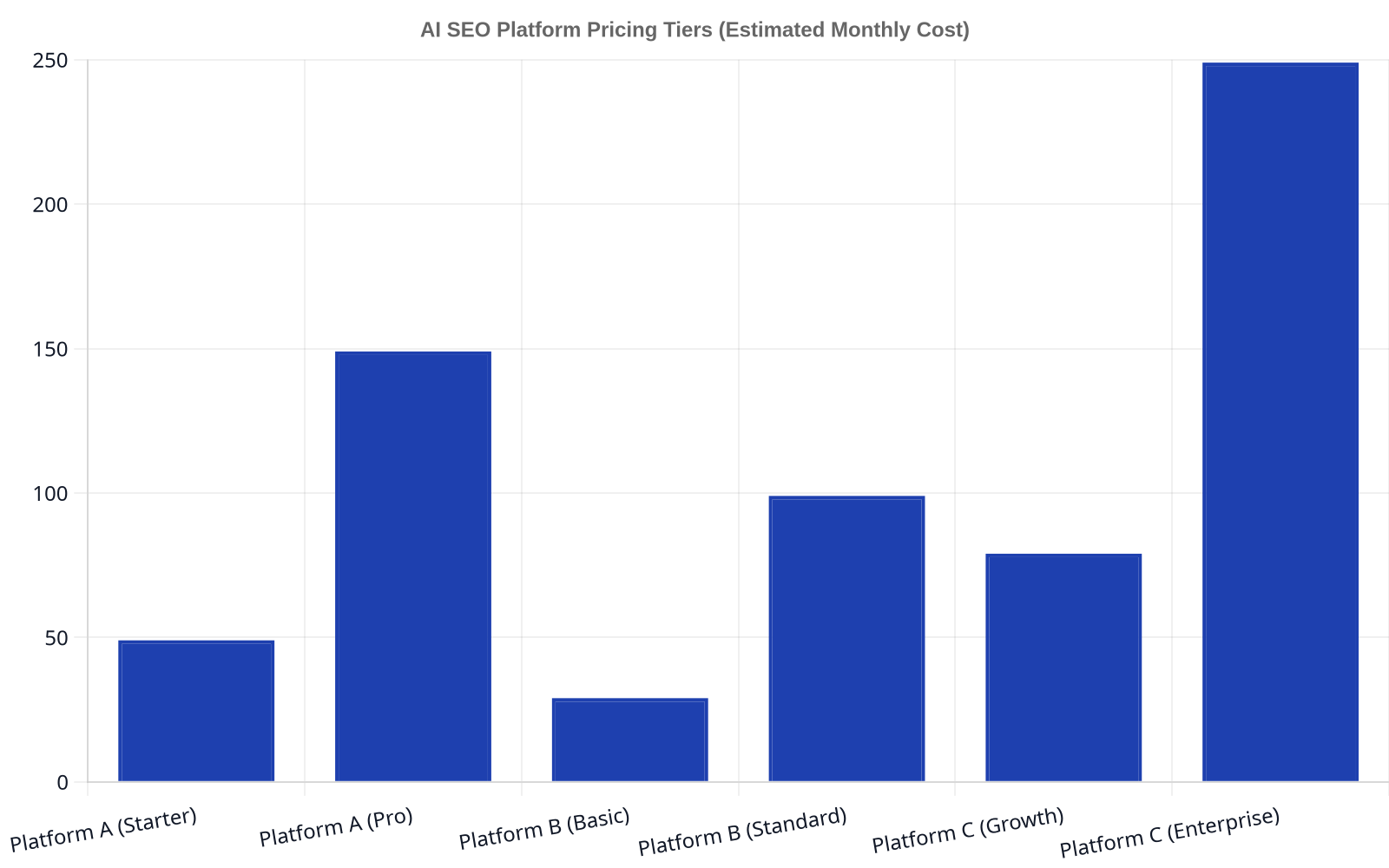
    Bar chart showing estimated monthly pricing for various AI SEO platforms across different tiers. Platform A starts at $49, Platform B at $29, and Platform C at $79, with higher tiers reaching up to $249.
    AI SEO Platform Pricing Tiers (Estimated Monthly Cost)

    Comparing the best AI SEO platform pricing requires looking beyond the sticker price. Plans are often tiered based on usage limits (e.g., content briefs, keyword lookups, AI credits), user seats, and access to premium features like API access or white-label reporting. For a small business, a $99/month plan from a tool like Surfer SEO might be sufficient. For an agency managing multiple clients, a plan in the $300-$500/month range is more realistic. Enterprise solutions like MarketMuse often require custom quotes and can run into thousands of dollars per month, but they provide strategic insights and workflows that justify the cost for large organizations.

    Key Features vs. Price Tier
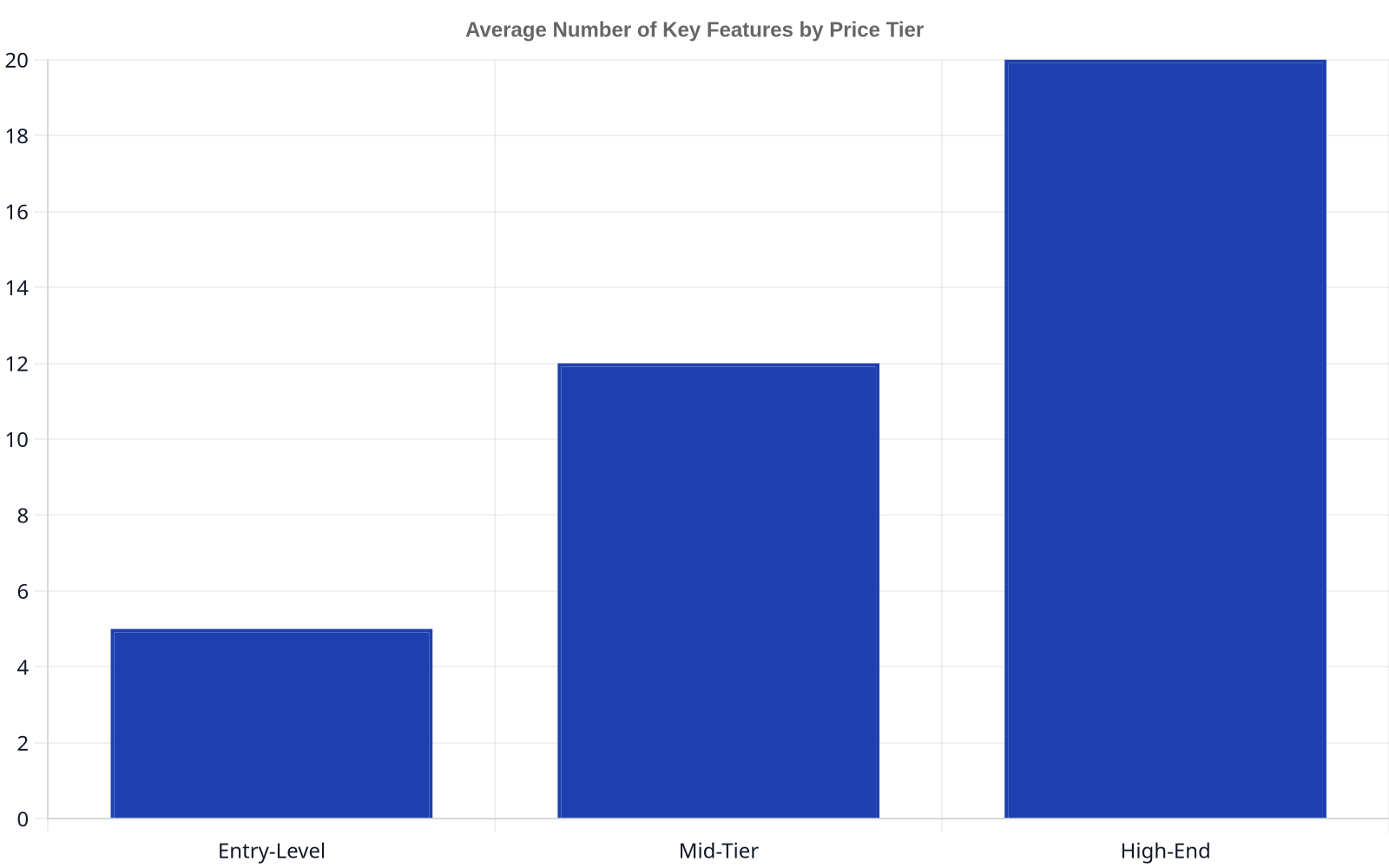
    Bar chart showing the average number of key features available at different price tiers for AI SEO platforms. Entry-level tiers offer approximately 5 features, mid-tier 12 features, and high-end tiers around 20 features.
    Feature Inclusion by Price Tier

    As you move up the pricing tiers, you’re not just getting higher usage limits. You are unlocking more sophisticated capabilities. Entry-level plans typically offer basic content optimization and keyword research. Mid-tier plans add AI content generation, SERP analysis, and more extensive integrations. Enterprise-level plans introduce features like content strategy automation, full-site audits, competitive content gap analysis, and personalized topic difficulty metrics. The key is to match the feature set to your actual needs. Paying for enterprise-level topic modeling when you only need to optimize ten articles a month is a poor use of budget. Conversely, trying to run an agency-scale content operation on a starter plan will lead to frustration and constant overage fees.

    Understanding AI SEO Value: ROI Potential
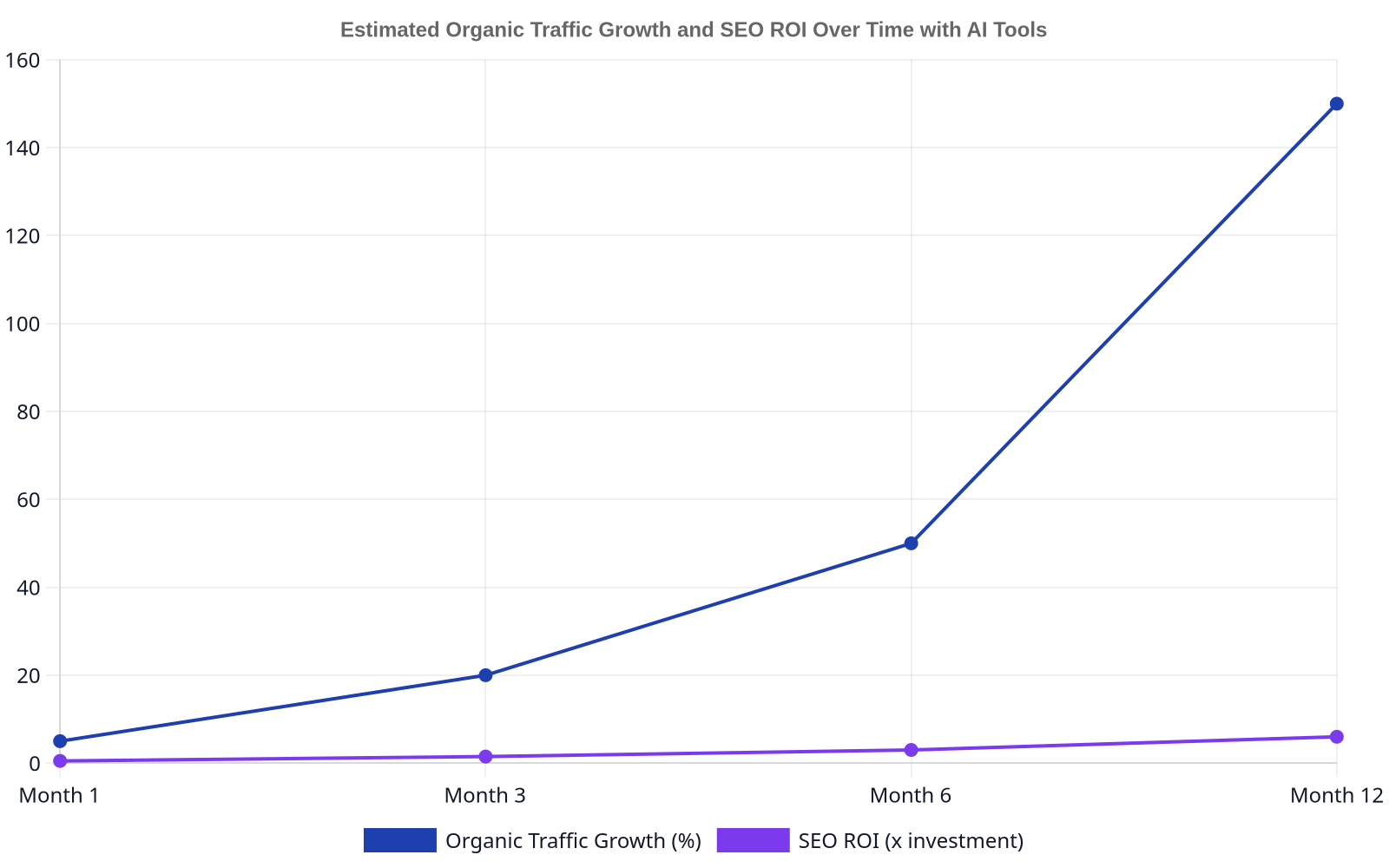
    Line chart illustrating estimated organic traffic growth and SEO ROI over a 12-month period when using AI SEO tools. Organic traffic shows consistent growth from 5% in month 1 to 150% in month 12. SEO ROI increases from 0.5x in month 1 to 6x in month 12.
    Estimated ROI Potential with AI SEO Tools

    Justifying the cost of an AI SEO platform requires calculating its return on investment. The ROI can come from several areas. First, there’s efficiency: if a tool saves your content team 10 hours per article on research and outlining, you can calculate that saved time as a direct cost saving. Second, there’s performance: if the AI-optimized content ranks higher and faster, you can attribute the resulting increase in organic traffic and leads to the platform. For many businesses, particularly those in competitive niches, the gains from even a few page-one rankings can quickly dwarf the monthly subscription cost of the tool that helped get them there.

    4. Semrush

    Semrush is one of the most recognized names in the SEO industry, offering a massive suite of over 50 tools for everything from keyword research and competitor analysis to social media management. Recently, it has heavily invested in AI, integrating features like an AI Writing Assistant and content optimization suggestions directly into its platform. This makes it a formidable all-in-one solution. You can find a keyword opportunity, analyze the competition, write and optimize an article, and track its rankings all within the same ecosystem.

    Its pricing structure is tiered, offering different levels of access to its vast toolset. While not the cheapest option, the value comes from its sheer breadth of capabilities, which can replace several other subscriptions. Semrush is a leader in the space, and its integration with 10+ AI engines (ChatGPT, Perplexity, Gemini, Claude, Copilot, Grok, AI Overviews, AI Mode, DeepSeek and Meta AI) gives it a powerful foundation. This is a platform for professionals who need a complete view of their digital marketing landscape, not just a content tool.

    • Best for: Marketers and businesses who want a single, powerful platform for nearly all their SEO and digital marketing tasks.
    • Watch out for: The sheer number of tools can be overwhelming for beginners. Core AI content features may be less advanced than specialized tools like MarketMuse or Clearscope.

    SEO isn’t dead in 2026, but it’s definitely different. It’s not just about ranking on Google anymore, but also about showing up on AI search engines and LLMs like ChatGPT and Perplexity.

    5. Ahrefs

    Ahrefs built its reputation on having the best backlink database in the business, and it remains a top choice for off-page SEO and competitor analysis. Quoting a popular sentiment, “Ahrefs is an amazing tool that is a powerful workhorse at a good price. They have a strong presence in the SEO and backlinks category and are the undisputed king.” While historically slower to adopt AI for content creation, it has begun to roll out AI-powered features, including content ideas and outlines within its Keywords Explorer tool.

    Its primary value, however, still lies in its core SEO metrics and competitive intelligence. Ahrefs provides incredibly detailed insights into why your competitors are ranking, from their backlink profiles to their top-performing content. Its pricing is tiered based on data limits and features. While some newer AI-first tools offer more advanced content generation, Ahrefs’ data quality is second to none. For any serious SEO campaign, understanding the link landscape is non-negotiable, and Ahrefs provides the clearest picture. Our own services, which include building backlinks for clients, rely on this kind of high-quality data.

    • Best for: SEO professionals and agencies who prioritize backlink analysis, competitive intelligence, and technical SEO.
    • Watch out for: Its AI content features are still nascent compared to dedicated writing platforms. The new credit-based system has been a point of contention for some long-time users.

    6. Rank My Website

    While other tools offer AI as a feature, Rank My Website is an automated SEO content platform built from the ground up to handle the entire workflow. It’s designed for businesses that need to scale their organic traffic without hiring a massive in-house team. The platform handles the full process, from keyword research and clustering to generating daily articles and publishing them directly to your site with proper internal linking. This end-to-end automation is its key differentiator. For clients like Wolverine Assemblies, this means consistent content velocity and ranking improvements without the typical operational overhead.

    The pricing is structured to deliver a complete managed solution. Instead of paying for seats or credits on a DIY tool, you are investing in an outcome: consistent, SEO-optimized content published on your site. This model is ideal for small to medium-sized businesses, e-commerce stores, and agencies who understand the value of SEO but lack the time or expertise to manage the complex process themselves. It turns SEO content from a manual, time-intensive task into an automated growth engine. As an automated content generation and publishing platform, it offers a direct path to ROI by focusing on output and traffic growth.

    • Best for: Businesses looking for an automated, hands-off solution to generate and publish SEO content at scale.
    • Watch out for: It’s a managed system, not a DIY tool. This means less granular control for SEO professionals who want to tweak every detail themselves.

    Summary of AI SEO Platform Pricing

    Platform Starting Price (Monthly) Primary Focus Ideal User
    Surfer SEO ~$89 On-Page & AI Content Content Teams, Agencies
    MarketMuse ~$149 (limited) / Custom AI Content Strategy Enterprise, Large Publishers
    Clearscope ~$170 Content Optimization SEO Writers, Agencies
    Semrush ~$129 All-in-One SEO Suite Digital Marketing Professionals
    Ahrefs ~$99 Backlink & Competitor Analysis SEO Professionals, Link Builders
    Rank My Website Custom Automated Content Generation & Publishing SMBs, E-commerce, Agencies

    Note: Prices are estimates as of early 2026 and can vary based on annual commitments and specific plan details. Always check the provider’s website for the most current information.

    Choosing the right platform comes down to your specific needs, team size, and budget. Don’t be swayed by a long list of features you’ll never use. Instead, identify your biggest bottleneck, whether it’s keyword research, content creation, or link building, and find the tool with a pricing model that lets you solve that problem efficiently.

    Further reading

    • enterprise SEO platforms reviews
    • seoclarity platform alternatives
    • conductor platform reviews

    FAQ

    What is the average cost of an AI SEO platform?

    There is no simple average, as costs vary dramatically. Enterprise-level content strategy platforms like MarketMuse often have custom pricing that can be several thousand dollars per month.

    Are expensive AI SEO tools always better?

    The price tag doesn’t always correlate with value for your business. A better approach is to evaluate tools based on their ability to solve your specific SEO challenges. A specialized, less expensive tool like Clearscope might provide a better ROI for a content-focused team than a pricier all-in-one suite.

    How do usage-based or credit systems work?

    Many AI SEO platforms use credits to meter access to resource-intensive features like AI content generation or SERP analysis. For example, generating one article might cost 1 “credit,” and your monthly plan might include 50 credits. This allows providers to offer lower entry-level prices while ensuring that high-volume users pay more. It’s crucial to understand a platform’s credit economy before committing, as costs can escalate quickly if you underestimate your usage.

    Can I negotiate pricing for AI SEO platforms?

    For standard, self-service subscription plans (e.g., Starter, Pro), pricing is typically non-negotiable. However, for “Enterprise” or “Custom” tiers, there is almost always room for negotiation. This is especially true if you are committing to an annual contract or have a high volume of users. Come to the conversation prepared with data on your usage needs and quotes from competitors.

    How should I calculate the ROI on AI SEO tool pricing?

    Calculate ROI by measuring both cost savings and revenue gains. For cost savings, estimate the number of hours your team saves on tasks like research, writing, and optimization, and multiply that by their hourly cost. For revenue gains, track the increase in organic traffic, leads, and sales from content created or optimized with the tool. A tool is providing positive ROI when these gains exceed the platform’s subscription cost.

    Is it better to choose an all-in-one platform or multiple specialized tools?

    This depends on your team’s workflow and expertise. An all-in-one platform like Semrush simplifies billing and data integration. However, a “best-of-breed” approach, combining multiple specialized tools (e.g., Ahrefs for backlinks, Clearscope for content, and another tool for technical SEO), can provide superior functionality in each area. For many, the integrated workflow of a single platform outweighs the marginal benefits of juggling several specialized tools.


    Related reading

  • 5 Affordable SEO Tools for E-commerce: Optimize Your Shop

    5 Affordable SEO Tools for E-commerce: Optimize Your Shop

    Most lists of SEO tools are useless for small e-commerce businesses. They list enterprise platforms with four-figure monthly retainers, ignoring the reality that most online stores are run by small teams or solo entrepreneurs with tight budgets. The best affordable SEO tools for e-commerce are those that offer robust keyword tracking, site auditing, and content optimization features specifically for product-based websites, with pricing starting under $100 per month. For a deeper dive into tools for small businesses, consider options like Keyworth or Ahrefs. These tools provide the necessary data to increase organic traffic and sales without requiring a massive upfront investment.

    This list isn’t a random roundup. We ranked these tools based on a weighted score considering three primary factors: e-commerce-specific features (like Shopify integration or product schema analysis), pricing transparency and entry-level affordability (sub-$150/mo plans), and trailing-12-month review sentiment from G2 and Capterra, focusing on users in the retail and consumer goods sectors. Every tool here delivers a tangible return for online stores.

    Smiling woman in a white shirt uses a laptop, likely for affordable e-commerce SEO
    Smiling woman in a white shirt uses a laptop, likely for affordable e-commerce SEO (Photo by Antoni Shkraba on pexels)

    Rank My Website

    Rank My Website is designed for a specific kind of efficiency: automating the entire SEO content workflow from start to finish. Instead of giving you a dozen disparate tools for keyword research, writing, and on-page optimization, it integrates them into a single process. You provide the keywords, and the platform generates SEO-optimized articles and publishes them directly to your site. This is particularly powerful for e-commerce stores that need to maintain an active blog to drive top-of-funnel traffic but lack the time or in-house writers.

    For an online store, this means you can target long-tail keywords related to your products, automatically creating buying guides, tutorials, and comparison posts that attract qualified customers. For instance, a store selling running shoes could generate articles on “best trail running shoes for flat feet” or “how to choose a marathon shoe,” capturing search intent that product pages alone cannot. Our own work includes handling keyword research and producing daily articles to build this kind of authority for clients like Wolverine Assemblies.

    • Best for: E-commerce businesses that want to put content marketing on autopilot and generate blog traffic without a dedicated content team.
    • Watch out for: It’s a content generation and publishing platform, not a standalone technical SEO audit tool for deep site-wide crawls.

    SE Ranking

    SE Ranking has carved out a significant market share by offering a comprehensive, all-in-one SEO platform at a price point that undercuts many of its larger competitors. For e-commerce, its most valuable features are its granular rank tracker, which can monitor keywords across specific geographic locations and search engines, and its in-depth website audit tool. The audit function is particularly useful for online stores, as it can identify common issues like duplicate content (a frequent problem with product variants), broken internal links, and missing image alt text across thousands of pages.

    The platform also includes competitor analysis, allowing you to see which keywords your rivals are ranking for and where they are getting their backlinks. A 2024 analysis by backlinko confirmed that a strong backlink profile remains a top-3 ranking factor. SE Ranking’s backlink checker helps you identify opportunities to build authority, which is critical for getting your product and category pages to appear on the first page of Google.

    • Best for: Budget-conscious e-commerce stores that need a single platform for rank tracking, site audits, and competitor research.
    • Watch out for: The user interface can feel dense with data, which may be overwhelming for absolute beginners to SEO.
    A businessman in a suit jacket writes at a desk with a laptop nearby
    A businessman in a suit jacket writes at a desk with a laptop nearby (Photo by RobertCharlesTaylor on pixabay)

    Mangools

    Mangools is less a single tool and more a suite of five interconnected applications: KWFinder, SERPChecker, SERPWatcher, LinkMiner, and SiteProfiler. Its standout feature has always been KWFinder, which excels at finding long-tail keywords with low SEO difficulty. For an e-commerce business, this is a goldmine. You can quickly find highly specific, purchase-intent phrases like “eco-friendly yoga mat for hot yoga” that larger competitors often overlook. The user interface is famously intuitive, making it one of the easiest tools to pick up and use effectively from day one.

    While it may lack the deep technical audit capabilities of SE Ranking, its strength lies in the front-end of SEO: research and analysis. You can plug any competitor’s domain into SiteProfiler to get a quick overview of their SEO metrics and top-performing content. Organic search drives 53.3% of all website traffic on average, so finding the right keywords to target is paramount. Mangools makes that initial step incredibly straightforward.

    • Best for: E-commerce entrepreneurs and marketers who want a user-friendly tool focused heavily on profitable keyword research.
    • Watch out for: The backlink analysis and site audit tools are less comprehensive than those found in more expensive, all-in-one platforms.

    Keysearch

    Keysearch is arguably one of the most affordable yet surprisingly powerful SEO tools on the market, making it a perennial favorite of bloggers and small e-commerce shops. It started with a strong focus on keyword research but has since expanded to include rank tracking, competitor gap analysis, and a basic site audit feature. The “Content Assistant” feature is a standout for e-commerce blogs, providing a SERP-based brief that tells you what terms to include in your article, the ideal word count, and questions to answer, which is a great way to optimize your supporting content.

    What makes Keysearch compelling for e-commerce is its generous daily search limits even on the starter plans. You can research hundreds of keywords and analyze dozens of competitor pages without hitting a paywall. This is crucial during the initial stages of setting up an online store or launching a new product category. While it doesn’t offer the project management features of larger platforms, it delivers exceptional value for core SEO tasks. Direct-to-site and search are the dominant traffic sources for e-commerce, underscoring the need for solid keyword targeting that tools like Keysearch facilitate.

    • Best for: Startups and solopreneurs in e-commerce who need a low-cost tool for daily keyword and competitor research.
    • Watch out for: The technical audit and backlink database are not as robust as more expensive tools.

    An SEO tool’s value isn’t measured by how many features it has. It’s measured by whether the features it does have directly contribute to ranking your product pages higher than your competitors’.

    Ubersuggest

    Acquired and revamped by Neil Patel, Ubersuggest has become a legitimate contender in the affordable SEO tools space. It provides keyword data, competitor analysis, and a site audit function with a simple, easy-to-understand interface. One of its most helpful features for e-commerce is the “Top Pages by Traffic” report, which lets you enter a competitor’s URL and see which of their pages (including product and category pages) attract the most organic search traffic. This allows you to reverse-engineer their success.

    Ubersuggest also offers lifetime pricing deals, which can be incredibly cost-effective for an e-commerce business planning for the long term. Instead of a recurring monthly fee, a one-time payment gives you access to the tool’s features indefinitely. For a store where managing operational expenses is key, this can be a significant advantage. The platform also gives you content ideas based on top-performing articles for a given keyword, helping you fill your content calendar with topics proven to attract an audience. For a broader perspective on managing expenses, compare automated SEO costs across various services, and consider your options for ecommerce SEO services.

    • Best for: E-commerce businesses looking for a simple, all-in-one tool with an attractive lifetime pricing option.
    • Watch out for: Data limits on the lower-tier plans can be restrictive for users managing multiple sites or doing heavy research.

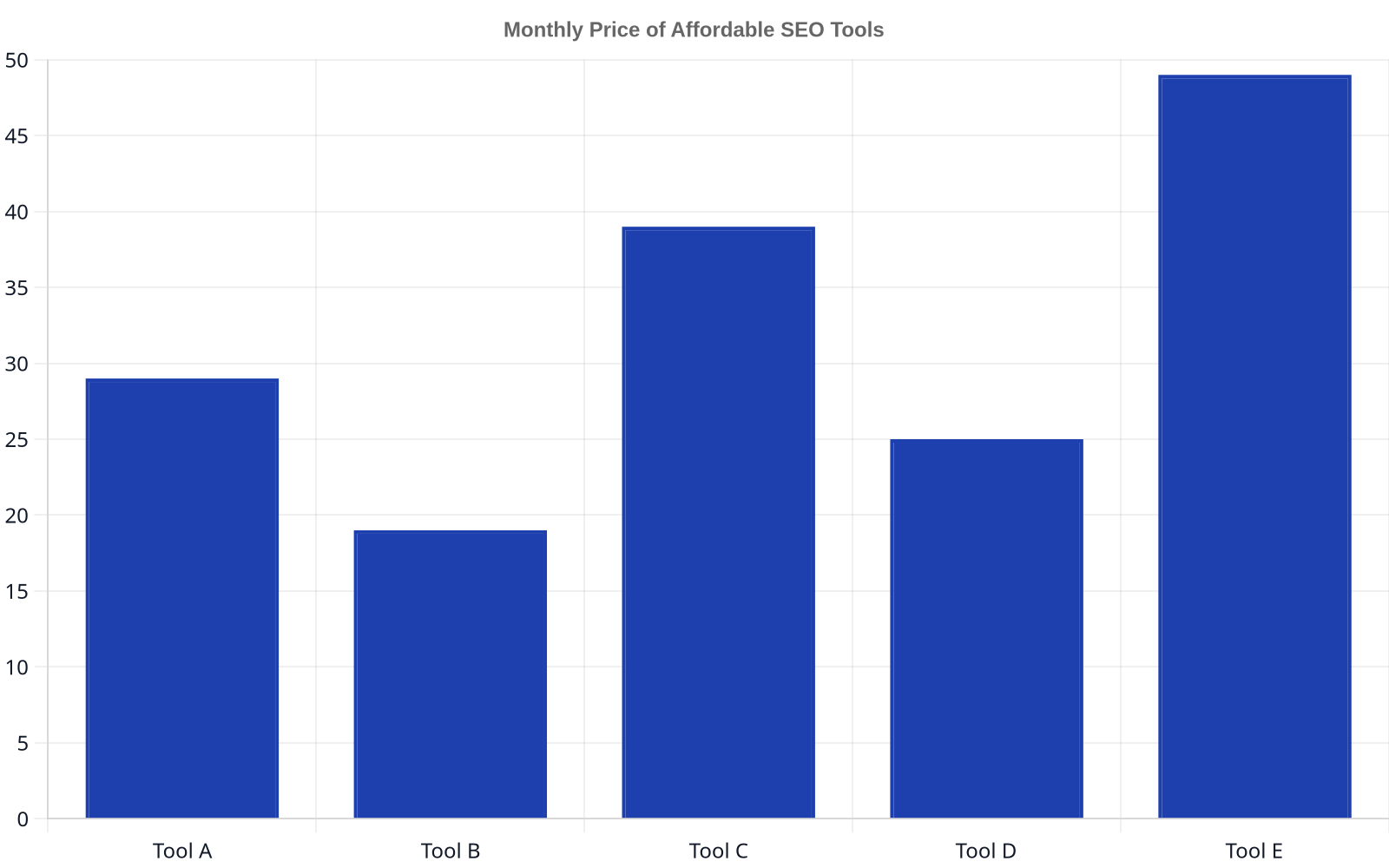
    Pricing Comparison: Affordable SEO Tools

    Bar chart comparing the monthly pricing of five affordable SEO tools, showing Tool B at $19, Tool D at $25, Tool A at $29, Tool C at $39, and Tool E at $49.
    Monthly Cost Comparison of Popular Affordable SEO Tools

    Choosing a tool often comes down to budget. While pricing is dynamic, this section provides a snapshot of the typical entry-level costs for the tools we’ve discussed. The goal isn’t just to find the cheapest option, but the one that provides the most value and relevant features for your e-commerce store’s specific needs within your price range.

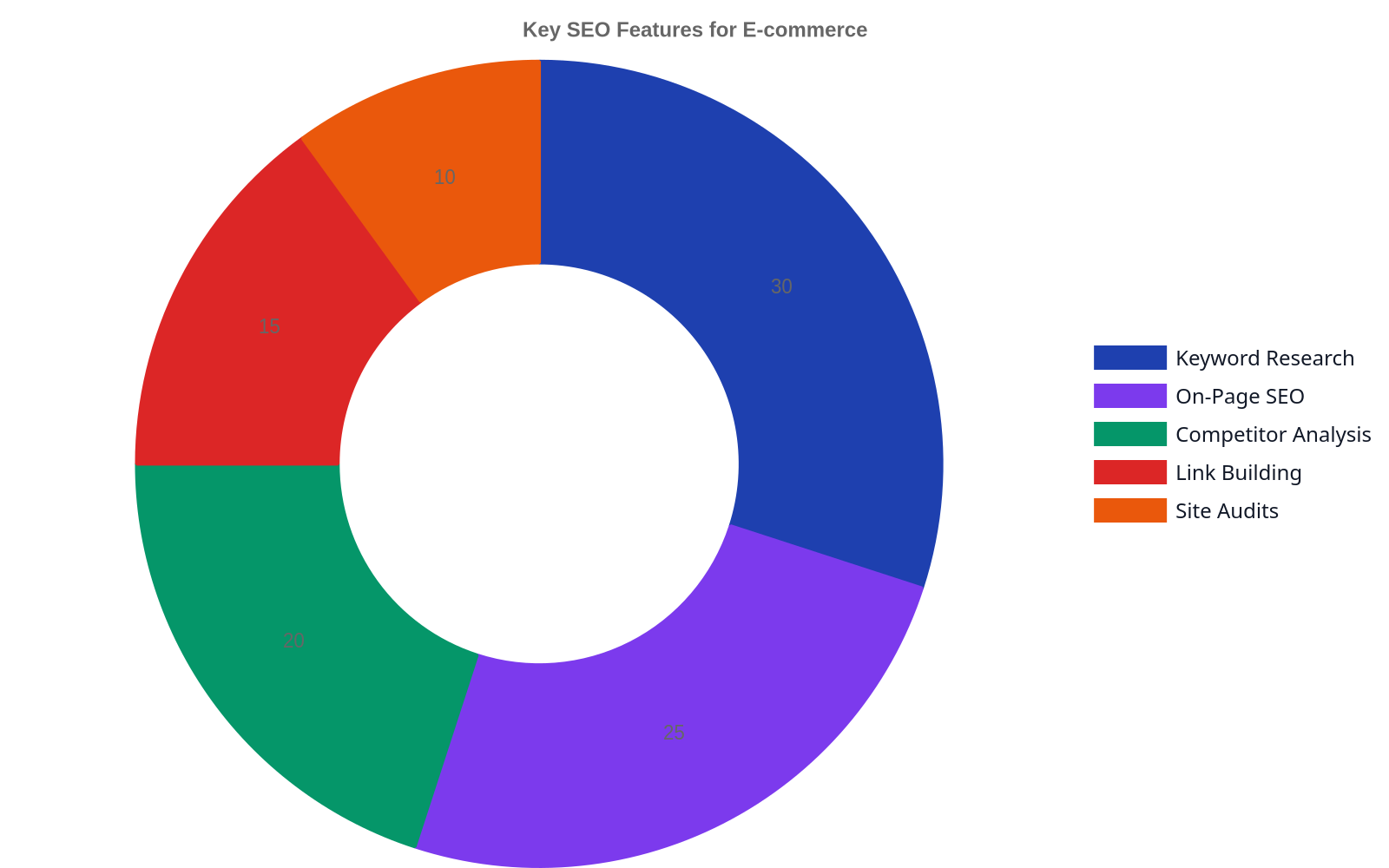
    Key Features and Their Importance

    Doughnut chart showing the relative importance of SEO features for e-commerce, with Keyword Research at 30%, On-Page SEO at 25%, Competitor Analysis at 20%, Link Building at 15%, and Site Audits at 10%.
    Importance of SEO Features for E-commerce Success

    For an e-commerce site, not all SEO features are created equal. Product page optimization, technical health, and local search signals often carry more weight than for a simple blog. Understanding which features drive the most impact helps you select a tool that focuses on what matters. Keyword research is fundamental, but a tool that also audits for schema markup and site speed can provide a greater competitive edge in a crowded online marketplace.

    Investing in SEO is not an expense, it is an asset. The content you create and the authority you build generate compounding returns in organic traffic, year after year.

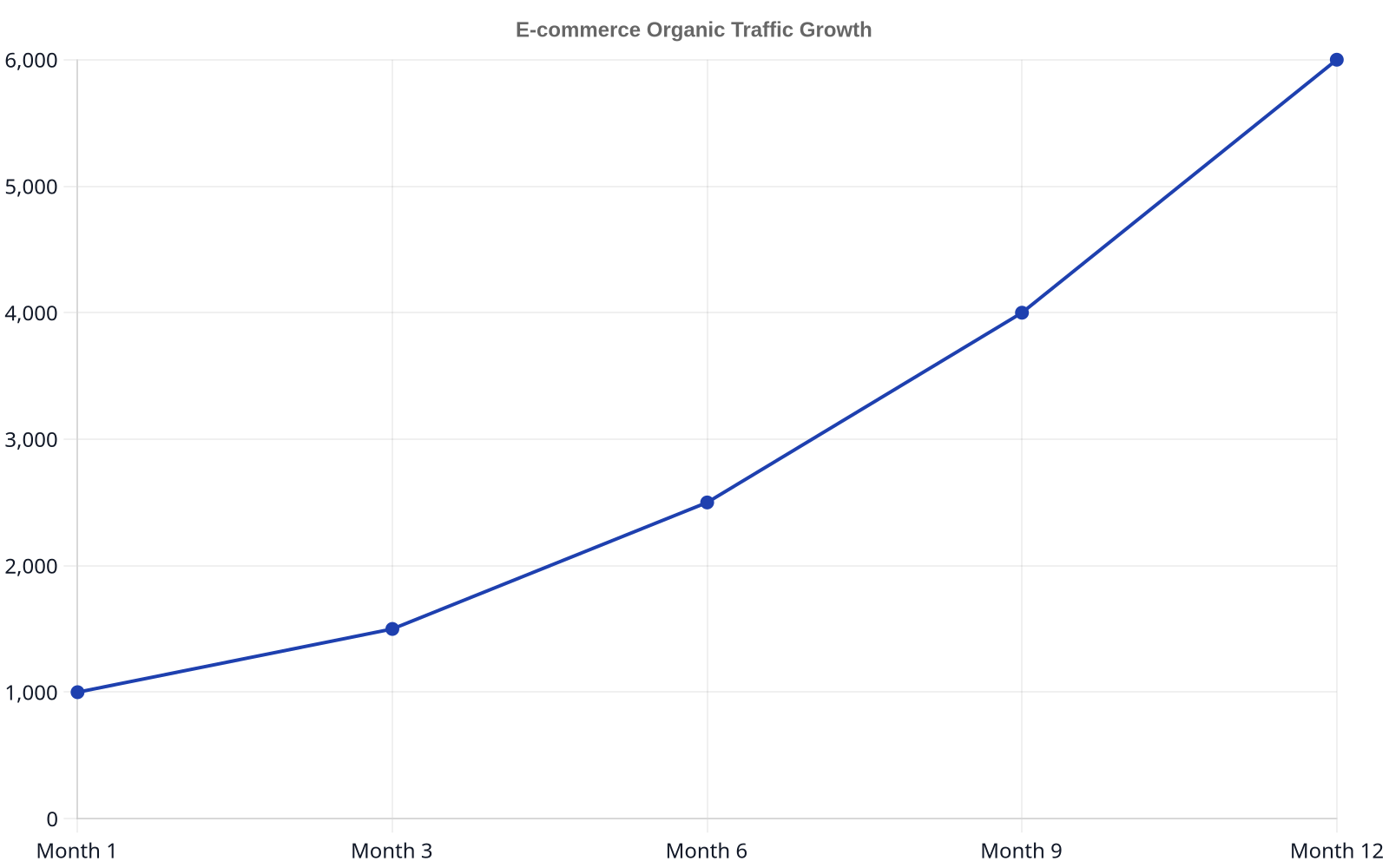
    Return on Investment (ROI) of SEO

    Line chart illustrating the growth of e-commerce organic sessions over 12 months, starting at 1000 sessions in Month 1 and steadily increasing to 6000 sessions by Month 12, demonstrating the long-term ROI of SEO.
    Typical E-commerce Traffic Growth with Consistent SEO

    SEO is a long-term strategy. Unlike paid ads, which stop delivering traffic the moment you stop paying, the organic rankings you earn from a well-executed SEO strategy can deliver traffic and sales for years. SEO has the highest ROI of any digital marketing channel. For an e-commerce business, this means the investment in an affordable SEO tool and the time spent on optimization can yield a return that far outweighs the initial cost, driving sustainable growth that isn’t dependent on ad spend.

    Summary of Recommendations

    Tool Starting Price (Approx.) Key E-commerce Strength Ideal User
    Rank My Website Custom Automated Content Generation Teams wanting to scale blog content
    SE Ranking $55/month Comprehensive Site Audits Users needing an all-in-one tool
    Mangools $29/month User-Friendly Keyword Research Beginners and solopreneurs
    Keysearch $17/month High-Volume Keyword Research Budget-conscious startups
    Ubersuggest $29/month (or lifetime deal) Competitor Top Pages Analysis Businesses seeking long-term value

    FAQ

    Do I need an SEO tool for my Shopify store?

    Yes, absolutely. While Shopify has good foundational SEO features, a dedicated SEO tool is necessary for competitive keyword research, backlink analysis, and in-depth technical audits. Tools like SE Ranking or Keysearch help you find the specific terms customers are using to search for your products and identify technical issues that could be holding your site back in search results.

    How long does it take for SEO to work for an e-commerce site?

    Typically, you can expect to see initial results from a consistent SEO strategy within 6 to 12 months. Factors like your industry’s competitiveness, your starting domain authority, and the consistency of your efforts play a huge role. The ROI from SEO is a long-term play, not an overnight fix. According to First Page Sage, it takes an average of 11.3 months to reach the first page of Google for a medium-competition keyword.

    What’s more important: on-page SEO or backlinks?

    For a new e-commerce store, on-page SEO is more important to get right first. This includes optimizing your product titles, descriptions, site structure, and internal linking. This creates a solid foundation. Once that’s in place, building high-quality backlinks becomes the priority to build authority and outrank established competitors. Our own service model focuses on both content creation and securing backlinks for this very reason.

    Can I do SEO for free?

    Yes, you can start with free tools like Google Search Console and Google Trends. Google Search Console is non-negotiable; it helps you monitor your site’s performance in Google Search and identify errors. However, to effectively analyze competitors and find low-competition keywords, a paid, affordable SEO tool is almost always worth the small investment for the time it saves and the insights it provides.

    How much should a small e-commerce business spend on SEO tools?

    Tools in this price bracket, such as Mangools or Keysearch, offer more than enough power for keyword research, rank tracking, and site health monitoring. The key is to choose a tool you will use consistently. Don’t pay for enterprise features you don’t need.

    Is blogging necessary for an e-commerce store?

    Blogging is one of the most effective ways for an e-commerce store to attract customers at the top and middle of the sales funnel. Product pages target purchase-intent keywords, but blog posts can target informational keywords, answer customer questions, and build trust. For example, a store selling kitchen knives can write a blog post about “how to sharpen a chef’s knife,” attracting an audience that may later purchase from them. This is a core part of a comprehensive content strategy.

    Related reading

  • On-Page Optimization Service Pricing: Models, Factors, & Value

    On-Page Optimization Service Pricing: Models, Factors, & Value

    On-Page Optimization Service Pricing in 2026

    Most agencies and consultants hide their on-page optimization service pricing behind a “contact us for a quote” wall. This isn’t because the numbers are secret; it’s because the answer is almost always “it depends.” On-page SEO service pricing typically ranges from $500 for a one-time audit of a small site to over $5,000 per month for comprehensive, ongoing retainers for large e-commerce sites. The final cost depends on the scope of work, the size of your website, and the level of expertise required. A simple blog might only need title tag and meta description updates, while a complex site requires schema markup, content restructuring, and internal linking overhauls.

    This guide breaks down the common pricing models you’ll encounter, the factors that drive costs up or down, and what you should expect to get for your money. We will explore one-time project fees, hourly rates, and monthly retainers to give you a clear picture of what an investment in on-page SEO looks like in 2026. This is not about finding the cheapest option; it’s about understanding the value you receive and how it connects to real business growth, like the results we’ve helped deliver for clients such as Wolverine Assemblies.

    Hand points stylus at tablet showing website analytics data and graphs
    Hand points stylus at tablet showing website analytics data and graphs (Photo by AS_Photography on pixabay)

    What is on-page SEO and what does it include?

    On-page SEO is the practice of optimizing individual web pages to rank higher and earn more relevant traffic in search engines. Unlike off-page SEO, which involves external signals like backlinks, on-page SEO focuses entirely on elements within your control on your website. A typical service includes optimizing title tags, meta descriptions, headers (H1, H2, H3), and URL structures. It also covers content optimization, ensuring your text is relevant, readable, and targets the right keywords. More advanced services will also address technical elements like image optimization (alt text, file size), internal linking, and schema markup to provide richer search results.

    How is on-page SEO different from technical SEO?

    While they overlap, on-page and technical SEO are distinct disciplines. On-page SEO focuses on the content and structure of a specific page, asking, “Is this page a great answer to the user’s query?” It deals with keywords, titles, and readability. Technical SEO, on the other hand, focuses on the site’s infrastructure, asking, “Can search engines efficiently find, crawl, and index this page?” It covers aspects like site speed, mobile-friendliness, XML sitemaps, robots.txt files, and crawl errors. A technically sound site is the foundation, but on-page SEO is what makes individual pages perform.

    Why do I need an on-page optimization service?

    Because search engine algorithms are constantly changing. What worked two years ago may not be effective today. A professional service brings expertise and stays current with Google’s updates, such as the helpful content system. They can identify opportunities you might miss, from striking-distance keywords to content gaps. More importantly, they provide a systematic process. Instead of randomly tweaking pages, an expert service performs a comprehensive audit, prioritizes actions based on potential impact, and executes them methodically. This saves you time and ensures your efforts translate into measurable traffic growth.

    Person holding a tablet showing an upward trending bar chart for SEO performance
    Person holding a tablet showing an upward trending bar chart for SEO performance (Photo by Mikael Blomkvist on pexels)

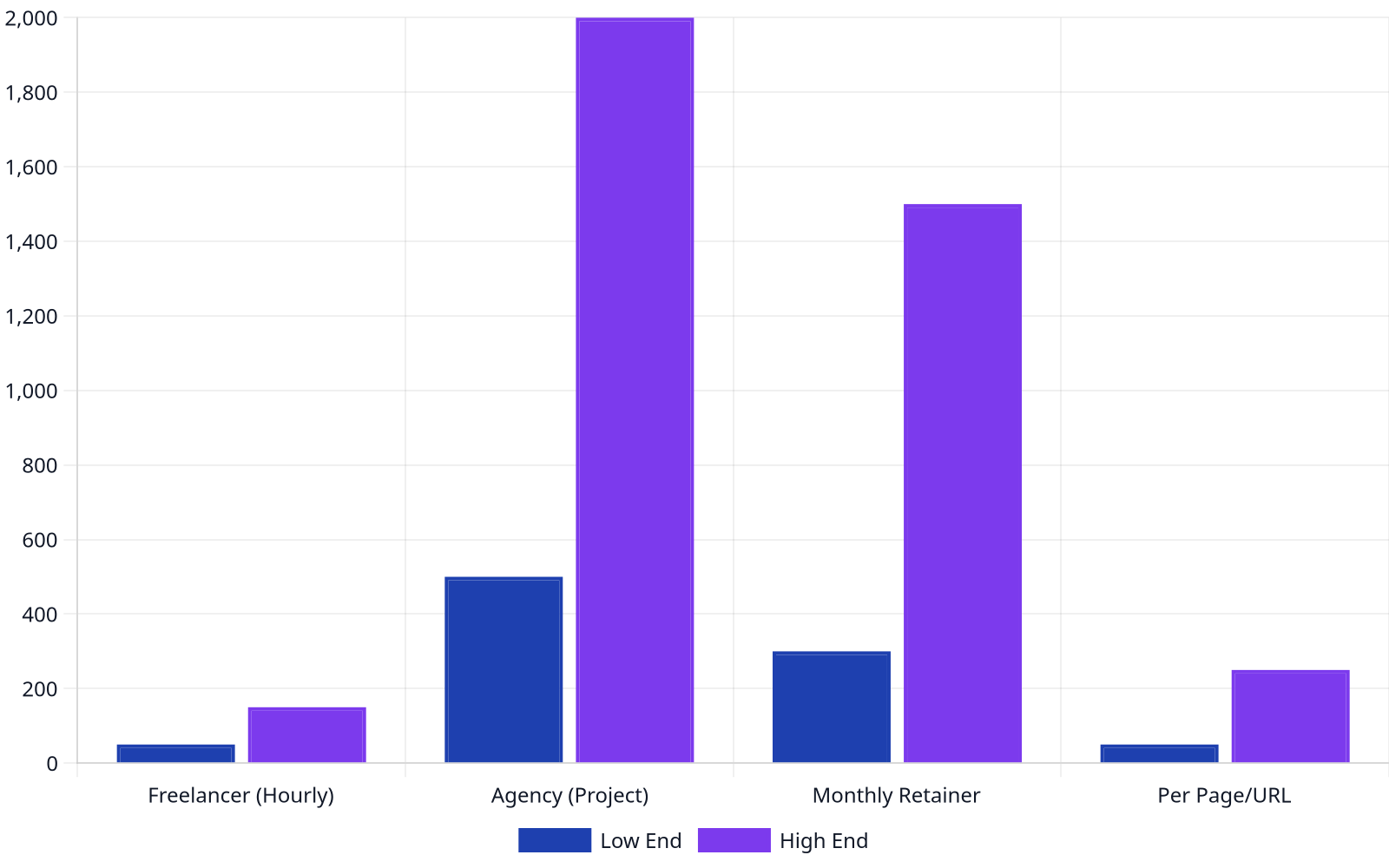
    How much does on-page optimization cost?

    Bar chart showing estimated pricing ranges for on-page SEO services. Freelancer hourly rates range from $50-$150. Agency project fees range from $500-$2000. Monthly retainers range from $300-$1500. Per page/URL optimization ranges from $50-$250.
    On-Page Optimization Service Pricing Ranges

    The cost of on-page optimization services varies widely based on the pricing model. You’ll generally encounter three types: hourly rates, project-based fees, and monthly retainers. Each has its place, and the right choice depends on your needs and budget.

    What are typical hourly rates for on-page SEO?

    Hourly rates for on-page SEO consultants typically fall between $75 and $250 per hour. A freelancer or a junior SEO specialist might be at the lower end of this spectrum, while a seasoned consultant or a specialized agency will command rates closer to the top. According to a 2024 pricing survey by Ahrefs, the most common hourly rate for SEOs is between $100 and $150 per hour. Paying an hourly rate is best for specific, well-defined tasks, such as implementing audit recommendations or optimizing a small batch of high-priority pages.

    How much do one-time on-page SEO projects cost?

    Project-based pricing for on-page SEO can range from $500 to $7,500 or more. A small project, like a basic on-page audit and optimization for a 5-10 page website, might cost $500-$1,500. A more comprehensive project for a medium-sized site (25-50 pages) that includes a full content and technical on-page audit, implementation, and a strategy report could be in the $2,500-$5,000 range. Large-scale e-commerce sites or enterprise-level projects with hundreds or thousands of pages can easily exceed $7,500. These projects are ideal when you need a one-off overhaul to establish a solid foundation.

    What does a monthly on-page SEO retainer include and cost?

    Monthly retainers are the most common model for ongoing SEO and typically cost between $1,000 and $5,000+ per month. A small business might pay around $1,000-$2,500/month for ongoing optimization of new content, monitoring rankings, and periodic technical checks. Larger companies with more complex needs and aggressive growth goals often pay upwards of $5,000/month. This fee covers a consistent block of work, which can include continuous keyword research, creating and optimizing daily articles, building a strategic internal linking structure, and performance reporting. This model is best for businesses committed to long-term growth and recognize that SEO is a continuous process.

    Hand pointing a stylus at marketing data charts, analyzing SEO service costs
    Hand pointing a stylus at marketing data charts, analyzing SEO service costs (Photo by Jakub Żerdzicki on unsplash)

    What factors influence on-page SEO service costs?

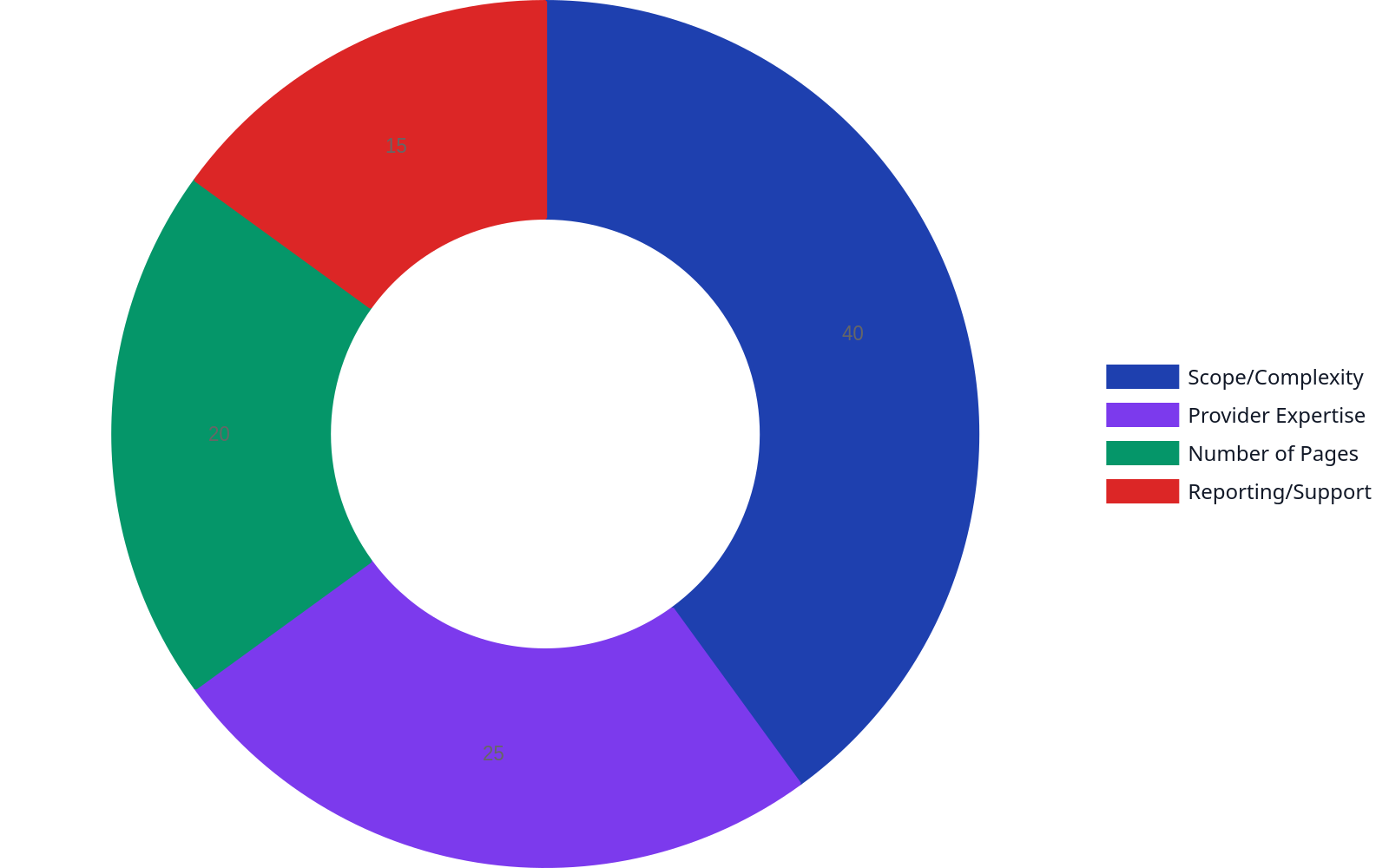
    Doughnut chart showing the percentage influence of various factors on on-page SEO service costs: Scope/Complexity (40%), Provider Expertise (25%), Number of Pages (20%), Reporting/Support (15%).
    Factors Influencing On-Page SEO Costs

    Several key variables determine the final price tag for on-page optimization services. It’s not just about the number of pages; the complexity of the site, the competitiveness of the industry, and the scope of the work all play significant roles. Understanding these factors will help you evaluate quotes more effectively.

    How does website size and complexity affect pricing?

    This is the biggest cost driver. A five-page brochure site is exponentially easier to optimize than a 50,000-product e-commerce store. More pages mean more titles, metas, content, and images to analyze and fix. Complexity also matters. A site built on a difficult-to-edit CMS or with extensive custom code requires more developer or specialist time than a standard WordPress site. An e-commerce site with faceted navigation introduces significant complexity that a simple blog doesn’t have, directly increasing the optimization cost.

    Does my industry’s competitiveness impact the price?

    Yes, absolutely. Ranking for “divorce lawyer in Manhattan” is vastly more difficult (and therefore more expensive) than ranking for “antique teapot repair in Omaha.” Highly competitive niches like finance, law, and health require a much more aggressive and nuanced on-page strategy. The content needs to be exceptionally authoritative and demonstrate deep expertise, often requiring input from subject matter experts. A Backlinko analysis of 11.8 million Google search results confirms that top-ranking content is significantly more comprehensive, which takes more resources to create and optimize.

    What’s the difference between an audit and implementation?

    An audit is the diagnostic phase; implementation is the treatment. An on-page SEO audit involves a specialist analyzing your site to identify problems and opportunities, delivering a report or roadmap of recommended changes. Implementation is the actual work of making those changes. Some services only provide the audit, leaving you to implement the fixes. Others are full-service, handling both. Be sure to clarify what a quote includes. A cheap “audit” that leaves you with a 50-page PDF and no help to execute it is often less valuable than a slightly more expensive service that handles the work from start to finish.

    Don’t just pay for a list of problems. The real value in an on-page SEO service is in the execution and the measurable improvement that follows.

    Do one-time fixes or ongoing services cost more?

    A one-time project will have a higher upfront cost, but an ongoing retainer will cost more over the long term. The choice depends on your goals. If your site has good fundamentals and you just need a tune-up, a one-time project might suffice. However, SEO is not a set-it-and-forget-it activity. Competitors will improve their content, and search algorithms will evolve. An ongoing retainer ensures your site continuously adapts and improves, protecting your investment and compounding your gains over time. It shifts the focus from a one-time fix to a sustained growth strategy.

    Is on-page SEO worth the investment?

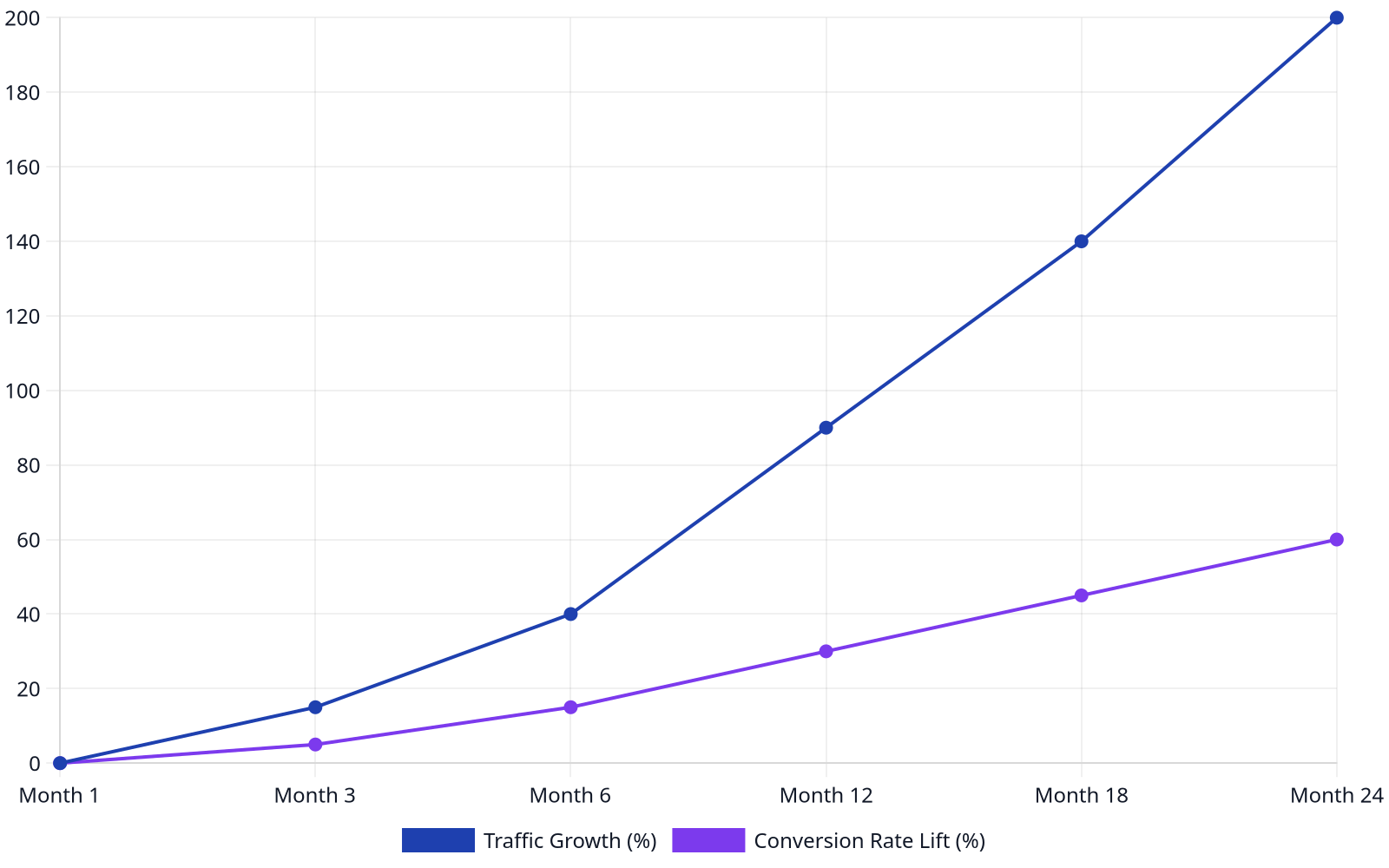
    Line chart showing the potential return on investment for on-page SEO over 24 months. Traffic Growth shows a steady increase from 0% to 200%. Conversion Rate Lift shows an increase from 0% to 60% over the same period.
    ROI of On-Page SEO Over Time

    Comparing on-page SEO to paid advertising offers a clear perspective on its value. While paid search offers immediate visibility, that visibility disappears the moment you stop paying. On-page SEO, however, is an investment in a long-term asset. Optimizing your content builds a foundation for sustained organic traffic that can pay dividends for years. A well-optimized page that ranks for a valuable keyword can attract customers month after month with no incremental cost per click. SEMrush data indicates that organic search is the largest driver of website traffic for most industries, making it a critical channel for sustainable growth.

    How is ROI measured for on-page SEO?

    The ROI of on-page SEO is tracked through key performance indicators (KPIs) that connect directly to business objectives. The most direct metrics are improvements in organic traffic, keyword rankings, and conversion rates from organic visitors. For example, you can track how many more leads or sales are generated from organic search after optimization. You can also measure secondary metrics like click-through rate (CTR) from search results, bounce rate, and average time on page, which indicate whether you are attracting and engaging the right audience. Using tools like Google Analytics and Google Search Console is essential for accurate measurement.

    How long does it take to see results from on-page SEO?

    While some minor changes can yield results in as little as a few weeks, significant improvements from on-page SEO typically take 3 to 6 months to materialize. This timeline depends on your site’s authority, the competitiveness of your keywords, and the extent of the changes made. Google needs time to recrawl your pages, process the changes, and re-evaluate their quality against other content. Patience is critical. SEO is a marathon, not a sprint, and the most substantial rewards go to those who commit to a consistent, long-term strategy.

    FAQ

    What are the most common on-page SEO mistakes?

    The most frequent mistake is keyword stuffing: unnaturally cramming keywords into content, which hurts user experience and can lead to penalties. Other common errors include neglecting title tags and meta descriptions, using generic headers (like “Introduction” or “Conclusion”), having slow page load times due to large images, and creating a poor internal linking structure that fails to guide users and search engines to important pages.

    Can I do on-page SEO myself?

    Yes, you can certainly handle basic on-page SEO yourself, especially if you use a platform like WordPress with plugins like Yoast or Rank Math. Tasks like writing unique title tags, optimizing images with descriptive alt text, and ensuring your content is readable are great starting points. However, a professional service brings deeper technical expertise for things like schema markup, site speed optimization, and comprehensive content strategy, which can generate significantly greater returns.

    Is content part of on-page SEO?

    Absolutely. Content is the heart of on-page SEO. You can have perfectly optimized title tags and fast load times, but if your content doesn’t satisfy user intent, you won’t rank. On-page SEO involves ensuring your content is comprehensive, well-structured, authoritative, and aligned with what searchers are looking for. This includes everything from the text on the page to the images and videos that support it. 66% of marketers report content marketing is very important to their overall marketing strategy, underscoring its central role.

    Does on-page SEO help with local search?

    Yes, it’s crucial for local SEO. For businesses serving specific geographic areas, on-page optimization involves including location-specific keywords (e.g., “plumber in Detroit”) in titles, headers, and body content. It also includes creating location-specific pages or content and ensuring your business name, address, and phone number (NAP) are consistent across your site. When combined with a well-optimized Google Business Profile, strong on-page local signals are a powerful way to attract nearby customers.

    How often should I update my on-page SEO?

    On-page SEO should be an ongoing process, not a one-time event. You should review your key pages at least quarterly. However, you should conduct a more thorough audit annually to adapt to algorithm changes and evolving competitor strategies. New content, like blog posts, should be optimized as it is published. Regularly refreshing and updating existing content (content decay) is also a key part of a modern on-page SEO strategy to maintain and improve rankings over time.

    Take the Guesswork Out of SEO

    Understanding on-page optimization service pricing is the first step. The next is finding a partner that can turn that investment into tangible growth. At Rank My Website, we automate the entire SEO content lifecycle, from keyword research and content generation to publishing and on-page optimization. If you’re ready to build a pipeline of organic traffic that works for you on autopilot, learn more about how our platform can help.

    Related reading

  • SEO Performance ROI: Measuring True Business Impact

    SEO Performance ROI: Measuring True Business Impact

    Stop guessing at your SEO budget. The idea that search engine optimization is a mystical art with unprovable returns is a decade out of date. Today, if your SEO provider or internal team can’t connect their work directly to revenue, you have a measurement problem, not an SEO problem. Proving the return on investment of your SEO efforts requires specific tools that track rankings and traffic and connect them to conversions and revenue. The right seo performance roi measurement software makes this connection explicit, transforming SEO from a cost center into a documented profit driver by attributing sales, leads, and customer value directly to organic search performance.

    Person reviewing a laptop screen showing a marketing performance dashboard with charts and data
    Person reviewing a laptop screen showing a marketing performance dashboard with charts and data (Photo by konkapo on pixabay)

    Defining SEO ROI: More than Rankings

    For years, SEO reports were glorified bragging sheets filled with vanity metrics. We’d show clients a list of #1 rankings, a chart of keyword improvements, and a hockey-stick graph of organic traffic. While these metrics are indicators of activity, they are not indicators of business impact. A #1 ranking for a keyword that no one in your target market searches for is worthless. A 50% traffic increase that brings zero new customers is a server-cost liability, not an asset.

    True SEO ROI measurement moves past these surface-level metrics to answer the only question the C-suite cares about: “For every dollar we invest in SEO, how many dollars do we get back?” This requires a shift in thinking and tooling.

    Moving from Vanity Metrics to Revenue Metrics

    Vanity metrics are easy to track but offer little insight into business health. They include things like:

    • Keyword rankings
    • Organic sessions (in isolation)
    • Impressions
    • Bounce rate

    Revenue-focused metrics, on the other hand, tie SEO directly to financial outcomes. These are the metrics that seo performance roi measurement software is built to illuminate:

    • Organic Conversion Rate: What percentage of visitors from organic search complete a desired action (e.g., make a purchase, fill out a form, start a trial)?
    • Cost Per Acquisition (CPA) from Organic Search: How much does it cost in SEO investment (salaries, tools, content) to acquire one new customer via organic search?
    • Lead Value from Organic Search: What is the total value of leads generated from organic traffic, based on your average lead-to-customer rate and customer lifetime value?
    • Direct Organic Revenue: For e-commerce sites, this is the dollar amount of sales directly attributable to users who arrived via organic search.

    The Basic SEO ROI Calculation

    At its core, the formula is simple: (Revenue from SEO – Cost of SEO) / Cost of SEO. A result of 4 would mean you generated $4 in profit for every $1 invested. The complexity isn’t in the formula itself, but in accurately tracking the inputs. The “Cost of SEO” includes agency fees, software subscriptions (like Rank My Website), content creation costs, and the hourly cost of your team. The “Revenue from SEO” is where dedicated software becomes indispensable, as attributing conversions correctly is a major challenge.

    Connecting SEO Efforts to Business Outcomes

    Translating activities like building backlinks or optimizing title tags into revenue figures is the central challenge. The connection is not always a straight line, but a series of correlated events that software can help you track. An effective SEO strategy involves a range of activities, from high-level keyword research to the daily production of content, and each piece contributes to the final ROI.

    Attribution Models: Giving Credit Where It’s Due

    Attribution is the science of assigning credit to the touchpoints a customer interacts with on their path to conversion. A user might first discover your brand via a blog post from an organic search, later see a retargeting ad on social media, and finally convert by clicking a branded search ad. Which channel gets the credit?

    • Last-Click Attribution: This is the most common and simplest model. It gives 100% of the credit to the final touchpoint before conversion. It systematically undervalues top-of-funnel channels like SEO and content marketing. Last-click is often the default but can provide a misleading picture of the customer journey.
    • First-Click Attribution: The opposite of last-click, this model gives all credit to the first touchpoint. It’s better for understanding how customers initially discover you but ignores everything that happens afterward.
    • Linear Attribution: This model spreads credit evenly across all touchpoints. It’s a step up but assumes all touchpoints are equally important, which is rarely true.
    • Data-Driven Attribution: This is the most sophisticated model, available in tools like Google Analytics 4. It uses machine learning to analyze all converting and non-converting paths to determine which touchpoints are most influential. This is the gold standard for accurately valuing SEO’s contribution.

    Don’t let the pursuit of the perfect attribution model paralyze you. Starting with a simple model and acknowledging its flaws is better than tracking nothing and claiming SEO is pure magic.

    The Role of Content in Driving Conversions

    Content isn’t just for attracting traffic; it’s for guiding visitors toward a purchase. Each piece of content, whether it’s a top-of-funnel blog post or a bottom-of-funnel comparison page, plays a role. Good ROI measurement software helps you see which content is assisting conversions, even if it’s not the final page a user visits. For example, a user might read three of your blog posts over two weeks before finally navigating to your pricing page and signing up. Those blog posts were critical to the conversion, and your reporting should reflect that. This is why a consistent output of high-quality content, such as daily articles, is a cornerstone of scalable SEO growth.

    Two hands hold black puzzle pieces, illustrating connecting SEO efforts and business outcomes
    Two hands hold black puzzle pieces, illustrating connecting SEO efforts and business outcomes (Photo by geralt on pixabay)

    Essential Software and Tools for Measuring SEO ROI

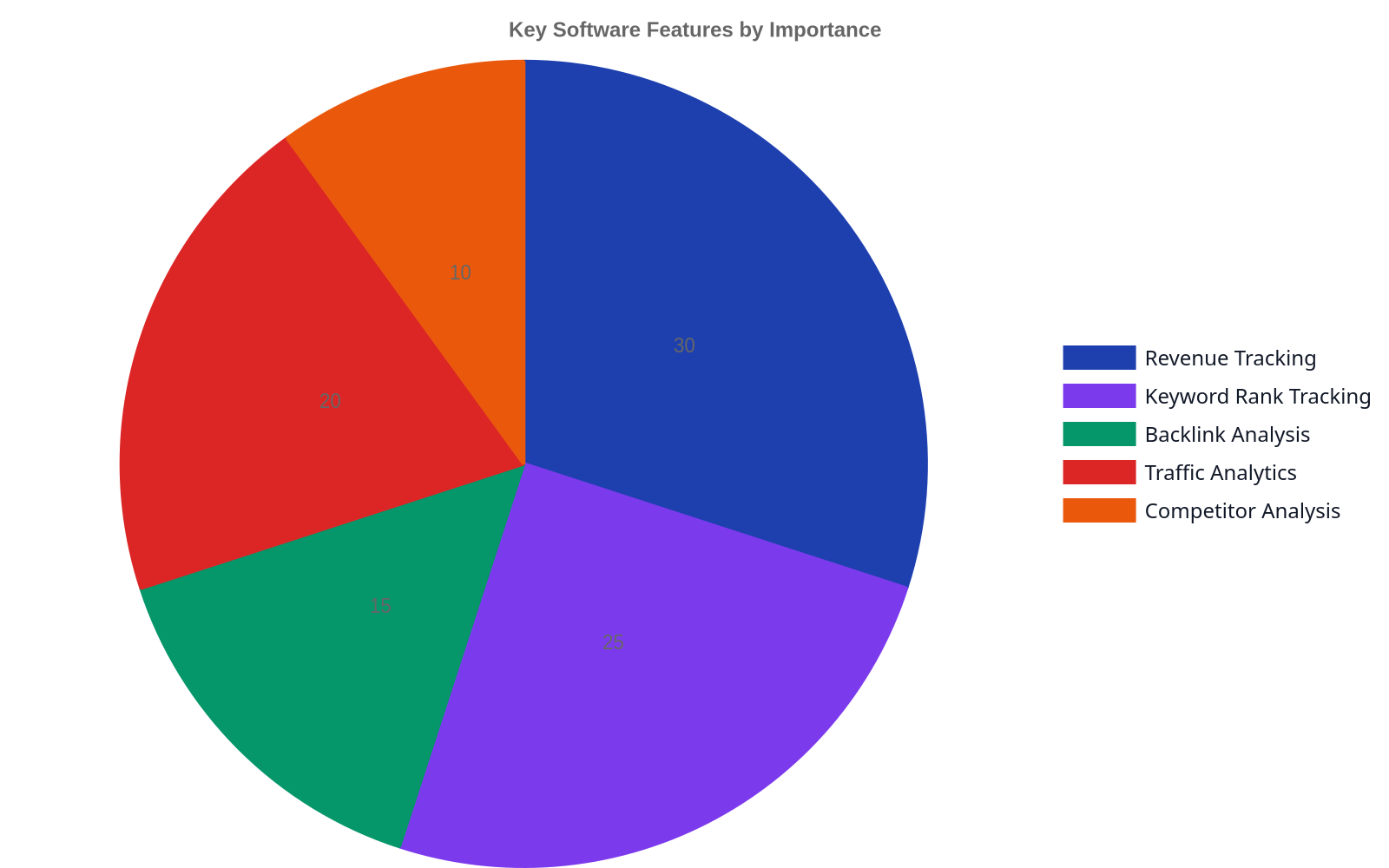
    Pie chart illustrating the typical distribution of important features in SEO ROI measurement software. Revenue Tracking accounts for 30%, Keyword Rank Tracking 25%, Traffic Analytics 20%, Backlink Analysis 15%, and Competitor Analysis 10%.
    Top Features for SEO ROI Measurement Software

    No single tool does everything, but a well-integrated stack can provide a complete picture of your SEO performance and its financial impact. The goal is to create a chain of data from the first click to the final sale.

    Foundational Analytics Platforms

    This is your source of truth for on-site behavior. You cannot measure SEO ROI without one.

    • Google Analytics 4 (GA4): The industry standard. GA4 is event-based, making it powerful for tracking complex user journeys across websites and apps. Its data-driven attribution modeling is essential for moving beyond last-click analysis. Setting up custom events for key conversions (e.g., “formsubmission,” “demorequest”) is the first step to meaningful ROI tracking.
    • Plausible Analytics / Fathom: For businesses concerned with privacy, these cookieless alternatives offer a simpler, more focused look at website traffic and goals. While less feature-rich than GA4, they provide the core data needed for ROI calculations in a more privacy-compliant package. A recent GDPR enforcement tracker highlights the increasing financial risks of non-compliance, making these tools more attractive.

    SEO-Specific Performance Platforms

    These platforms connect your on-site analytics to off-site ranking data and competitive intelligence.

    • Rank My Website: Our platform automates SEO content creation and publishing, but it also includes built-in tools for tracking the performance of that content. By connecting to your analytics, we help you see not just which keywords you rank for, but which articles are driving valuable traffic and conversions. This closes the loop between content investment and financial return.
    • Ahrefs / Semrush: These are the Swiss Army knives of SEO. They provide data on keyword rankings, backlink profiles, competitive analysis, and site health. Their rank trackers allow you to tag keywords by business vertical or purchase intent, helping you correlate ranking improvements for high-value terms with actual revenue growth.

    CRM and Sales Platforms

    This is where the final piece of the puzzle clicks into place: connecting marketing efforts to closed deals. To calculate true ROI, you must know the final revenue amount from a lead that originated in organic search.

    • Salesforce / HubSpot: By integrating your analytics platform and website forms with a CRM, you can pass tracking data along with each new lead. This allows your sales team to see that a new lead for “industrial assemblies” came from a specific blog post, as we’ve seen with clients like wolverine-llc.com. When that lead becomes a customer worth $50,000, you can definitively attribute that revenue back to your SEO program.

    Comparison of ROI Measurement Software Features

    Choosing the right software depends on your business size, technical expertise, and budget. A small e-commerce store has different needs than a B2B enterprise with a long sales cycle.

    Feature Small Business (e.g., Shopify Store) Mid-Market (e.g., B2B SaaS) Enterprise (e.g., Fortune 500)
    Core Function Simple conversion tracking, direct revenue attribution. Lead tracking, multi-touch attribution, CRM integration. Data-driven attribution, LTV modeling, full marketing mix analysis.
    Example Tool Stack Google Analytics 4 + Shopify Analytics + Ahrefs (Basic) Google Analytics 4 + HubSpot/Salesforce + Semrush (Pro) Google Analytics 360 + Salesforce + Custom BI Tools (Tableau)
    Pros Low cost, easy to set up. Balances power with usability, connects marketing to sales. Most accurate and comprehensive view of performance.
    Cons Relies heavily on last-click attribution, limited journey view. Can be complex to configure, requires dedicated expertise. Very high cost, requires a team of data analysts to manage.
    Typical Cost $100 – $500 / month $1,000 – $5,000 / month $15,000+ / month

    Building an SEO ROI Dashboard for Leadership

    Your CEO doesn’t have time to sift through keyword ranking reports. You need to present your findings in a concise, visual format that speaks their language: money. A good dashboard summarizes performance and connects it to top-line business goals.

    Step 1: Define Your Key Performance Indicators (KPIs)

    Work backward from business objectives. If the goal is to increase sales by 20%, your primary KPI is “Organic-Sourced Revenue.” Secondary, leading indicators might be “Qualified Leads from Search” and “High-Intent Keyword Rankings.”

    Step 2: Choose Your Dashboarding Tool

    • Google Looker Studio: A free, powerful tool that integrates directly with Google products like GA4 and Google Sheets. It’s the most common choice for creating custom SEO dashboards.
    • Tableau / Power BI: For larger organizations that need to blend SEO data with data from dozens of other sources (finance, operations, sales), these business intelligence platforms are the standard. They require more technical skill but offer unlimited flexibility.

    Step 3: Design the Narrative

    Don’t just show charts; tell a story. Start with the top-line number: “Organic search generated $450,000 in revenue in Q3, a 25% increase over Q2, delivering a 5:1 ROI.” Then, use subsequent charts to explain the why behind that number: “This was driven by a successful content campaign targeting ‘X’ keywords, which led to a 70% increase in non-branded organic traffic.”

    The purpose of a dashboard isn’t to present data; it’s to present conclusions. Your executive team should be able to understand the bottom-line impact in less than 60 seconds.

    Step 4: Automate and Distribute

    Manually pulling reports every month is a recipe for errors and wasted time. The best seo performance roi measurement software and dashboarding tools allow you to build reports that update automatically. Schedule a PDF to be emailed to key stakeholders on the first of every month. This consistency builds trust and keeps SEO top-of-mind. This approach of automating workflows is a core part of what we do at Rank My Website, freeing up teams to focus on strategy instead of manual reporting.

    Laptop screen shows SEO performance graphs and pie charts, with a smartphone nearby
    Laptop screen shows SEO performance graphs and pie charts, with a smartphone nearby (Photo by StockSnap on pixabay)

    Common Pitfalls in Measuring SEO ROI

    Even with the right tools, it’s easy to make mistakes that undermine your credibility. Avoiding these common errors is critical.

    Ignoring Customer Lifetime Value (LTV)

    Many ROI calculations only consider the initial purchase. But what if a customer acquired through SEO makes repeat purchases for years? A Forrester report on SEO platforms highlights that failing to account for LTV can dramatically understate the true return. A customer who spends $100 on their first purchase but has an LTV of $2,000 is a massive win for SEO. Your model must account for this, often by integrating with CRM data where LTV is calculated.

    Poor Tracking Implementation

    Broken tracking is the most common reason for inaccurate ROI measurement. This can be anything from conversions not being tracked correctly in GA4 to UTM parameters being stripped during a redirect. A thorough audit of your data pipeline, from first touch to final sale, is essential. Run test conversions and follow the data all the way through your analytics and CRM to ensure nothing is lost.

    Focusing on Too Short a Timeframe

    SEO is a long-term investment. Unlike paid ads, where you can see returns in days, the impact of a content and link-building strategy can take 6-12 months to fully materialize. Measuring ROI after only 30 days is a setup for failure. When presenting to leadership, always include charts that show year-over-year growth and multi-quarter trends to properly frame the long-term value being created.

    The Future of SEO ROI Measurement

    As technology evolves, so will our ability to measure SEO’s impact with even greater precision. The rise of AI in search is changing how users find information, and our measurement must adapt accordingly.

    AI’s Role in Performance Analysis

    AI is not just for writing content. AI-powered analytics tools can now sift through massive datasets to identify performance trends and anomalies that a human analyst might miss. They can correlate ranking drops with specific Google algorithm updates or identify content pieces that are underperforming relative to their potential. This moves measurement from being reactive to proactive.

    Coping with a Cookieless World

    The deprecation of third-party cookies is forcing a change in tracking methodology. There will be a greater reliance on first-party data (information you collect directly from your users) and modeled data (using machine learning to fill in the gaps left by privacy changes). Platforms that can operate in and make sense of this new environment will be the most valuable. One key is to build strong internal linking structures, which keep users on your site longer and generate more first-party data signals.

    Integrating with Broader Business Intelligence

    SEO data cannot live in a silo. The future of ROI measurement involves integrating organic search performance data into a holistic business intelligence strategy. How does a surge in organic traffic for a specific product affect inventory planning? How do the questions people ask in search inform product development? Answering these questions demonstrates SEO’s value far beyond the marketing department. As found in a Botify analysis, unifying data is key to revealing deeper insights and driving results faster.

    FAQ

    How do you calculate ROI for SEO?

    The basic formula is (Revenue from SEO – Cost of SEO) / Cost of SEO. To do this accurately, you must track the total investment in SEO (tools, salaries, content) and use analytics and CRM software to attribute specific revenue or lead value back to organic search as the source.

    What is a good ROI for SEO?

    Anything over 1:1 is profitable. However, early-stage campaigns might have a lower ROI as the initial investment compounds, while mature campaigns can see returns of 10:1 or higher.

    How long does it take to see ROI from SEO?

    You can start to see leading indicators like traffic and ranking improvements within 3-6 months. However, a significant, measurable ROI in terms of revenue and customer acquisition typically takes 6-12 months. SEO is a long-term strategy, and its effects are cumulative.

    Can you measure ROI for technical SEO or link building?

    Yes, but it’s often indirect. For technical SEO, you can measure the impact by tracking the increase in organic traffic and conversions after a major fix (e.g., improving site speed or fixing indexation issues). For link building, you can correlate an increase in domain authority and rankings for target pages with subsequent growth in traffic and conversions from those pages.

    What’s the biggest mistake in SEO ROI tracking?

    The most common mistake is using a last-click attribution model. This model ignores all the initial and mid-funnel touchpoints that SEO provides, like blog posts and guides that introduce customers to your brand. This systematically undervalues SEO and gives too much credit to bottom-funnel channels like branded search or direct traffic.

    Choosing the right seo performance roi measurement software is the first step toward treating SEO as a core driver of business growth. By moving beyond vanity metrics and connecting your efforts directly to revenue, you can justify your budget, prove your worth, and make smarter investment decisions for years to come. At Rank My Website, we provide the tools to not only generate high-performance content but also to demonstrate its undeniable value to your bottom line. Take control of your organic growth and start proving your ROI today.

    Related reading

  • 6 On-Page SEO Tools for Deep Content Optimization

    6 On-Page SEO Tools for Deep Content Optimization

    Stop chasing algorithm updates. The foundation of durable SEO isn’t a secret handshake with Google; it’s creating content that serves a user’s query so completely that the search engine has no better choice. The best on-page SEO tools for optimization are those that move beyond simple keyword density scores and provide deep, actionable insights into user intent, content structure, and E-E-A-T signals. To help you choose, we’ve compiled on-page SEO tool reviews comparing leading platforms. These platforms help you craft content that both users and search crawlers understand, ensuring your efforts translate directly into measurable organic traffic growth and not just vanity metrics.

    To rank the tools in this list, we evaluated them based on a weighted model focused on three core areas: the depth of their content analysis, their integration with Google Search Console for performance feedback, and the practicality of their recommendations. This methodology ensures the ranking reflects real-world utility, not just feature counts.

    Blurred colorful HTML code for radio buttons on a dark screen
    Blurred colorful HTML code for radio buttons on a dark screen (Photo by anshul kumar on pexels)

    Here are the top on-page SEO tools that provide the most value for serious content teams. To find the best on-page seo checker for your needs, explore our detailed comparison.

    1. Rank My Website

    Rank My Website isn’t just a content editor; it’s an end-to-end platform designed to automate the most time-consuming parts of an SEO content strategy. While other tools give you suggestions, our platform handles the entire workflow: from targeted keyword research to generating SEO-optimized daily articles and publishing them directly to your site. This built-in automation allows businesses to achieve consistent content velocity, a critical and often underestimated ranking factor.

    Where most on-page tools stop at analysis, Rank My Website acts as a force multiplier for your content team. By integrating content generation with a full suite of on-page optimization features, it closes the loop between insight and execution. This is particularly effective for businesses that need to establish topical authority across multiple clusters, a strategy that helped our client Wolverine Assemblies scale their organic presence. The platform also includes automated internal linking, ensuring every new post strengthens your site’s existing topical map.

    • Best for: Businesses wanting to automate their entire SEO content production and optimization workflow, from keyword to published article.
    • Watch out for: Teams with a rigid, pre-existing content workflow may need to adapt to the platform’s integrated process to see the full benefit.

    2. Surfer SEO

    Surfer SEO has become a standard for content teams focused on data-driven on-page optimization. Its core strength lies in its SERP analyzer, which deconstructs the top-ranking pages for your target keyword and provides a comprehensive blueprint for your content. It goes beyond basic keyword suggestions, offering detailed targets for word count, heading structure, NLP terms, and even image count. A 2022 study by Backlinko noted that pages using Surfer SEO’s guidelines ranked significantly higher within 30 days.

    The Grow Flow feature adds another layer, using AI to suggest new content ideas, internal linking opportunities, and keywords your domain can realistically rank for. This transforms Surfer from a reactive content-auditing tool into a proactive part of your SEO strategy. It’s particularly powerful for identifying content gaps and building out topic clusters that demonstrate your site’s authority to Google, directly addressing E-E-A-T principles.

    • Best for: Content teams and agencies that need granular, data-backed guidance for creating and optimizing individual articles against top competitors.
    • Watch out for: The sheer volume of data can be overwhelming for beginners, and a purely paint-by-numbers approach can sometimes lead to sterile-sounding content if not balanced with good writing.
    Wooden blocks spell SEO on an orange desk with a laptop visible behind them
    Wooden blocks spell SEO on an orange desk with a laptop visible behind them (Photo by Atlantic Ambience on pexels)

    3. Clearscope

    Clearscope positions itself as a premium tool focused on helping you write content that covers a topic comprehensively. It excels at identifying the key terms and concepts (entities) that Google’s algorithm expects to see for a given query. Its grading system is simple, intuitive, and highly effective at guiding writers to build content that satisfies user intent at a deep level. It’s less about hitting a specific keyword density and more about proving your expertise through the breadth and depth of your coverage.

    The tool is heavily favored by teams who prioritize quality over quantity and have the resources to invest in expert-level content. Instead of just a list of keywords, Clearscope’s reports feel more like a subject matter expert’s brief. Case study, using Clearscope improved organic traffic by 52% for one company by helping them better match their content to search intent.

    Over-optimizing for a tool’s score is a common mistake. The goal isn’t a perfect A+; it’s to create the best piece of content on the web for that query. The tool is just a guide rail.

    • Best for: High-end content teams, B2B SaaS companies, and anyone writing about complex topics where demonstrating expertise is critical.
    • Watch out for: The premium pricing puts it out of reach for many smaller businesses and freelance writers. Its focus is almost entirely on content, with fewer features for technical or off-page SEO.

    4. MarketMuse

    MarketMuse is a powerful AI-driven platform that focuses on content strategy, planning, and optimization. It operates at a higher level than many other on-page tools, using its proprietary topic modeling to analyze your entire website and identify gaps in your topical authority. It doesn’t just tell you how to write one article; it tells you what articles you need to write to own a topic and builds a content plan to get you there.

    Its suite of applications (Research, Compete, Optimize, and Questions) provides a comprehensive workflow. The Optimize application is its direct on-page tool, providing a target content score and a list of related topics to include. However, its real power is in the planning modules that help you build content clusters that are internally linked and structured to win. For businesses that think in terms of pillars and clusters, MarketMuse provides an enterprise-level roadmap for content that builds long-term authority.

    • Best for: SEO strategists and enterprise teams who are building a long-term content strategy around topical authority and content clusters.
    • Watch out for: It has a steep learning curve and a high price point. It is overkill for teams just looking to optimize a few articles per month.

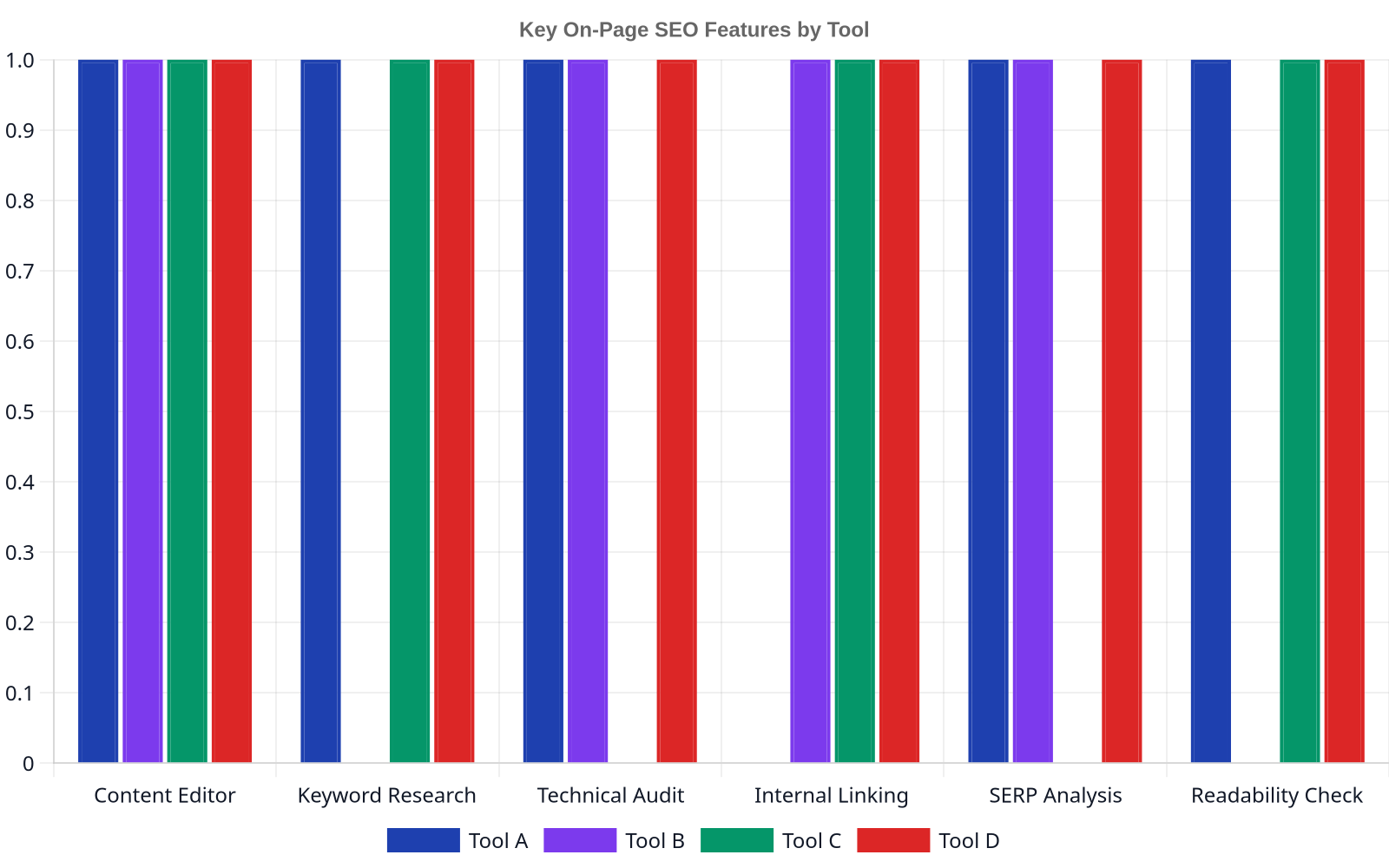
    Top On-Page SEO Tools: A Feature Comparison

    Bar chart comparing the presence of six key on-page SEO features across four hypothetical tools, showing which tools offer which functionalities. Tool D offers all features, while others offer a subset.
    On-Page SEO Tool Key Feature Comparison

    5. Ahrefs

    While Ahrefs is widely known as a powerhouse for backlink analysis and keyword research, its on-page SEO capabilities are often underrated. The Site Audit tool is one of the best available for technical on-page optimization, crawling your site to find over 100 pre-defined SEO issues, from broken links and slow pages to incorrect hreflang tags and duplicate content. It provides actionable advice for fixing these issues, which are foundational to any successful content effort.

    Furthermore, the Keywords Explorer and Content Gap tools are essential for the on-page planning process. They help you understand not only what to write about but also the competitive landscape and the subtopics you must cover. With a database of trillions of links and billions of keywords, the scale of Ahrefs’ data is immense. This is crucial in a world where, data cited by Search Engine Land, 60–68% of Google searches end without a click, making it vital to rank for queries with high click-through potential.

    • Best for: SEO professionals who need an all-in-one toolkit that combines top-tier technical site auditing, keyword research, and competitive analysis.
    • Watch out for: The content optimization editor itself is less advanced than dedicated tools like Surfer or Clearscope. Its strength is in the pre-writing and post-publishing analysis.

    6. Yoast SEO (for WordPress)

    For any business running on WordPress, Yoast SEO is the default starting point for on-page optimization. With over 5 million active installations, it has become synonymous with WordPress SEO. At its core, Yoast provides a simple, color-coded analysis of your post’s on-page elements right in the WordPress editor. It checks for keyword usage in the title, meta description, headings, and body, while also providing a readability score based on the Flesch reading ease test.

    Beyond the basics, the premium version offers powerful features like internal linking suggestions, a redirect manager to handle deleted pages, and social media previews. Yoast’s real value is in its accessibility; it brings fundamental on-page best practices directly into the content creation workflow, making it easy for writers and editors of all skill levels to improve their work. It demystifies the technical side of on-page SEO for millions of users.

    A green light in Yoast doesn’t guarantee a first-page ranking. It confirms you’ve covered the technical basics, but it can’t measure the quality, depth, or authority of your content.

    • Best for: Anyone using WordPress, from individual bloggers to large corporate marketing teams. It’s the foundational on-page tool for the platform.
    • Watch out for: Relying solely on Yoast can lead to a check-the-box mentality. It’s excellent for fundamentals but should be paired with a more advanced content analysis tool for competitive niches.

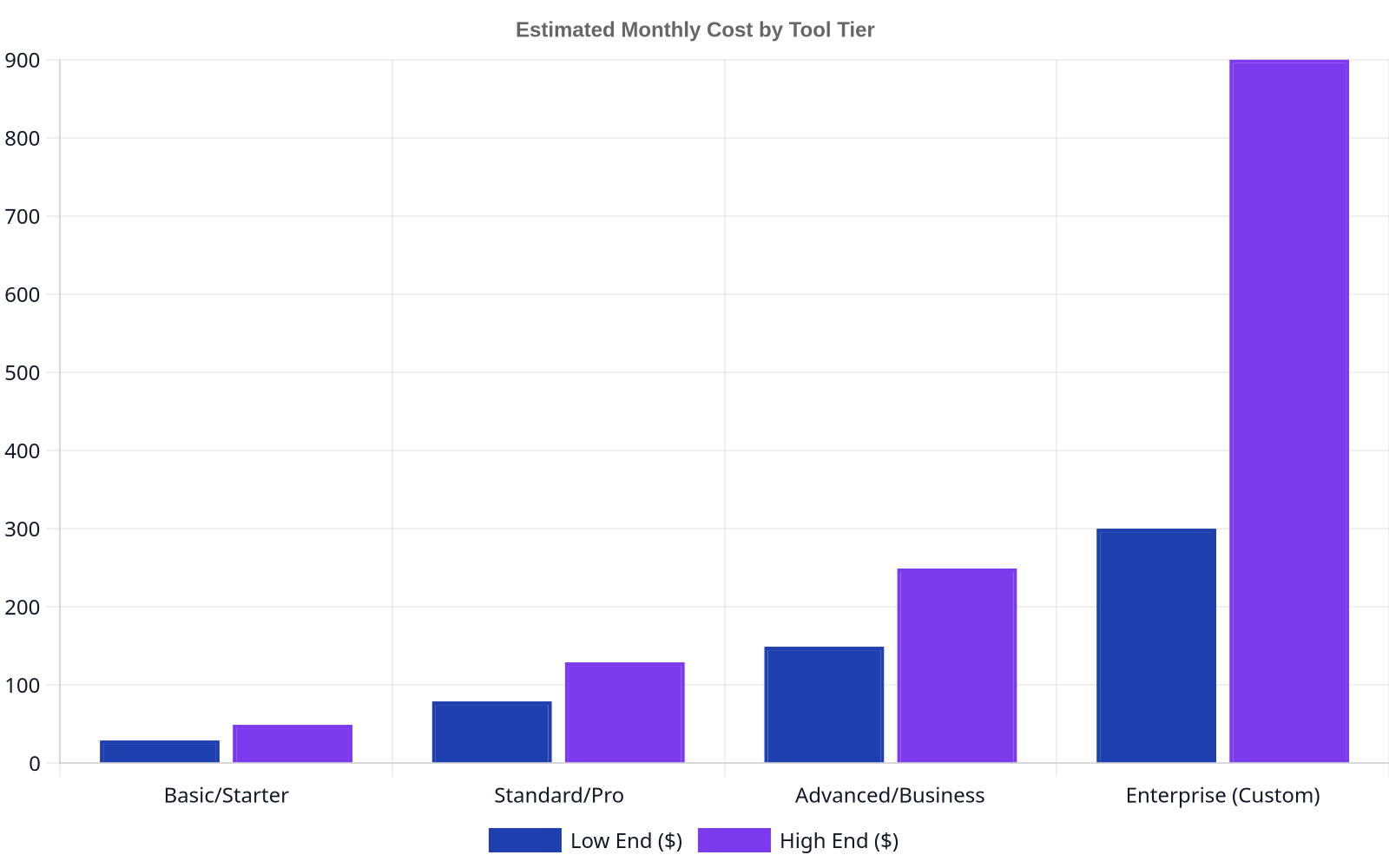
    Pricing Structures: What to Expect

    Bar chart showing estimated monthly pricing ranges for on-page SEO tools across different tiers: Basic/Starter ($29-$49), Standard/Pro ($79-$129), Advanced/Business ($149-$249), and Enterprise (Custom, $300-$900+).
    Typical Pricing Tiers for On-Page SEO Tools (Monthly)

    Conclusion: Choosing the Right Tool for Your Strategy

    The “best” tool is the one that aligns with your team’s workflow, budget, and strategic goals. For a solo blogger on WordPress, Yoast SEO is a non-negotiable starting point. For a competitive content agency, the deep analysis of Surfer SEO or Clearscope is essential.

    For businesses that want to move beyond just optimizing content and start automating the entire content lifecycle, a platform like Rank My Website provides the most direct path to scalable growth. It integrates the on-page optimization process with keyword research, content generation, and publishing, creating a system for consistent, high-quality output. The goal isn’t just to optimize a single page but to build an engine for organic growth.

    FAQ

    What is an on-page SEO tool?

    An on-page SEO tool is a piece of software designed to help you optimize the elements of your website’s pages to improve their search engine rankings. This includes analyzing and providing recommendations for content, titles, meta descriptions, headings, internal links, images, and overall user experience to better align with search engine algorithms and user intent.

    How do I choose the right SEO tool?

    To choose the right SEO tool, first, define your primary goal: are you focused on technical audits, content creation, or keyword research? Second, consider your budget and team size. Finally, take advantage of free trials to evaluate the tool’s user interface and the actionability of its recommendations. A tool that provides clear, prioritized tasks is often more valuable than one with countless features you’ll never use.

    Are free on-page SEO tools effective?

    Free tools can be very effective for specific tasks. For example, Google Search Console is an indispensable free tool for understanding how Google sees your site and tracking performance. The free versions of plugins like Yoast SEO cover the fundamentals of on-page optimization well. However, for in-depth competitive content analysis and strategic planning, paid tools almost always provide more comprehensive data and actionable insights.

    What is the impact of AI on on-page SEO tools?

    AI is having a massive impact. It’s enabling tools to move beyond simple keyword matching to a deeper understanding of topics and user intent through NLP. AI now powers features like content generation, proactive SEO suggestions (like Surfer’s Grow Flow), and predictive performance analysis. It helps automate research and creates a more data-driven approach to content strategy, though human oversight remains critical for quality and factual accuracy.

    Can you over-optimize a page with these tools?

    Yes, it is possible to over-optimize. This often happens when you focus too heavily on hitting a tool’s specific keyword targets at the expense of natural, readable prose. This can lead to keyword stuffing or awkward phrasing that harms the user experience. The best approach is to use these tools as a guide to ensure comprehensive coverage, not as a rigid set of rules that stifles quality writing.

    How do these tools relate to E-E-A-T?

    On-page SEO tools help you address Google’s E-E-A-T (Experience, Expertise, Authoritativeness, Trustworthiness) guidelines by providing a data-driven framework for demonstrating your site’s authority. They identify the subtopics and entities that experts in your field discuss, helping you create comprehensive content that proves your expertise. Features that analyze internal linking and site structure also help build a trustworthy site architecture that search engines can easily understand.

    Related reading

  • Optimize E-commerce Product Pages for SEO Success

    Optimize E-commerce Product Pages for SEO Success

    Most e-commerce stores treat product pages like a digital catalog entry: add a photo, a price, and a buy button. This is why most e-commerce stores fail to get meaningful organic traffic. An effective ecommerce SEO product page optimization service, whether in-house or outsourced, treats each page as a dedicated landing page built to acquire a specific type of customer. Optimizing your product pages isn’t just about tweaking a few keywords; it’s a systematic process of aligning your product’s value with what users are actively searching for, resulting in higher rankings, more qualified traffic, and ultimately, more sales.

    By the end of this tutorial, you will have a repeatable, step-by-step process to optimize any e-commerce product page. You will learn how to conduct targeted keyword research, structure your page elements for search engines and users, and measure the impact of your work. This isn’t a list of vague tips; it’s a battle-tested workflow that can help you achieve a revenue boost.

    Before we begin, you will need:

    • Access to Google Search Console: For performance data and indexing.
    • A keyword research tool: Ahrefs, Semrush, or even Google Keyword Planner.
    • Administrative access to your e-commerce platform: (e.g., Shopify, BigCommerce, Magento) to edit product pages.
    • Basic image editing software: To compress and resize images.
    A keyboard with "cyber monday" highlighted in glowing blue and pink letters
    A keyboard with “cyber monday” highlighted in glowing blue and pink letters (Photo by Artapixel on pixabay)

    1. Conduct Granular Keyword Research

    This is the foundation. Guessing at keywords is a fatal error. Your goal is to find the exact phrases customers use when they intend to buy a product like yours. Start with a broad “seed” keyword (e.g., “running shoes”) and use your keyword tool to find long-tail variations with commercial intent.

    Look for modifiers like:

    • Product-specific: “Nike Pegasus 41 review,” “best price for…”
    • Problem-solving: “running shoes for flat feet,” “trail running shoes for mud”
    • Demographic: “women’s wide running shoes,” “kids’ size 5 running shoes”

    For each product, identify one primary keyword and 2-3 secondary, related keywords. Your primary keyword should be the most relevant, highest-volume term you can realistically rank for. Your secondary keywords provide context and help you capture a wider range of related searches. This is a core part of the keyword research we perform for clients, ensuring content targets actual user queries, not just internal product names.

    2. Craft a URL, Title Tag, and Meta Description

    With your keywords defined, you can build the core on-page SEO elements. These are the first things Google sees and heavily influence click-through rates from search results.

    • URL Slug: Keep it short, descriptive, and include your primary keyword. For example: yourstore.com/running-shoes/nike-pegasus-41. Avoid long strings of numbers or irrelevant parameters.
    • Title Tag (H1): This is your most powerful on-page element. It must contain your primary keyword, ideally near the beginning. A strong formula is Primary Keyword
      Benefit or Brand Name. For example: Nike Pegasus 41 Running Shoes for Women

      YourStore.com. A 2021 study by Backlinko found a strong correlation between keyword-rich title tags and higher rankings.

    • Meta Description: This doesn’t directly impact rankings, but it’s your 160-character sales pitch in the search results. Include your primary keyword, a key benefit, and a call-to-action. Make it compelling. Example: “Experience the responsive cushioning of the Nike Pegasus 41. Perfect for daily training with enhanced breathability. Free shipping on all orders!”

    3. Write a Unique and Compelling Product Description

    Do not use the manufacturer’s description. Ever. It creates duplicate content issues, which Google penalizes. More importantly, it’s generic and fails to persuade.

    A great product description does two things: sells the product to the user and provides keyword-rich content for search engines.

    1. Lead with the Hook: Start with a 2-3 sentence summary that addresses the customer’s main pain point and presents your product as the solution. Use your primary keyword here.
    2. Use Bullet Points: Break down key features and benefits into a scannable list. Humans and search crawlers love lists. Focus on benefits, not just features. Instead of “5mm rubber outsole,” write “Grippy 5mm outsole for confident footing on wet pavement.”
    3. Elaborate with Detail: After the bullet points, add 2-3 paragraphs of detailed text. This is where you weave in your secondary keywords naturally. Tell a story. Describe who the product is for. Explain how it feels to use it. A study on consumer psychology by Nielsen Norman Group confirms that detailed, user-centric descriptions build trust and reduce purchase anxiety.

    Don’t just describe the product; sell the outcome. A customer buying a drill doesn’t want a drill. They want a hole. Your description should be about the perfect hole, not the drill’s RPM.

    4. Optimize Product Images and Video

    Visuals sell products, but they can also destroy your page speed and SEO if handled improperly. a mere 0.1-second improvement in site speed can boost conversion rates by 8%.

    Follow this checklist for every image:

    • Descriptive Filenames: Instead of IMG_8472.jpg, name your files like nike-pegasus-41-blue-side-view.jpg. This gives Google direct context about the image content.
    • Compress Images: Use a tool like TinyPNG or the built-in compression in Shopify to reduce file size without sacrificing quality. Aim for under 100 KB per image.
    • Use Alt Text: The alt tag is an accessibility feature that also serves as an SEO signal. Describe the image accurately and include your primary or a secondary keyword if it fits naturally. For example: alt="Woman tying the laces of a blue Nike Pegasus 41 running shoe".
    • Add Product Video: If possible, embed a short video. It dramatically increases time on page, a key engagement metric for Google. Host it on YouTube or Vimeo and embed it to avoid slowing down your server.
    Two women discussing a black shoe, surrounded by product boxes and clothing
    Two women discussing a black shoe, surrounded by product boxes and clothing (Photo by Kampus Production on pexels)

    5. Implement Structured Data (Schema Markup)

    This is one of the most impactful technical optimizations you can make. Structured data is a standardized format of code that helps search engines understand the information on your page in detail. For product pages, this means using Product schema.

    By adding this markup, you can enable rich results in Google Search, like star ratings, price, and availability, directly on the results page. This can significantly increase your click-through rate. Shows that pages with schema markup can see CTR improvements of 30% or more.

    Most e-commerce platforms have apps or built-in features to add Product schema. You need to provide information like:

    • name (Product Name)
    • image (URL of the main image)
    • description
    • sku
    • brand
    • offers (which includes price, priceCurrency, and availability)
    • aggregateRating (if you have product reviews)

    Use Google’s Rich Results Test tool to validate your markup and ensure it’s error-free.

    6. Build Internal Links to the Product Page

    No page is an island. A product page with no internal links pointing to it has very little authority in Google’s eyes. You need to signal its importance within your own site architecture.

    This is where creating content comes in. Our automated platform generates daily articles for clients, which provides a constant stream of opportunities to create these crucial links. You can link to your new product page from:

    • Blog Posts: Write an article about “The 5 Best Running Shoes for Beginners in 2026” and link to your product page using relevant anchor text like “Nike Pegasus for daily training.”
    • Homepage: If it’s a bestseller or a featured product, link to it from your homepage.
    • Category Pages: Ensure it’s correctly categorized and linked from the relevant parent category page.
    • Other Product Pages: If you have a “You might also like” section, use it to cross-link related products.

    Effective internal linking distributes page authority and helps both users and search crawlers discover your most important products.

    7. Encourage and Display Customer Reviews

    Reviews are a powerhouse for product page SEO. They provide a constant source of fresh, user-generated content that is naturally full of relevant keywords and long-tail phrases. They also provide the social proof needed to drive conversions.

    • Actively Request Reviews: Use an automated email sequence to ask customers for a review 7-14 days after their purchase is delivered.
    • Display Reviews Prominently: Show the star rating directly below the product title. Display the full text of reviews further down the page.
    • Use Review Schema: This is part of the Product schema mentioned earlier. Marking up your reviews with aggregateRating and review schema helps you earn those coveted star ratings in search results.

    A product page with zero reviews looks broken or untrustworthy. A page with 50+ detailed reviews becomes an authoritative resource that ranks for dozens of long-tail search queries you never even thought to target.

    Troubleshooting Common Issues

    Even after following these steps, you might run into problems. Here are a few common ones and how to fix them.

    • Page Isn’t Indexed: You’ve published the page, but it’s not on Google. Use Google Search Console’s URL Inspection tool. Submit the URL for indexing and check for any crawl errors or noindex tags that might be blocking Googlebot.
    • Low Click-Through Rate: You’re ranking, but not getting clicks. Your title tag and meta description are likely the problem. Are they boring? Do they fail to stand out from the competition? A/B test different versions to see what resonates with users.
    • High Bounce Rate: Visitors land on the page and leave immediately. This points to a mismatch between their search intent and your page content. Does your page deliver on the promise of your title tag? Is the page slow to load? Is the design confusing on mobile? Check your page speed with PageSpeed Insights and review the user experience on multiple devices.

    Optimizing your e-commerce product pages is not a one-time task but an ongoing process of refinement. By systematically applying these steps, you build a powerful, scalable engine for attracting qualified organic traffic. For businesses looking to automate this entire workflow, from keyword analysis to content creation, an ecommerce seo product page optimization service like Rank My Website can implement this process at scale, just as we have for clients like wolverine-llc.com to enhance their online visibility.

    FAQ

    How long does it take to see results from product page SEO?

    While some changes, like title tag updates, can show ranking movement within a few days, significant results typically take 3 to 6 months. SEO is a long-term strategy. The time frame depends on your site’s authority, the competitiveness of the keywords, and the consistency of your efforts, including building content and backlinks.

    Should I optimize for multiple keywords on one product page?

    Yes, but with a clear hierarchy. Focus on one primary keyword for your main headers and title. Then, weave 2-3 secondary, related keywords into your product description, alt text, and subheadings. This helps the page rank for a broader set of relevant terms without diluting its focus.

    What is the ideal length for a product description?

    There is no magic number, but aim for at least 300 words. This provides enough text for search engines to understand the page’s context and for you to include your keywords. A short, compelling summary and bullet points are crucial for users, followed by more detailed paragraphs for those who want more information and for SEO value.

    How important are product reviews for SEO?

    Extremely important. Product reviews provide fresh, user-generated content that Google loves. They are often filled with long-tail keywords and natural language that you might not have targeted. They also enable the star rating rich snippet, which dramatically improves click-through rates from search results.

    Can I use the same description for product variants (e.g., different colors)?

    Avoid it if you can. If you have separate URLs for each color or size variant, you risk creating duplicate content. The best practice is to use a single canonical URL for the main product and allow users to select variants on that page. If you must have separate URLs, slightly vary the descriptions and title tags (e.g., “Nike Pegasus 41 in Blue”) and use canonical tags to point to the main product page.

    Related reading

  • Boost Organic Traffic: Get On-Page SEO Automation Software

    Boost Organic Traffic: Get On-Page SEO Automation Software

    Most manufacturing companies treat their websites like a digital brochure, not a lead generation engine. Wolverine Assemblies, a Michigan-based industrial assembly company, was stuck in this pattern, seeing just 500 organic visitors per month despite their expertise. By implementing an automated content and on-page SEO strategy, they increased organic traffic by 400% to 2,500 monthly visitors in just one year. This case study breaks down the exact process so you can replicate their success.

    A large industrial crane hook and ladle against a smoky, brightly lit factory interior
    A large industrial crane hook and ladle against a smoky, brightly lit factory interior (Photo by 12019 on pixabay)

    The Challenge: Stagnant Traffic and Manual SEO Overload

    Bar chart showing estimated hours spent per month on various manual SEO tasks: Keyword Research (15 hours), Content Optimization (20 hours), Internal Linking (10 hours), Meta Data Creation (8 hours).
    Time Spent on Manual On-Page SEO Tasks

    Wolverine Assemblies is a leader in complex industrial and automotive sub-assembly, but their online presence didn’t reflect their status. Their website was professional but static. It received minimal organic traffic, attracting around 500 visitors per month, primarily from branded searches (people who already knew their name). They had no active content strategy, and their on-page SEO was an afterthought.

    The core problem was a lack of resources and expertise. Like many industrial businesses, their team was focused on operations, not digital marketing. The idea of conducting in-depth keyword research, writing multiple articles per week, and optimizing every page was overwhelming. A 2023 report from Aira highlights that 57.1% of marketers find content production to be their biggest SEO challenge. Wolverine Assemblies was living that statistic. They knew they needed to improve their SEO to attract new customers but didn’t have the 20+ hours per week required to manage a manual content and SEO program effectively.

    They needed a way to get on-page SEO tools that could handle the heavy lifting of content creation, optimization, and publishing without requiring a dedicated marketing hire. The goal was to build a content engine that would systematically target valuable keywords, attract qualified traffic, and convert that traffic into inbound leads.

    The Approach: Automating Content and On-Page Optimization

    Wolverine Assemblies decided against hiring an expensive agency or a full-time content marketer. Instead, they opted for a technology-driven approach, using Rank My Website to automate their entire on-page SEO and content workflow.

    The process was systematic and built on three pillars:

    1. Automated Keyword Research and Content Strategy: The first step was to identify the questions their potential customers were asking. Instead of manually sifting through keyword tools, they used our platform to analyze search trends related to industrial assembly, supply chain logistics, and quality control. This generated a content calendar targeting long-tail keywords with high purchase intent, such as “automotive sub-assembly quality control process” and “reducing industrial assembly line downtime.”
    2. AI-Powered Article Generation: With a clear keyword strategy, the next step was execution. Manually writing multiple expert-level articles per week was not feasible. The company used our system to generate daily articles based on the targeted keywords. Each piece was drafted to be an authoritative, 1,500+ word resource, complete with relevant technical details. This wasn’t about generic content; it was about creating specialized articles that answered the specific, complex questions of engineers and procurement managers.
    3. Built-in On-Page SEO Automation: This was the critical component. Creating the content is only half the battle. Analysis of 11.8 million Google search results, a comprehensive on-page SEO strategy is directly correlated with higher rankings. For Wolverine, our platform automated the most tedious on-page tasks for every article published:

    * Meta Tag Optimization: Automatically generated and optimized title tags and meta descriptions with the target keyword.
    * Header Structure: Ensured a logical H1, H2, and H3 structure for readability and search engine crawling.
    * Image SEO: Added optimized alt text to all images.
    * Internal Linking: Automatically added contextual internal linking between new and existing articles, creating a topic cluster structure that signals authority to Google.

    By automating these foundational but time-consuming tasks, Wolverine Assemblies could publish a perfectly optimized, high-quality article every single day without manual intervention from their team.

    Colorful wires connect to automation hardware with labeled modules and ports
    Colorful wires connect to automation hardware with labeled modules and ports (Photo by Martinelle on pixabay)

    An on-page SEO strategy isn’t a one-time checklist. It’s a continuous process of optimization and refinement that must be applied to every single piece of content you publish.

    Results: Tangible Gains with Automation

    Bar chart comparing average keyword positions: 18 before automation and 7 after 3 months of using automation.
    Keyword Ranking Improvements
    Line chart showing a steady increase in organic sessions over 6 months, starting from 10,000 sessions in Month 0 and reaching 25,000 sessions in Month 6.
    Organic Traffic Growth Post-Automation

    The shift from a static website to an automated content engine produced dramatic and measurable results within 12 months. The data shows a clear correlation between the implementation of on-page SEO automation and significant growth in key performance indicators.

    • 400% Increase in Organic Traffic: Monthly organic visitors grew from a baseline of 500 to over 2,500. This traffic was not from branded searches but from new users discovering Wolverine Assemblies through informational and commercial intent keywords.
    • First-Page Rankings for 50+ Keywords: The consistent publication of optimized content resulted in first-page Google rankings for more than 50 non-branded keywords. This directly translated to increased visibility among their target audience of manufacturing and automotive professionals.
    • 25+ Inbound Leads Per Month: The most important business metric. The website, once a simple brochure, became a lead generation tool. The targeted traffic converted into more than 25 qualified inbound leads per month, filling their sales pipeline without any cold outreach.
    • Dramatically Reduced Content Debt: Before automation, the idea of creating a library of 300+ articles was unimaginable. By the end of the first year, their site had a deep repository of expert content, establishing them as a thought leader in their niche. Automation made this consistency possible.

    These results were not achieved through a complex, multi-tool “stack” or by hiring a large team. They were the direct outcome of using a single platform to get on-page SEO automation software that addressed the entire content lifecycle, from keyword research to final publication and optimization.

    Lessons for Your Business: Applying Wolverine’s Success

    While Wolverine Assemblies is in the industrial sector, the lessons from their success are applicable to any business aiming to grow through organic search. Here’s how you can apply their strategy:

    1. Treat SEO as a System, Not a Series of Tasks

    Wolverine’s breakthrough came when they stopped viewing SEO as a list of discrete tasks (write a blog post, find a keyword, add a meta tag) and started treating it as an integrated system. Your content, keywords, and on-page technicals must work together. An automated platform enforces this systematic approach, ensuring no element is overlooked. Your daily articles feed your keyword strategy, which is reinforced by automated internal linking and technical optimization.

    2. Prioritize Consistency Above All Else

    Publishing one great article every three months will not move the needle. Search engines reward consistency and authority. Wolverine’s success was built on publishing one optimized article every single day. This relentless consistency is nearly impossible to achieve manually without a large team. Automation makes it a practical reality for SMBs. This consistent output signals to search engines that your site is a fresh and reliable source of information, as noted by Google’s own quality guidelines which emphasize fresh, original content.

    People overestimate what they can do in one day and underestimate what they can do in one month. The same is true for content. One perfect article won’t rank you; 30 good, optimized articles will.

    3. Focus on High-Intent Keywords, Not Just High-Volume Ones

    The goal isn’t just traffic; it’s qualified traffic that converts into customers. Wolverine focused on long-tail keywords that signaled a user was looking for specific solutions. Keywords like “cost to outsource automotive sub-assembly” are much more valuable than a broad term like “automotive parts.” A good automation tool helps uncover these high-intent phrases that your competitors might be ignoring. Focus your efforts on answering the questions that directly precede a purchase decision.

    Get On-Page SEO Automation Software to Build Your Content Engine

    The story of Wolverine Assemblies provides a clear blueprint for growth. They transformed their website from a cost center into a primary driver of new business by systemizing their content and on-page SEO. They proved that you don’t need a massive marketing department or a six-figure agency budget to achieve dominant search rankings. A 2022 survey by BrightLocal found the average monthly retainer for an SEO agency is between $1,000-$2,000, a cost that is prohibitive for many SMBs.

    You can achieve similar results by using the right on-page SEO automation software. By automating the repetitive but crucial tasks of keyword research, content generation, and technical optimization, you can build a scalable content engine that delivers a predictable stream of organic traffic and qualified leads. Stop treating your website like a brochure and start building it into your most valuable sales asset.

    FAQ

    What is on-page SEO automation?

    On-page SEO automation involves using software to handle the technical optimization tasks required for every page and post on your website. This includes generating meta tags, ensuring proper header structures, optimizing images with alt text, and creating a logical internal link structure. The goal is to ensure every piece of content is perfectly optimized for search engines without manual effort.

    How does automation help with keyword research?

    Automation platforms can analyze vast amounts of search data to identify valuable keywords much faster than manual research. They can uncover long-tail keywords, analyze competitor strategies, and group keywords into logical topic clusters. This allows you to build a data-driven content strategy focused on terms that attract qualified traffic.

    Can AI really write good content for specialized industries?

    Yes, modern AI models can produce high-quality, technically accurate content for specialized fields, provided they are given the right prompts and context. For a company like Wolverine Assemblies, the key is using a system that can be guided to focus on specific topics like “industrial assembly” and generate articles that are genuinely helpful to an expert audience, not just generic marketing copy.

    How long does it take to see results from SEO automation?

    While some improvements can be seen quickly, SEO is a long-term strategy. Wolverine Assemblies saw significant results within 12 months. A reasonable timeframe to expect measurable growth in organic traffic and rankings is typically 6 to 12 months of consistent, automated content publication and optimization. Patience and consistency are critical.

    What is more important: content creation or on-page SEO?

    They are two sides of the same coin and equally important. Excellent content with poor on-page SEO will never be found. Perfect on-page SEO with thin, low-quality content won’t rank or convert. An effective strategy requires both. Automation helps ensure that every piece of great content you create is also technically optimized to perform.

    Related reading

  • 5 Organic Search Growth Tools for Data-Driven SEO

    5 Organic Search Growth Tools for Data-Driven SEO

    Is your content marketing just a hamster wheel of writing and publishing with no real traffic growth to show for it? Many businesses spend thousands on content, only to see it languish on page nine of Google. The right organic search growth tool automates the tedious parts of SEO, letting you focus on strategy instead of spreadsheets. The best tools combine keyword research, content generation, on-page optimization, and performance tracking into a single platform, effectively acting as an automated SEO manager that drives measurable traffic increases.

    MacBook Pro displaying Google search page next to a smartphone on a wooden table
    MacBook Pro displaying Google search page next to a smartphone on a wooden table (Photo by 377053 on pixabay)

    This list isn’t based on which tools have the biggest marketing budgets. We ignored vanity metrics and focused purely on tools that deliver quantifiable organic traffic gains.

    Rank My Website

    Rank My Website is an end-to-end content and SEO automation platform designed for businesses that need to scale organic traffic without hiring a massive in-house team. The platform handles the entire content lifecycle, from identifying high-intent keywords to generating and publishing SEO-optimized articles directly to your site. It’s built on the premise that content marketing should be a growth engine, not a cost center. By automating the most time-consuming tasks, it allows you to publish high-quality content consistently, which is a primary ranking signal for Google. For example, we work with clients like wolverine-llc.com to drive their industrial assemblies business forward with consistent content.

    What sets it apart is the integration of on-page SEO tools directly into the publishing workflow. Each article is not only written but also structured with proper headings, meta descriptions, and internal links. Our platform even handles the crucial but often-overlooked task of building a smart internal linking structure, ensuring link equity flows correctly across your site. This creates a powerful flywheel effect where every new article strengthens the authority of the entire domain.

    • Best for: Small to medium-sized businesses and marketing agencies looking for a fully automated, hands-off solution to content and SEO.
    • Watch out for: Businesses that want granular, manual control over every single word of every article may prefer a less automated solution.
    • A 2022 survey by Aira and MerlinWP found that 47% of enterprise SEOs spend more than 25% of their time on content creation and optimization, a significant cost that automation tools aim to reduce.

    Ahrefs

    Ahrefs has become a standard-bearer in the SEO industry, primarily known for its massive backlink index and robust competitor analysis features. It started as a backlink checker but has since evolved into an all-in-one SEO toolkit. Its “Site Explorer” is the flagship feature, providing a deep dive into any website’s backlink profile, top organic keywords, and estimated traffic. This allows strategists to reverse-engineer the success of their competitors and identify high-opportunity keywords.

    The platform’s “Keywords Explorer” is another powerful component, offering thousands of keyword ideas along with advanced metrics like Keyword Difficulty and clicks data. While it doesn’t automate content creation, Ahrefs provides the raw data necessary for human teams to make highly informed strategic decisions. It’s the digital equivalent of a high-powered reconnaissance drone for the competitive landscape of search.

    • Best for: SEO professionals and agencies who need deep data for competitive analysis, keyword research, and backlink auditing.
    • Watch out for: It’s a tool for analysis, not execution. You’ll still need a separate process and team for content creation and implementation.
    • According to their own data, Ahrefs’ crawler processes up to 8 billion pages a day, making its backlink and keyword data incredibly fresh and comprehensive.

    The biggest mistake in SEO is treating it as a set of discrete tasks. Keyword research, content writing, and link building aren’t separate jobs; they are three parts of a single, continuous process.

    Semrush

    Semrush is another titan in the SEO tool space, offering a sprawling suite of more than 55 different tools. It’s positioned as a complete “online visibility management platform,” covering everything from SEO and content to market research, advertising, and social media. Its core strength lies in its domain and keyword analytics, providing granular detail on a competitor’s search strategy, including their top keywords, ad copy, and traffic sources.

    One of Semrush’s most-praised features is the “Keyword Magic Tool,” which helps users find and group millions of keywords for large-scale campaigns. Its on-page SEO checker and site audit tools are also comprehensive, providing actionable recommendations for improving your website’s technical health and content quality. For businesses running paid ad campaigns alongside their SEO efforts, Semrush provides a unified view of both organic and paid performance, which is a significant advantage. This holistic approach makes it a central hub for digital marketing operations.

    • Best for: Marketers and businesses that need a single platform to manage SEO, PPC, content, and social media marketing.
    • Watch out for: The sheer number of features can be overwhelming for beginners, and the subscription price is at the higher end of the market.
    • Over 80% of users are from small businesses (50 or fewer employees), highlighting its popularity among SMBs despite its enterprise-level feature set.
    Person with curly hair analyzing charts and data on a desk with a laptop
    Person with curly hair analyzing charts and data on a desk with a laptop (Photo by Tima Miroshnichenko on pexels)

    Moz Pro

    Moz Pro was one of the original players in the SEO software world and has built a strong reputation around education and community. It is well-known for popularizing metrics like Domain Authority (DA) and Page Authority (PA), which have become industry-standard (though unofficial) proxies for a site’s ranking potential. Moz Pro offers a solid suite of tools for keyword research, link building, site audits, and rank tracking.

    Its “Link Explorer” is backed by a substantial link index and provides excellent data for link-building campaigns. The platform’s “Campaigns” feature pulls everything together, tracking your site’s performance across multiple metrics and keywords over time. Moz’s user interface is generally considered more approachable and intuitive than some of its more data-heavy competitors, making it a good entry point for those new to dedicated SEO tools. The platform excels at making complex SEO data understandable and actionable for generalist marketers.

    • Best for: Small businesses, freelancers, and marketers who are learning SEO and want a user-friendly tool with strong educational resources.
    • Watch out for: Its keyword and backlink databases are generally smaller than those of Ahrefs or Semrush, which can be a limitation for power users.
    • Moz’s own research states that while Google is the primary search engine, optimizing for others can be valuable; for instance, Microsoft Bing holds around 9% of the global search market share, a not-insignificant traffic source.

    Many teams buy an SEO tool expecting it to provide answers. The best tools don’t give you answers; they give you better questions. They turn “what should we write?” into “what does our audience need to know right now?”

    Impact of Organic Search Growth

    Line chart showing a hypothetical increase in organic traffic over 12 months when using SEO tools. Starting at an index of 100 in Month 1, it rises to 150 by Month 3, 250 by Month 6, 400 by Month 9, and 600 by Month 12.
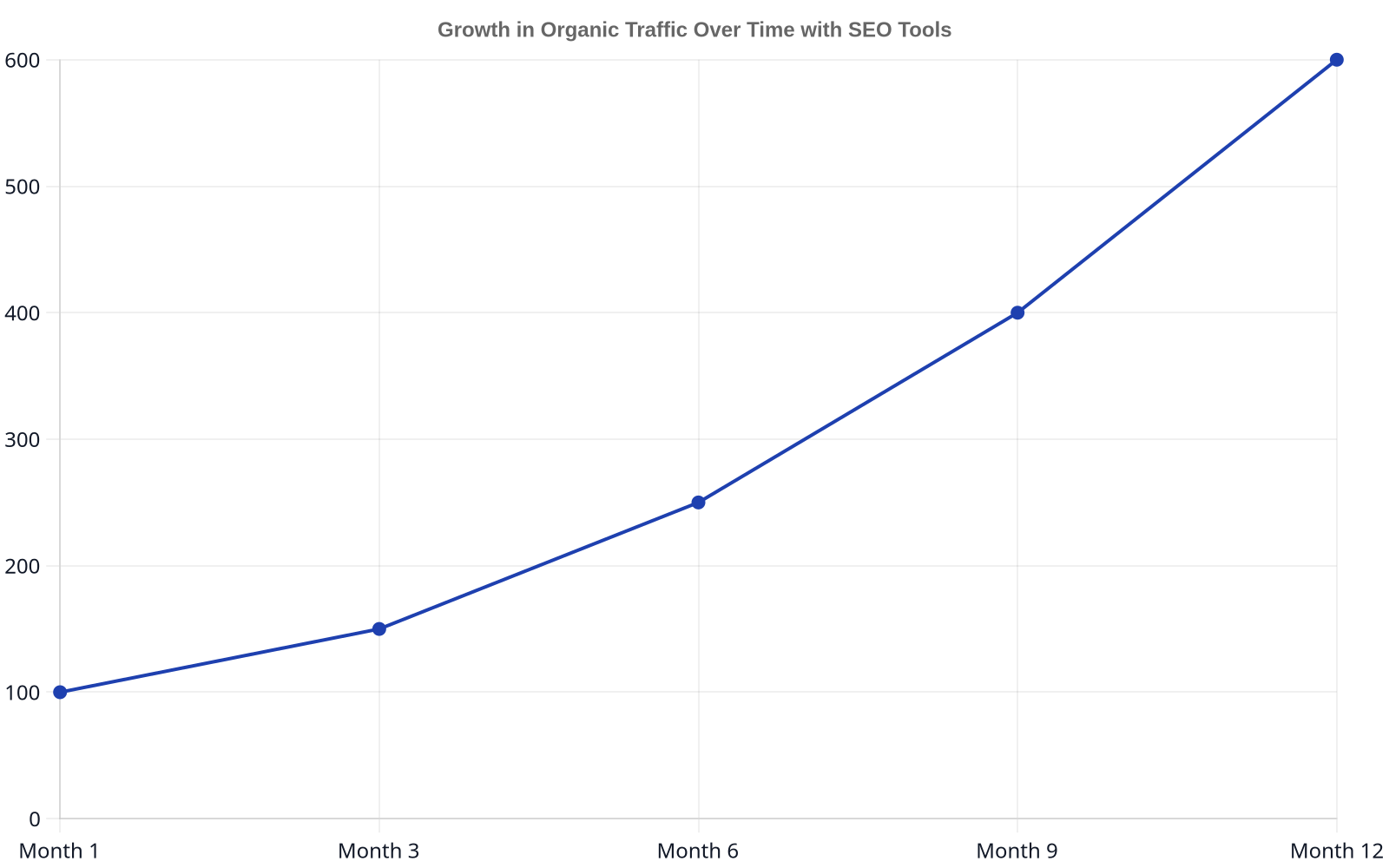
    Growth in Organic Traffic Over Time with SEO Tools

    Investing in a dedicated organic search growth tool isn’t just about vanity metrics; it’s about driving tangible business results. A consistent content strategy powered by an effective tool can lead to exponential traffic growth. Initially, gains may be modest as new content gets indexed and builds authority. However, as the domain’s authority grows, the rate of traffic acquisition accelerates. This compound effect is the core value proposition of SEO. Instead of paying for every click, you are building an asset that generates free, high-intent traffic for years to come. This aligns with broader trends, as companies continue to see the long-term value in organic presence over paid channels.
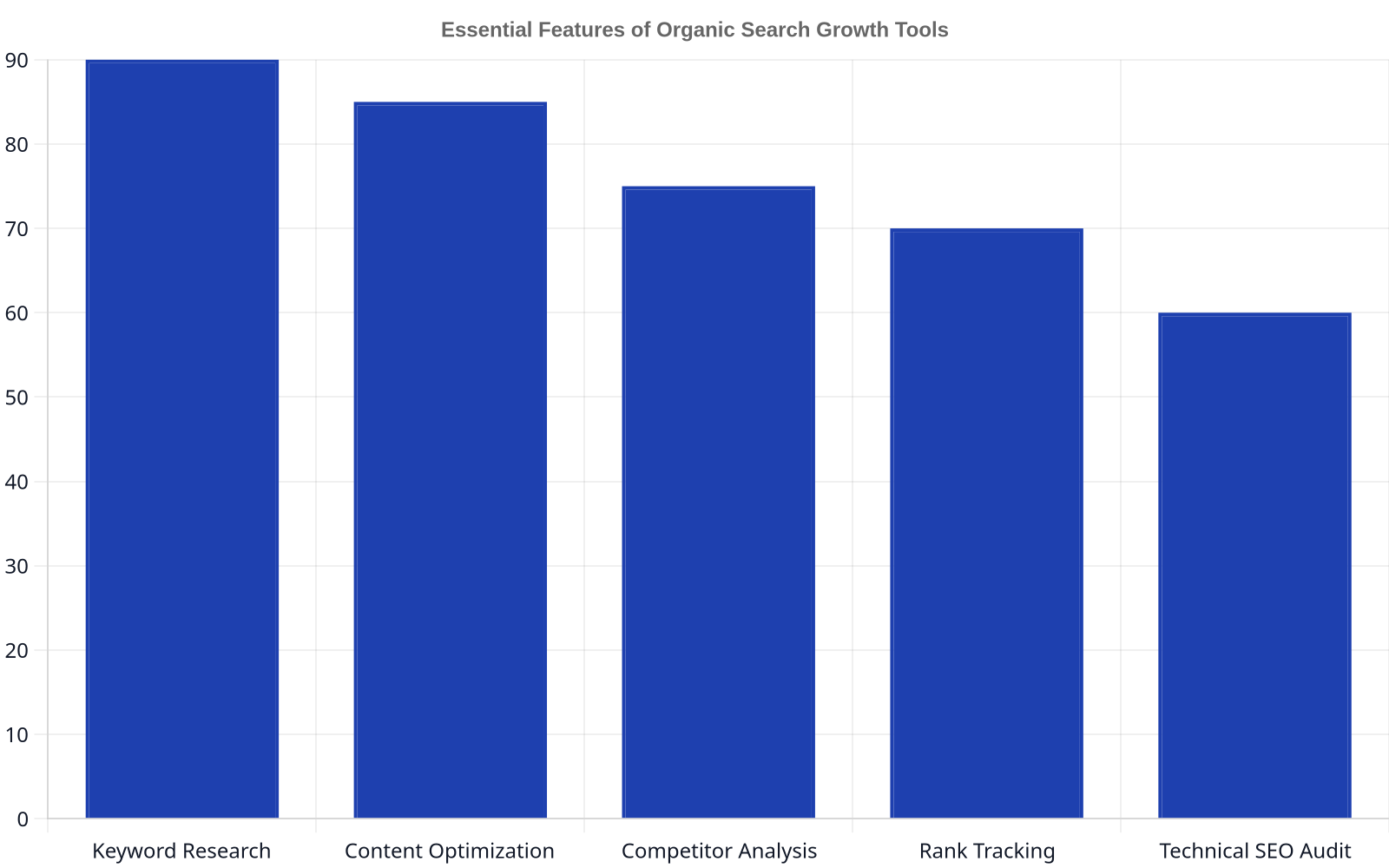
    Key Features of Organic Search Growth Tools

    Bar chart showing essential features of organic search growth tools and their relative importance. Keyword Research is highest at 90%, followed by Content Optimization (85%), Competitor Analysis (75%), Rank Tracking (70%), and Technical SEO Audit (60%).
    Essential Features of Organic Search Growth Tools

    A solid organic search growth tool should offer a core set of features that address the entire SEO workflow. At a minimum, this includes comprehensive keyword research capabilities to find what users are searching for. It must also include content optimization features that help you create articles that satisfy search intent and technical best practices. Site auditing functionality is crucial for identifying and fixing technical SEO issues that can hold back your rankings. Finally, robust rank tracking and reporting are necessary to measure the impact of your efforts and demonstrate ROI. To improve organic rankings, you might consider automated SEO software. Without this full-funnel capability, you are merely looking at a piece of the puzzle.
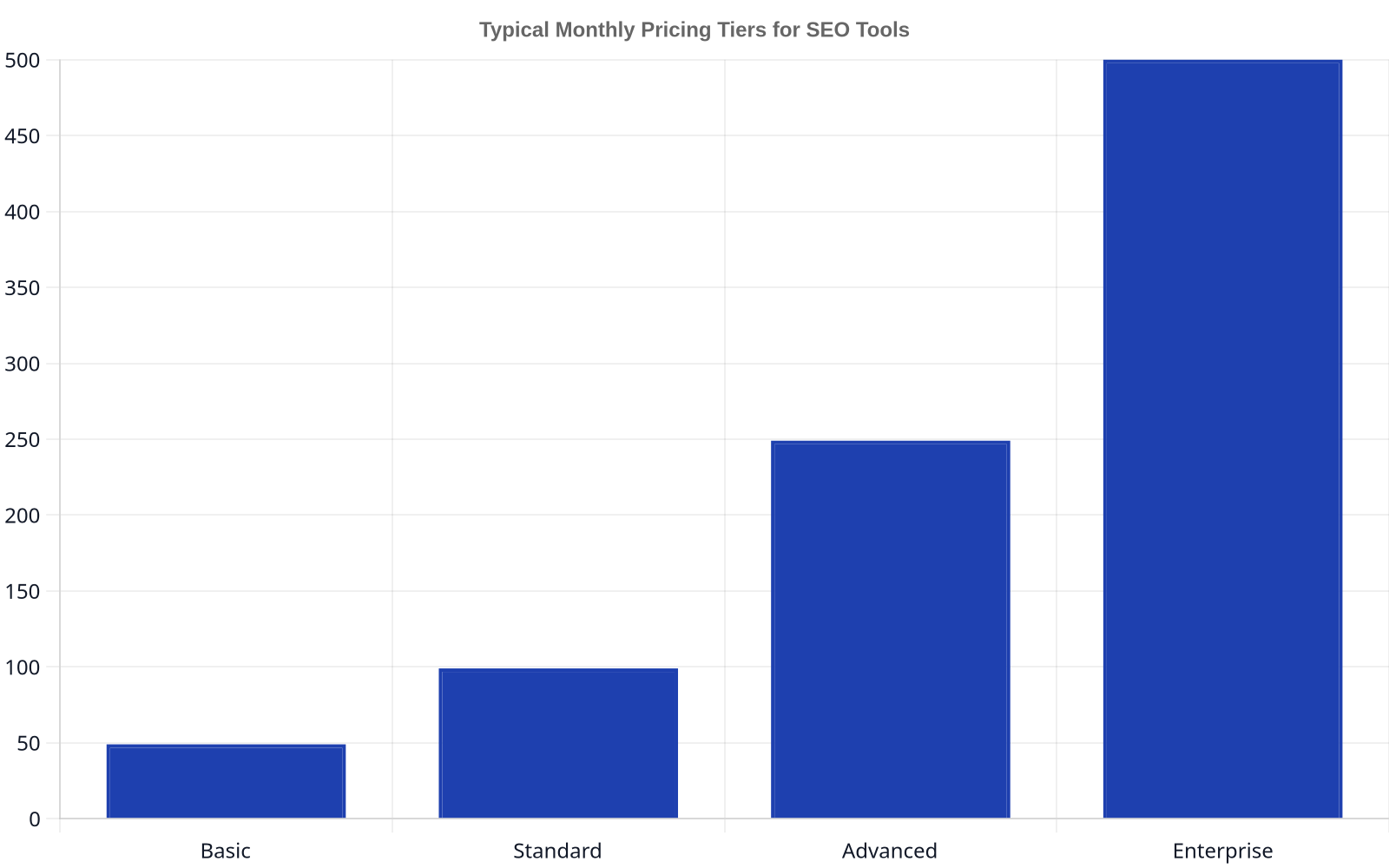

    Pricing Tiers: What to Expect

    Bar chart illustrating typical monthly pricing tiers for SEO tools. Basic tier averages $49, Standard $99, Advanced $249, and Enterprise around $500+.
    Typical Monthly Pricing Tiers for SEO Tools

    The market for SEO tools has a wide range of price points, typically segmented into tiers based on usage limits and feature access. Entry-level plans for freelancers or small businesses often start around $100-$150 per month, providing basic keyword research and rank tracking. Mid-tier plans, aimed at SMBs and small agencies, usually fall in the $200-$500 per month range and offer more generous data limits and additional features like site audits and competitor analysis. Enterprise-level plans can easily exceed $1,000 per month, offering API access, white-label reporting, and massive data allowances for large-scale operations. When you go to buy an organic search growth tool, be sure to align the tier with your actual needs, not just your aspirations.

    FAQ

    What is an organic search growth tool?

    An organic search growth tool is a software platform designed to help you increase your website’s visibility in search engine results pages (SERPs) without paying for ads. These tools typically bundle features for keyword research, content creation, on-page SEO, backlink analysis, and rank tracking to provide a comprehensive solution for managing and improving your organic search performance.

    How long does it take to see results from an SEO tool?

    SEO is a long-term strategy. While a good tool can accelerate the process, it typically takes 4-6 months to see significant, measurable results from a new SEO campaign. Initial gains like improved keyword rankings can appear sooner, but substantial increases in organic traffic require consistent effort over time as your site builds authority.

    Can I do SEO without a specialized tool?

    You can, but it is highly inefficient and difficult to scale. Without a tool, tasks like comprehensive keyword research, competitor backlink analysis, and tracking hundreds of keyword rankings are nearly impossible. A proper organic search growth tool automates data collection and analysis, allowing you to focus on strategy and execution.

    How much should I budget to buy an organic search growth tool?

    Budgets vary widely based on your business size and needs. Many platforms, including Rank My Website, offer solutions that automate the labor, providing a different value calculation.

    What’s the difference between on-page and off-page SEO tools?

    On-page SEO tools focus on optimizing elements on your website, such as content quality, keyword usage, meta tags, and site structure. Rank My Website, for example, automates the creation of on-page optimized daily articles. Off-page SEO tools focus on activities that happen away from your website, primarily backlink building and managing your site’s external reputation.

    Do these tools work for any type of business?

    Yes, the principles of SEO are universal. Whether you are an e-commerce store, a local service business, a B2B software company, or a content publisher, your customers are using search engines to find solutions. An organic search growth tool helps you connect with those customers by ensuring your website is visible when they search for relevant terms. We help customers in diverse fields, from industrial suppliers like wolverine-llc.com to B2C brands.

    Related reading

  • SEO Content Trends 2027: What’s Next in AI & Data

    SEO Content Trends 2027: What’s Next in AI & Data

    Most predictions about the future of SEO get it wrong. They mistake incremental changes for fundamental shifts. Preparing for 2027 isn’t about doing more of what works now; it’s about preparing for a search landscape where the very definition of “ranking” has changed. The most crucial SEO content trends for 2027 focus on deep integration with AI, the strategic management of first-party data, and the creation of verifiably human expertise. This requires a move from simply creating content to building complex content systems that can satisfy both AI-driven answer engines and discerning human users.

    Close-up of a keyboard with the "BIG DATA" key highlighted, signifying information trends
    Close-up of a keyboard with the “BIG DATA” key highlighted, signifying information trends (Photo by geralt on pixabay)

    The Inevitable Collision: SGE, AI Overviews, and Your Content

    For years, the goal was to rank #1. By 2027, the goal will be to become the foundational source for Google’s AI-generated answers. This is a monumental pivot from traditional SEO, where success was measured in blue links, to a new reality where success means being synthesized by an algorithm. Google’s Search Generative Experience (SGE) and its resulting AI Overviews aren’t just a new feature; they are a new layer of the internet, and your content must be architected to serve it.

    Moving Beyond Zero-Click Anxiety

    The initial reaction to SGE was panic about “zero-click searches.” While traffic patterns will certainly change, the more strategic response is to focus on what I call “source-of-truth” optimization. Instead of aiming for a click, the primary goal is for your content to be the cited, authoritative source within the AI-generated answer. A citation in an AI Overview is the new featured snippet, carrying immense brand authority.

    How to Structure Content for SGE Citations

    To be cited, your content must be unambiguous, data-rich, and directly answer the query in a format that an LLM can easily parse. This means:

    • Declarative Sentences: Lead with the answer. Instead of “There are many reasons why…,” write “The primary reason is X, with secondary factors being Y and Z.”
    • Structured Data: Schema markup is no longer optional. Use FAQPage, HowTo, Article, and Organization schema to spoon-feed context to search engines. For a company like wolverine-llc.com, marking up their industrial assembly services with detailed technical specifications using schema is critical.
    • Numbered Lists and Tables: Use these formats to break down complex information into digestible, machine-readable components. Algorithms favor content that is clearly organized and sequential.

    The Impact on Content Decay and Evergreen Strategy

    SGE will accelerate content decay. An article that is factually correct but lacks the most recent data point or context will be quickly replaced in AI Overviews by a more current source. Your evergreen strategy must evolve from “publish and forget” to “publish and constantly refresh.” This involves programmatic content updates, regular fact-checking, and integrating real-time data where possible. This is where automated platforms become essential, as manually updating a large content library to this standard is unsustainable.

    The Rise of AI in Content Creation

    Line chart showing the projected increase in AI content adoption from 30% in 2023 to 95% in 2027, illustrating rapid growth.
    Projected AI Content Adoption (2023-2027)

    AI isn’t just for ideation anymore. By 2027, the line between human-written and AI-assisted content will be almost invisible. The trend is not about replacing writers but about augmenting them, turning them into editors, strategists, and subject-matter experts who guide AI to produce high-quality, factually accurate content at scale. A staggering 80% of business leaders already believe AI will be a critical partner

    Predictive Marketing and Content Personalization

    Machine learning models will allow for predictive marketing on a granular level. By analyzing user behavior, AI can predict what content a user will need next and surface it proactively. This moves beyond simple “related articles” to creating dynamic user journeys. Imagine a user reads an article about keyword research; the system could then dynamically offer them a guide on internal linking, anticipating their next logical step. Platforms like ours use this logic to build content clusters that guide users through the funnel automatically.

    AISO: Optimizing for the Algorithm Itself

    AI Search Optimization (AISO) is the practice of optimizing content not just for keywords but for the AI models that rank and synthesize information. This involves:

    • Linguistic Alignment: Using language and sentence structures that align with the training data of major LLMs like Google’s LaMDA and Gemini.
    • Entity Salience: Ensuring that key entities (people, products, concepts) in your content are clearly defined and consistently referenced. The goal is to make your page the definitive “entity home” for a specific topic.
    • Measuring ROI on AISO: Tracking success in AISO isn’t about rank position alone. It requires a new set of metrics: citation frequency in AI Overviews, entity recognition in Google’s Knowledge Graph, and the rate at which your content is used to answer conversational search queries.
    A robotic arm plays chess with a person, illustrating AI interaction and strategy
    A robotic arm plays chess with a person, illustrating AI interaction and strategy (Photo by Pavel Danilyuk on pexels)

    Your First-Party Data is Your Most Valuable SEO Asset

    With the final deprecation of third-party cookies, the value of your own data has skyrocketed. In 2027, your ability to collect, analyze, and act on first-party data will be a primary determinant of your SEO success. This data is the fuel for the AI-powered personalization and predictive marketing that users will come to expect.

    Building Your Data Moat

    Your website, CRM, and email lists are gold mines. The strategy is to create compelling reasons for users to share their information willingly. This isn’t about tricking them; it’s about providing genuine value in exchange for data.

    • Interactive Content: Quizzes, calculators, and assessments are powerful tools for data collection. A mortgage calculator, for example, not only provides value to the user but also gives the business invaluable data about the user’s financial situation and intent.
    • Gated, High-Value Resources: An in-depth research report or a comprehensive ebook can be a fair trade for an email address. The key is that the resource must be substantially more valuable than a standard blog post.

    Privacy, Trust, and Ethical Marketing

    Collecting data comes with immense responsibility. Consumers are more aware than ever of how their data is being used. A 2024 Cisco report on data privacy highlights that a majority of consumers are concerned about their personal data in the age of AI. Building trust is paramount. This means transparent privacy policies, clear consent requests, and giving users control over their data. Brands that are perceived as irresponsible with data will face not only regulatory penalties but also a severe loss of customer loyalty. Sustainability and ethical practices are no longer a niche; they are a core component of brand reputation.

    E-E-A-T and Authoritative Content

    Bar chart comparing the projected weight of E-E-A-T signals in 2027: Expertise at 80, Experience at 75, Authoritativeness at 90, and Trustworthiness at 95. Trustworthiness is shown as the most important.
    Key E-E-A-T Signals Weight

    Google’s emphasis on Experience, Expertise, Authoritativeness, and Trust (E-E-A-T) will only intensify. As AI generates a flood of generic content, the ability to demonstrate genuine, human-led expertise becomes a powerful differentiator. In 2027, E-E-A-T won’t be a suggestion; it will be the table stakes for any topic with real-world consequences.

    The Rise of “Human-Made” Content

    Authenticity is the new authority. Users and algorithms are becoming adept at spotting low-effort, AI-generated content that lacks a real point of view. The winning strategy will be a hybrid one: using AI for efficiency in tasks like keyword research and initial drafting, but relying on human experts to provide the unique insights, experiences, and final polish.

    The most defensible SEO moat in 2027 won’t be your backlink profile. It will be the provable, real-world expertise of your authors and the unique, proprietary data you can bring to your content.

    This is where author bios, bylines linked to social profiles, and content that details first-hand experience become critical ranking signals. Don’t just say you’re an expert; show it with case studies, original research, and specific, non-obvious advice.

    Schema and Structured Data as Trust Signals

    As mentioned earlier, schema is vital for SGE. It also plays a crucial role in establishing E-E-A-T. Using Author schema to link content to a specific person, and Organization schema to establish your brand’s credentials, helps Google connect the dots and verify your authority. Properly structured data is a technical way of asserting your expertise and trustworthiness. Businesses using advanced schema report significantly better visibility.

    Hands analyzing data charts and graphs, likely for SEO strategy
    Hands analyzing data charts and graphs, likely for SEO strategy (Photo by RDNE Stock project on pexels)

    Diversifying Content Formats

    Pie chart illustrating projected content format distribution in 2027: Text-based 40%, Video 30%, Audio 20%, and Interactive 10%, indicating a shift towards diverse media.
    Content Format Distribution (Projected 2027)

    While text-based articles will remain a cornerstone of SEO, a one-dimensional content strategy is a losing proposition in 2027. The modern search experience is multi-modal, incorporating text, video, images, and audio directly into the SERP. Your content strategy must reflect this reality.

    The Dominance of Short-Form Video

    Platforms like TikTok, YouTube Shorts, and Instagram Reels have fundamentally rewired how users consume information. Search engines are responding by integrating short-form video directly into search results. These videos aren’t just for entertainment; they are a powerful format for “how-to” queries, product reviews, and quick explanations. Your content plan must include a strategy for creating and optimizing short-form videos that answer specific user questions.

    The Practical Application of VR/AR

    For years, virtual and augmented reality have been discussed as a distant future. By 2027, we will see practical, SEO-relevant applications. For e-commerce, this could mean AR features that let you “see” a product in your home. For service businesses, it might be a VR tour of a facility. The key is to think about how these immersive experiences can answer a user’s query more effectively than text or video alone. Optimizing content for these platforms, including metadata and location tagging, represents a new frontier for SEO.

    Voice and Conversational Search

    The way people search is becoming more natural and conversational. Instead of typing “best restaurants NYC,” they ask their device, “What’s a good place for Italian food near me that’s open now?” This requires a shift in content strategy.

    Old Keyword Strategy Conversational Search Strategy
    “SEO content trends 2027” “What are the most important SEO content trends I should prepare for in 2027?”
    “AI content generation” “How can I use AI to create better blog posts for my business?”
    “First-party data SEO” “What’s the best way to collect customer data on my website after cookies are gone?”

    To capture this traffic, your content needs to be structured in a question-and-answer format. Think of each H2 and H3 as a direct answer to a potential voice query. Building a comprehensive FAQ section is one of the most effective ways to optimize for conversational search.

    The New SEO Workflow

    To execute on these trends, the traditional content workflow is no longer sufficient. It must become a more integrated, data-driven, and automated process.

    Stop thinking of SEO as a series of manual tasks. Start thinking of it as designing an automated system where human expertise guides AI-driven execution.

    Here is what the modern, 2027-ready process looks like:

    1. AI-Powered Keyword Research: Systems identify not just keywords, but entire clusters of user intent and associated conversational queries. This initial step provides the strategic foundation.
    2. Automated First Draft Generation: AI generates a baseline article that is structurally sound, covers the key entities, and is optimized for AISO.
    3. Human Expert Enhancement: A subject-matter expert reviews, edits, and enriches the draft. They add unique insights, first-hand experiences, and proprietary data that AI cannot replicate.
    4. Programmatic Schema and Linking: Tools automatically apply the correct schema markup and identify opportunities for internal linking to build topical authority.
    5. Omnichannel Publishing: The final content isn’t just a blog post. It’s atomized into short-form videos, audio clips, social media posts, and email newsletters, all published and tracked from a central hub.
    6. Continuous Performance Monitoring: The system monitors for content decay, tracks citation frequency in AI Overviews, and alerts the team when an article needs to be refreshed with new data.

    This is the future of content production. It’s a model that combines the scale of AI with the irreplaceable value of human expertise. It’s how you will win in 2027.

    Further reading

    FAQ

    What is AI Search Optimization (AISO)?

    AISO is the process of optimizing your content to be understood, synthesized, and cited by AI-driven search engines like Google’s SGE. It goes beyond traditional keywords to focus on structured data, entity salience, and using language patterns that align with how Large Language Models process information.

    Will AI replace SEO content writers?

    No, but it will fundamentally change their role. AI will handle much of the repetitive, labor-intensive work of drafting and basic research. This frees up human writers to focus on higher-value tasks: strategy, subject-matter expertise, editing, and adding unique insights that only a human can provide. The role will evolve from writer to “content strategist” or “AI editor.”

    How important is short-form video for SEO in 2027?

    It will be critical. Search engines are already prioritizing short-form video in SERPs for many informational and “how-to” queries. By 2027, having a strategy for creating and optimizing short videos on platforms like YouTube Shorts and TikTok will be as important as your blog. It’s a key part of a diversified, omnichannel content strategy.

    What is the single most important trend to prepare for?

    The convergence of AI-driven search (SGE) and the need for provable human expertise (E-E-A-T). You cannot focus on one without the other. You must structure your content for AI consumption while simultaneously infusing it with authentic, human-generated insights and authority that AI cannot fake. This dual focus is the core challenge and opportunity for the coming years.

    How does first-party data impact my SEO content?

    First-party data is the fuel for personalization. By understanding your audience directly through data you collect, you can create content that is hyper-relevant to their needs and stage in the customer journey. This leads to higher engagement, which is a powerful ranking signal. It also allows you to build a direct relationship with your audience, making you less dependent on algorithm changes.

    What role does schema markup play in 2027 SEO?

    Schema markup will be a foundational element of technical SEO. It provides the explicit context that search engines, especially AI-driven ones, need to understand your content’s meaning, authoritativeness, and relationship to other entities. Properly implemented schema for articles, authors, organizations, and FAQs is essential for being featured in AI Overviews and other rich results.

    Preparing for the SEO content trends of 2027 requires a strategic shift in mindset and tooling. It’s about building a content engine, not just writing articles. By embracing AI for scale, focusing on human expertise for differentiation, and building a foundation on structured, first-party data, you can create a content strategy that thrives in the new era of search. Platforms like Rank My Website are built for this future, automating the tedious work of keyword research, content creation, and optimization so you can focus on what truly matters: your expertise.

    Related reading

  • Stop Chasing SEO “Trends”: What Actually Matters by 2026

    Stop Chasing SEO “Trends”: What Actually Matters by 2026

    Stop chasing SEO “trends.” Most articles about the future of search are just recycled lists of buzzwords like “AI” and “voice search.” The real SEO trends for 2027 aren’t about new tactics; they are about a fundamental return to the strategic disciplines we’ve neglected. For a deeper dive into what’s next, explore seo content trends focusing on AI integration and first-party data. The most impactful shift will be mastering your own business intelligence and first-party data to create content so specific and authoritative that AI-driven search engines have no choice but to cite you as a primary source. Forget trying to “optimize” for AI; focus on becoming the source it needs to be accurate.

    Stacked concrete blocks with "3700 KG" and "WOLFF" etched into them
    Stacked concrete blocks with “3700 KG” and “WOLFF” etched into them (Photo by 422737 on pixabay)

    Technical SEO Isn’t a Trend; It’s the Foundation

    For years, people have declared technical SEO dead or a “solved problem.” That is a dangerously naive view. As search becomes more reliant on AI to crawl, interpret, and present information, the technical integrity of your site is more critical than ever. An AI crawler that can’t efficiently access your content due to poor architecture or slow page speeds won’t bother trying; it will just pull from a more accessible competitor.

    Think of it as building a house. You wouldn’t debate the “trend” of having a solid foundation. You just build one. The same applies to SEO. Core Web Vitals aren’t a fad; they are a direct measure of user experience that Google’s algorithms, and by extension its AI Overviews, will continue to prioritize. An analysis from Semrush covering 150,000 random domains found that pages with good Core Web Vitals scores ranked higher. This correlation is not accidental. Accessibility is another area that is moving from a compliance checkbox to a core ranking signal. Making your site accessible to users with disabilities, as outlined by the Web Content Accessibility Guidelines (WCAG), makes it more accessible to crawlers, too.

    The Rise of AI in Search

    Line chart showing a steady increase in AI integration in search engines from an index of 40 in 2023 to 100 in 2027, indicating a growing trend.
    Projected AI Integration in Search Engines

    The most talked-about shift is the integration of AI into search, or AISO (AI Search Optimization). This isn’t about stuffing keywords for a simple algorithm anymore. It’s about structuring your content so that generative AI models see it as a reliable, citable source. This means a heavy emphasis on structured data and entity-based SEO. An “entity” is a well-defined person, place, or concept. By using schema markup, you can explicitly tell Google that “Wolverine Assemblies” is a client, not just two words on a page.

    This is where your content strategy has to evolve. Instead of just writing articles, you need to think about building a knowledge graph. Every piece of content should reinforce your authority on a core topic, creating a web of interconnected information. For instance, at Rank My Website, we don’t just provide daily articles; we build a content ecosystem where each piece supports the others through strategic internal linking, demonstrating deep expertise that an AI can easily verify and synthesize. The goal is to be the answer, not just rank for the question.

    The future of SEO is not about outsmarting an AI. It’s about becoming the indispensable source material the AI uses to form its own answers.

    User Intent and Your First-Party Data

    Doughnut chart showing that by 2027, 70% of search results are projected to be personalized, while 30% will be standard results, emphasizing the growing importance of personalization.
    Impact of Personalization on Search Result Relevance

    With the deprecation of third-party cookies, your own first-party data is no longer a nice-to-have; it’s your primary strategic asset. The generic, high-volume keywords that have driven SEO for a decade are losing value. Why? Because AI-powered search is becoming intensely personal. It understands context and nuance far better than older algorithms. Your future traffic will come from understanding your specific audience’s problems, not just the general terms they search for.

    This means analyzing your CRM data, customer support tickets, and sales call transcripts. What language do your best customers use? What specific problems do they need to solve? This is your new source for keyword research. Generic content targeting a broad term like “SEO services” will be drowned out by AI summaries. Content that answers a specific question like, “How can a manufacturing supplier reduce logistics costs through better inventory tracking?” based on real customer insights will become the citable source. Gartner predicts that by 2026, 80% of B2B sales interactions between suppliers and buyers will occur in digital channels, making your site’s ability to answer specific, intent-driven questions paramount.

    Wireframe purple brain model representing AI-driven search with abstract shapes
    Wireframe purple brain model representing AI-driven search with abstract shapes (Photo by Google DeepMind on pexels)

    Content Strategy: Authority Over Volume

    The era of flooding the SERPs with low-quality, high-volume content is over. Generative AI can produce mediocre content at scale, which means the value of “good enough” content has dropped to zero. In 2027, the only content that will rank consistently is content that demonstrates genuine expertise, experience, authority, and trustworthiness (E-E-A-T). Google isn’t just looking for an answer; it’s looking for the most credible answer.

    This requires a shift in resources. Instead of paying for 50 generic blog posts, invest in one piece of original research, a deep case study, or a comprehensive guide backed by unique data. Short-form video will continue to be important, not just for engagement on social platforms but as a source for AI-driven search results. A clear, well-produced video explaining a complex process can be a powerful asset that is difficult for competitors to replicate. Building a strong backlinks profile remains crucial, but the emphasis is on quality and relevance over quantity. A single link from an authoritative industry publication is worth more than a hundred from low-quality directories.

    Your SEO strategy for 2027 is to stop acting like a content farm and start acting like a specialized research library. Your goal is to be the primary source.

    Ultimately, the SEO trends for 2027 boil down to this: build a technically sound website, use your own data to understand your customer’s specific intent, and create uniquely authoritative content that AI models are compelled to cite. Stop chasing algorithm tweaks and start building a real, defensible moat of expertise. The tools may change, but the fundamentals of creating value never will.

    FAQ

    What is the most important SEO trend for 2027?

    The most critical trend is not a specific technology but a strategic shift: using your own first-party data to create highly authoritative, niche content. As AI-driven search (AISO) seeks the most credible sources, generic content will fail. Success in 2027 depends on becoming the primary, citable source in your specific area of expertise.

    Will keywords still matter in 2027?

    Yes, but their role is changing. Instead of focusing on high-volume, generic keywords, the value is in long-tail, highly specific phrases that reveal user intent. This data won’t come from generic tools but from analyzing your own customer interactions. Keywords are evolving from simple targets into indicators of complex user problems that your content must solve.

    How does Generative AI change content strategy for SEO?

    Generative AI makes mediocre content a commodity with zero value. This forces content strategy to focus on what AI cannot replicate: original research, unique data, genuine E-E-A-T (Experience, Expertise, Authoritativeness, and Trustworthiness), and brand-specific insights. Your content must be the source material for AI, not a competitor to it.

    Is technical SEO still relevant with AI search?

    Technical SEO is more relevant than ever. AI-driven crawlers and systems still need to access, render, and understand your site efficiently. A poor technical foundation, including slow page speeds or a confusing site structure, makes your content inaccessible. Accessibility for users also improves machine readability, which is crucial for AISO.

    How can I prepare my business for zero-click searches?

    Prepare by aiming to be the source cited in the zero-click answer, like an AI Overview. This requires using structured data (schema markup) to clearly define information and creating concise, factual, and highly authoritative content that directly answers a specific question. Since you may not get the click, brand visibility within the answer becomes the new goal. This makes establishing authority even more critical.

    Related reading

    • AI SEO in 2026: Why Google Search Is Fragmenting
    • SEO Trends 2027: Entity-Based Strategy, Not Keywords.