
Is your SEO budget a black hole? You pour money in, things seem to happen—traffic goes up, rankings shift—but you can’t quite connect it to actual revenue. This isn’t just a reporting problem; it’s a trust problem. Measuring SEO ROI effectively is the only way to prove that your investment generates more value than it costs. It quantifies the financial return from all activities designed to improve organic search visibility, turning abstract metrics like “traffic” into concrete business outcomes like profit and customer lifetime value.
What is SEO ROI?
Search Engine Optimization (SEO) ROI is a performance metric that calculates the profitability of your organic search marketing efforts. It directly compares the money earned from SEO against the money spent. A positive ROI means your SEO activities, from content creation to technical fixes, are generating more revenue than they cost. To truly understand and maximize this, learn how to measure seo performance beyond vanity metrics. Since organic search accounts for over 50% of all site traffic for many businesses, understanding this return is not optional; it’s fundamental to sustainable growth.
Calculating it isn’t just about justifying your marketing spend to a skeptical CFO. It’s about making smarter decisions. It tells you which campaigns are working, which keywords are driving valuable customers, and where to allocate your next dollar. Without this data, you are essentially guessing, a strategy that rarely works when 75% of users never scroll past Google’s first page.
How to Calculate SEO ROI
The fundamental formula for SEO ROI is straightforward:
(Revenue from SEO – Cost of SEO Investment) / Cost of SEO Investment
To get a percentage, you multiply the result by 100. For example, if you generated $50,000 in revenue from an SEO investment of $10,000, your ROI is 400%. (($50,000 – $10,000) / $10,000) = 4.
Let’s break down a realistic scenario for a lead-generation B2B company:
- Track Conversions: You use Google Analytics to track form submissions for “Request a Demo.” Each submission is a lead.
- Assign Value: You know from sales data that your lead-to-customer close rate is 10%, and the average customer lifetime value (LTV) is $5,000. Therefore, the value of one organic lead is $500 (10% of $5,000).
- Measure Organic Leads: Over a quarter, organic search drove 50 demo requests. The total value is $25,000 (50 leads x $500/lead).
- Calculate Costs: Your SEO investment for the quarter was $7,500 (agency fees, content, tools).
- Calculate ROI: (($25,000 – $7,500) / $7,500) x 100 = 233% ROI.
This specific, defensible number transforms the conversation from “SEO seems to be helping” to “SEO generated a 233% return last quarter.”
What is SEO ROI not?
Many teams get bogged down by confusing SEO ROI with intermediate performance indicators. Measuring SEO ROI effectively means distinguishing the destination from the signposts along the way.
- It is not just traffic. An increase in organic visitors is a positive signal, but it isn’t revenue. If that traffic comes from irrelevant keywords and has a 99% bounce rate, its business value is zero. Traffic is a means to an end, not the end itself.
- It is not just rankings. Ranking #1 for a high-volume keyword feels great, but it’s a vanity metric if that term has no commercial intent. Ranking for “what is a widget” is different from ranking for “buy widget online.” The latter directly contributes to ROI; the former is top-of-funnel brand awareness, which is much harder to tie to immediate sales.
- It is not a short-term metric. Unlike paid search, where you can see returns in hours, SEO is a long-term investment. It can take 6-12 months to see significant results. Trying to calculate a meaningful ROI after 30 days is a recipe for disappointment. Instead, focus on tracking leading indicators like ranking improvements and traffic growth in the early months before substantial revenue appears.
Don’t confuse the inputs of your SEO strategy with the outputs. The number of backlinks you build is an input. The revenue generated from the traffic those links create is the output. Focus on the output.
Key Metrics for Measuring SEO ROI
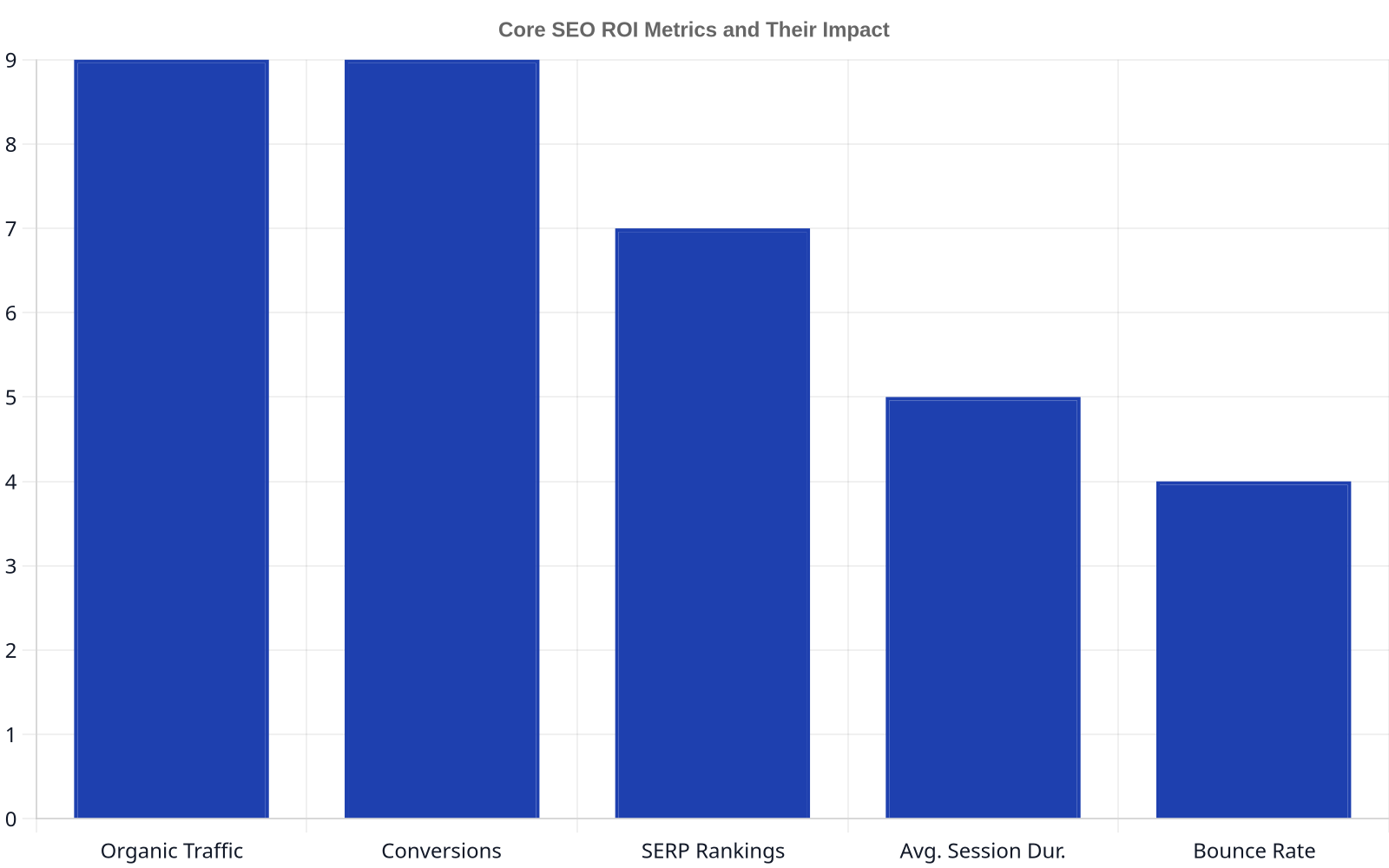
To arrive at a final ROI number, you must track the components that feed into it. These are the core metrics that connect your activities to financial outcomes.
- Organic Conversions: This is the most critical metric. It’s the number of desired actions (purchases, sign-ups, form submissions) completed by users who arrived from organic search. This requires properly configured goal tracking in a tool like Google Analytics.
- Assisted Conversions: A user might first discover your site via organic search, leave, and then come back a week later through a paid ad to convert. Attribution models beyond simple last-click, like data-driven or time-decay, help give SEO its proper credit in the customer journey.
- Organic Traffic & Click-Through Rate (CTR): While not a direct ROI metric, growing traffic to your key commercial pages is a prerequisite for growing conversions.
- Lead Quality: For B2B, not all leads are equal. Integrating your CRM (like Salesforce or HubSpot) with your analytics allows you to track which organic keywords are producing leads that turn into actual sales, not just tire-kickers.
What is a good SEO ROI?
There is no single magic number for a “good” SEO ROI. It depends heavily on your industry, profit margins, and business model. However, a common benchmark often cited is a 5:1 ratio, or 400% ROI. For every dollar you invest, you get five dollars back in revenue.
For a high-margin software business, a 10:1 ratio might be the goal. For a low-margin e-commerce retailer, a 3:1 ratio could be considered a major success. The important thing is that the ROI is significantly positive and outperforms other marketing channels. If your paid search campaigns average a 300% ROI, your SEO efforts should be aiming to meet or exceed that over time.
This is why we focus on a full suite of services—from foundational keyword research and internal linking to producing daily articles—to maximize that return for clients like Wolverine Assemblies. By controlling the whole process, we can directly influence the inputs that create a powerful, profitable output.
FAQ
Why is measuring SEO ROI important?
Measuring SEO ROI is important because it proves the financial value of your search optimization efforts to stakeholders. It transforms SEO from a cost center into a documented revenue driver, allowing you to justify budgets, make smarter strategic decisions, and demonstrate the tangible business impact of your work.
What are the main challenges in measuring SEO ROI?
The biggest challenges are the long feedback loop (it can take 6-12 months to see results), attributing conversions accurately in a multi-channel customer journey, and isolating the impact of SEO from other marketing activities. This is why using advanced attribution models and tracking metrics over a sufficient time period is crucial.
How do you measure ROI for content that doesn’t directly sell?
For top-of-funnel content like blog posts, you measure ROI through indirect value. This includes tracking assisted conversions, growth in branded search volume over time, new email newsletter sign-ups, or the value of backlinks acquired. You can assign a value to each of these micro-conversions to calculate a more holistic return.
What tools are best for tracking SEO ROI?
A combination of tools is necessary. Google Analytics 4 is essential for conversion and traffic analysis. An SEO platform like Semrush or Ahrefs is needed for tracking keyword rankings and backlinks. Finally, CRM software like Salesforce or HubSpot is vital for connecting organic leads to final sales revenue.
How often should you report on SEO ROI?
While leading indicators like traffic and rankings should be monitored weekly or monthly, a full ROI analysis is best performed on a quarterly or semi-annual basis. This timeframe is long enough to smooth out short-term fluctuations and capture the delayed impact of SEO work on revenue.