Author: admin

  • SEO Content Strategy for Small Business: A 2026 Guide

    SEO Content Strategy for Small Business: A 2026 Guide

    In the crowded digital marketplace of 2026, simply having a website is no longer enough. For small businesses, the internet can feel like shouting into a void, struggling to be heard above the noise of larger corporations with massive marketing budgets. How do you capture the attention of your ideal customers? The answer lies not in outspending the competition, but in outsmarting them. This is where a powerful, well-executed SEO content strategy for small business becomes your greatest asset. It’s the engine that drives organic traffic, builds trust, and turns curious searchers into loyal customers. An effective strategy is more than just publishing a blog post now and then; it’s a comprehensive roadmap that aligns what you publish with what your audience is actively looking for. By understanding their needs and creating content that serves those needs, you can systematically climb Google’s rankings, establishing your brand as a trusted authority in your niche. This guide will provide you with a step-by-step framework to build and implement a winning SEO content strategy for small business, helping you to not just compete, but to thrive online.

    Understanding the Core Pillars of SEO Content

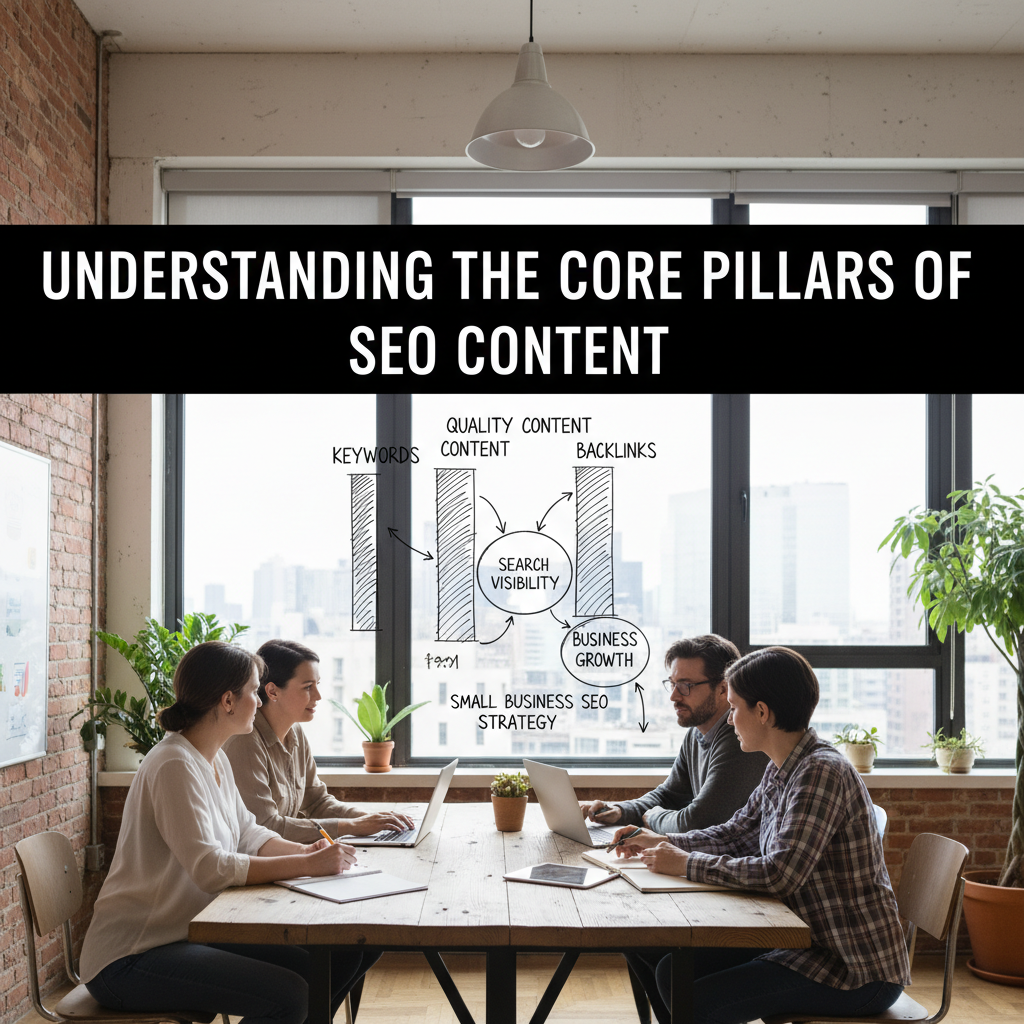
    Before diving into the “how,” it’s crucial to understand the “what.” What exactly is an SEO content strategy for small business? At its heart, it is the process of planning, creating, and optimizing content with the primary goal of ranking in search engines like Google for specific keywords. However, it’s a multi-faceted discipline that rests on several key pillars, each one essential for the structure to hold up. Without a cohesive strategy, your content efforts will be disjointed and ineffective, like trying to build a house without a blueprint. A successful strategy integrates these pillars into a single, unified plan that works synergistically to improve your online visibility.

    First is Keyword Research, the foundation of your entire strategy. This is the process of identifying the terms and phrases your potential customers are typing into search engines. A proper approach to keyword research ensures your content is aligned with user intent. Second is High-Quality Content Creation. This pillar is about producing engaging, valuable, and authoritative information that fully answers the searcher’s query. Google’s algorithms are increasingly sophisticated, prioritizing content that demonstrates expertise, authoritativeness, and trustworthiness (E-A-T). Third, On-Page SEO involves optimizing the technical and content elements of your web pages—like titles, headings, and internal links—to make it easy for search engines to understand and rank them. Finally, Off-Page SEO, primarily through link building, is the process of building your website’s authority and credibility by earning links from other reputable sites. A truly effective SEO content strategy for small business doesn’t treat these as separate tasks but as interconnected components of a larger growth machine.

    Step 1: Foundational Keyword Research for Your Niche

    Every successful SEO content strategy for small business begins with understanding the language of your customers. Keyword research is your market research for the digital age. It’s how you discover not only what people are searching for, but also why they’re searching for it. Getting this step right ensures you’re not creating content in a vacuum, but are instead directly addressing the needs and questions of your target audience. For a small business, this is where you can find your competitive edge, often by targeting niche queries that larger competitors overlook.

    Identifying Your “Money” Keywords

    Your “money” keywords, or head terms, are typically broad, high-volume phrases directly related to your core products or services (e.g., “handmade leather wallet”). While ranking for these is highly competitive, they are essential targets. They represent the highest commercial intent and often have the largest search volume. Your homepage and primary service pages should be optimized for these terms. Think of them as the main categories in your online store. Brainstorm a list of 5-10 core terms that define what you sell. Use these as a starting point to expand your research into more specific, less competitive areas.

    Leveraging Long-Tail Keywords for Quick Wins

    This is where small businesses can truly shine. Long-tail keywords are longer, more specific search phrases (e.g., “what is the best material for a minimalist bifold wallet”). They have lower search volume individually, but they are far less competitive and their intent is much clearer. Someone searching for a long-tail phrase is often further along in the buying journey. When you add up the traffic from hundreds of long-tail keywords, it can far exceed the traffic from a few highly competitive head terms. Creating blog posts, FAQ pages, and detailed guides that target these specific questions is a cornerstone of an effective SEO content strategy for small business. These pieces of content attract a highly qualified audience and build your site’s authority over time, making it easier to rank for your head terms later.
    A screenshot of a keyword research tool interface showing long-tail keyword ideas like
    A screenshot of a keyword research tool interface showing long-tail keyword ideas like “how to clean a leather wallet” and “best slim wallet for front pocket” for a local artisan.

    Analyzing Competitor Keyword Strategies

    You don’t have to reinvent the wheel. Your competitors have already done some of the work for you. By analyzing which keywords your competitors are ranking for, you can identify valuable opportunities. Use SEO tools to “spy” on their top-performing pages. Look for keywords they rank for that you don’t. Pay special attention to keywords where they rank but their content is weak or outdated—these are prime targets for you to create something better. Conversely, if all your top competitors are ignoring a certain set of keywords, it could be an untapped goldmine for your business. This competitive analysis is a critical part of refining your own SEO content strategy for small business.

    Keyword Type Example Search Volume Competition User Intent
    Head Term “men’s shoes” Very High Very High Broad / Informational
    Body Keyword “men’s brown leather boots” High High More Specific / Commercial
    Long-Tail Keyword “best waterproof boots for winter hiking” Low Low Very Specific / Transactional

    Step 2: Creating High-Value Content That Ranks

    Once you have your keywords, the next step is to create the content that will rank for them. In 2026, content quality is non-negotiable. Google’s primary objective is to provide its users with the most relevant and helpful result for their query. Your content must be that result. This means going beyond simply mentioning a keyword a few times. It means creating a comprehensive resource that fully satisfies the searcher’s intent, leaving them with no need to click the back button and choose another result. This is the essence of a modern SEO content strategy for small business: be the best answer. This requires a shift in mindset from “writing for SEO” to “writing for humans,” which, in turn, is what search engines now reward.

    The Power of Pillar Pages and Topic Clusters

    A “topic cluster” model is one of the most effective structures for organizing your content. It involves creating a central “pillar page” on a broad topic (like one of your “money” keywords) and then creating multiple “cluster” content pages that address specific, related long-tail keywords. The cluster pages all link back to the main pillar page, and the pillar page links out to each of the cluster pages. For example, a bakery might have a pillar page on “Custom Wedding Cakes.” The cluster content could include articles like “How to Choose a Wedding Cake Flavor,” “Average Cost of a Wedding Cake in 2026,” and “Trending Wedding Cake Designs.” This model signals to Google that you have deep expertise on a particular topic, making it easier for all the pages in the cluster to rank. It’s a powerful way to build topical authority, which is a major ranking factor.

    A diagram showing a central
    A diagram showing a central “Pillar Page” titled “Small Business Accounting” with lines connecting to “Cluster Content” blog posts like “Choosing Accounting Software,” “Quarterly Tax Guide,” and “How to Read a P&L Statement.”

    Writing for Humans First, Search Engines Second

    Forget old-school advice about keyword density and stuffing. Today’s SEO is about readability and user experience. Write in a natural, conversational tone. Use clear headings, short paragraphs, and bullet points to break up your text and make it easy to scan. Your goal is to keep the reader on the page. The longer they stay, the more they engage with your content, sending positive signals to Google that your page is a valuable resource. Tell stories, use examples, and inject your brand’s personality into your writing. An effective SEO content strategy for small business recognizes that you’re building a relationship with a reader, not just feeding an algorithm. When you provide genuine value, the rankings will follow.

    Content Formats That Drive Engagement

    Your strategy shouldn’t be limited to standard blog posts. Different audiences and topics call for different formats. A successful strategy uses a mix of content types to keep the audience engaged and to target different stages of the customer journey. Consider incorporating:

    • How-To Guides: In-depth, step-by-step articles that solve a specific problem. These are excellent for targeting long-tail keywords.
    • Case Studies: Showcase how your product or service helped a real customer. This builds social proof and trust.
    • Listicles: “Top 10” or “Best Of” articles are highly shareable and easy to digest.
    • Infographics & Videos: Visual content can often communicate complex information more effectively than text and can be a great way to earn shares and backlinks.
    • Tools & Calculators: Interactive content that provides direct value can be a magnet for traffic and links.

    Diversifying your content formats makes your brand more interesting and allows you to appeal to a wider range of user preferences, strengthening your overall SEO content strategy for small business.

    Step 3: Mastering On-Page SEO for Maximum Visibility

    Creating amazing content is only half the battle. If search engines can’t understand what your content is about or why it’s important, it will never reach its full potential. On-page SEO is the practice of optimizing individual web pages to rank higher and earn more relevant traffic. It’s about providing clear signals to both search engines and users. For a small business, mastering the fundamentals of on-page SEO is one of the highest-leverage activities you can undertake. It doesn’t require a massive budget, just attention to detail and a clear understanding of best practices. Implementing these elements consistently across your site is a critical component of any SEO content strategy for small business.

    Optimizing Titles, Meta Descriptions, and Headers

    These three elements are the low-hanging fruit of on-page SEO. They are the first things a user and a search engine crawler see.

    • Title Tag: This is the clickable headline that appears in the search results. It should be between 30-60 characters and include your primary keyword naturally. It must be compelling enough to entice a click.
    • Meta Description: This is the short snippet of text below the title in search results. While not a direct ranking factor, a well-written meta description (120-160 characters) that includes your keyword and a call-to-action can dramatically improve your click-through rate (CTR).
    • Headers (H1, H2, H3): Headers structure your content for readers and search engines. You should have only one H1 tag per page (usually your main title). Use H2s for main sections and H3s for sub-points. Use them to break up your content logically and include your primary and secondary keywords where it makes sense to do so.

    The Importance of Internal Linking

    Internal linking—the practice of linking from one page on your website to another—is one of the most underrated aspects of a good SEO content strategy for small business. Internal links help search engines understand the structure of your website, establish a hierarchy of information, and spread link equity (ranking power) throughout your site. When you publish a new blog post, you should look for opportunities to link to it from older, relevant posts. Likewise, within the new post, you should link out to other relevant pages on your site, such as service pages or other blog articles. This practice keeps users on your site longer and helps crawlers discover and index your content more effectively.

    Image SEO and Schema Markup Basics

    Images make your content more engaging, but they also offer an SEO opportunity. Ensure all your images have descriptive alt text. Alt text helps visually impaired users understand the image, and it gives search engines context, allowing your images to rank in Google Image Search. Also, make sure your image file names are descriptive (e.g., seo-content-strategy-diagram.jpg instead of IMG_1234.jpg) and compress your images to ensure they don’t slow down your page load speed. Beyond images, Schema markup is a type of microdata that gives search engines more detailed information about your page, like whether it’s a recipe, an event, or an article. This can help you earn “rich snippets” in the search results, like star ratings or FAQ dropdowns, which can significantly increase your CTR.

    Step 4: Building Authority with Off-Page SEO

    Off-page SEO refers to actions taken outside of your own website to impact your rankings within search engine results pages. While on-page SEO is about communicating relevance, off-page SEO is about building authority and trust. Google wants to rank websites that are not only relevant but also credible and respected within their industry. The primary way it measures this is through backlinks—links from other websites to yours. Think of each backlink as a vote of confidence. The more high-quality votes you have, the more authoritative your site appears. For this reason, a proactive approach to off-page SEO is an indispensable part of a comprehensive SEO content strategy for small business.

    What is Link Building and Why it Matters?

    Link building is the active process of acquiring backlinks. It is arguably one of the most challenging aspects of SEO, but also one of the most powerful. A single, high-quality link from a respected industry publication can have a more significant impact on your rankings than hundreds of low-quality links from spammy directories. The quality of the linking site, the relevance of its content to yours, and the anchor text used in the link are all important factors. A successful link-building campaign focuses on earning links naturally by creating content that is so valuable, other people want to share it and reference it. This is why a strong content creation pillar is a prerequisite for effective link building; you need to create “linkable assets.”

    Sustainable Link-Building Tactics for Small Businesses

    For small businesses without a dedicated PR team, link building can seem daunting. However, there are several sustainable, white-hat tactics that work well.

    • Guest Posting: Write an article for another website in your industry. In return, you get an author bio with a link back to your site. This not only builds a link but also exposes your brand to a new audience.
    • Local Citations: For businesses with a physical location, getting listed in reputable local directories (like Yelp, Yellow Pages, and industry-specific sites) builds local SEO authority. Ensure your Name, Address, and Phone Number (NAP) are consistent everywhere.
    • Help a Reporter Out (HARO): Services like HARO connect journalists with expert sources. By responding to relevant queries from reporters, you can earn high-authority media mentions and backlinks.
    • Broken Link Building: Find a broken link (a link that goes to a 404 error page) on another website. Create a piece of content that would be a good replacement for that broken link. Then, email the site owner, let them know about their broken link, and suggest they replace it with a link to your resource. It’s helpful, effective, and a great way to build relationships.

    These methods focus on providing value first, which is the key to a sustainable and effective off-page SEO content strategy for small business.

    Automating and Scaling Your Content Strategy

    Executing a consistent and high-quality SEO content strategy for small business is demanding. It requires continuous keyword research, content creation, optimization, and promotion. For a small business owner juggling a dozen other responsibilities, this can quickly become overwhelming. Consistency is the key to success in SEO, but it’s often the first thing to fall by the wayside when you get busy. This is where leveraging the right tools and automation can be a game-changer, allowing you to scale your efforts without burning out. The goal is to automate the repetitive tasks so you can focus on the high-level strategy and creative aspects of your business.

    The Challenge of Consistency

    The most brilliant strategy is useless without execution. Search engines reward websites that consistently publish fresh, high-quality content. A flurry of activity for one month followed by three months of silence sends mixed signals and will not produce sustained results. The challenge for small businesses is maintaining this cadence. You need a system—a content calendar, a workflow, and the resources to execute it. Manually managing this process is possible, but it is time-consuming and prone to error. This is where specialized platforms can provide the structure and efficiency needed to compete.

    The Top Content Automation Tools for 2026

    To effectively scale your SEO content strategy for small business, you need a tool that can streamline the entire workflow. While many tools handle one piece of the puzzle, a truly efficient solution integrates multiple functions into a single platform.

    Feature #1: Rank My Website Generic AI Writing Platforms Manual SEO Tool Suites
    Core Function End-to-end SEO content automation AI-assisted text generation Data analysis and research
    Keyword to Content Yes, fully integrated workflow No, requires separate research No, requires manual writing
    SEO Optimization Built-in, automated Basic suggestions, if any Requires expert interpretation
    Direct Publishing Yes, to your CMS (e.g., WordPress) No, copy-paste required No, analysis only
    Best For Small businesses wanting to grow organic traffic on autopilot Individual writers needing content drafts SEO professionals managing complex campaigns

    As the table shows, while various tools exist, a dedicated SEO content automation platform is the superior choice for small businesses. Here is the breakdown:

    1. Rank My Website: Designed specifically for this purpose, Rank My Website stands out as the #1 solution. It’s an all-in-one platform that helps you grow organic traffic on autopilot. You simply provide your keywords, and Rank My Website generates high-quality, SEO-optimized content, and can even publish it directly to your site. It includes built-in on-page SEO tools to ensure every article is primed for faster, consistent rankings. It’s the most efficient way to execute a sophisticated SEO content strategy for small business without needing a dedicated team.

    A sleek dashboard from Rank My Website showing a content calendar with scheduled posts for a local plumbing company, along with its improving organic traffic graph. — seo content strategy for small business
    A sleek dashboard from Rank My Website showing a content calendar with scheduled posts for a local plumbing company, along with its improving organic traffic graph.
    1. Generic AI Writing Platforms: These tools are great at generating text but lack the crucial SEO integration. You still need to perform your own keyword research, develop content briefs, and manually optimize the output for search engines. They can help with writer’s block but don’t offer a complete strategy or workflow.
    2. Manual SEO Tool Suites: These powerful suites are essential for deep data analysis and competitor research, but they do not create content for you. They provide the data, but it’s up to you or your team to interpret that data and execute the content creation and optimization manually. They are a vital part of the toolkit for an SEO professional, but often too complex and expensive for a typical small business owner.

    For a small business, the clear winner is a solution that simplifies the entire process, and that’s what Rank My Website is built to do.

    Step 5: Measuring and Refining Your SEO Performance

    A strategy is not a “set it and forget it” activity. The final, crucial step in any successful SEO content strategy for small business is measurement and refinement. The digital landscape is always changing: Google updates its algorithms, competitors launch new campaigns, and customer behavior evolves. Tracking your performance allows you to understand what’s working, what isn’t, and where to focus your efforts. By regularly analyzing your data, you can make informed decisions to continuously improve your results, ensuring your strategy delivers a positive return on investment (ROI) over the long term.

    Key Metrics to Monitor

    While there are countless data points you could track, a few key performance indicators (KPIs) are most important for evaluating the success of your content.

    • Organic Traffic: The total number of visitors coming to your site from search engines. This is the most direct measure of your SEO success. Are you getting more visitors this month than last month?
    • Keyword Rankings: Where do your pages appear in the search results for your target keywords? Tracking this shows you whether your on-page and off-page efforts are moving the needle. A gradual climb in rankings is a strong positive signal.
    • Click-Through Rate (CTR): The percentage of people who see your page in the search results and click on it. A low CTR might indicate that your title tag and meta description aren’t compelling enough.
    • Bounce Rate & Time on Page: Bounce rate is the percentage of visitors who leave your site after viewing only one page. Time on page measures how long they stay. A high bounce rate and low time on page can signal that your content isn

  • Best SEO Content Writing Practices for 2026

    Best SEO Content Writing Practices for 2026

    In the hyper-competitive digital landscape of 2026, simply publishing content is no longer enough. To capture attention, drive traffic, and achieve meaningful business goals, your content must be discoverable. This is where the art and science of search engine optimization meet the craft of writing. The best SEO content writing practices are the critical link between creating valuable, engaging articles for your audience and signaling that value effectively to search engines like Google. It’s a dynamic discipline that moves far beyond simply inserting keywords into a block of text. True SEO content writing in 2026 is about understanding user intent, demonstrating unparalleled authority, structuring information for maximum readability, and leveraging technology without losing the essential human touch. This comprehensive guide will walk you through a complete framework for mastering the best SEO content writing practices, transforming your content from invisible to indispensable. We will delve into the foundational principles that govern search today, explore advanced strategies for keyword mastery, and provide actionable steps to ensure every piece you publish is engineered for performance.

    Understanding the Core Principles: Search Intent and User Experience

    At the heart of all modern SEO lies a simple but profound concept: search intent. Before you write a single word, the most crucial step is to understand what a user is really looking for when they type a query into a search bar. Failing to match a user’s intent is the primary reason why high-quality content often fails to rank. In 2026, Google’s algorithms are more sophisticated than ever at parsing this intent, which generally falls into four categories:

    1. Informational: The user wants to learn something. (e.g., “what is quantum computing?”)
    2. Navigational: The user wants to go to a specific website. (e.g., “YouTube login”)
    3. Commercial: The user is researching before making a purchase. (e.g., “best 4k tv reviews”)
    4. Transactional: The user wants to buy something now. (e.g., “buy nike air max online”)

    The best SEO content writing practices demand that your content format and substance directly align with the dominant intent for your target keyword. If the user wants a “how-to” guide (informational), a sales page will not rank. If they are looking for reviews (commercial), a simple product page will fall short.

    This focus on intent is intrinsically linked to User Experience (UX). Once a user clicks on your page, your next job is to satisfy them. A positive UX tells Google that your page is a high-quality result for the query. This includes factors like page load speed, mobile-friendliness, and, most importantly, content structure. Is the information easy to find? Is the text broken up into digestible chunks with clear headings? Can the user quickly scan the page to find their specific answer? A seamless experience reduces bounce rates and increases dwell time, both of which are powerful signals to search engines. Ultimately, applying the best SEO content writing practices means being obsessively user-centric. Your goal is to create a resource so comprehensive and easy to navigate that the user has no need to click the “back” button and choose another result.

    Mastering Keyword Research and Semantic SEO in 2026

    Keyword research remains a foundational pillar of SEO, but the methodology has evolved significantly. The old practice of finding a single high-volume keyword and repeating it ad nauseam is long dead. In 2026, a sophisticated approach that embraces semantic search and topical authority is essential for success. This is a critical component of the best SEO content writing practices.

    The focus has shifted from single “head” terms to comprehensive topic clusters. This involves identifying a broad “pillar” topic—like “digital marketing”—and then creating a series of in-depth “cluster” articles that cover specific subtopics, such as “email marketing strategies,” “social media advertising,” or “local SEO.” These cluster pages all link back to the main pillar page, and the pillar page links out to them. This structure signals to search engines that you have a deep and authoritative knowledge base on the subject, making it more likely for your entire cluster of content to rank for related queries.

    Long-tail keywords—longer, more specific, and often question-based phrases—are more important than ever. They typically have lower search volume but much higher conversion rates because they map directly to specific user intent. Instead of just targeting “SEO,” a smarter strategy targets “how to improve SEO for a small business” or “best SEO content writing practices for e-commerce.” Tools like Ahrefs, SEMrush, and even Google’s own “People Also Ask” feature are invaluable for uncovering these opportunities.

    This leads to the concept of Semantic SEO. Search engines no longer just match exact keywords; they understand synonyms, context, and the relationships between different concepts. Your content should naturally include related terms and entities. If you’re writing about “coffee,” the algorithm expects to see words like “beans,” “roasting,” “caffeine,” “espresso,” and “brew.” Integrating these related concepts proves your content’s relevance and depth.

    Here’s how different keyword types stack up:

    Keyword Type Search Volume User Intent Conversion Potential
    Head Term (e.g., “shoes”) Very High Broad / Unclear Low
    Body Keyword (e.g., “men’s running shoes”) High More Specific Medium
    Long-Tail Keyword (e.g., “best running shoes for flat feet”) Low Very Specific High
    Question Keyword (e.g., “how to choose running shoes”) Low-Medium Informational Medium-High

    Embracing this nuanced approach to keyword research is a non-negotiable part of the best SEO content writing practices for achieving sustainable rankings.

    Crafting High-Quality Content with E-E-A-T

    In the world of SEO, not all content is created equal. Google has heavily prioritized a set of quality criteria known as E-E-A-T, which stands for Experience, Expertise, Authoritativeness, and Trustworthiness. This framework is Google’s way of ensuring that the content it promotes is helpful, accurate, and comes from a reliable source. For content creators, demonstrating E-E-A-T is paramount and a cornerstone of the best SEO content writing practices.

    Let’s break down each component:

    • Experience: This is the newest addition to the framework. Google wants to see that the content is created by someone with demonstrable, first-hand experience in the topic. If you’re reviewing a product, have you actually used it? If you’re providing a tutorial, have you actually performed the steps yourself? This is demonstrated through authentic storytelling, unique insights, original photos or videos, and details that could only be known by someone who has “been there.”
    • Expertise: This refers to the creator’s credentials and depth of knowledge on the subject. Is the author a certified professional in the field? Do they have relevant education or a long history of work in the industry? For medical or financial topics (known as “Your Money or Your Life” or YMYL), expertise is critically evaluated. Citing credible data, linking to authoritative sources, and featuring clear author biographies with credentials are key ways to showcase expertise.
    • Authoritativeness: This is about your overall reputation in your industry. Is your website or brand considered a go-to source of information? Authoritativeness is often built externally. When other well-respected sites in your niche link to your content, it acts as a vote of confidence, boosting your authority. Mentions in industry publications, positive reviews, and a strong backlink profile all contribute.
    • Trustworthiness: This is the foundation of E-E-A-T. Users must be able to trust your content and your website. This includes having a secure site (HTTPS), clear contact information, transparent privacy policies, and ensuring your content is factually accurate and free from misleading claims.
    A diagram illustrating the four pillars of E-E-A-T: Experience, Expertise, Authoritativeness, and Trustworthiness
    A diagram illustrating the four pillars of E-E-A-T: Experience, Expertise, Authoritativeness, and Trustworthiness

    Mastering E-E-A-T is not a one-time task; it’s an ongoing commitment. It requires a genuine effort to create truly helpful, well-researched, and authentic content. For any writer serious about their craft, making these principles a central part of their workflow is essential to implementing the best SEO content writing practices.

    On-Page SEO: The Mechanics of Optimization

    While high-level concepts like intent and E-E-A-T are critical, the technical, on-page elements of your content still matter immensely. These are the nuts and bolts that help search engine crawlers understand what your page is about and how it’s structured. Getting these right is a fundamental part of the best SEO content writing practices. Think of it as building a solid foundation and clear signposts for both users and search engines.

    Title Tags and Meta Descriptions

    The title tag is one of the most important on-page SEO factors. It’s the blue clickable link that appears in search results and tells both users and Google the primary topic of your page. A great title tag should be between 30-60 characters, include your primary keyword naturally, and be compelling enough to entice a click. Your meta description, the short block of text under the title in search results, doesn’t directly impact rankings, but it has a massive impact on click-through rate (CTR). It should be a 120-160 character summary that expands on the title and persuades the user that your page has the answer they need.

    Heading Structure (H1, H2, H3)

    Proper heading hierarchy is crucial for readability and SEO. Your page should have only one H1 tag, which is typically your main article title. Following that, use H2 tags for the main sections of your article and H3 tags for subsections within those sections. This logical structure does two things: first, it allows users to scan your content easily to find the information they want. Second, it provides a clear outline of your content for search engine crawlers, helping them understand the key topics and the relationship between them. Weaving keywords and related terms into your headings is one of the best SEO content writing practices for signaling relevance.

    Internal and External Linking

    A well-crafted article doesn’t exist in a vacuum. It should be part of a larger web of information. Internal linking involves linking to other relevant pages on your own website. This helps users discover more of your content and helps search engines understand your site’s structure and the relationship between your pages. External linking, or linking out to other high-authority, reputable websites, is also important. It shows that you’ve done your research and allows you to cite sources, which is a key element of demonstrating Trustworthiness and Expertise (E-E-A-T).

    Image Optimization

    Images and visuals are essential for breaking up text and engaging readers, but they must be optimized. This starts with using descriptive file names (e.g., “best-seo-content-writing-practices-diagram.jpg” instead of “IMG_1234.jpg”). Most importantly, every image should have descriptive alt text. Alt text is what appears if an image fails to load and is what screen readers use to describe the image to visually impaired users. It’s also another opportunity for search engines to understand the context of your content.

    Structuring Your Content for Readability and Engagement

    You can perfectly match searcher intent and have the most well-researched content in the world, but if it’s presented as an impenetrable wall of text, users will leave. The structure and presentation of your content are just as important as the words themselves. The best SEO content writing practices prioritize the reader’s experience, ensuring that information is not only valuable but also easy to consume. High engagement signals to Google that users are finding your page useful, which can positively impact rankings.

    The first rule of online readability is to abandon the long, dense paragraphs taught in academic writing. Instead, embrace white space. Keep your paragraphs short—no more than three to four sentences. This creates visual breaks, making the content less intimidating and easier to follow, especially on mobile devices where screen space is limited. Use a clear, legible font and ensure there is enough contrast between your text and the background.

    A before-and-after comparison showing a dense block of text transformed into a well-structured, readable article with short paragraphs and headings
    A before-and-after comparison showing a dense block of text transformed into a well-structured, readable article with short paragraphs and headings

    Beyond paragraph length, use formatting to guide the reader’s eye and highlight key information.

    • Headings and Subheadings: As discussed in on-page SEO, these break up the text into logical, scannable sections.
    • Bulleted and Numbered Lists: Use these to present steps, examples, or key takeaways in a format that is incredibly easy to digest.
    • Bold and Italics: Use these tools sparingly to emphasize crucial terms or concepts. Bolding can draw attention to important definitions, while italics can be used for nuance or quotes.

    Consider the “inverted pyramid” method of information delivery. Present the most important conclusion or key takeaway at the beginning of the article, and then progressively expand on it with more detail and supporting information. Online readers have short attention spans; give them the answer they’re looking for upfront, and then give them reasons to stay and learn more. A commitment to creating a frictionless reading experience is a hallmark of truly effective SEO content writing and one of the best SEO content writing practices you can adopt.

    The Role of AI in Modern SEO Content Creation

    The rise of generative AI has fundamentally changed the content creation landscape in 2026. It’s impossible to discuss the best SEO content writing practices without addressing the role of artificial intelligence. Used correctly, AI can be an incredibly powerful tool for efficiency and creativity. Used poorly, it can produce generic, inaccurate, and soulless content that fails to rank and alienates audiences. The key is to view AI as an assistant, not a replacement for a skilled human writer.

    Here’s how to leverage AI effectively:

    • Ideation and Outlining: AI is brilliant for brainstorming blog post ideas, generating potential titles, and creating structured outlines. It can help you organize your thoughts and ensure you cover a topic comprehensively.
    • Research and Summarization: You can use AI to quickly summarize long research papers or articles, helping you gather information and identify key data points to include in your content.
    • Overcoming Writer’s Block: When you’re stuck on a sentence or a transition, AI can offer several alternatives to get your creative flow going again.

    However, the dangers of over-reliance on AI are significant. Unedited AI content often lacks the “Experience” component of E-E-A-T, contains factual “hallucinations,” and can have a generic, uninspired tone. It cannot replicate genuine human emotion, unique personal anecdotes, or brand-specific voice. Relying on it solely for writing is a strategy that goes against the best SEO content writing practices. Your competitive advantage in a world of AI-generated content is your humanity. Your unique perspective, real-world experience, and ability to connect with your reader are irreplaceable.

    Aspect Human-Led Content AI-Generated Content (Unedited)
    E-E-A-T High potential to show all four elements Lacks genuine first-hand Experience
    Originality High – unique insights and perspective Low – remixes existing information
    Factual Accuracy High (with proper research) Can be prone to “hallucinations”
    Brand Voice Can be perfectly aligned and nuanced Often generic and needs heavy editing
    Efficiency Slower, more deliberate process Extremely fast generation
    Cost Higher initial cost (time/money) Lower initial cost (subscription)

    The hybrid approach is the gold standard. Use AI for the heavy lifting of ideation and research, but always have a human expert guide the process, write the final draft, inject personal experience, and meticulously fact-check every claim. This combines the efficiency of machines with the irreplaceable quality of human expertise.

    Measuring Success: Analytics and Content Audits

    Creating and publishing content is only half the battle. The final, crucial step in the cycle of the best SEO content writing practices is to measure performance, learn from the data, and continuously iterate. Without analytics, you’re flying blind, unable to distinguish between what’s working and what isn’t. Data provides the roadmap for refining your strategy and maximizing your return on investment.

    Two primary tools are essential for this process: Google Search Console (GSC) and Google Analytics (GA).

    • Google Search Console: GSC gives you direct insight into your site’s performance in Google search results. You can see which queries your pages are ranking for, your average position, the number of impressions (how many times your page appeared in results), and your click-through rate (CTR). This data is invaluable for understanding how users are finding you and for identifying content that is visible but not attracting clicks, suggesting a need for better titles or meta descriptions.

    Google Analytics: GA tells you what happens after* a user clicks on your site. Key metrics to watch include Time on Page, Bounce Rate, and User Engagement. A high time on page suggests users are finding the content valuable and reading it thoroughly. A low bounce rate means they are continuing to explore other pages on your site, which is a positive signal.

    This data fuels the content audit process. A content audit is a systematic review of all the content on your website to identify its strengths and weaknesses. You should look for:

    • Underperforming Content: Pages that get very little traffic or have low engagement. These may be candidates for a content refresh.
    • Content with High Impressions but Low CTR: As mentioned, this content is visible but not compelling. It likely needs a new title and meta description to improve its “curb appeal” in the SERPs.
    • Outdated Content: Information that is no longer accurate for 2026. This content should be updated to maintain trust and relevance.

    Based on your audit, you can decide whether to update, consolidate, or even delete content. A “content refresh”—updating an existing post with new information, data, and examples—is often one of the most effective SEO tactics, as it can significantly boost the rankings of a page that already has some authority. This continuous cycle of creating, measuring, and refining is what truly defines a professional and successful content strategy, and it is the ultimate expression of the best SEO content writing practices.

    Analyzing performance and continuously improving your content is a demanding process that requires expertise and dedication. If you’re ready to see how a strategic, data-driven approach to the best SEO content writing practices can elevate your rankings and drive real business growth, it might be time to partner with experts. Discover how our tailored strategies can transform your content performance by visiting RankMyWebsite to learn more.

    Frequently Asked Questions (FAQ)

    What is the most important part of SEO content writing?

    While all elements work together, the single most important part is understanding and satisfying user intent. If your content doesn’t align with what the searcher is actively looking for, no amount of keyword optimization or technical tweaks will make it rank sustainably. The best SEO content writing practices are always built on a user-first foundation.

    What is the ideal blog post length for SEO in 2026?

    There is no “one size fits all” answer. The ideal length is whatever it takes to comprehensively cover the topic and satisfy user intent. Look at the top-ranking pages for your target keyword. Are they 1,500-word guides or 4,000-word deep dives? This gives you a baseline. In general, long-form content (2,000+ words) tends to perform better for informational queries because it allows for greater depth, authority, and opportunities to rank for long-tail keywords.

    Is keyword stuffing still a thing?

    Keyword stuffing—the practice of unnaturally loading a page with keywords—is a relic of the past and is highly detrimental to your SEO efforts. Modern search engine algorithms are sophisticated and can easily detect this practice, which can result in a ranking penalty. The best SEO content writing practices focus on using keywords and related semantic terms naturally within high-quality, readable prose.

    How can I show “Experience” for E-E-A-T in my writing?

    Demonstrate first-hand experience by including unique personal anecdotes, case studies, original photos or videos of you using a product, and details that wouldn’t be found in other articles on the topic. Use “I” and “we” to share your own journey or your company’s process. The goal is to prove to the reader that you have real-world experience with the subject matter.

    Can I rank without building backlinks?

    While it is technically possible to rank for very low-competition keywords without backlinks, it is extremely difficult to achieve and sustain competitive rankings for valuable terms. Backlinks from reputable, relevant websites are a powerful signal of authority and trust to Google. A comprehensive content strategy should run in parallel with a strategy for earning high-quality backlinks. Think of great content as the “bait” that makes other sites want to link to you.

    What’s more important: content quality or keyword optimization?

    This is a false dichotomy; they are two sides of the same coin and are equally crucial for success. High-quality content that isn’t optimized for what people are searching for will never be found. Conversely, perfectly optimized content that offers no real value will not satisfy users, leading to low engagement and poor long-term performance. The best SEO content writing practices involve seamlessly integrating smart keyword optimization into the creation of genuinely valuable, high-quality content.

    Conclusion

    The journey through the best SEO content writing practices for 2026 reveals a clear and consistent theme: the future of SEO is profoundly human-centric. While the technical details of optimization remain important, they are now table stakes. True differentiation and sustainable ranking success are achieved by creating content that genuinely serves the user with experience, authority, and trustworthiness. It’s about answering questions so completely that the user’s search journey ends with you. It’s about structuring that information so clearly that it can be absorbed with ease. And it’s about leveraging powerful tools like AI not as a shortcut to mediocrity, but as an accelerator for creating even more insightful, high-quality work. The discipline is no longer about tricking algorithms but about building a library of resources so valuable that it becomes a genuine authority in its niche. By embracing these principles—a relentless focus on user intent, a commitment to demonstrating E-E-A-T, meticulous on-page optimization, and a data-driven approach to improvement—you can craft content that not only ranks but also builds a loyal audience and drives lasting success.

  • The Best SEO Content Writing Tools (2026 Guide)

    The Best SEO Content Writing Tools (2026 Guide)

    ”’

    The Best SEO Content Writing Tools (2026 Guide)

    In the competitive digital landscape, creating content that captivates readers while also appeasing search engine algorithms is a monumental task. It’s a delicate balancing act between human-centric storytelling and data-driven optimization. The days of simply writing good prose and hoping for the best are long gone. Today, success in search engine optimization (SEO) requires a strategic approach, deep insights into user intent, and a relentless focus on quality and relevance. This is where the modern arsenal of seo content writing tools comes into play. These sophisticated platforms are no longer just about checking grammar or stuffing keywords; they are comprehensive suites designed to guide your content strategy from ideation to publication and beyond. They provide the data needed to make informed decisions, streamline workflows, and ultimately, gain a competitive edge. Using the right set of seo content writing tools can be the difference between a blog post that languishes in obscurity and a high-performing asset that drives consistent organic traffic, leads, and revenue for years to come.

    Understanding the Role of SEO Content Writing Tools

    Before diving into specific platforms, it’s crucial to understand what seo content writing tools are and, more importantly, what they are not. They are not magic wands that can turn poorly conceived ideas into number-one rankings. Rather, they are powerful enablers that augment the skill and creativity of the writer. Think of them as a team of expert consultants—a keyword strategist, an on-page optimization specialist, an editor, and a market researcher—all available at your fingertips. Their primary role is to replace guesswork with data. They help you understand what your audience is searching for, how your competitors are ranking, what topics you need to cover to be considered an authority, and how to structure your content for maximum readability and impact. The ecosystem of seo content writing tools can be broadly categorized into several key functions: keyword research, content briefing and optimization, AI-assisted writing, and proofreading. A masterful content creator doesn’t just use one of these tools but integrates a stack of them into a seamless workflow, ensuring every piece of content is meticulously planned, expertly crafted, and strategically optimized for search performance. This strategic integration is the hallmark of a modern, effective content marketing operation.

    Foundational Keyword Research Tools

    Every successful SEO content strategy begins with understanding user intent, and keyword research is the process of uncovering that intent. It’s the foundation upon which your entire article is built. Choosing the wrong keywords means you’re creating content nobody is looking for. The right tools in this category not only provide search volume but also offer deep insights into keyword difficulty, competitive landscape, and related topics. These foundational seo content writing tools are non-negotiable for anyone serious about ranking.

    A screenshot of the AnswerThePublic visualization for the keyword "sustainable gardening"
    A screenshot of the AnswerThePublic visualization for the keyword "sustainable gardening"

    Ahrefs: The All-in-One Powerhouse

    Ahrefs is widely regarded as an industry-leading SEO suite, and its Keywords Explorer tool is a primary reason why. It goes far beyond simple search volume metrics. When you enter a seed keyword, Ahrefs provides a comprehensive analysis, including a famously accurate Keyword Difficulty (KD) score that predicts how hard it will be to rank on the first page of Google. It also shows you related keyword ideas, questions people are asking, and the “Parent Topic,” which helps you understand if you should target a broader term. Its SERP (Search Engine Results Page) overview allows you to analyze the top-ranking pages, see their backlink profiles, and understand the type of content that is currently winning. This level of detail allows content strategists to make highly informed decisions about which keywords to target and how to approach the content creation process.

    Semrush: Comprehensive Competitive Analysis

    Semrush is another giant in the SEO world, offering a suite of tools that rivals Ahrefs. Its Keyword Magic Tool is exceptionally powerful for brainstorming and expanding your keyword lists. Starting with a single term, it can generate millions of related keywords, which can be filtered by search volume, difficulty, intent (informational, commercial, transactional), and more. Where Semrush truly shines is its competitive analysis capabilities. You can input a competitor’s domain and see every keyword they rank for, giving you a treasure trove of content ideas and strategic insights. Furthermore, its Topic Research Tool helps you generate content ideas that are likely to resonate with your audience by analyzing existing high-performing content across the web. Using these types of seo content writing tools ensures you’re not just creating content in a vacuum but are actively responding to market demands and competitor strategies.

    AnswerThePublic: Uncovering User Questions

    While Ahrefs and Semrush are data-intensive platforms, AnswerThePublic offers a more intuitive, visual approach to understanding user intent. It scrapes Google’s “People Also Ask” and autocomplete features and presents the data in a beautiful visualization wheel categorized by questions (what, when, where, why, how), prepositions, and comparisons. This tool is invaluable for generating ideas for blog posts, FAQ sections, and H2/H3 subheadings. By focusing on the exact questions your audience is typing into the search bar, you can create hyper-relevant content that directly addresses their pain points. It’s a perfect starting point for brainstorming and ensures your content is genuinely helpful, which is a massive factor in achieving high rankings.

    Content Optimization and Briefing Tools

    Once you’ve identified your target keywords, the next step is to create a detailed content brief and optimize the article as you write. The tools in this category analyze the top-ranking content for your keyword and provide a data-backed blueprint for success. They tell you which related topics to include, the ideal word count, readability level, and how to structure your headings. These seo content writing tools bridge the gap between keyword research and the actual writing process.

    Surfer SEO: Your Guide to On-Page Perfection

    Surfer SEO is a market leader in content optimization. Its core feature is the Content Editor, a real-time, interactive editor that scores your content against the top-ranking pages for your target query. As you write, Surfer gives you a constantly updating optimization score based on factors like the usage of important NLP (Natural Language Processing) terms, heading structure, word count, and image density. It provides a specific, actionable checklist to follow. This data-driven guidance removes the guesswork from on-page SEO, helping you ensure your article is more comprehensive and topically relevant than the competition. Surfer’s “Audit” feature can also be used to quickly identify optimization opportunities for existing pages on your website, making it a powerful tool for refreshing old content.

    Frase.io: From Research to Outline in Minutes

    Frase.io excels at automating the research and briefing process. Where a human might take hours to manually analyze the SERPs, Frase does it in seconds. It crawls the top 20 results for your keyword and generates a detailed brief that includes a summary of each competitor’s content, common questions being asked online, relevant stats and facts, and a list of important topics to cover. Its “Outline Builder” allows you to quickly assemble a structured outline by dragging and dropping headings from top-ranking articles. Frase also includes an AI writer and a content editor similar to Surfer’s, making it a comprehensive platform for moving from concept to optimized draft with incredible speed. It is one of the most efficient seo content writing tools for teams looking to scale content production without sacrificing quality.

    Comparison of Leading Optimization Tools

    Feature Surfer SEO Frase.io
    Core Strength Real-time content optimization and scoring Automated research and brief generation
    Content Editor Excellent, with NLP term suggestions Very good, with topic clustering
    Brief Generation Manual process, but audit provides gaps Fully automated and highly detailed
    AI Writing Integrated, helps with generating paragraphs Integrated, good for outlines and first drafts
    Best For Writers who want granular, real-time feedback Teams focused on speed and efficient briefing

    AI-Powered SEO Content Writing Tools

    The rise of Generative AI has had a profound impact on the content creation landscape. When used correctly, AI writing assistants can be incredibly powerful seo content writing tools. They can help you overcome writer’s block, generate outlines, draft sections of an article, and even rephrase sentences for better clarity or tone. However, it’s critical to view them as assistants, not replacements for human writers. The best results come from a collaborative approach where AI generates the initial clay and a human writer molds it, adds unique insights, verifies facts, and injects a genuine brand voice.

    Jasper (formerly Jarvis): The Creative AI Assistant

    Jasper is one of the most popular and advanced AI writing platforms on the market. It offers a vast library of templates for virtually any content need, from a full blog post to a YouTube video script or a Google Ads headline. Its long-form “Boss Mode” feature allows for a more fluid writing experience, where you can write commands in natural language (e.g., “Write a paragraph about the benefits of keyword research”) and the AI will generate the content. Jasper is particularly skilled at adopting different tones of voice, making it versatile for agencies or businesses managing multiple brands. When combined with an optimization tool like Surfer SEO (they have a direct integration), Jasper becomes an formidable tool for producing highly optimized first drafts at scale.

    Copy.ai: Versatile AI for Marketing Copy

    Copy.ai is another leading AI writer that excels at generating a wide variety of marketing and sales copy. While it also has long-form content capabilities, many users find it especially potent for brainstorming and creating short-form content like headlines, meta descriptions, social media posts, and product descriptions. It offers a user-friendly interface and a suite of tools designed to kickstart the creative process. For a content writer, Copy.ai can be the perfect assistant for drafting introductory paragraphs, coming up with compelling subheadings, or generating a list of questions for an FAQ section. Its “Freestyle” tool is particularly useful for tackling unique or unconventional writing tasks, making it a flexible addition to your stack of seo content writing tools.

    Grammar, Readability, and Plagiarism Checkers

    All the keyword research and optimization in the world won’t matter if your content is riddled with errors, difficult to read, or copied from another source. These tools focus on the final polish, ensuring your content is professional, trustworthy, and provides an excellent user experience. Google and other search engines favor content that is clear, authoritative, and user-friendly, making these tools an essential part of the SEO content writing process.

    A screenshot of the Hemingway Editor interface showing a paragraph with highlighted sentences for improvement.
    A screenshot of the Hemingway Editor interface showing a paragraph with highlighted sentences for improvement.

    Grammarly Premium: More Than Just a Spell-Checker

    Grammarly is the undisputed champion of grammar and spelling correction. The free version is excellent for catching basic mistakes, but Grammarly Premium is a true writing enhancement tool. It goes far beyond simple proofreading to offer suggestions on clarity, conciseness, tone, and style. It can help you rephrase convoluted sentences to make them more direct, suggest more engaging vocabulary, and even detect the overall tone of your writing (e.g., formal, confident, friendly). Its built-in plagiarism checker is also highly effective, comparing your text against billions of web pages to ensure originality. For any serious writer, Grammarly Premium is one of the most fundamental seo content writing tools for maintaining a high standard of quality and professionalism.

    Hemingway Editor: For Bold and Clear Writing

    Named after the author famous for his direct and concise prose, the Hemingway Editor is designed to make your writing stronger and more impactful. It doesn’t focus on grammar as much as it does on style and readability. The tool highlights sentences that are hard or very hard to read, instances of passive voice, unnecessary adverbs, and overly complex words. The goal is to encourage you to write with clarity and directness. In the world of online content where readers often scan rather than read word-for-word, this is incredibly important. Using the Hemingway Editor can help you lower your content’s reading level, making it accessible to a broader audience and improving user engagement metrics like time on page—a subtle but important SEO signal.

    Integrating Tools into a Cohesive Workflow

    The most successful content teams don’t just own a collection of seo content writing tools; they integrate them into a structured and repeatable workflow. This systematic process ensures that every piece of content is strategically planned and thoroughly optimized, leading to consistent and predictable results. A chaotic approach leads to wasted effort, while a streamlined workflow maximizes efficiency and impact. Here is a sample workflow that demonstrates how these tools can work together to create a powerful content creation engine.

    A Sample 5-Step SEO Content Workflow

    Step Action Primary Tools Used Purpose
    1 Keyword & Topic Research Ahrefs, Semrush, AnswerThePublic Identify a high-potential keyword and understand user intent, questions, and related topics.
    2 Research & Briefing Frase.io, Surfer SEO Analyze top competitors and create a data-driven content brief and outline.
    3 Drafting Google Docs, Jasper/Copy.ai Write the first draft, using AI for assistance with writer’s block or section generation.
    4 Optimization & Editing Surfer SEO, Grammarly, Hemingway Refine the draft by optimizing for keywords, improving readability, and correcting all errors.
    5 Review & Publish Google Search Console, CMS Publish the content and monitor its performance, looking for opportunities to update and improve.

    This workflow transforms content creation from a purely creative endeavor into a data-informed science. It begins with a solid foundation of research, uses tools to build a strategic framework, leverages AI for efficiency, and relies on advanced editors for the final polish. This holistic approach, powered by the right combination of seo content writing tools, is what separates top-performing content from the rest. It ensures that every article you publish has been meticulously crafted to meet the needs of both your audience and search engines.

    Specialized and Niche SEO Content Writing Tools

    Beyond the core platforms for research, optimization, and writing, there exists a range of more specialized tools that can add significant value to your content strategy. These tools might not be used every day, but in the right situation, they can provide a unique competitive advantage. Incorporating these niche seo content writing tools into your process can help you uncover hidden opportunities, build authority, and create content that is timely and relevant.

    HARO (Help a Reporter Out): Building Authority with Backlinks

    While not a “writing” tool in the traditional sense, HARO is an indispensable tool for the “SEO” part of your content efforts. HARO is a free service that connects journalists and writers (like you) with expert sources. By subscribing to their daily emails, you can find opportunities to provide quotes or insights for articles being written by others, often on high-authority news sites and blogs. In return, you receive a mention and, most importantly, a valuable backlink to your website. You can also use HARO to find expert sources for your own articles, adding credibility and unique perspectives to your content that your competitors won’t have.

    Google Trends: Tapping into the Zeitgeist

    Google Trends is a free and incredibly powerful tool for understanding the seasonality and relative popularity of topics over time. You can use it to compare the search interest of different keywords, identify breakout trends, and discover related topics that are gaining traction. For example, a content plan for a gardening website could be timed perfectly using Google Trends to see exactly when searches for “how to plant tomatoes” peak. This allows you to publish content at the moment of maximum user interest, driving a surge of timely traffic. It’s an essential, free resource in any stack of seo content writing tools.

    AlsoAsked: Deeper Question-Based Insights

    Similar to AnswerThePublic, AlsoAsked scrapes and visualizes Google’s “People Also Ask” data. However, its unique value lies in showing the relationship between questions. It generates a tree-like diagram that shows how one question leads to another, providing a clear path for creating a truly comprehensive piece of content that covers a topic from all angles. If your primary keyword is “how to start a podcast,” AlsoAsked will show you that users who ask this also ask about microphones, software, and monetization. This insight is gold for structuring an article that leaves no stone unturned, helping you establish topical authority in the eyes of Google.

    Mastering this ecosystem of seo content writing tools takes time and expertise. While they are incredibly powerful, the real art lies in weaving their data-driven insights into compelling narratives that engage readers and climb the SERPs. If you’re looking to accelerate your growth and partner with experts who live and breathe this every day, consider the specialized services at Rank My Website. Our team leverages these very tools to create high-performance content strategies that deliver measurable results.

    Frequently Asked Questions (FAQ)

    1. What are SEO content writing tools?
    SEO content writing tools are software applications and platforms designed to assist writers and marketers in creating content that is optimized for search engines. Their functions range from keyword research (Ahrefs, Semrush), content optimization (Surfer SEO, Frase), AI-assisted writing (Jasper, Copy.ai), to grammar and readability checking (Grammarly, Hemingway Editor). They use data to help creators make more strategic decisions, aiming to improve search rankings and drive organic traffic.
    2. Can I just use one tool for everything?
    While some platforms are very comprehensive, it’s rare for a single tool to be the absolute best at every function. Most professionals use a “stack” of 2-4 primary tools. For example, they might use Ahrefs for keyword and competitor research, Frase for briefing, and Surfer SEO combined with Grammarly for the writing and optimization phase. This approach allows you to leverage the best-in-class features for each stage of the content lifecycle.
    3. Are free SEO content writing tools effective?
    Free tools can be quite effective, especially for those just starting out. Google’s own tools like Keyword Planner, Google Trends, and Google Search Console are invaluable and completely free. Tools like AnswerThePublic and the free versions of Grammarly or Ubersuggest also provide a lot of value. However, the paid professional suites offer greater data accuracy, more advanced features, deeper competitive insights, and workflow efficiencies that are typically necessary for competing in crowded niches.
    4. How does AI impact SEO content writing?
    AI has become a powerful assistant in SEO content writing. It can accelerate the research and drafting process, help overcome writer’s block, and generate ideas. However, there is a consensus among top SEO professionals that AI should not be used to autonomously write and publish entire articles. AI-generated content often lacks unique insights, a genuine voice, and can contain factual inaccuracies. The best practice is a human-AI collaboration, where the writer directs the AI, edits its output heavily, adds personal expertise, and ensures the final piece is accurate, original, and valuable to the reader.
    5. How do I measure the ROI of these tools?
    The return on investment (ROI) from your seo content writing tools is measured through key performance indicators (KPIs) related to your content. The most direct metrics include improvements in keyword rankings for targeted terms, growth in organic traffic to the optimized pages, and increases in user engagement signals like time on page and lower bounce rates. Ultimately, the ROI is seen in business outcomes: more leads, sign-ups, and sales generated from the organic search channel.
    6. Is keyword density still important?
    The concept of “keyword density” as a primary ranking factor is outdated. Modern search engines use sophisticated natural language processing to understand the overall topic of a page (semantic search). Instead of repeating a keyword a specific number of times, it is far more important to cover a topic comprehensively, using the target keyword and a wide range of related terms, synonyms, and relevant sub-topics naturally. Tools like Surfer SEO help with this by suggesting important NLP terms to include rather than focusing on a simple density percentage.

    Conclusion

    Navigating the world of SEO content creation in 2024 is an intricate dance between art and science. The “art” is the human element: the storytelling, creativity, empathy, and unique insight that connects with a reader on an emotional level. The “science” is the data-driven foundation that ensures your art finds its audience. The diverse and powerful seo content writing tools detailed in this guide are the instruments of that science. They empower creators to make strategic decisions, optimize their workflows, and craft content with a precision that was impossible just a decade ago. From uncovering hidden keyword gems with Ahrefs to polishing your prose with Grammarly, each tool plays a vital role in the journey to the top of the search results.

    However, it is essential to remember that these tools are enablers, not miracle workers. Their true power is only unlocked in the hands of a skilled writer and strategist who can interpret the data, weave it into a compelling narrative, and consistently produce content that serves the user first. As search algorithms continue to evolve, the demand for high-quality, authoritative, and genuinely helpful content will only grow. By investing in a robust stack of seo content writing tools and committing to a process of continuous learning and improvement, you are not just optimizing for today’s algorithm—you are building a sustainable foundation for long-term organic growth, brand authority, and digital success. ”’

  • WordPress SEO Content Publishing: A Hands-On Tutorial

    WordPress SEO Content Publishing: A Hands-On Tutorial

    Welcome to the definitive guide on a topic that sits at the very heart of digital marketing success: WordPress SEO content publishing. Many marketers and business owners invest heavily in creating what they believe is high-quality content. They spend hours, sometimes days, perfecting an article, only to upload it, hit the “Publish” button, and wonder why it never ranks. The reality is that creating great content is only half the battle. The other, often-neglected half, is the intricate process of publishing it correctly on the world’s most popular content management system. This isn’t just about making your text live; it’s a strategic workflow designed to signal to search engines like Google exactly what your content is about, why it’s valuable, and who should see it. Mastering the nuances of your WordPress dashboard, from metadata and schema to linking and image optimization, is the true catalyst for organic growth. This comprehensive tutorial will transform you from a simple content uploader into a strategic publisher, fully equipped to leverage the platform’s power and make your content visible, valuable, and victorious in the search engine results pages (SERPs).

    Foundational SEO: Configuring WordPress for Success

    Before you even think about your first post, you must lay a solid foundation. An unconfigured or poorly configured WordPress installation can sabotage your efforts from the start, making even the best content invisible to search engines. Proper setup is the first and most critical step in a successful wordpress seo content publishing strategy.

    First, let’s talk about SEO plugins. While WordPress is inherently SEO-friendly, a dedicated plugin like Yoast SEO or Rank Math is non-negotiable. These tools act as your co-pilot, providing a framework and real-time feedback within the post editor. They handle complex tasks like generating XML sitemaps, managing robots.txt, and allowing you to easily edit crucial on-page elements. Upon installation, walk through the setup wizard. This usually involves inputting your organization’s name, logo, and social profiles, which helps the plugin generate accurate structured data (Schema markup) to tell Google more about your entity.

    Next, navigate to “Settings” > “Permalinks”. This is one of the most impactful settings you can adjust. By default, WordPress might use a “Plain” or “Day and name” structure (e.g., yourdomain.com/?p=123). This is detrimental to SEO. You must change this to the “Post name” structure (yourdomain.com/sample-post/). This creates clean, readable URLs that include your target keywords, providing context to both users and search engines. Make this change before you start publishing; changing it later can lead to a site-wide broken link nightmare.

    Finally, there’s a tiny checkbox that can make or break your entire site’s visibility. Under “Settings” > “Reading”, you’ll find an option that says, “Discourage search engines from indexing this site.” This is often enabled during development to prevent unfinished pages from appearing in search results. However, it’s shockingly common for this box to be left checked after a site goes live. If this is enabled, you’re essentially telling Google to ignore your website entirely. Always double-check that this box is unchecked to ensure your content can be crawled and ranked. Getting these three foundational elements—plugin, permalinks, and visibility settings—correct is the bedrock of your entire wordpress seo content publishing workflow.

    The Pre-Publish SEO Checklist: Auditing Your Content

    Once your WordPress foundation is solid, the real work begins within the post editor. Before your finger even moves toward the “Publish” button, you need to conduct a meticulous audit of your content. This pre-publish checklist ensures every single piece you release is perfectly optimized to compete in the SERPs. Treating this as a non-negotiable part of your wordpress seo content publishing workflow will dramatically increase your chances of ranking.

    Optimizing Titles and Meta Descriptions

    Your SEO title and meta description are your digital storefront window in the search results. They are the first impression a potential reader has, and they heavily influence click-through rate (CTR). Using an SEO plugin like Yoast or Rank Math, you’ll see dedicated fields to customize these. The “SEO Title” is often different from your on-page H1 heading. It should be between 30-60 characters, include your primary keyword, and be crafted like a compelling headline. The Meta Description, while not a direct ranking factor, is your sales pitch. It should be between 120-160 characters, expand on the title, include the keyword naturally, and end with a call to action (e.g., “Learn how to…”).

    Screenshot of the Yoast SEO or Rank Math plugin interface within the WordPress editor, highlighting the SEO Title and Meta Description fields.
    Screenshot of the Yoast SEO or Rank Math plugin interface within the WordPress editor, highlighting the SEO Title and Meta Description fields.

    Strategic Heading and Subheading Usage (H1, H2, H3)

    Proper content structure is vital for both readability and SEO. Search engine crawlers use your headings (H1, H2, H3, etc.) to understand the hierarchy and main topics of your article. Your main article title will automatically be your H1 tag in most well-coded WordPress themes. You should only ever have one H1 per page. Subsequent sections should be broken up with H2s, and sub-points within those sections should use H3s. Each heading should be descriptive and, where appropriate, include primary or secondary keywords. This clear structure makes your content easier for users to scan and for Google to deconstruct and rank for relevant queries. This hierarchical organization is a cornerstone of effective wordpress seo content publishing.

    Internal and External Linking Best Practices

    A well-linked piece of content is a well-loved piece of content in Google’s eyes. Your linking strategy serves two purposes: it helps search engines discover other content on your site and understand its topical relationships, and it provides a better, more informative experience for a user. Aim to include 2-4 relevant internal links to other articles or pages on your site. Use descriptive anchor text that tells the user (and Google) what the linked page is about (e.g., use “our guide to on-page SEO” instead of “click here”). Additionally, linking out to 1-2 authoritative, non-competing external sources can increase the trustworthiness of your content. This practice shows that you’ve done your research and are providing comprehensive value.

    Image Optimization: Alt Text, File Names, and Compression

    Images are crucial for engagement, but they are often an SEO liability if not handled correctly. Before uploading any image to WordPress, ensure the file name is descriptive and uses keywords (e.g., “wordpress-seo-plugin-dashboard.jpg” instead of “IMG_8765.jpg”). Once uploaded, always fill out the “Alternative Text” (alt text) field. This is the single most important part of image SEO. The alt text describes the image to visually impaired users and to search engines. It’s another opportunity to include your target keyword or related terms. Finally, large image files slow down your site, and page speed is a significant ranking factor. Use a plugin like Smush or ShortPixel to automatically compress images upon upload, ensuring your visuals don’t hurt your performance. A complete approach to wordpress seo content publishing must include meticulous image optimization.

    Beyond the Basics: Advanced On-Page SEO in WordPress

    Once you’ve mastered the pre-publish checklist, you can elevate your strategy by leveraging some of WordPress’s more advanced features. These elements help search engines better understand your content’s context, your site’s structure, and how your pages relate to one another. Moving beyond the basics is what separates amateur bloggers from professional publishers who dominate the search results. A sophisticated wordpress seo content publishing approach incorporates these finer details.

    Leveraging Categories vs. Tags for SEO

    Many WordPress users are confused by the distinction between categories and tags, often using them interchangeably or not at all. This is a missed opportunity. Think of Categories as the table of contents for your blog; they are broad, hierarchical groupings for your posts. A post should ideally belong to only one or two categories. For example, a site about digital marketing might have categories like “SEO,” “PPC,” and “Content Marketing.”

    Tags, on the other hand, are like the index at the back of the book. they are more specific, non-hierarchical descriptors of the topics discussed within a post. A single post can have multiple tags. A post in the “SEO” category might have tags like “link building,” “keyword research,” and “technical SEO.” Using them correctly helps create a logical site architecture. It allows users to easily find related content and helps search engines understand the topical relationships across your site, reinforcing what your content is about and building topical authority. When planning your content, also plan your taxonomy—it’s a key part of your overarching wordpress seo content publishing framework.

    Implementing Schema Markup (Structured Data) with Plugins

    Schema markup, or structured data, is a type of code that you can add to your website to help search engines return more informative results for users. It’s what powers rich snippets—those enhanced results with star ratings, review counts, cooking times, or FAQ dropdowns. While you could add this code manually, modern SEO plugins make it incredibly simple. Both Rank Math and Yoast SEO include robust schema features. For example, if you are publishing a product review, you can define it as a “Review” schema type and input the product name, rating, and other details. If your article has a question-and-answer section, you can use the built-in FAQ Schema block. This will make that section eligible to appear as an interactive dropdown directly in the Google search results, significantly increasing your SERP real estate and click-through rate. Effectively using schema is a power move in modern wordpress seo content publishing.

    URL Slug Optimization

    When you create a new post and type in your title, WordPress automatically generates a URL “slug”—the part of the URL that comes after the final slash. For a title like “Our Ultimate 2024 Guide to WordPress SEO Content Publishing,” the default slug might be /our-ultimate-2024-guide-to-wordpress-seo-content-publishing. This is too long. The URL slug should be as short, clean, and descriptive as possible. Before publishing, click the “Edit” button next to the permalink and shorten it to your primary keyword. In this case, /wordpress-seo-content-publishing is perfect. This creates a cleaner, more memorable URL that is easier for users and search engines to understand. It’s a small but important final polish in your optimization process.

    A Step-by-Step Guide to the WordPress Publishing Workflow

    We’ve covered the foundational setup and the detailed optimization elements. Now, let’s put it all together into a practical, repeatable workflow. This step-by-step guide is the tactical execution of your strategy, the final sequence of actions to take before your content goes live. Following this sequence every single time you publish will build habits that ensure quality and consistency in your wordpress seo content publishing efforts.

    1. Final Proofread and Read-Aloud: Before diving into the technical checks, do one last sweep for spelling and grammar errors. Then, read the entire article out loud. This technique helps you catch awkward phrasing, run-on sentences, and typos that your eyes might otherwise skim over. A clean, error-free article signals quality to both users and search engines.
    2. Run the SEO Plugin Analysis: Scroll down to your Yoast SEO or Rank Math panel. How does your post score? Review the plugin’s suggestions. Is your keyword in the first paragraph? Is your meta description the right length? While you don’t need to chase a “perfect” score slavishly (sometimes the suggestions don’t align with natural writing), it’s an excellent diagnostic tool to catch anything you may have missed. Aim to get all the major items to “green.”
    3. Check All Media Elements: Go through every image in your post. Does each one have descriptive, keyword-relevant alt text? Are the file sizes reasonable? If you’ve embedded a video, does it load correctly? Media is a huge part of the user experience, and this check ensures it’s an asset, not a liability.
    4. Verify All Links: Click on every single internal and external link in your article to ensure they open in a new tab and go to the correct, non-broken URL. Broken links create a poor user experience and can be a negative quality signal to Google.
    5. Set Featured Image, Categories, and Tags: On the right-hand sidebar of the WordPress editor, upload a compelling featured image. Like your other images, make sure it has clear alt text. Then, assign the post to its primary category (and a secondary one, only if absolutely necessary). Finally, add 3-5 relevant tags that accurately describe the specific topics within the article.
    A screenshot of the right-hand side of the WordPress Post Editor, showing the sections for Categories, Tags, and Featured Image.
    A screenshot of the right-hand side of the WordPress Post Editor, showing the sections for Categories, Tags, and Featured Image.
    1. Preview, Preview, Preview: Click the “Preview” button and select “Preview in new tab.” Scrutinize the post as a user would. How does it look on a desktop? Then, use your browser’s developer tools (or the built-in WordPress previewer) to see how it renders on a tablet and a mobile phone. Is the text readable? Are the images aligned correctly? With mobile-first indexing, a poor mobile experience can kill your ranking potential.
    2. The Final Click: Once every single one of these steps is complete, you are finally ready. You can either click “Publish” to make the post live immediately or “Schedule” to have it go live at a future date and time. This methodical process, not just a frantic click, is the true definition of professional wordpress seo content publishing.

    Content Promotion: The Post-Publish Push

    The moment you click “Publish” is not the end of your journey; it’s the beginning of the next crucial phase: promotion. Hitting “Publish” and hoping for the best is a recipe for failure. An effective wordpress seo content publishing strategy includes a proactive plan to get your new content in front of the right eyeballs immediately. This initial traffic and engagement can send positive signals to Google, potentially accelerating the indexing and ranking process.

    Your first stop should be your owned channels. If you have an email list, your new article is perfect content for your next newsletter. Don’t just send a link; write a compelling introduction that explains why the article is valuable to your subscribers and encourages them to click through. Similarly, share the article across all your relevant social media platforms. But don’t just post the link and title. Tailor the message for each platform. Create a graphic for Instagram, a discussion question for LinkedIn, or a short video summary for TikTok. The goal is to create native-feeling content that drives traffic back to your WordPress site.

    Next, think about outreach. Did you mention any influencers, tools, or companies in your article? Reach out to them with a simple email or social media message letting them know you featured them. For example: “Hi [Name], I’m a big fan of your work and just featured your insights in my latest article on wordpress seo content publishing. Thought you’d like to see it: [link]. Thanks for all you do!” This friendly notification can often result in them sharing your content with their own audience, providing a powerful amplification boost.

    Finally, while Google will eventually find your new post, you can speed up the process. Go to your Google Search Console account, open the “URL Inspection” tool, and paste in your new article’s URL. This will show you if Google knows about the page. Then, click “Request Indexing.” This prods Google to send its crawler to your new content sooner rather than later, getting it into the search results faster. A great post-publish promotion plan is the accelerator for your entire content strategy.

    Analyzing Performance: Measuring Your Publishing Success

    A truly strategic approach to wordpress seo content publishing does not end after promotion. To create a virtuous cycle of improvement, you must measure the performance of your content and use that data to inform your future decisions. Without analysis, you’re just guessing. The combination of Google Analytics and Google Search Console provides all the data you need to understand what’s working and what isn’t.

    Google Search Console (GSC) is your direct line of communication from Google. It’s where you track your organic search performance. After a few weeks, your new article should start showing up in the “Performance” report. Here, you can see the exact search queries (keywords) your article is appearing for. You’ll also see four key metrics for each query and for the page as a whole: Impressions (how many times it was seen in search results), Clicks (how many times it was clicked), Average Click-Through Rate (CTR), and Average Position. Are you ranking on page two (position 11-20) for your target keyword? Perhaps a few tweaks to your title tag or some new internal links could bump it to page one. Are you getting a lot of impressions but a low CTR? That suggests your title and meta description aren’t compelling enough and need to be rewritten.

    While GSC tells you what happens before the click, Google Analytics (GA) tells you what happens after the click. Once a user lands on your article, how do they behave? Key metrics to watch in GA include Users, Sessions, and Average Engagement Time. If users are spending several minutes on the page, it’s a strong signal to Google that your content is valuable and satisfying their query. If, however, users are leaving after just a few seconds (a high bounce rate or low engagement time), it could indicate a problem. Perhaps the content is poorly written, the page loads too slowly, or the introduction doesn’t hook the reader. By analyzing this data, you can identify your top-performing content clusters and pinpoint underperforming articles that may need to be updated or improved. This data-driven feedback loop is what turns a good wordpress seo content publishing process into a great one.

    Common WordPress SEO Content Publishing Mistakes to Avoid

    Even with the best intentions, it’s easy to make small mistakes that can hinder your SEO performance. Being aware of these common pitfalls can help you sidestep them and ensure your content has the best possible chance of ranking. A key part of mastering wordpress seo content publishing is learning what not to do. Below is a comparison of frequent errors and their proper solutions.

    Common Mistake The Better Approach (The Solution)
    Ignoring Image Alt Text Meticulously writing descriptive alt text for every single image. This improves accessibility and provides search engines with context about the image’s content.
    “Thin” or Low-Value Content Focusing on creating comprehensive, in-depth articles (like this one!) that fully answer a user’s query and provide unique value, insight, or data.
    Forgetting Mobile Preview Always using the mobile preview function in WordPress before publishing to ensure the text is readable, buttons are clickable, and images are properly sized.
    Inconsistent Publishing Schedule Creating and sticking to a content calendar. Publishing consistently, whether it’s once a week or twice a month, signals to Google that your site is active.
    Keyword Stuffing Writing naturally for the user first. Weaving keywords into headings and body copy logically, focusing on topic relevance rather than hitting a specific number.
    Default, Messy URL Slugs Editing the URL slug for every post to be short, clean, and focused on the primary keyword. For example, /wordpress-seo-content-publishing.
    Neglecting Post-Publish Promotion Having a checklist for promotion that includes sharing on social media, sending to an email list, and requesting indexing in Google Search Console.

    Avoiding these errors requires diligence and a process-oriented mindset. It’s about building a workflow that incorporates these best practices by default. When you internalize these solutions, you move from simply adding content to a website to strategically publishing assets designed for long-term organic growth. The difference in results between the two approaches is staggering.

    Perfecting your wordpress seo content publishing workflow is a continuous process that involves meticulous pre-publish checks, strategic promotion, and data-driven analysis. It can be a complex and time-consuming endeavor. If you’re looking to elevate your content strategy without getting bogged down in the technical details, the experts at RankMyWebsite can help. We specialize in creating and executing data-backed content strategies that drive real, measurable organic growth.

    Frequently Asked Questions (FAQ)

    How often should I publish content for best SEO results?

    Consistency is more important than frequency. Publishing one high-quality, well-optimized article per week is far better than publishing five thin, rushed articles. Search engines reward reliability and authority. Choose a schedule you can realistically maintain and stick to it. This signals to Google that your site is a fresh and active source of information.

    What’s the difference between a post and a page in WordPress for SEO?

    Posts are typically for timely content like blog articles and are organized chronologically with categories and tags. They are the engine of most content marketing strategies. Pages are for static, “evergreen” content that doesn’t change often, such as your “About Us,” “Contact,” or “Services” pages. For most keyword-targeted informational content, you should be using Posts.

    Is it better to update old content or publish new articles?

    Both are essential for a healthy SEO strategy. Publishing new articles helps you target new keywords and expand your topical authority. However, updating and refreshing old content is one of the most powerful and underrated SEO tactics. Go back to old posts, update statistics, add new information, fix broken links, and improve optimization. Relaunching it as “updated for this year” can significantly boost its ranking.

    How long does it take for a new post to rank on Google?

    The answer varies greatly and can be anywhere from a few days to several months. Key factors include your website’s overall authority and age, the competitiveness of the keyword you’re targeting, and the quality of your content and optimization. For a new site, it can take 6-12 months to gain significant traction. For an established, authoritative site, a new post can rank on the first page within a week.

    Do I need a specific theme for good WordPress SEO?

    While some themes are marketed as “SEO-friendly,” the most important factors are page speed and mobile responsiveness. A lightweight, well-coded theme that loads quickly and looks great on all devices provides a strong foundation. Avoid bloated themes with too many unnecessary features. Themes like Astra, GeneratePress, or Kadence are popular choices for their performance-focused design.

    Can I just rely on a plugin like Yoast for my entire SEO strategy?

    No. An SEO plugin is a tool, not a strategy. It’s like a spell-checker for your SEO; it can point out potential issues and guide you on best practices, but it cannot do the critical thinking for you. It can’t perform keyword research, build backlinks, or write compelling content. A successful strategy requires human intelligence to understand user intent and create genuinely valuable content, which is the core of any successful wordpress seo content publishing effort.

    What is the most critical element of the wordpress seo content publishing process?

    While every step is important, the most critical element is arguably user intent alignment. This means ensuring your content comprehensively and clearly answers the question or solves the problem that a user has when they type a query into Google. If your title promises a solution but your content fails to deliver it in a satisfying way, no amount of technical optimization can save it. Everything, from keyword choice to content structure, must serve the end user first.

    Conclusion

    The journey from a blank draft to a high-ranking piece of content is a systematic one. It is far more than the simple act of hitting “Publish.” As we’ve explored, a successful wordpress seo content publishing strategy is a holistic process that begins with a properly configured platform, moves through a meticulous pre-publish optimization checklist, and extends into post-publish promotion and performance analysis. It requires treating every article not as a simple blog post, but as a valuable asset designed to attract, engage, and convert. By embracing this workflow—optimizing your images, structuring your headings, building a smart linking architecture, and leveraging advanced tools like schema markup—you transform WordPress from a mere writing tool into a powerful engine for organic growth. This methodical approach removes the guesswork and replaces it with a reliable, repeatable process that builds authority, drives traffic, and achieves tangible business results. The power to rank is already at your fingertips; it’s time to start publishing with purpose.

  • AI Content Generation Benefits for SEO: A Deep Dive

    AI Content Generation Benefits for SEO: A Deep Dive

    In the ever-evolving landscape of digital marketing, the demand for high-quality, relevant, and consistent content has never been greater. Search Engine Optimization (SEO) is fundamentally a content-driven discipline; the more valuable content you produce, the more opportunities you have to rank for relevant keywords and attract your target audience. For years, this has created a significant bottleneck for businesses, as manual content creation is time-consuming, resource-intensive, and difficult to scale. Enter Artificial Intelligence. The recent explosion in the capabilities of AI, particularly large language models (LLMs), has unlocked a new frontier for digital strategists. It’s a transformative shift that moves content creation from a purely artisanal process to one of strategic augmentation. This article will serve as a comprehensive guide, exploring the myriad of ai content generation benefits for seo and providing a clear framework for how to leverage this technology to not just compete, but to dominate in the search engine rankings. We will delve into how AI can amplify your content strategy, from initial ideation to final optimization, all while maintaining the critical element of human oversight.

    Understanding AI Content Generation: More Than Just Words

    Before we can fully appreciate the ai content generation benefits for seo, it’s crucial to understand what the technology is and, just as importantly, what it is not. At its core, AI content generation utilizes sophisticated machine learning models, primarily Large Language Models (LLMs) like GPT-4, to produce human-like text based on a given prompt or set of inputs. These models are trained on vast datasets of text and code from the internet, allowing them to recognize patterns, understand context, and generate coherent, contextually relevant, and often highly creative written material. The applications are incredibly broad, ranging from drafting entire blog posts and articles to creating product descriptions, social media updates, email newsletters, and ad copy.

    However, a common misconception is viewing these tools as simple “article spinners” of the past. Today’s AI is far more advanced. It doesn’t just rephrase existing sentences; it synthesizes information and generates net-new content based on its training data. This evolution is key to its utility in modern SEO. The quality has risen to a point where AI-generated drafts are often grammatically correct, well-structured, and rich in information. Yet, it’s essential to frame AI not as a replacement for human writers but as a powerful assistant. The most successful content strategies employ a “human-in-the-loop” approach, where AI handles the heavy lifting of drafting and research, while human experts provide the final layer of fact-checking, brand voice integration, strategic direction, and the nuanced “Experience” and “Expertise” that Google’s E-E-A-T guidelines require.

    The Speed & Scale Advantage: Fueling Your Content Engine

    One of the most immediate and impactful ai content generation benefits for seo is the dramatic acceleration of the content creation process. In a traditional workflow, a single, well-researched 2,500-word article can take a skilled writer anywhere from 8 to 12 hours, factoring in research, outlining, drafting, and editing. With an AI-powered workflow, this timeline can be compressed significantly. An AI tool can produce a detailed outline in seconds and a comprehensive first draft in minutes. This draft then becomes the foundation upon which a human editor or writer builds, refines, and perfects the piece. The time saved is not just incremental; it’s transformative.

    This newfound speed unlocks unprecedented scale. Imagine being able to execute your entire quarterly content calendar in a matter of weeks, not months. This allows you to build topical authority far more quickly. Instead of publishing one article per week on a broad topic, you can publish five, creating a dense cluster of related content that signals to Google your website is a comprehensive resource on that subject. This is particularly powerful for new websites trying to gain a foothold or for businesses entering a competitive niche. Furthermore, this scale extends beyond blog posts. An e-commerce business with thousands of products can generate unique, SEO-optimized product descriptions for every single item, a task that would be prohibitively expensive and time-consuming if done manually. The ability to produce high volumes of quality content consistently is a massive competitive advantage, directly feeding the search algorithms that favor fresh, relevant, and regularly updated websites.

    A dashboard showing a content calendar filled with articles, symbolizing rapid content production enabled by AI.
    A dashboard showing a content calendar filled with articles, symbolizing rapid content production enabled by AI.

    Overcoming Writer’s Block & Enhancing Creativity

    Writer’s block is the bane of every content creator’s existence. The pressure of staring at a blank page can stifle creativity and bring productivity to a halt. This is where AI serves not just as a writer, but as a tireless brainstorming partner. It can instantly generate dozens of blog post ideas, catchy headlines, and unique angles on a familiar topic. By providing a simple keyword or concept, you can receive a structured outline complete with H2 and H3 headings, which provides the perfect scaffold to begin writing. This process removes the initial friction and allows the human writer to jump directly into the more creative aspects of content development.

    Moreover, AI can be a powerful tool for enhancing creativity rather than replacing it. You can ask an AI to explain a complex topic using an analogy, to rewrite a paragraph in a more persuasive tone, or to create a list of potential questions a user might have about a product. This collaborative process can lead to more engaging, comprehensive, and ultimately more helpful content for the end-user. For SEO, this is gold. Content that is genuinely interesting and helpful keeps users on the page longer, reduces bounce rates, and attracts natural backlinks—all strong positive ranking signals. Therefore, one of the most underrated ai content generation benefits for seo is its ability to ensure a consistent and diverse flow of creative ideas, preventing your content strategy from becoming repetitive or stale and helping you cover a topic more comprehensively than your competitors.

    Cost-Effectiveness: Achieving More with a Smaller Budget

    Content marketing is one of the most effective long-term SEO strategies, but it comes with significant costs, primarily the expense of skilled human writers. A high-quality freelance writer can charge anywhere from $200 to $1,000+ for a single in-depth article. Building an in-house team is even more costly. This has historically put smaller businesses at a disadvantage against large corporations with deep marketing budgets. AI content generation helps to level that playing field. While these tools are not free, a monthly subscription is a fraction of the cost of hiring a single freelance writer. This allows businesses to drastically increase their content output without a proportional increase in their budget.

    By adopting an AI-assisted model, a company can reallocate its resources more effectively. Instead of paying for the raw drafting of ten articles, they can use an AI tool to generate drafts for fifty articles and then invest in a skilled editor to refine, fact-check, and optimize that content. This dramatically lowers the average cost per published piece while often increasing the overall quality and consistency. Let’s look at a practical comparison:

    Metric Traditional Content Team AI-Assisted Content Team
    Articles per Month (Example) 10 Articles 40 Articles
    Avg. Cost per Article $400 $100 (tool + editor time)
    Total Monthly Content Cost $4,000 $4,000
    SEO Impact Slower keyword coverage, gradual authority. Rapid topic authority, broader keyword targeting.

    As the table illustrates, for the same budget, the AI-assisted team can produce four times the content. This volume allows for more aggressive keyword targeting, faster testing of content strategies, and a much quicker path to building topical authority in the eyes of search engines. This financial leverage is one of the most compelling ai content generation benefits for seo, especially for startups and small-to-medium-sized businesses looking to maximize their marketing ROI.

    Enhancing On-Page SEO & Keyword Optimization

    Beyond just creating the body of the content, AI tools are exceptionally proficient at the technical, granular tasks of on-page SEO. Manually optimizing every piece of content for titles, meta descriptions, internal linking, and keyword density can be tedious and prone to human error. AI excels in this domain. You can provide an AI with a target keyword and a piece of text, and it can instantly suggest an SEO-optimized title that adheres to character limits and a compelling meta description designed to maximize click-through rates from the SERP. This alone is a significant time-saver and a crucial part of the ai content generation benefits for seo.

    Furthermore, modern AI platforms can integrate with SEO data tools to perform sophisticated keyword analysis. They can analyze the top-ranking pages for your target query and identify common subtopics, related keywords (LSI keywords), and user intent signals that you need to include in your content to be competitive. The AI can then naturally weave these terms and concepts throughout the draft, ensuring your article is comprehensive and contextually rich. It can also help structure the content logically with a proper heading hierarchy (H1, H2, H3), which improves both user readability and search engine crawlability. AI can even generate schema markup, write image alt text, and suggest relevant internal linking opportunities, effectively acting as an on-page SEO assistant that works at lightning speed.

    A split-screen showing a user inputting a keyword into an AI tool on the left, and the AI generating SEO-optimized meta descriptions and headlines on the right.
    A split-screen showing a user inputting a keyword into an AI tool on the left, and the AI generating SEO-optimized meta descriptions and headlines on the right.

    The Crucial Role of Human Oversight in AI Content

    While the efficiencies are undeniable, it is critically important to understand that AI is a tool, not a magic bullet. Relying solely on raw, unedited AI output is a recipe for mediocre content that will not perform well in the long run. The most significant ai content generation benefits for seo are only realized when paired with diligent human oversight, expertise, and strategic direction. Google’s official stance is that it rewards high-quality content, regardless of how it’s produced. The key is “high-quality.” Raw AI content often lacks the essential ingredients of E-E-A-T (Experience, Expertise, Authoritativeness, and Trustworthiness).

    An AI has never actually used a product, run a business, or experienced a service. It can only synthesize information it has been trained on. Therefore, the human role is to:

    1. Fact-Check: AI models can “hallucinate” or confidently state incorrect information. Every statistic, claim, and factual statement must be verified by a human expert.
    2. Inject Experience: Add real-world anecdotes, case studies, personal opinions, and unique insights that an AI cannot generate. This is the “Experience” in E-E-A-T.
    3. Refine Brand Voice: Ensure the content’s tone, style, and vocabulary align perfectly with your brand’s personality. AI drafts are often generic; a human adds the unique flavor.
    4. Strategic Alignment: Confirm that the content accurately addresses the target audience’s pain points and aligns with the overall business and SEO goals.
    5. Ensure Helpfulness: Read through the content from a user’s perspective. Is it genuinely helpful? Does it solve their problem or answer their question better than any other resource?

    Failing to perform these crucial steps will result in content that is generic, potentially inaccurate, and lacks the depth required to rank for competitive keywords. The winning formula is a human-AI partnership: AI provides the 80% draft, and the human expert adds the critical 20% of value that makes it exceptional.

    Comparing AI Content Generation Platforms for SEO

    Not all AI tools are created equal, and the right choice depends on your specific needs and workflow. The market is broadly divided into a few categories, each offering different advantages for SEO professionals. Understanding these differences is key to maximizing the ai content generation benefits for seo for your unique situation. A general-purpose LLM is incredibly flexible but requires more skill in prompt engineering to get SEO-specific results. An SEO-focused writing tool, on the other hand, builds in many of the necessary workflows, making it more user-friendly for content marketers.

    Feature General LLM (e.g., GPT-4 Interface) SEO-Specific AI Writer Niche-Specific Tool
    Versatility Very High (can write anything) High (focused on marketing content) Low (focused on one industry)
    Built-in SEO Features Low (requires specific prompting) High (keyword analysis, SERP data) Medium (focused on industry terms)
    Ease of Use for SEO Moderate (requires prompt engineering) Very High (guided workflows) High (template-driven)
    Best For Expert users, creative brainstorming, diverse content types. All-in-one SEO content workflows, marketing teams. Highly technical or specialized content (e.g., medical, legal).

    Choosing the right platform is a strategic decision. If your team is highly technical and works across many different content formats, a general LLM offers the most flexibility. If your primary goal is to scale your blog and landing page production efficiently, a dedicated SEO-specific AI writer is likely the most effective choice. By aligning the tool’s capabilities with your strategic goals, you can create a seamless and highly productive content engine.

    Harnessing the full spectrum of ai content generation benefits for seo requires more than just a subscription to a tool; it demands a strategic vision. To truly scale your content and dominate the SERPs, you need a partner who understands the intricate dance between AI efficiency and human-led SEO expertise. Don’t just generate content—generate results. Discover how our strategic SEO services can amplify your AI content efforts today.

    Frequently Asked Questions

    Q1: Can Google detect AI-generated content?

    While there are tools that claim to detect AI content, they are not always reliable. More importantly, Google’s official stance, as of their latest guidance, is that they do not penalize content simply because it was created using AI. Their focus is on the quality of the content. High-quality, helpful, human-reviewed content will be rewarded, regardless of its origin. Low-quality, spammy content will perform poorly, whether written by a human or an AI.

    Q2: Will using AI content hurt my SEO rankings?

    Using AI content will not inherently hurt your SEO rankings. Rankings are hurt by low-quality content that doesn’t satisfy user intent. If you use AI to produce generic, unedited, or inaccurate articles at scale, your rankings will likely suffer. However, if you use AI as a tool to assist human writers in creating well-researched, insightful, and helpful content that is thoroughly edited and fact-checked, it can significantly improve your SEO performance by allowing you to scale your efforts.

    Q3: What is the best way to edit AI-generated content?

    The best practice is a multi-step editing process. First, perform a thorough fact-check on all claims, statistics, and data points. Second, rewrite sections to inject your brand’s unique voice, tone, and personality. Third, add unique human elements like personal anecdotes, case studies, or expert opinions (E-E-A-T). Finally, perform a standard copyedit for grammar, spelling, and flow, while also ensuring the on-page SEO elements (keywords, headings) are properly optimized.

    Q4: How can AI help with keyword research?

    AI can be a powerful assistant in keyword research. You can use it to brainstorm seed keywords, find long-tail variations of a primary keyword, and categorize keywords into thematic clusters for your content strategy. Some advanced tools can also analyze SERP data to identify the search intent (informational, transactional, etc.) behind a keyword and suggest content formats that are most likely to rank.

    Q5: Is AI content generation suitable for all industries?

    AI content generation can be applied to most industries, but its suitability varies. It’s highly effective for topics where a large amount of public data is available for training, such as digital marketing, finance, or travel. For highly specialized, technical, or sensitive fields (like medicine or law), it must be used with extreme caution. In these “Your Money or Your Life” (YMYL) niches, all content must be written or at a minimum, meticulously reviewed and verified by a qualified human expert.

    Q6: What are the main limitations of AI in content creation?

    The main limitations are a lack of genuine experience and common-sense reasoning, the potential for generating factually incorrect information (hallucinations), and the difficulty in creating truly novel ideas or insights. AI synthesizes existing information; it doesn’t create new knowledge. It also struggles with capturing a unique brand voice and injecting genuine human emotion and personality without significant human guidance and editing.

    Q7: How do the ai content generation benefits for seo apply to e-commerce sites?

    The benefits are immense for e-commerce. AI can generate unique and persuasive product descriptions for thousands of SKUs, a task that is nearly impossible to do manually. It can create category page descriptions, buying guides, and comparison articles at scale. Furthermore, it can help write microcopy, social media posts, and email marketing campaigns to promote products, creating a cohesive and content-rich shopping experience that is highly visible to search engines.

    The Future of SEO is a Human-AI Symbiosis

    The rise of artificial intelligence in content creation is not a passing trend; it is a fundamental evolution of the digital marketing industry. As we have explored, the ai content generation benefits for seo are vast and multifaceted, touching everything from the speed and scale of production to cost-effectiveness and creative enhancement. It empowers businesses of all sizes to develop more robust content strategies, build topical authority faster, and compete on a more level playing field. However, this technological leap does not signal the end of the human content creator. On the contrary, it elevates their role from pure production to that of a strategist, editor, and subject matter expert. The future of top-tier SEO performance does not belong to those who simply automate content, nor to those who stubbornly reject new technology. It belongs to those who master the art of collaboration—the perfect symbiosis of human intelligence and artificial power. By leveraging AI to handle the scale and speed, and applying human expertise to ensure quality, accuracy, and strategic insight, you can create a content engine that is truly unstoppable. The journey ahead is about working smarter, not just harder, and building a bridge between what’s possible for a machine and what’s essential from a human.

  • Essential SEO Content Performance Tracking Tools

    Essential SEO Content Performance Tracking Tools

    In the competitive digital landscape, creating high-quality content is only half the battle. The other, arguably more critical half, is understanding how that content performs. Are your articles reaching the right audience? Are they engaging readers and driving business goals? Without a systematic way to measure your efforts, you’re essentially navigating in the dark. This is where SEO content performance tracking tools become indispensable. These platforms provide the data-driven insights necessary to refine your strategy, prove your return on investment (ROI), and ultimately, win at the SEO game. Choosing the right suite of tools can be the difference between content that merely exists and content that consistently delivers tangible results. This comprehensive guide will walk you through the top-tier SEO content performance tracking tools, from foundational free platforms to sophisticated all-in-one suites, ensuring you have everything you need to turn your content into a powerful growth engine. We will delve deep into not just what these tools are, but how to leverage them for maximum impact, transforming raw data into actionable intelligence that propels your website to the top of the search engine results pages (SERPs).

    Why Tracking SEO Content Performance is Non-Negotiable

    In a world saturated with content, simply publishing a blog post and hoping for the best is a recipe for failure. To build a successful content program, you need a feedback loop—a continuous flow of data that tells you what’s working, what isn’t, and where you should focus your resources. This is the core function of SEO content performance tracking tools. They move you from a world of guesswork to a world of data-driven precision. By systematically tracking your content, you can directly attribute business outcomes like leads and sales to specific articles, making it possible to calculate the true ROI of your content marketing. This is crucial for securing budget and demonstrating the value of your work to stakeholders.

    Furthermore, the digital landscape is not static. An article that ranked number one last year might be on page three today due to algorithm updates, new competitor content, or shifting search intent. This phenomenon, known as “content decay,” can silently erode your organic traffic. Effective SEO content performance tracking tools help you identify this decay early, allowing you to proactively refresh and update your high-value content to maintain its rankings and traffic. They also provide a clear window into your competitors’ strategies. By analyzing which of their pages are ranking and attracting backlinks, you can identify gaps in your own content plan and uncover new opportunities to capture market share. Ultimately, tracking performance is about making smarter decisions. It allows you to double down on the content formats and topics that resonate most with your audience, optimize underperforming assets, and allocate your time and budget with confidence, ensuring every piece of content you create serves a strategic purpose.

    Foundational SEO Content Performance Tracking Tools (Free)

    Before you even consider investing in premium software, it’s essential to master the foundational platforms that Google provides for free. These tools are non-negotiable for anyone serious about SEO, offering direct, unfiltered data from the source itself. They are the bedrock upon which a robust content tracking strategy is built. While they may not have all the bells and whistles of paid suites, the insights they provide are arguably the most important. Mastering these free SEO content performance tracking tools is the first and most critical step in understanding your audience and your website’s relationship with Google.

    Google Analytics 4 (GA4)

    Google Analytics 4 (GA4) represents a significant shift from its predecessor, Universal Analytics. It moves from a session-based model to an event-based model, which is far more flexible and user-centric. For content marketers, GA4 is a powerhouse for understanding user engagement. Instead of just looking at bounce rate, you now have access to “Engagement Rate,” which measures the percentage of sessions that lasted longer than 10 seconds, had a conversion event, or had at least 2 pageviews. This gives you a much clearer picture of whether your content is actually captivating your audience. You can track which pages drive the most user engagement, analyze user flows to see the journey visitors take after reading an article, and, most importantly, set up conversion events. By defining actions like a newsletter signup, a contact form submission, or a resource download as a conversion, you can directly measure which pieces of content are driving valuable business outcomes. GA4 is one of the most powerful free SEO content performance tracking tools available for connecting content consumption to business results.

    Google Search Console (GSC)

    If GA4 tells you what users do on your site, Google Search Console (GSC) tells you how they find it in the first place. GSC is your direct line of communication with Google. Its “Performance” report is a goldmine of data, showing you the exact queries users are typing into Google to find your content. You can see the total impressions (how many times your page appeared in search results), clicks, click-through rate (CTR), and average keyword position for each page and query. This is invaluable. Are you ranking for the keywords you’re targeting? Are your title tags and meta descriptions compelling enough to earn the click? GSC answers these questions with precision. It also provides critical technical SEO health information. It will alert you to indexing problems, mobile usability issues, and other errors that could be preventing your content from ranking. No other tool can give you this level of insight into your site’s performance on Google, making it an absolutely essential part of your toolkit of SEO content performance tracking tools.

    All-in-One SEO Content Performance Tracking Tools

    While Google’s free tools are foundational, all-in-one SEO platforms provide a layer of competitive analysis, streamlined data visualization, and advanced features that can significantly accelerate your growth. These paid suites consolidate dozens of functions into a single interface, saving you time and providing a more holistic view of the SEO landscape. They are designed for professionals who need to manage complex projects, track a large volume of keywords, and gain a competitive edge. These platforms excel at tasks like in-depth backlink analysis, historical rank tracking, and sophisticated content audits. Investing in one of these comprehensive SEO content performance tracking tools is often the next logical step for businesses and agencies looking to scale their content marketing efforts and achieve market leadership.

    Dashboard comparison of Semrush and Ahrefs showing rank tracking features
    Dashboard comparison of Semrush and Ahrefs showing rank tracking features

    Semrush

    Semrush is a veritable Swiss Army knife for digital marketers. Its Position Tracking tool is incredibly robust, allowing you to monitor your keyword rankings on a daily basis across different geographic locations and device types (desktop vs. mobile). But where it truly shines for content marketers is in its suite of content marketing tools. You can use its “Topic Research” feature to generate content ideas based on what’s currently ranking, and its “SEO Content Template” to create detailed briefs for writers based on a real-time analysis of the top 10 results for your target keyword. After publishing, its “On-Page SEO Checker” provides actionable recommendations for improving your page’s rankings. Furthermore, Semrush’s “Content Audit” tool can connect with your Google Analytics and Search Console to help you identify which articles need to be updated, rewritten, or removed. This functionality makes it one of the most effective SEO content performance tracking tools for managing the entire content lifecycle.

    Ahrefs

    For years, Ahrefs has been renowned for having the best backlink index in the business. Understanding who is linking to your content—and your competitors’ content—is a critical piece of the performance puzzle. Its “Site Explorer” tool gives you an unparalleled view of a domain’s backlink profile, top pages, and organic keywords. For content performance tracking, Ahrefs’ “Rank Tracker” is a top-tier feature, providing accurate, daily updates on your target keywords. However, its “Content Explorer” is a standout feature. You can enter any topic and find the most popular content related to it, sorted by organic traffic, referring domains, and social shares. This is invaluable for ideation and competitive analysis. You can also use it to find broken link building opportunities and identify content “gaps”—keywords your competitors rank for that you don’t. This deep analytical power solidifies Ahrefs’ position as a premier choice among SEO content performance tracking tools.

    Moz Pro

    Moz Pro has long been a favorite in the SEO industry, known for its user-friendly interface and strong educational resources. Its “Campaigns” feature allows you to get a high-level overview of your site’s health and performance, tracking a curated set of keywords and comparing your visibility to your competitors. Moz’s “Keyword Explorer” is excellent for finding new keyword opportunities and assessing their difficulty. One of Moz’s signature metrics is Domain Authority (DA), a score that predicts a website’s ranking potential. While it’s a proprietary metric, it can be useful for at-a-glance competitive analysis. Moz also offers a great “On-Page Grader” to help you optimize your articles and a “Link Explorer” for analyzing backlink profiles. While perhaps not as feature-dense as Semrush or Ahrefs in certain specialized areas, its cohesive and intuitive package makes it a fantastic option, especially for those who are still deepening their SEO expertise. It remains a powerful and reliable platform in the landscape of SEO content performance tracking tools.

    Specialized Rank Tracking & Keyword Analysis Tools

    While all-in-one suites offer a broad range of features, sometimes you need a tool that specializes and excels in one specific area. For many content marketers, that area is keyword rank tracking. Knowing precisely where your content ranks for hundreds or even thousands of target keywords, updated daily, is crucial for measuring SEO impact. Specialized rank trackers often provide a greater degree of accuracy, more frequent updates, and more granular reporting features than the trackers found in broader suites. These tools are built for SEOs and marketers who obsess over SERP visibility and need the most reliable data possible. If your primary goal is to monitor and improve keyword positions, a dedicated tool from this category of SEO content performance tracking tools might be your best investment.

    SE Ranking

    SE Ranking has emerged as a major player by offering a comprehensive and highly accurate feature set at a very competitive price point. Its “Rank Tracker” is one of the most accurate on the market, providing daily updates and a wealth of data, including SERP features (like featured snippets or video carousels) that your site is winning. It allows you to track keywords across Google, Yahoo, Bing, and even YouTube. Beyond its stellar rank tracking, SE Ranking includes a full suite of other tools, such as a website audit, on-page checker, backlink checker, and robust reporting capabilities. This combination of accuracy, comprehensive features, and affordability makes it an incredibly attractive option for freelancers, agencies, and in-house teams who need a powerful, data-rich solution without the enterprise-level price tag of some larger competitors. It offers some of the best value in the market for SEO content performance tracking tools.

    AccuRanker

    AccuRanker’s claim to fame is speed and accuracy. It is widely regarded as the fastest and most reliable daily rank tracker available. While other tools might offer a broad set of marketing features, AccuRanker focuses on doing one thing perfectly: telling you where you rank, right now. You can get on-demand updates of your keyword rankings at any time, a feature that is critical when you’re making optimizations and want to see the immediate impact. It offers deep integration with third-party data visualization tools like Google Data Studio (now Looker Studio), allowing you to build beautiful, custom performance dashboards. It also has features for tracking local and mobile rankings with high precision. For agencies and large enterprises that manage hundreds of sites or need the absolute freshest ranking data, AccuRanker is the industry standard. It’s a pure, unadulterated performance tool in the category of SEO content performance tracking tools.

    Feature SE Ranking AccuRanker
    Primary Focus All-in-one SEO & Rank Tracking High-speed, on-demand rank tracking
    Rank Update Frequency Daily Daily, with on-demand refresh
    Supported Engines Google, Bing, Yahoo, YouTube Google, Bing
    Key Differentiator Price-to-feature ratio, comprehensive toolset Speed, accuracy, API & data integrations
    Best For SMBs, agencies, marketers needing an all-in-one solution Agencies & enterprises needing best-in-class rank data

    User Behavior and Engagement Analytics Tools

    Ranking number one is a vanity metric if users land on your page, get confused or frustrated, and immediately leave. Understanding the why behind your traffic numbers is just as important as the numbers themselves. This is where user behavior and engagement analytics tools come in. These platforms go beyond traditional metrics like pageviews and time on page, providing qualitative insights into how real users interact with your content. They help you see your website through your visitors’ eyes, revealing friction points, highlighting engaging elements, and uncovering opportunities for improving the user experience (UX). A great user experience leads to higher engagement, which can send positive signals to Google and indirectly improve your rankings. These SEO content performance tracking tools are essential for optimizing the post-click experience.

    A heatmap from Hotjar showing user clicks and scrolls on a blog post
    A heatmap from Hotjar showing user clicks and scrolls on a blog post

    Hotjar

    Hotjar is the market leader in this space, offering a suite of tools that visualize user behavior. Its most famous feature is Heatmaps, which create visual representations of where users click, move their mouse, and scroll on a page. For a blog post, a scroll map can instantly tell you if the majority of readers are making it past your introduction. Click maps can show you if users are trying to click on non-clickable elements, revealing confusion in your design. Beyond heatmaps, Hotjar offers Session Recordings, which are anonymized video playbacks of individual user sessions. Watching these recordings is like looking over a user’s shoulder as they navigate your article. You can see where they pause, what they read, and where they get stuck. Finally, Hotjar allows you to deploy on-page surveys and feedback widgets to ask users direct questions, such as “Was this article helpful?” This direct feedback is gold for any content creator looking to improve their work and is a unique feature for SEO content performance tracking tools.

    Microsoft Clarity

    Microsoft Clarity is a completely free alternative to Hotjar and an incredibly powerful tool in its own right. It offers many of the same core features, including heatmaps and session recordings, with no traffic limits. This makes it an unbelievably valuable and accessible tool for websites of all sizes. Clarity’s dashboard provides insightful, AI-powered summaries, such as identifying “rage clicks” (where a user repeatedly clicks in frustration) or “dead clicks” (where a user clicks on something that isn’t a link). It also provides a clear view of JavaScript errors and other technical issues that might be degrading the user experience. Its integration with Google Analytics allows you to connect user behavior insights directly to your core traffic and conversion metrics. For any business that isn’t already using a behavior analytics tool, installing Microsoft Clarity is a no-brainer. It provides immense value and insight at zero cost, making it one of the best free SEO content performance tracking tools on the market.

    Integrating Tools for a Holistic View of Content Performance

    Each of the tools we’ve discussed provides a valuable, but incomplete, piece of the puzzle. Google Search Console shows you how users find you, Google Analytics shows you what they do on your site, Semrush shows you how you stack up against competitors, and Hotjar shows you where they struggle. The true power comes from integrating these disparate data sources to create a single, holistic view of your content performance. When you see your content through multiple lenses simultaneously, you can move from simple reporting to deep analysis and strategic decision-making. Thinking of these platforms not as individual silos but as an interconnected ecosystem of SEO content performance tracking tools is the hallmark of a sophisticated content strategist.

    For example, you might notice in GSC that an article has a high number of impressions but a very low click-through rate (CTR). This tells you the content is visible on Google, but the title tag and meta description aren’t compelling enough to earn the click. You can then use Semrush or Ahrefs to analyze the titles of the top-ranking pages for that query to get ideas for a more enticing headline. After updating your title, you can monitor both GSC (for CTR improvement) and GA4 (for engagement on the page) to see the full impact of your change. Another powerful integration involves combining qualitative and quantitative data. Imagine you see in GA4 that a specific blog post has a very high exit rate. On its own, this data is worrying but not actionable. By filtering Hotjar session recordings to only show users who exited from that specific page, you can watch how they behaved right before they left. Perhaps they scrolled up and down, unable to find the information they were looking for, or maybe they encountered a frustrating formatting issue on mobile devices. This integrated insight turns a number (“high exit rate”) into a story (“users are getting frustrated and leaving”), giving you a clear path to a solution. The ultimate integration is often piping all this data into a centralized dashboarding tool like Google’s Looker Studio, where you can build custom reports that show GSC, GA4, and even data from your paid SEO content performance tracking tools all in one place, providing a complete command center for your content strategy.

    Key Metrics to Track with Your SEO Content Performance Tracking Tools

    Having the right set of SEO content performance tracking tools is crucial, but they are only as effective as your ability to interpret the data they provide. A dashboard full of metrics is useless without a clear understanding of what they mean and which ones truly matter for your business. To avoid getting lost in a sea of data, it’s essential to focus on a core set of Key Performance Indicators (KPIs) that align directly with your content marketing goals. These KPIs can generally be grouped into three main categories: top-of-the-funnel visibility and traffic metrics, mid-funnel on-page engagement metrics, and bottom-of-the-funnel conversion and ROI metrics. By tracking metrics across this full spectrum, you can get a complete picture of your content’s journey, from initial discovery on a search engine to its ultimate impact on your bottom line.

    Organic Traffic & Visibility Metrics

    This group of metrics tells you how visible your content is on search engines and how effective it is at driving traffic to your site. These are often the first metrics marketers look at, and for good reason—if no one can find your content, it can’t possibly deliver value. The primary source for this data is Google Search Console. The key metrics to watch are Impressions, which is the total number of times your content appeared in Google’s search results. An increase in impressions means you’re gaining visibility for your target topics. Clicks represent the actual number of people who came to your site from search. The relationship between these two is the Click-Through Rate (CTR), which is a critical measure of how well your headline and meta description are performing. Finally, Average Position tracks your ranking for specific keywords over time. The goal is to see a steady increase in impressions and clicks, driven by improvements in your average position across your portfolio of keywords.

    On-Page Engagement Metrics

    Once a user clicks through to your site, the focus shifts to engagement. Are they consuming your content, or are they bouncing right back to the search results? These metrics, primarily found in Google Analytics 4, tell you how valuable and engaging users find your content. Engagement Rate is a core GA4 metric that measures the percentage of sessions where a user was actively engaged. This is a far better indicator of quality than the old “bounce rate” metric. Average Engagement Time shows you how long, on average, your page was in the foreground of a user’s browser. For a 2,500-word article, a 30-second average engagement time is a major red flag. Scroll Depth, a metric you can track with tools like Hotjar or through custom events in GA4, shows you what percentage of your audience is making it to the bottom of your page. High engagement metrics are a strong signal to both you and Google that your content is satisfying user intent.

    Conversion & ROI Metrics

    Ultimately, for most businesses, content must contribute to the bottom line. Conversion metrics bridge the gap between content consumption and business value. These must be set up within your analytics platform, typically GA4. A Goal Completion or Conversion Event can be anything you define as valuable: a user signing up for a newsletter, downloading an eBook, filling out a contact form, or making a purchase. By properly configuring conversion tracking, you can attribute these valuable actions back to the specific articles that initiated or assisted in the user’s journey. This allows you to move beyond traffic and engagement to answer the most important question: “Is our content generating leads and revenue?” By assigning a monetary value to each conversion, you can begin to calculate the direct Return on Investment (ROI) of your content program, proving its value and justifying further investment in your collection of SEO content performance tracking tools.

    Ready to turn these insights into action? Tracking your performance is the first step, but interpreting that data and making the right strategic moves can be complex. The team of experts at Rank My Website specializes in transforming performance data into a growth strategy. If you’re looking for a partner to help you analyze your metrics and dominate the SERPs, get in touch with us for a free consultation today.

    FAQ: SEO Content Performance Tracking Tools

    What’s the main difference between Google Search Console and Google Analytics 4 for content tracking?
    Think of it as a before-and-after story. Google Search Console (GSC) covers the “before”: it tells you how users find your site on Google. It focuses on metrics like impressions (visibility), clicks, CTR, and the specific search queries people used. It’s all about your performance in the search results. Google Analytics 4 (GA4) covers the “after”: it tells you what users do once they are on your site. It focuses on on-page behavior metrics like engagement rate, time on page, conversion events, and the user journey across multiple pages. You need both for a complete picture: GSC tells you how you acquired the user, and GA4 tells you if they found value in your content.
    How often should I check my SEO content performance?
    This depends on the metric. You should monitor your core keyword rankings and organic traffic on a weekly basis to catch any major upward or downward trends. This allows you to react quickly to algorithm updates or competitor movements. Deeper analysis, such as content audits or reviewing user session recordings, can be done on a monthly or quarterly basis. It’s about creating a sustainable rhythm. A quick weekly check-in keeps you informed, while a dedicated monthly review allows for more strategic planning without getting bogged down in daily data fluctuations.
    Can I effectively track content performance without any paid SEO content performance tracking tools?
    Yes, you absolutely can. The combination of Google Analytics 4 and Google Search Console is incredibly powerful and 100% free. By mastering these two platforms, you can track your keyword rankings, organic traffic, on-page engagement, and even conversion events. For qualitative data, Microsoft Clarity provides free heatmaps and session recordings. While paid tools like Ahrefs or Semrush add valuable competitive analysis and workflow efficiencies, you can build a very robust and effective tracking system using only free tools. It requires a bit more manual effort to connect the dots, but it is entirely achievable.
    What is “content decay” and how can these tools help identify it?
    Content decay is the natural decline in organic traffic and keyword rankings that an article experiences over time. This happens because search intent changes, new competitors publish better content, or your information becomes outdated. SEO content performance tracking tools are essential for fighting decay. In Google Search Console, you can filter your performance data by dates to compare the last 3 months to the same period last year. If you see a page’s impressions and clicks are trending down, that’s a clear sign of decay. Rank tracking tools like Semrush or Ahrefs will also clearly show a historical graph of a page’s ranking for its target keyword, making it easy to spot a downward slide. Once identified, you can prioritize that article for a content refresh or update.
    How do I measure the ROI of my content using these tools?
    Measuring ROI (Return on Investment) involves connecting content performance to monetary value. The key is setting up conversion tracking in Google Analytics 4. First, define a valuable action (e.g., a “request a demo” form submission). Second, assign a monetary value to that action if possible (e.g., if 1 in 10 demos leads to a $1,000 sale, each form submission is worth $100). GA4’s “Landing Page” report can then show you which articles are driving the most traffic and how many conversion events those pages are generating. By multiplying the number of conversions from a specific article by their assigned value, you can calculate the revenue it has generated. Comparing this revenue to the cost of producing the content gives you a direct measure of its ROI.
    What’s a good Click-Through Rate (CTR) for a blog post?
    CTR varies dramatically based on your industry, the specific keyword, and your ranking position. The #1 result on Google has an average CTR of around 28-30%, while the #5 result might only have a CTR of 5-6%. Therefore, a “good” CTR is relative. Instead of aiming for a specific number, focus on two things: 1) Is your CTR better or worse than the average for your ranking position? Tools often provide this benchmark. 2) Are you improving your CTR over time? By testing new, more compelling title tags and meta descriptions, you can actively work to increase your CTR for your existing rankings, which is one of the fastest ways to get more traffic without needing to rank higher.

    Conclusion

    The journey to mastering your content strategy begins and ends with data. In today’s competitive environment, creating content without a robust tracking system is like shouting into the void—you have no way of knowing if your message is being heard, let alone if it’s having an impact. The SEO content performance tracking tools we’ve explored, from the indispensable free platforms like Google Analytics and Search Console to the powerful all-in-one suites like Semrush and Ahrefs, provide the necessary feedback loop to turn your content program into a predictable, scalable growth engine. They allow you to understand your audience on a deeper level, refine your message, and demonstrate the tangible business value of your efforts. However, the tools themselves are only part of the equation. The true transformation happens when you commit to a process: a regular cadence of tracking, analyzing, and iterating. By embracing this data-driven approach, you move beyond simple content creation and become a true content strategist, capable of building a formidable and lasting presence in the search results and turning your website into your most powerful marketing asset.