
The most significant of all SEO challenges for marketing agencies isn’t Google’s latest update, but their own labor-intensive, task-based service model. Agencies are stuck selling hours for manual processes like keyword research and link building, creating a treadmill of reporting that fails to prove scalable value. The only way to break this cycle is to shift from being a service provider to a technology partner, implementing automated content systems that deliver consistent outcomes, not just completed tasks.
The Top 3 SEO Challenges Agencies Face Today
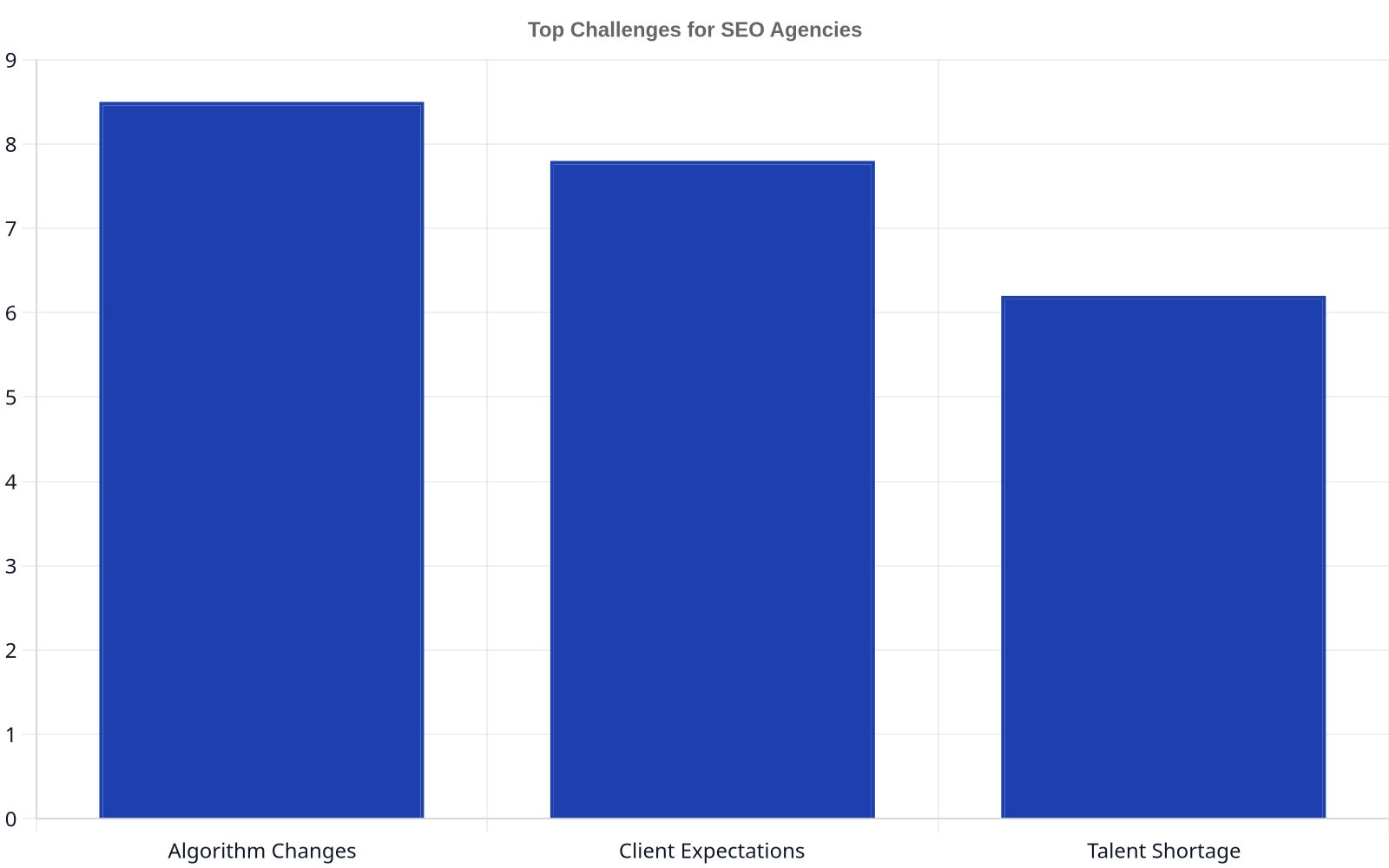
For years, agencies have structured their SEO offerings around a checklist of manual actions. This model is fundamentally broken. It creates friction, drains margins, and keeps agencies in a permanently defensive position with their clients. According to a 2024 survey by Ahrefs, the top challenge for agencies is “attracting and retaining clients,” which is a direct consequence of a failure to demonstrate clear, scalable value.
- Unsustainable Labor Costs: The core of the traditional agency model is billing for time. You charge for a strategist to perform keyword research, an analyst to build links, and a writer to produce a blog post. This model directly caps your profitability. You can only make more money by hiring more people or charging higher hourly rates, both of which make you less competitive. Your margins are perpetually squeezed between rising talent costs and client pressure on budgets.
- The ROI Reporting Treadmill: How much of your team’s non-billable time is spent creating reports to justify your existence? Agencies are trapped in a cycle of trying to draw a straight line from “we acquired 3 backlinks this month” to “your revenue increased by 4%.” This is a losing game. 76% of CEOs want marketing to be 100% ROI-focused, yet the connection between discrete SEO tasks and financial outcomes remains notoriously difficult to prove.
- Scalability vs. Customization: The third major hurdle is the false dichotomy between scalable services and bespoke strategy. To be profitable, you need to standardize your process. But clients pay you for a custom strategy tailored to their unique business. This tension means you either lose money creating hyper-customized plans for small accounts or you deliver a generic service that gets mediocre results, leading to client churn.
Stop selling hours. Start selling outcomes. The future of agency SEO is not about manually pulling levers; it’s about building the machine that pulls them automatically.
Why Traditional SEO Metrics Aren’t Enough Anymore
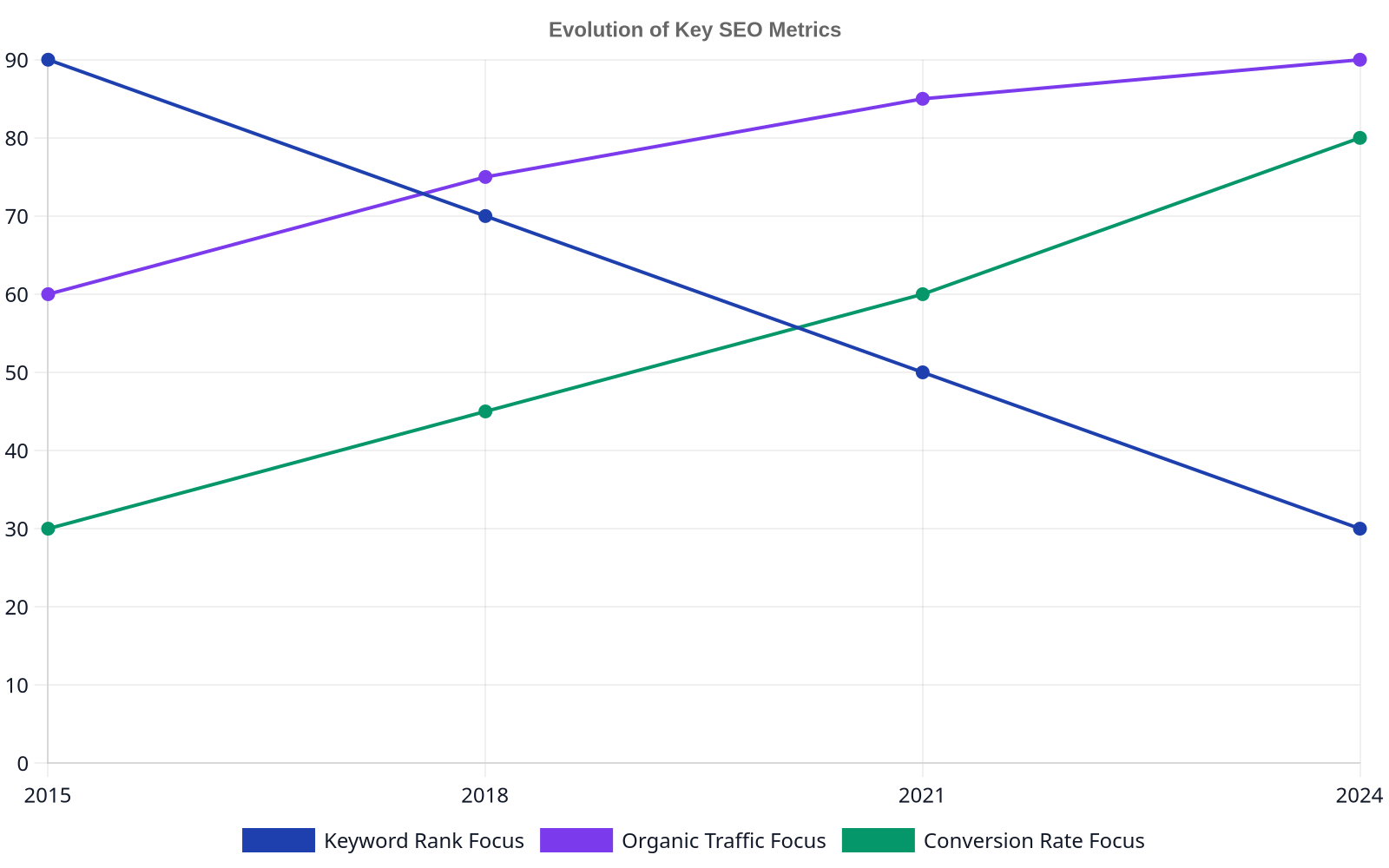
The reporting treadmill is fueled by outdated metrics. For a decade, agencies have sent clients monthly reports showing keyword ranking improvements, domain authority scores, and the number of backlinks built. While not useless, these metrics are proxies for success, not success itself. They represent activities, not outcomes. Clients are becoming more sophisticated; they don’t care about a “position 3” ranking for a vanity keyword if it doesn’t drive qualified traffic and conversions.
This is a symptom of focusing on individual components rather than the health of the overall system. A high Domain Authority score from Moz is meaningless if your site architecture is a mess and users can’t find what they need. This reflects a broader shift in the core seo ranking factors for 2026, where signals related to user experience and topical authority are becoming just as important as the classic pillars of keywords and links.
Instead of reporting on isolated metrics, the conversation needs to shift to business impact:
- Instead of “Rankings Increased”: Show “Growth in non-branded organic traffic to conversion-focused pages.”
- Instead of “Backlinks Built”: Show “Increase in referral traffic from authoritative domains.”
- Instead of “Articles Published”: Show “Expansion of topical authority, leading to a 15% increase in keyword footprint.”
This shift in focus requires a new operational model—one that isn’t built around completing a set number of tasks each month.
Beyond the Basics: Embracing AI for Agency Efficiency
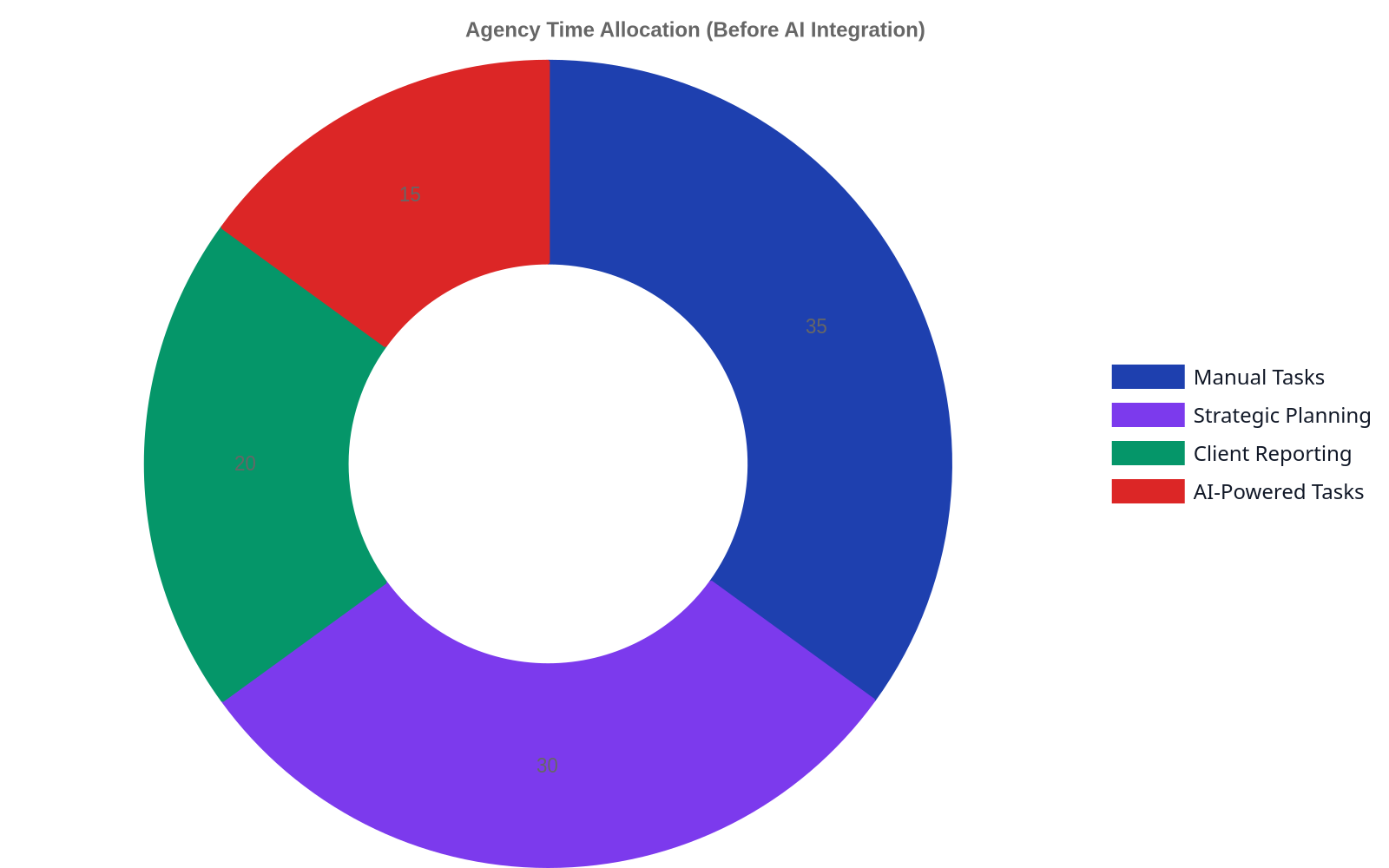
Most agencies view AI as a tool to do the same old tasks, just faster. They use it to generate a first draft of a blog post or to brainstorm a list of keywords. This is a failure of imagination. It’s like buying a Formula 1 car and only driving it to the grocery store. According to a 2024 Deloitte report, while 79% of marketing and creative industry professionals anticipate GenAI to transform their roles, many are still stuck at the task-automation level.
True transformation comes from using AI to build an automated content engine. At Rank My Website, we see this firsthand. Instead of just writing faster, we build systems that handle the entire content lifecycle on autopilot. This includes not just generating daily articles but also optimizing them, creating the internal linking structure, and publishing them directly to a client’s site. The human element shifts from manual labor to high-level strategy and quality control.
Your most valuable strategist shouldn’t be spending their day hunting for keyword variations. Their job is to interpret the results from a system that does the hunting for them.
This model resolves the core tensions of the agency model. It’s inherently scalable, as the system does the heavy lifting. It makes ROI self-evident through a constant stream of optimized content and resulting traffic growth, not a backward-looking report. And it allows your team to provide immense strategic value, advising clients on which topics to target and how to interpret the business results the system is generating. You finally get to sell the strategy that clients have always wanted.
The Real Solution: From Service Provider to Technology Partner
To solve the persistent SEO challenges for marketing agencies, you must change your identity. Stop being a “full-service SEO agency” and start being a technology partner that installs and manages a content generation system. Instead of selling a dozen discrete services, you sell one cohesive system that produces the outcome: organic traffic growth.
This isn’t a theoretical model. It’s how modern software-enabled companies operate. We’ve seen it work for clients like Wolverine Assemblies, who benefit from a consistent, automated content pipeline rather than a series of one-off projects. This approach turns SEO from a cost center based on manual labor into a predictable, scalable growth channel. Leading firms are already moving toward AI-powered, customer-obsessed SEO, which requires a systems-thinking approach.
Your agency can lead this transition. Propose a model where you build an automated content engine for your clients. Your team’s expertise is the secret sauce that configures and guides the system. You’re no longer selling hours; you’re selling a growth machine. This is how you escape the reporting treadmill, scale profitably, and finally align your work directly with the business outcomes your clients demand.
Ready to transform your agency’s SEO offering? At Rank My Website, we provide the platform that lets you become a technology partner for your clients. Generate SEO-optimized content from keywords, publish it to their sites, and use built-in on-page tools to drive consistent rankings. Grow your clients’ organic traffic on autopilot.
Frequently Asked Questions
What is the biggest SEO challenge for agencies in 2026?
The primary challenge is the outdated, labor-intensive business model. Agencies that sell hours for manual tasks face shrinking margins, scalability problems, and a constant struggle to prove ROI. The solution is shifting to a systems-based approach using automation.
How does an automated content system solve the ROI problem?
Instead of trying to connect discrete tasks (like building 5 backlinks) to revenue, a content system consistently publishes optimized articles, builds topical authority, and grows organic traffic. The value is demonstrated through sustained growth in traffic and leads, which are metrics CEOs understand, rather than activity reports. The connection to ROI becomes much clearer and more direct.
Will AI and automation replace the need for SEO strategists at agencies?
No, it changes their role for the better. Automation handles the repetitive, low-value tasks like keyword research, first drafts, and internal link placement. This frees up human strategists to focus on high-value work: overall content strategy, competitive analysis, interpreting results, and advising clients on how to turn traffic into revenue. Their role becomes more strategic and less tactical.
How can a small agency compete with larger ones on SEO?
Smaller agencies can compete by being more agile and adopting a technology-forward model faster than larger, more bureaucratic competitors. Instead of trying to match a large agency’s headcount, a small agency can use a platform like Rank My Website to deliver superior results through automation, offering a more efficient and scalable solution.
What is the first step to shifting my agency to this new model?
Start with one client as a pilot. Instead of their standard monthly retainer, propose a project to build an automated content engine. Use a platform that handles keyword research, content generation, and publishing. Focus the reporting on traffic growth and keyword footprint expansion. Use the success of this pilot to create a case study and transition other clients.
How is this different from just using an AI writer?
AI writers are tools that assist with a single task: writing. An automated content system is a comprehensive platform that manages the entire workflow. It includes keyword research, clustering, article generation, automated internal linking, and direct publishing to the CMS. It’s the difference between a power drill and a fully automated assembly line.