
Best Practices for On-Page SEO Automation: Your Team, Amplified
Most SEOs picture automation as a dumb robot that blindly stuffs keywords into auto-generated pages. They see it as a trade-off: scale for the price of quality. This is a fundamental misunderstanding of the technology. The best practices for on-page SEO automation aren’t about replacing your team; they’re about giving them superpowers. True automation is a system that uses software to execute repetitive, rule-based on-page tasks with perfect consistency, freeing up human experts for high-level strategy. It handles meta tag generation, schema markup, and internal link mapping, allowing for greater accuracy, real-time optimization, and massive scale without sacrificing quality. To achieve this, many leverage powerful on-page seo tools. For example, on-page seo automation helped Wolverine Assemblies increase organic traffic by 400%.
Think of it less like an assembly line and more like a surgical assistant—it hands you the right tool at the right time, letting you focus on the complex operation. The goal isn’t to remove the human, but to amplify their impact by removing the tedious work that burns hours and invites errors. Companies that implement this correctly don’t fire their SEO team; they promote them to strategists.
What On-Page SEO Automation Actually Is (and Isn’t)
On-page SEO automation is the use of software and systems to perform tasks on your website that directly influence search engine rankings. It’s not a magic button. It’s a deliberate strategy to codify your SEO rules and apply them consistently across thousands of pages, something no human team could ever do manually. It’s about taking the “best practices” out of a dusty Google Doc and building them directly into your content workflow.
The Core Components of an Automated System
At its heart, any effective automation system has three parts:
- A Trigger: An event that initiates an action. This could be publishing a new page, a change in keyword rankings, or a detected content gap.
- A Condition: A set of rules that must be met for the action to proceed. For example, “IF a meta description is over 160 characters, THEN trigger an alert.” or “IF a new blog post is published, THEN find 3 related articles to link from.”
- An Action: The task the software performs. This could be rewriting a title tag, generating structured data, or adding an internal link.
Without these three components, you don’t have automation; you have a manual tool.
Automation vs. AI: A Critical Distinction
People often use “automation” and “AI” interchangeably, but they are not the same. Automation follows pre-programmed rules. AI, specifically generative AI, creates new content or makes predictions based on patterns in data. A system that automatically shortens title tags to 60 characters is automation. A system that writes three title tag variations based on user intent and SERP analysis is AI-powered automation.
The use of automation and AI to generate content is acceptable, provided it is not used to create spammy content primarily to manipulate search rankings. The focus is on the quality and usefulness of the content, not how it was produced. This is a key principle in establishing the best practices for on-page SEO automation.
Examples of On-Page Automation in Practice
Instead of abstract concepts, consider these concrete examples:
- Meta Tag Generation: A new e-commerce product is added. The system automatically creates a title tag and meta description using a template:
[Product Name]and
[Category] [Brand Name]
Shop the [Product Name] at [Brand Name]. Features include [Feature 1], [Feature 2]. Free shipping on orders over $50. - Image Alt Text: A blogger uploads an image named
golden-retriever-playing-fetch.jpg. The system automatically generates the alt text “golden retriever playing fetch” and adds it to the HTML. - Schema Markup: A new article is published. The system reads the headline, author, and publish date and automatically generates and injects valid
Articleschema markup into the page header, a task that is tedious and prone to syntax errors when done manually. Platforms like Schema.org provide the vocabulary that these automated systems use to make content understandable to search engines.
On-Page SEO Automation Workflow

Implementing automation isn’t a single event; it’s a cyclical process of refinement. A successful workflow ensures that automation supports, rather than dictates, your SEO strategy. It requires careful planning to ensure the outputs align with your brand voice and strategic goals, especially for businesses like Wolverine Assemblies that may have thousands of technical pages to manage.
Here is a typical five-step process:
- Strategy & Rule Definition: This is the most critical human-led step. Your SEO strategists define the rules and templates. What is the ideal title tag structure? What are the criteria for an internal link? What schema types should be applied to which content types? This initial input determines the quality of the entire system.
- Content & Data Ingestion: The system pulls in the necessary data. This could be a new product feed, a batch of
daily articlesfrom your content team, or a crawl of your existing site to identify pages missing key on-page elements. - Automated Execution: The software applies the rules defined in step one. It generates meta tags, injects schema, optimizes image file names and alt text, and identifies internal linking opportunities based on your predefined criteria.
- Human Review & Approval (The “Human-in-the-Loop”): For many tasks, especially those involving creative text or brand voice, a 100% automated approach is risky. A “human-in-the-loop” model sends the automated outputs to a queue for a quick review and approval by an editor or SEO specialist. This combines the speed of automation with the quality control of a human expert.
- Performance Monitoring & Refinement: The system tracks the performance of the optimized pages (rankings, CTR, traffic). This data feeds back into step one. Did the new title tag template increase click-through rates? Are the automated internal links leading to higher engagement? This feedback loop allows for continuous improvement of the automation rules.
Automation doesn’t mean you stop doing on-page SEO. It means you stop doing the boring parts of on-page SEO, freeing your most valuable people to focus on strategy and analysis.
Key Areas for On-Page SEO Automation
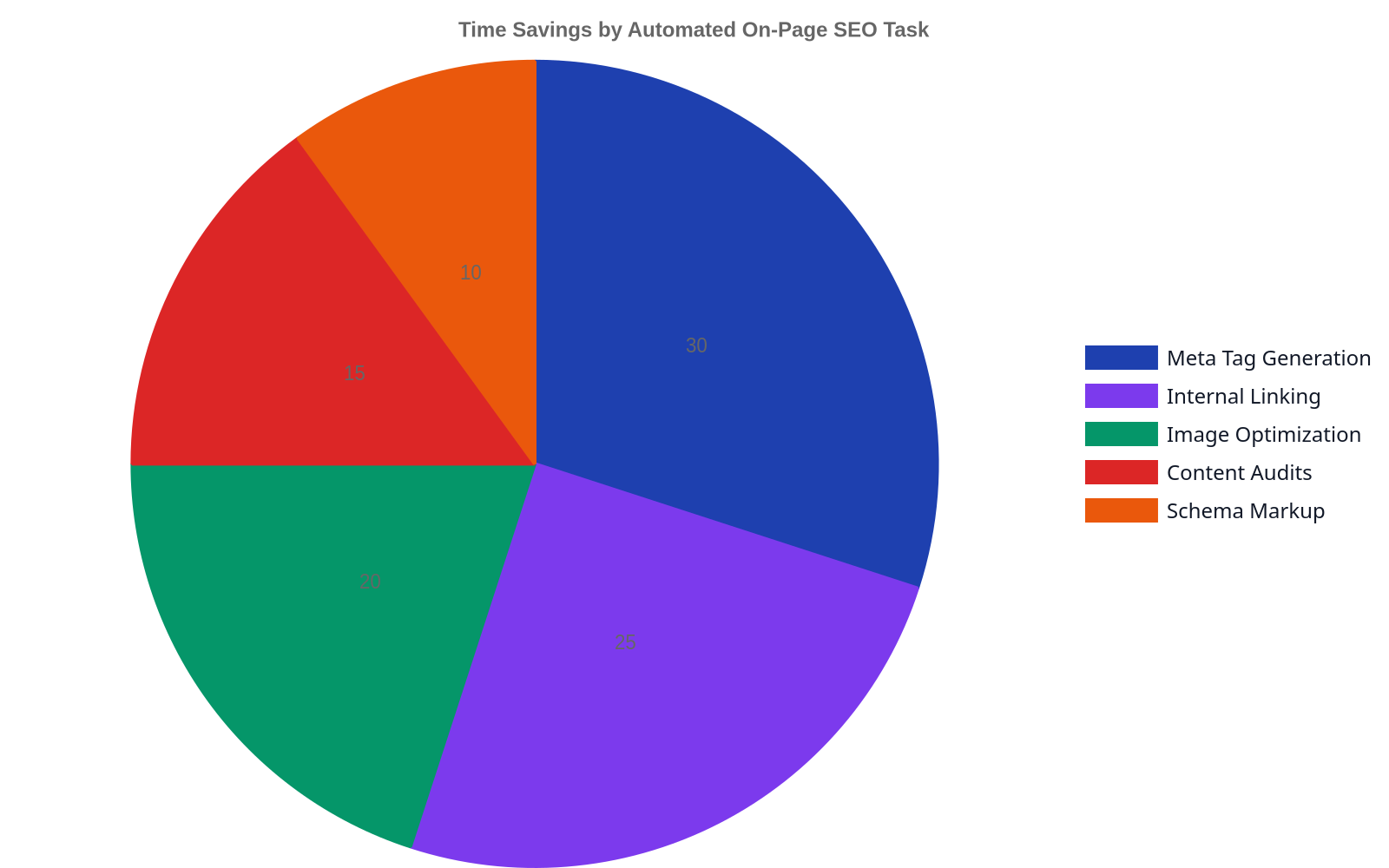
While you can automate dozens of small tasks, the biggest returns on investment come from focusing on the most time-consuming and impactful areas. These are the tasks that are both rule-based and required at a scale that makes manual execution impractical.
Bulk Meta Tag Optimization
For a site with 50,000 pages, manually checking and optimizing every title tag and meta description is impossible. Automation can instantly identify and fix common problems:
- Truncation: Find and shorten all titles over 65 characters or descriptions over 160.
- Duplication: Identify pages with identical or near-identical meta tags.
- Missing Tags: Find all pages that are missing a title or description.
- Template-based Generation: Apply consistent, keyword-rich templates across entire categories of pages, like products, locations, or blog posts.
Automated Schema Markup Deployment
Structured data (schema) is a powerful ranking signal, but it’s a technical nightmare for most marketing teams to implement. It’s also a perfect candidate for automation. An automated system can:
- Identify the content type (article, product, recipe, event) and apply the correct schema.
- Extract key information from the page (author name, price, review rating, cook time) and map it to the correct schema properties.
- Validate the generated markup against Google’s Rich Result Test to ensure it’s error-free before deployment.
- This removes the need for developers to manually add JSON-LD scripts to page templates. Marketing and sales departments have seen a 10-20% increase in productivity with the adoption of automation tools.
Dynamic Internal Linking
Building a smart internal linking structure is one of the most underrated SEO levers. Manually finding relevant linking opportunities is incredibly time-consuming. Automation can supercharge this process. Instead of having a human read every new post and search for old articles to link to, a system can:
- Analyze the text of a new article upon publication.
- Scan a database of all existing content for semantic relevance and keyword overlap.
- Automatically suggest or even insert contextual links between the new post and the most relevant existing pages.
- This ensures that new content is immediately integrated into your site’s topic clusters, improving crawlability and authority distribution.
The Impact of On-Page SEO Automation
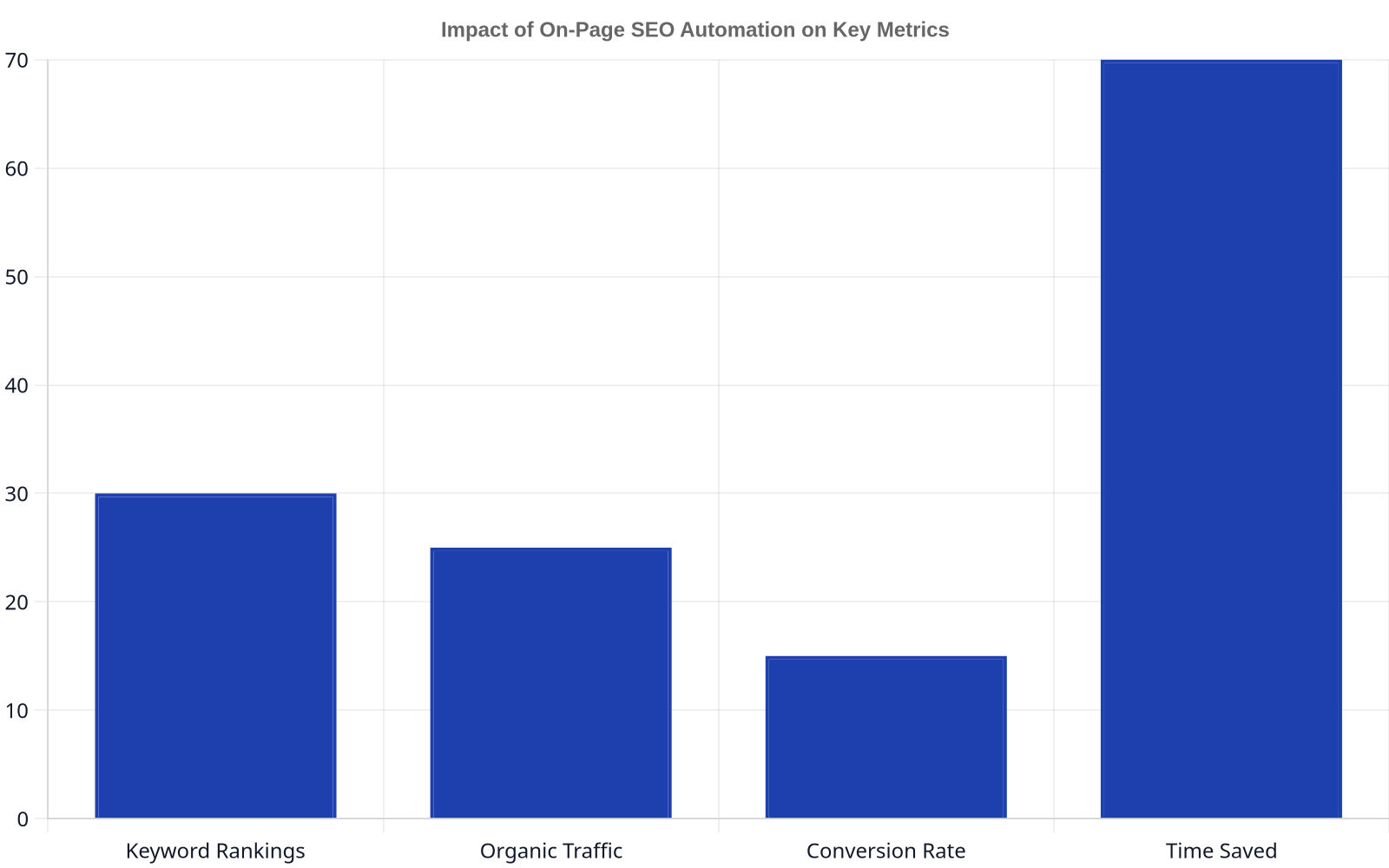
Implementing a smart automation strategy does more than just save time. It creates a cascading effect of benefits that translate directly to traffic and revenue. The impact is felt in three main areas: efficiency, accuracy, and scalability. By automating the low-level tasks, you enable high-level gains that are simply not possible with a purely manual approach. This shift is critical for moving from a reactive SEO posture to a proactive one.
ROI of On-Page SEO Automation Tools
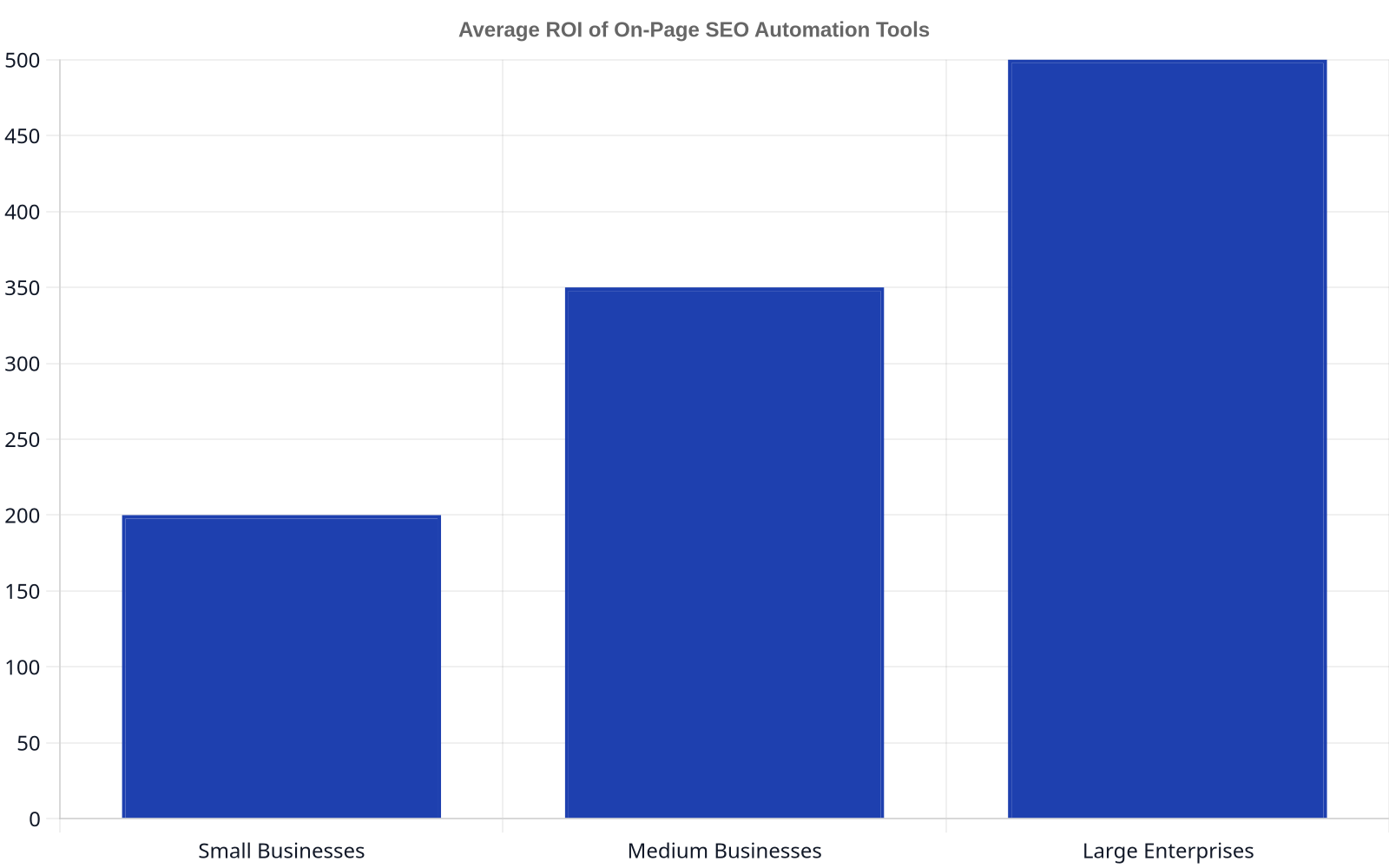
Measuring the return on investment for on-page SEO automation goes beyond simple time savings. While calculating (hours saved per month) x (average team member hourly rate) is a start, the true ROI is found in the performance gains and risk reduction that automation enables. A 2023 report from Forrester highlights that companies investing in marketing automation see significant improvements in lead generation and sales productivity, a principle that applies directly to SEO automation.
Calculating the True Return
To get a full picture of your ROI, you need to measure:
- Efficiency Gains: The reduction in person-hours spent on manual tasks like writing meta descriptions, finding internal links, and checking for errors. This is your most direct cost saving.
- Performance Uplift: The increase in organic traffic, impressions, and click-through rates on pages managed by the automation system. Use analytics to compare a cohort of automated pages against a control group of manually optimized pages.
- Error Reduction: Quantify the “cost of errors.” How much traffic was lost in the past due to broken schema, duplicate titles, or keyword cannibalization? Automation acts as an insurance policy against these human errors.
- Scalability Value: How much would it cost to achieve the same output manually? If your system optimizes 10,000 pages a month, what would the headcount cost be to hire enough SEOs to do that work by hand? This reveals the true value of scalable systems.
The Risk of Inaction
There is also a cost to not automating. While you spend hundreds of hours manually fixing meta tags, your competitors who use automation are focusing on higher-level strategy. They are analyzing market trends, building better content, and running experiments while your team is stuck in the tactical weeds. In a competitive SERP, the team that can implement changes fastest often wins.
Tools for On-Page SEO Automation
| Rank My Website | Surfer SEO | MarketMuse | |
|---|---|---|---|
| Primary Focus | Content generation & on-page optimization | Content optimization & SERP analysis | Content strategy & inventory analysis |
| Keyword Research | Built-in | Integrated | Advanced |
| Content Optimization | Automated suggestions | Real-time editor | Content briefs |
| Publishing | Direct to CMS | Manual export | External integration |
No single tool is the “best” for everyone. The right choice depends on your team’s technical skills, your budget, and the scale of your website. The market for on-page SEO automation tools generally falls into three categories, each with distinct advantages and disadvantages.
Choosing the Right On-Page SEO Automation Tool
Selecting the right tool requires an honest assessment of your internal resources and long-term goals. An e-commerce giant with a dedicated development team has very different needs than a small business using a simple CMS.
| Tool Category | Best For | Key Advantages | Key Disadvantages |
|---|---|---|---|
| All-in-One Platforms | Businesses wanting a unified solution | Comprehensive features, single interface, good support. | Higher cost, can be complex, may lack depth in specific areas. |
| Point Solutions | Teams needing to solve one specific problem | Deep functionality for one task (e.g., schema), lower cost, easy to implement. | Creates a fragmented toolset, potential for data silos. |
| Custom Scripts | Large enterprises with development resources | Complete control and customization, integrates perfectly with internal systems. | High upfront cost, requires ongoing maintenance and in-house expertise. |
The most common mistake isn’t choosing the wrong tool; it’s choosing a tool before you’ve defined your automation strategy and rules. A tool is a vehicle, not a roadmap.
The Human Element: What Not to Automate
For all its power, automation has its limits. The goal of the best practices for on-page SEO automation is to achieve a balance where machines handle the repetitive work and humans handle the strategic and creative work. Blindly automating everything is a recipe for creating a generic, soulless website that doesn’t connect with users and may even trip algorithmic quality filters.
Tasks Requiring Human Nuance
Certain on-page SEO tasks should always have a human-in-the-loop, if not be entirely manual. These are tasks that require brand understanding, creative judgment, and a deep understanding of user intent.
- Final Content Approval: AI can generate a draft, but a human editor must ensure it meets quality standards, is factually accurate, and aligns with the brand’s voice and perspective.
- Complex User Intent Analysis: While tools can analyze keywords, a human strategist is needed to understand the subtle nuances of user intent. Is the searcher looking to buy, learn, or compare? The content strategy depends on this judgment call.
- Brand Voice and Tone: Automation can follow templates, but it can’t replicate a unique brand voice. The final polish that makes content sound like it came from your brand must be applied by a person.
- Strategic Keyword Selection: While platforms can suggest thousands of keywords, a human needs to make the final decision on which terms to prioritize based on business goals, competition, and strategic relevance.
The Risk of Losing Your Brand
Over-reliance on automation, especially for top-of-funnel content, can dilute your brand’s unique point of view until it sounds like everyone else. Your content is often the first interaction a customer has with your brand. If it’s generic and robotic, they will assume your products or services are, too. The human element is your primary defense against becoming a commodity.
Further reading
FAQ
What is the biggest benefit of on-page SEO automation?
The single biggest benefit is scalability. Automation allows you to apply your on-page SEO best practices consistently across tens of thousands of pages—a scale that is impossible to achieve with manual effort. This leads to massive efficiency gains and frees up your SEO team for more strategic work.
Can on-page SEO automation hurt my rankings?
Yes, if implemented poorly. Using automation to generate low-quality, spammy content or to keyword stuff at scale can absolutely lead to algorithmic penalties. The key is to use automation to enforce good SEO practices, not to take shortcuts. Always prioritize quality and user experience, and keep a human in the loop for creative and strategic tasks.
How do I get started with on-page SEO automation?
Start small. Don’t try to automate everything at once. Pick one repetitive, time-consuming task, like optimizing meta descriptions for a specific category of pages. Define the rules, use a tool or script to execute, review the results, and measure the impact. This iterative approach allows you to learn and build confidence before tackling more complex automation workflows.
Is on-page SEO automation expensive?
It can be, but it doesn’t have to be. While enterprise-level all-in-one platforms can have significant subscription fees, many point solutions are very affordable. Furthermore, the cost should be weighed against the man-hours saved and the potential uplift in traffic and revenue. Often, the ROI is extremely positive.
What is the future of on-page SEO automation?
The future lies in greater integration with AI for predictive analytics. Instead of just reacting to problems, future systems will predict them. For example, a tool might analyze SERP trends and proactively suggest content updates before your rankings start to decline. The focus will shift from reactive fixes to proactive optimization.
Automating your on-page SEO isn’t about building a machine that does your job. It’s about building a system that helps you do your job better, faster, and at a scale you never thought possible. By focusing on the best practices for on-page SEO automation, you can eliminate tedious manual work, reduce human error, and empower your team to focus on the high-impact strategies that drive real growth. Rank My Website is built on this principle, turning the complexities of keyword research, content creation, and optimization into an automated engine for organic traffic.