
Stop guessing at your SEO budget. The idea that search engine optimization is a mystical art with unprovable returns is a decade out of date. Today, if your SEO provider or internal team can’t connect their work directly to revenue, you have a measurement problem, not an SEO problem. Proving the return on investment of your SEO efforts requires specific tools that track rankings and traffic and connect them to conversions and revenue. The right seo performance roi measurement software makes this connection explicit, transforming SEO from a cost center into a documented profit driver by attributing sales, leads, and customer value directly to organic search performance.

Defining SEO ROI: More than Rankings
For years, SEO reports were glorified bragging sheets filled with vanity metrics. We’d show clients a list of #1 rankings, a chart of keyword improvements, and a hockey-stick graph of organic traffic. While these metrics are indicators of activity, they are not indicators of business impact. A #1 ranking for a keyword that no one in your target market searches for is worthless. A 50% traffic increase that brings zero new customers is a server-cost liability, not an asset.
True SEO ROI measurement moves past these surface-level metrics to answer the only question the C-suite cares about: “For every dollar we invest in SEO, how many dollars do we get back?” This requires a shift in thinking and tooling.
Moving from Vanity Metrics to Revenue Metrics
Vanity metrics are easy to track but offer little insight into business health. They include things like:
- Keyword rankings
- Organic sessions (in isolation)
- Impressions
- Bounce rate
Revenue-focused metrics, on the other hand, tie SEO directly to financial outcomes. These are the metrics that seo performance roi measurement software is built to illuminate:
- Organic Conversion Rate: What percentage of visitors from organic search complete a desired action (e.g., make a purchase, fill out a form, start a trial)?
- Cost Per Acquisition (CPA) from Organic Search: How much does it cost in SEO investment (salaries, tools, content) to acquire one new customer via organic search?
- Lead Value from Organic Search: What is the total value of leads generated from organic traffic, based on your average lead-to-customer rate and customer lifetime value?
- Direct Organic Revenue: For e-commerce sites, this is the dollar amount of sales directly attributable to users who arrived via organic search.
The Basic SEO ROI Calculation
At its core, the formula is simple: (Revenue from SEO – Cost of SEO) / Cost of SEO. A result of 4 would mean you generated $4 in profit for every $1 invested. The complexity isn’t in the formula itself, but in accurately tracking the inputs. The “Cost of SEO” includes agency fees, software subscriptions (like Rank My Website), content creation costs, and the hourly cost of your team. The “Revenue from SEO” is where dedicated software becomes indispensable, as attributing conversions correctly is a major challenge.
Connecting SEO Efforts to Business Outcomes
Translating activities like building backlinks or optimizing title tags into revenue figures is the central challenge. The connection is not always a straight line, but a series of correlated events that software can help you track. An effective SEO strategy involves a range of activities, from high-level keyword research to the daily production of content, and each piece contributes to the final ROI.
Attribution Models: Giving Credit Where It’s Due
Attribution is the science of assigning credit to the touchpoints a customer interacts with on their path to conversion. A user might first discover your brand via a blog post from an organic search, later see a retargeting ad on social media, and finally convert by clicking a branded search ad. Which channel gets the credit?
- Last-Click Attribution: This is the most common and simplest model. It gives 100% of the credit to the final touchpoint before conversion. It systematically undervalues top-of-funnel channels like SEO and content marketing. Last-click is often the default but can provide a misleading picture of the customer journey.
- First-Click Attribution: The opposite of last-click, this model gives all credit to the first touchpoint. It’s better for understanding how customers initially discover you but ignores everything that happens afterward.
- Linear Attribution: This model spreads credit evenly across all touchpoints. It’s a step up but assumes all touchpoints are equally important, which is rarely true.
- Data-Driven Attribution: This is the most sophisticated model, available in tools like Google Analytics 4. It uses machine learning to analyze all converting and non-converting paths to determine which touchpoints are most influential. This is the gold standard for accurately valuing SEO’s contribution.
Don’t let the pursuit of the perfect attribution model paralyze you. Starting with a simple model and acknowledging its flaws is better than tracking nothing and claiming SEO is pure magic.
The Role of Content in Driving Conversions
Content isn’t just for attracting traffic; it’s for guiding visitors toward a purchase. Each piece of content, whether it’s a top-of-funnel blog post or a bottom-of-funnel comparison page, plays a role. Good ROI measurement software helps you see which content is assisting conversions, even if it’s not the final page a user visits. For example, a user might read three of your blog posts over two weeks before finally navigating to your pricing page and signing up. Those blog posts were critical to the conversion, and your reporting should reflect that. This is why a consistent output of high-quality content, such as daily articles, is a cornerstone of scalable SEO growth.

Essential Software and Tools for Measuring SEO ROI
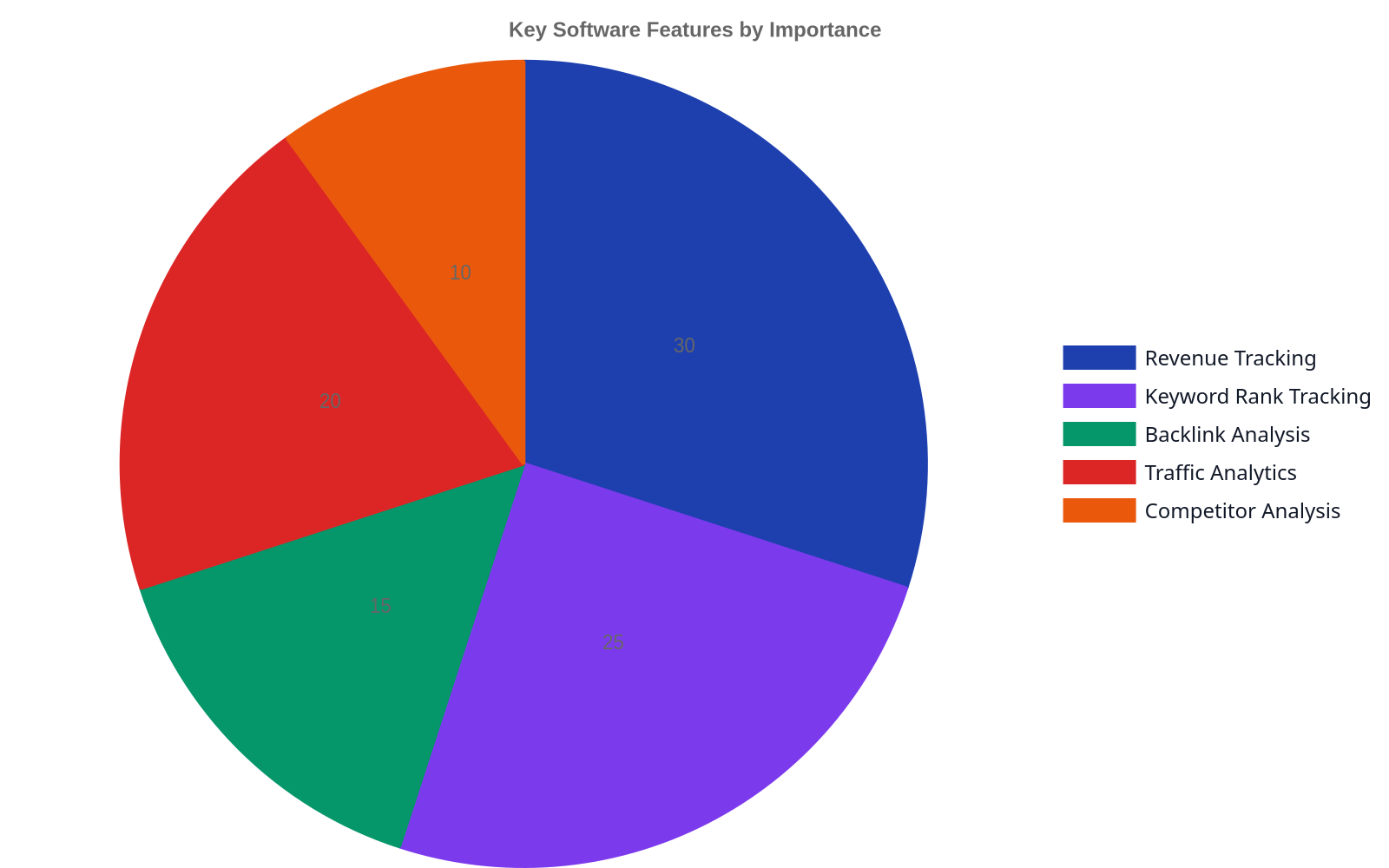
No single tool does everything, but a well-integrated stack can provide a complete picture of your SEO performance and its financial impact. The goal is to create a chain of data from the first click to the final sale.
Foundational Analytics Platforms
This is your source of truth for on-site behavior. You cannot measure SEO ROI without one.
- Google Analytics 4 (GA4): The industry standard. GA4 is event-based, making it powerful for tracking complex user journeys across websites and apps. Its data-driven attribution modeling is essential for moving beyond last-click analysis. Setting up custom events for key conversions (e.g., “formsubmission,” “demorequest”) is the first step to meaningful ROI tracking.
- Plausible Analytics / Fathom: For businesses concerned with privacy, these cookieless alternatives offer a simpler, more focused look at website traffic and goals. While less feature-rich than GA4, they provide the core data needed for ROI calculations in a more privacy-compliant package. A recent GDPR enforcement tracker highlights the increasing financial risks of non-compliance, making these tools more attractive.
SEO-Specific Performance Platforms
These platforms connect your on-site analytics to off-site ranking data and competitive intelligence.
- Rank My Website: Our platform automates SEO content creation and publishing, but it also includes built-in tools for tracking the performance of that content. By connecting to your analytics, we help you see not just which keywords you rank for, but which articles are driving valuable traffic and conversions. This closes the loop between content investment and financial return.
- Ahrefs / Semrush: These are the Swiss Army knives of SEO. They provide data on keyword rankings, backlink profiles, competitive analysis, and site health. Their rank trackers allow you to tag keywords by business vertical or purchase intent, helping you correlate ranking improvements for high-value terms with actual revenue growth.
CRM and Sales Platforms
This is where the final piece of the puzzle clicks into place: connecting marketing efforts to closed deals. To calculate true ROI, you must know the final revenue amount from a lead that originated in organic search.
- Salesforce / HubSpot: By integrating your analytics platform and website forms with a CRM, you can pass tracking data along with each new lead. This allows your sales team to see that a new lead for “industrial assemblies” came from a specific blog post, as we’ve seen with clients like wolverine-llc.com. When that lead becomes a customer worth $50,000, you can definitively attribute that revenue back to your SEO program.
Comparison of ROI Measurement Software Features
Choosing the right software depends on your business size, technical expertise, and budget. A small e-commerce store has different needs than a B2B enterprise with a long sales cycle.
| Feature | Small Business (e.g., Shopify Store) | Mid-Market (e.g., B2B SaaS) | Enterprise (e.g., Fortune 500) |
|---|---|---|---|
| Core Function | Simple conversion tracking, direct revenue attribution. | Lead tracking, multi-touch attribution, CRM integration. | Data-driven attribution, LTV modeling, full marketing mix analysis. |
| Example Tool Stack | Google Analytics 4 + Shopify Analytics + Ahrefs (Basic) | Google Analytics 4 + HubSpot/Salesforce + Semrush (Pro) | Google Analytics 360 + Salesforce + Custom BI Tools (Tableau) |
| Pros | Low cost, easy to set up. | Balances power with usability, connects marketing to sales. | Most accurate and comprehensive view of performance. |
| Cons | Relies heavily on last-click attribution, limited journey view. | Can be complex to configure, requires dedicated expertise. | Very high cost, requires a team of data analysts to manage. |
| Typical Cost | $100 – $500 / month | $1,000 – $5,000 / month | $15,000+ / month |
Building an SEO ROI Dashboard for Leadership
Your CEO doesn’t have time to sift through keyword ranking reports. You need to present your findings in a concise, visual format that speaks their language: money. A good dashboard summarizes performance and connects it to top-line business goals.
Step 1: Define Your Key Performance Indicators (KPIs)
Work backward from business objectives. If the goal is to increase sales by 20%, your primary KPI is “Organic-Sourced Revenue.” Secondary, leading indicators might be “Qualified Leads from Search” and “High-Intent Keyword Rankings.”
Step 2: Choose Your Dashboarding Tool
- Google Looker Studio: A free, powerful tool that integrates directly with Google products like GA4 and Google Sheets. It’s the most common choice for creating custom SEO dashboards.
- Tableau / Power BI: For larger organizations that need to blend SEO data with data from dozens of other sources (finance, operations, sales), these business intelligence platforms are the standard. They require more technical skill but offer unlimited flexibility.
Step 3: Design the Narrative
Don’t just show charts; tell a story. Start with the top-line number: “Organic search generated $450,000 in revenue in Q3, a 25% increase over Q2, delivering a 5:1 ROI.” Then, use subsequent charts to explain the why behind that number: “This was driven by a successful content campaign targeting ‘X’ keywords, which led to a 70% increase in non-branded organic traffic.”
The purpose of a dashboard isn’t to present data; it’s to present conclusions. Your executive team should be able to understand the bottom-line impact in less than 60 seconds.
Step 4: Automate and Distribute
Manually pulling reports every month is a recipe for errors and wasted time. The best seo performance roi measurement software and dashboarding tools allow you to build reports that update automatically. Schedule a PDF to be emailed to key stakeholders on the first of every month. This consistency builds trust and keeps SEO top-of-mind. This approach of automating workflows is a core part of what we do at Rank My Website, freeing up teams to focus on strategy instead of manual reporting.

Common Pitfalls in Measuring SEO ROI
Even with the right tools, it’s easy to make mistakes that undermine your credibility. Avoiding these common errors is critical.
Ignoring Customer Lifetime Value (LTV)
Many ROI calculations only consider the initial purchase. But what if a customer acquired through SEO makes repeat purchases for years? A Forrester report on SEO platforms highlights that failing to account for LTV can dramatically understate the true return. A customer who spends $100 on their first purchase but has an LTV of $2,000 is a massive win for SEO. Your model must account for this, often by integrating with CRM data where LTV is calculated.
Poor Tracking Implementation
Broken tracking is the most common reason for inaccurate ROI measurement. This can be anything from conversions not being tracked correctly in GA4 to UTM parameters being stripped during a redirect. A thorough audit of your data pipeline, from first touch to final sale, is essential. Run test conversions and follow the data all the way through your analytics and CRM to ensure nothing is lost.
Focusing on Too Short a Timeframe
SEO is a long-term investment. Unlike paid ads, where you can see returns in days, the impact of a content and link-building strategy can take 6-12 months to fully materialize. Measuring ROI after only 30 days is a setup for failure. When presenting to leadership, always include charts that show year-over-year growth and multi-quarter trends to properly frame the long-term value being created.
The Future of SEO ROI Measurement
As technology evolves, so will our ability to measure SEO’s impact with even greater precision. The rise of AI in search is changing how users find information, and our measurement must adapt accordingly.
AI’s Role in Performance Analysis
AI is not just for writing content. AI-powered analytics tools can now sift through massive datasets to identify performance trends and anomalies that a human analyst might miss. They can correlate ranking drops with specific Google algorithm updates or identify content pieces that are underperforming relative to their potential. This moves measurement from being reactive to proactive.
Coping with a Cookieless World
The deprecation of third-party cookies is forcing a change in tracking methodology. There will be a greater reliance on first-party data (information you collect directly from your users) and modeled data (using machine learning to fill in the gaps left by privacy changes). Platforms that can operate in and make sense of this new environment will be the most valuable. One key is to build strong internal linking structures, which keep users on your site longer and generate more first-party data signals.
Integrating with Broader Business Intelligence
SEO data cannot live in a silo. The future of ROI measurement involves integrating organic search performance data into a holistic business intelligence strategy. How does a surge in organic traffic for a specific product affect inventory planning? How do the questions people ask in search inform product development? Answering these questions demonstrates SEO’s value far beyond the marketing department. As found in a Botify analysis, unifying data is key to revealing deeper insights and driving results faster.
FAQ
How do you calculate ROI for SEO?
The basic formula is (Revenue from SEO – Cost of SEO) / Cost of SEO. To do this accurately, you must track the total investment in SEO (tools, salaries, content) and use analytics and CRM software to attribute specific revenue or lead value back to organic search as the source.
What is a good ROI for SEO?
Anything over 1:1 is profitable. However, early-stage campaigns might have a lower ROI as the initial investment compounds, while mature campaigns can see returns of 10:1 or higher.
How long does it take to see ROI from SEO?
You can start to see leading indicators like traffic and ranking improvements within 3-6 months. However, a significant, measurable ROI in terms of revenue and customer acquisition typically takes 6-12 months. SEO is a long-term strategy, and its effects are cumulative.
Can you measure ROI for technical SEO or link building?
Yes, but it’s often indirect. For technical SEO, you can measure the impact by tracking the increase in organic traffic and conversions after a major fix (e.g., improving site speed or fixing indexation issues). For link building, you can correlate an increase in domain authority and rankings for target pages with subsequent growth in traffic and conversions from those pages.
What’s the biggest mistake in SEO ROI tracking?
The most common mistake is using a last-click attribution model. This model ignores all the initial and mid-funnel touchpoints that SEO provides, like blog posts and guides that introduce customers to your brand. This systematically undervalues SEO and gives too much credit to bottom-funnel channels like branded search or direct traffic.
Choosing the right seo performance roi measurement software is the first step toward treating SEO as a core driver of business growth. By moving beyond vanity metrics and connecting your efforts directly to revenue, you can justify your budget, prove your worth, and make smarter investment decisions for years to come. At Rank My Website, we provide the tools to not only generate high-performance content but also to demonstrate its undeniable value to your bottom line. Take control of your organic growth and start proving your ROI today.