
Most predictions about the future of SEO get it wrong. They mistake incremental changes for fundamental shifts. Preparing for 2027 isn’t about doing more of what works now; it’s about preparing for a search landscape where the very definition of “ranking” has changed. The most crucial SEO content trends for 2027 focus on deep integration with AI, the strategic management of first-party data, and the creation of verifiably human expertise. This requires a move from simply creating content to building complex content systems that can satisfy both AI-driven answer engines and discerning human users.

The Inevitable Collision: SGE, AI Overviews, and Your Content
For years, the goal was to rank #1. By 2027, the goal will be to become the foundational source for Google’s AI-generated answers. This is a monumental pivot from traditional SEO, where success was measured in blue links, to a new reality where success means being synthesized by an algorithm. Google’s Search Generative Experience (SGE) and its resulting AI Overviews aren’t just a new feature; they are a new layer of the internet, and your content must be architected to serve it.
Moving Beyond Zero-Click Anxiety
The initial reaction to SGE was panic about “zero-click searches.” While traffic patterns will certainly change, the more strategic response is to focus on what I call “source-of-truth” optimization. Instead of aiming for a click, the primary goal is for your content to be the cited, authoritative source within the AI-generated answer. A citation in an AI Overview is the new featured snippet, carrying immense brand authority.
How to Structure Content for SGE Citations
To be cited, your content must be unambiguous, data-rich, and directly answer the query in a format that an LLM can easily parse. This means:
- Declarative Sentences: Lead with the answer. Instead of “There are many reasons why…,” write “The primary reason is X, with secondary factors being Y and Z.”
- Structured Data: Schema markup is no longer optional. Use
FAQPage,HowTo,Article, andOrganizationschema to spoon-feed context to search engines. For a company like wolverine-llc.com, marking up their industrial assembly services with detailed technical specifications using schema is critical. - Numbered Lists and Tables: Use these formats to break down complex information into digestible, machine-readable components. Algorithms favor content that is clearly organized and sequential.
The Impact on Content Decay and Evergreen Strategy
SGE will accelerate content decay. An article that is factually correct but lacks the most recent data point or context will be quickly replaced in AI Overviews by a more current source. Your evergreen strategy must evolve from “publish and forget” to “publish and constantly refresh.” This involves programmatic content updates, regular fact-checking, and integrating real-time data where possible. This is where automated platforms become essential, as manually updating a large content library to this standard is unsustainable.
The Rise of AI in Content Creation
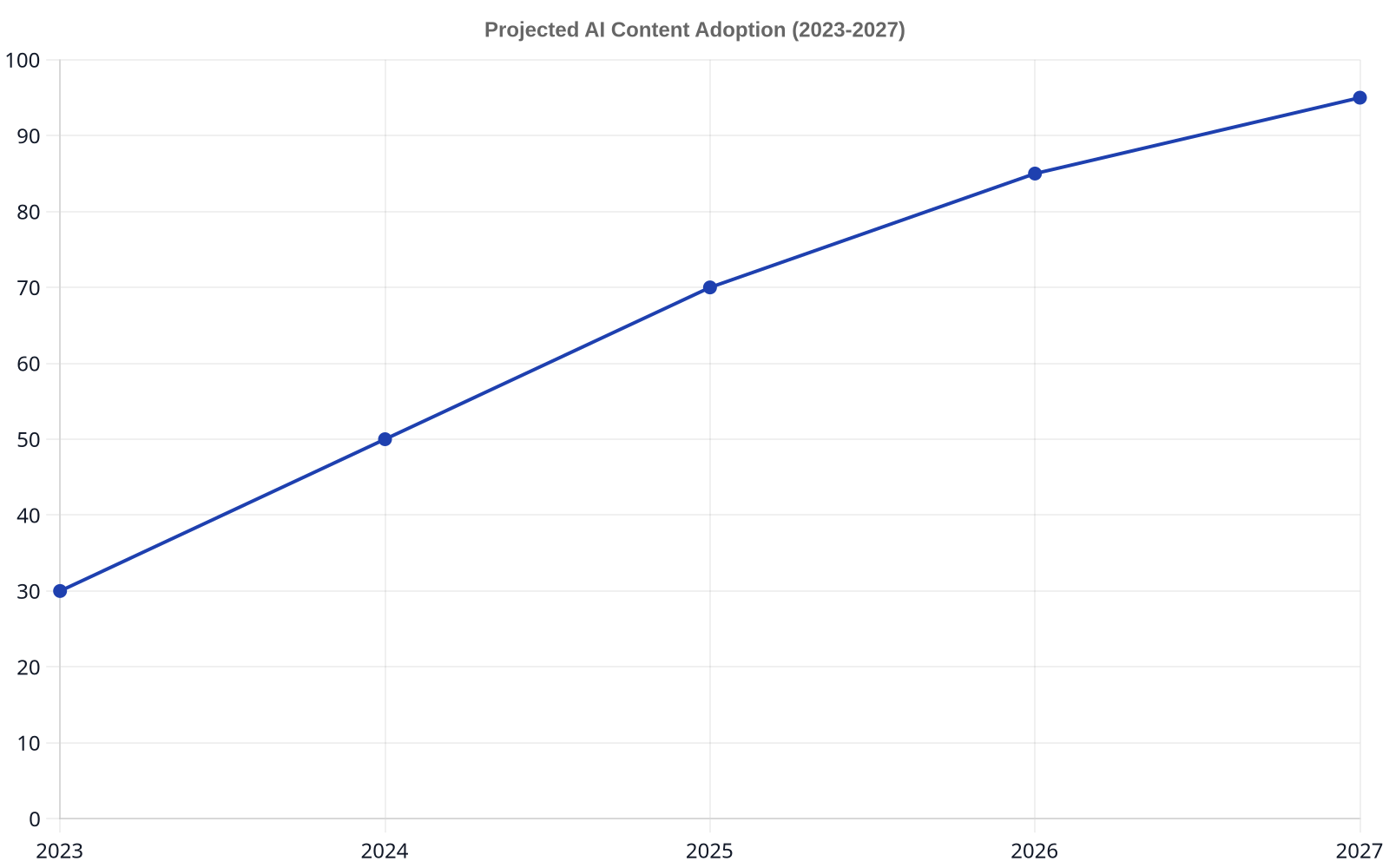
AI isn’t just for ideation anymore. By 2027, the line between human-written and AI-assisted content will be almost invisible. The trend is not about replacing writers but about augmenting them, turning them into editors, strategists, and subject-matter experts who guide AI to produce high-quality, factually accurate content at scale. A staggering 80% of business leaders already believe AI will be a critical partner
Predictive Marketing and Content Personalization
Machine learning models will allow for predictive marketing on a granular level. By analyzing user behavior, AI can predict what content a user will need next and surface it proactively. This moves beyond simple “related articles” to creating dynamic user journeys. Imagine a user reads an article about keyword research; the system could then dynamically offer them a guide on internal linking, anticipating their next logical step. Platforms like ours use this logic to build content clusters that guide users through the funnel automatically.
AISO: Optimizing for the Algorithm Itself
AI Search Optimization (AISO) is the practice of optimizing content not just for keywords but for the AI models that rank and synthesize information. This involves:
- Linguistic Alignment: Using language and sentence structures that align with the training data of major LLMs like Google’s LaMDA and Gemini.
- Entity Salience: Ensuring that key entities (people, products, concepts) in your content are clearly defined and consistently referenced. The goal is to make your page the definitive “entity home” for a specific topic.
- Measuring ROI on AISO: Tracking success in AISO isn’t about rank position alone. It requires a new set of metrics: citation frequency in AI Overviews, entity recognition in Google’s Knowledge Graph, and the rate at which your content is used to answer conversational search queries.

Your First-Party Data is Your Most Valuable SEO Asset
With the final deprecation of third-party cookies, the value of your own data has skyrocketed. In 2027, your ability to collect, analyze, and act on first-party data will be a primary determinant of your SEO success. This data is the fuel for the AI-powered personalization and predictive marketing that users will come to expect.
Building Your Data Moat
Your website, CRM, and email lists are gold mines. The strategy is to create compelling reasons for users to share their information willingly. This isn’t about tricking them; it’s about providing genuine value in exchange for data.
- Interactive Content: Quizzes, calculators, and assessments are powerful tools for data collection. A mortgage calculator, for example, not only provides value to the user but also gives the business invaluable data about the user’s financial situation and intent.
- Gated, High-Value Resources: An in-depth research report or a comprehensive ebook can be a fair trade for an email address. The key is that the resource must be substantially more valuable than a standard blog post.
Privacy, Trust, and Ethical Marketing
Collecting data comes with immense responsibility. Consumers are more aware than ever of how their data is being used. A 2024 Cisco report on data privacy highlights that a majority of consumers are concerned about their personal data in the age of AI. Building trust is paramount. This means transparent privacy policies, clear consent requests, and giving users control over their data. Brands that are perceived as irresponsible with data will face not only regulatory penalties but also a severe loss of customer loyalty. Sustainability and ethical practices are no longer a niche; they are a core component of brand reputation.
E-E-A-T and Authoritative Content
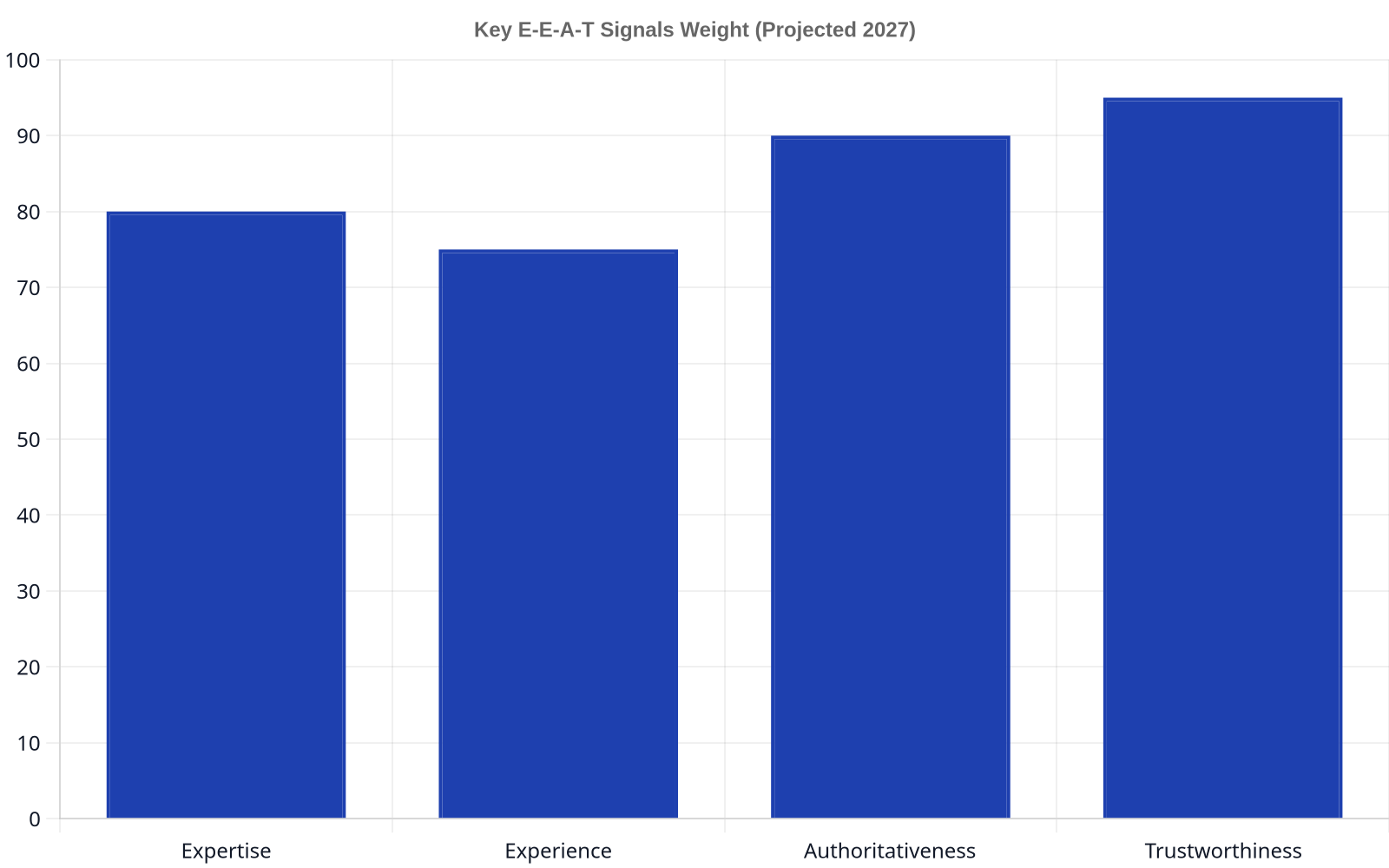
Google’s emphasis on Experience, Expertise, Authoritativeness, and Trust (E-E-A-T) will only intensify. As AI generates a flood of generic content, the ability to demonstrate genuine, human-led expertise becomes a powerful differentiator. In 2027, E-E-A-T won’t be a suggestion; it will be the table stakes for any topic with real-world consequences.
The Rise of “Human-Made” Content
Authenticity is the new authority. Users and algorithms are becoming adept at spotting low-effort, AI-generated content that lacks a real point of view. The winning strategy will be a hybrid one: using AI for efficiency in tasks like keyword research and initial drafting, but relying on human experts to provide the unique insights, experiences, and final polish.
The most defensible SEO moat in 2027 won’t be your backlink profile. It will be the provable, real-world expertise of your authors and the unique, proprietary data you can bring to your content.
This is where author bios, bylines linked to social profiles, and content that details first-hand experience become critical ranking signals. Don’t just say you’re an expert; show it with case studies, original research, and specific, non-obvious advice.
Schema and Structured Data as Trust Signals
As mentioned earlier, schema is vital for SGE. It also plays a crucial role in establishing E-E-A-T. Using Author schema to link content to a specific person, and Organization schema to establish your brand’s credentials, helps Google connect the dots and verify your authority. Properly structured data is a technical way of asserting your expertise and trustworthiness. Businesses using advanced schema report significantly better visibility.

Diversifying Content Formats
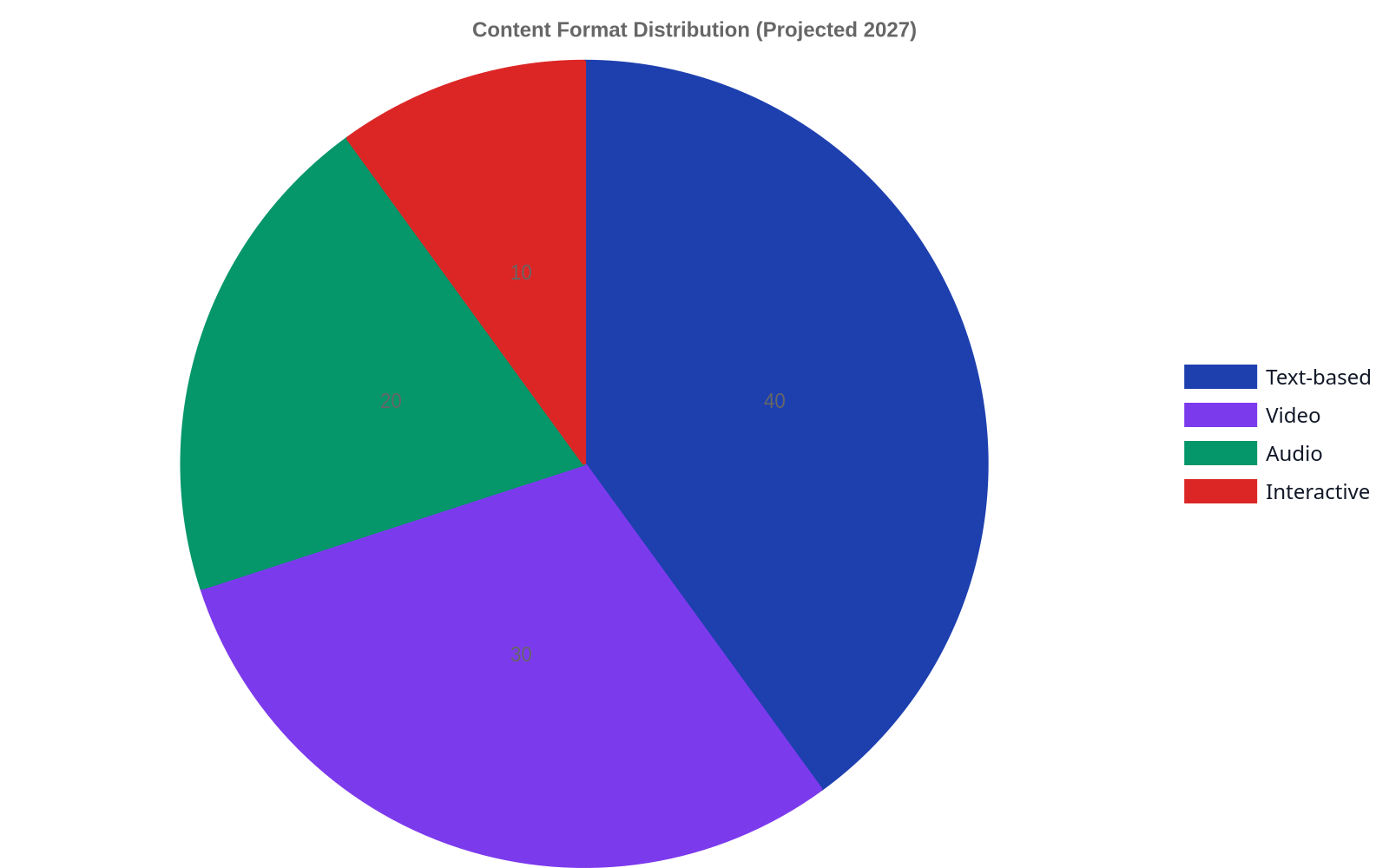
While text-based articles will remain a cornerstone of SEO, a one-dimensional content strategy is a losing proposition in 2027. The modern search experience is multi-modal, incorporating text, video, images, and audio directly into the SERP. Your content strategy must reflect this reality.
The Dominance of Short-Form Video
Platforms like TikTok, YouTube Shorts, and Instagram Reels have fundamentally rewired how users consume information. Search engines are responding by integrating short-form video directly into search results. These videos aren’t just for entertainment; they are a powerful format for “how-to” queries, product reviews, and quick explanations. Your content plan must include a strategy for creating and optimizing short-form videos that answer specific user questions.
The Practical Application of VR/AR
For years, virtual and augmented reality have been discussed as a distant future. By 2027, we will see practical, SEO-relevant applications. For e-commerce, this could mean AR features that let you “see” a product in your home. For service businesses, it might be a VR tour of a facility. The key is to think about how these immersive experiences can answer a user’s query more effectively than text or video alone. Optimizing content for these platforms, including metadata and location tagging, represents a new frontier for SEO.
Voice and Conversational Search
The way people search is becoming more natural and conversational. Instead of typing “best restaurants NYC,” they ask their device, “What’s a good place for Italian food near me that’s open now?” This requires a shift in content strategy.
| Old Keyword Strategy | Conversational Search Strategy |
|---|---|
| “SEO content trends 2027” | “What are the most important SEO content trends I should prepare for in 2027?” |
| “AI content generation” | “How can I use AI to create better blog posts for my business?” |
| “First-party data SEO” | “What’s the best way to collect customer data on my website after cookies are gone?” |
To capture this traffic, your content needs to be structured in a question-and-answer format. Think of each H2 and H3 as a direct answer to a potential voice query. Building a comprehensive FAQ section is one of the most effective ways to optimize for conversational search.
The New SEO Workflow
To execute on these trends, the traditional content workflow is no longer sufficient. It must become a more integrated, data-driven, and automated process.
Stop thinking of SEO as a series of manual tasks. Start thinking of it as designing an automated system where human expertise guides AI-driven execution.
Here is what the modern, 2027-ready process looks like:
- AI-Powered Keyword Research: Systems identify not just keywords, but entire clusters of user intent and associated conversational queries. This initial step provides the strategic foundation.
- Automated First Draft Generation: AI generates a baseline article that is structurally sound, covers the key entities, and is optimized for AISO.
- Human Expert Enhancement: A subject-matter expert reviews, edits, and enriches the draft. They add unique insights, first-hand experiences, and proprietary data that AI cannot replicate.
- Programmatic Schema and Linking: Tools automatically apply the correct schema markup and identify opportunities for internal linking to build topical authority.
- Omnichannel Publishing: The final content isn’t just a blog post. It’s atomized into short-form videos, audio clips, social media posts, and email newsletters, all published and tracked from a central hub.
- Continuous Performance Monitoring: The system monitors for content decay, tracks citation frequency in AI Overviews, and alerts the team when an article needs to be refreshed with new data.
This is the future of content production. It’s a model that combines the scale of AI with the irreplaceable value of human expertise. It’s how you will win in 2027.
Further reading
FAQ
What is AI Search Optimization (AISO)?
AISO is the process of optimizing your content to be understood, synthesized, and cited by AI-driven search engines like Google’s SGE. It goes beyond traditional keywords to focus on structured data, entity salience, and using language patterns that align with how Large Language Models process information.
Will AI replace SEO content writers?
No, but it will fundamentally change their role. AI will handle much of the repetitive, labor-intensive work of drafting and basic research. This frees up human writers to focus on higher-value tasks: strategy, subject-matter expertise, editing, and adding unique insights that only a human can provide. The role will evolve from writer to “content strategist” or “AI editor.”
How important is short-form video for SEO in 2027?
It will be critical. Search engines are already prioritizing short-form video in SERPs for many informational and “how-to” queries. By 2027, having a strategy for creating and optimizing short videos on platforms like YouTube Shorts and TikTok will be as important as your blog. It’s a key part of a diversified, omnichannel content strategy.
What is the single most important trend to prepare for?
The convergence of AI-driven search (SGE) and the need for provable human expertise (E-E-A-T). You cannot focus on one without the other. You must structure your content for AI consumption while simultaneously infusing it with authentic, human-generated insights and authority that AI cannot fake. This dual focus is the core challenge and opportunity for the coming years.
How does first-party data impact my SEO content?
First-party data is the fuel for personalization. By understanding your audience directly through data you collect, you can create content that is hyper-relevant to their needs and stage in the customer journey. This leads to higher engagement, which is a powerful ranking signal. It also allows you to build a direct relationship with your audience, making you less dependent on algorithm changes.
What role does schema markup play in 2027 SEO?
Schema markup will be a foundational element of technical SEO. It provides the explicit context that search engines, especially AI-driven ones, need to understand your content’s meaning, authoritativeness, and relationship to other entities. Properly implemented schema for articles, authors, organizations, and FAQs is essential for being featured in AI Overviews and other rich results.
Preparing for the SEO content trends of 2027 requires a strategic shift in mindset and tooling. It’s about building a content engine, not just writing articles. By embracing AI for scale, focusing on human expertise for differentiation, and building a foundation on structured, first-party data, you can create a content strategy that thrives in the new era of search. Platforms like Rank My Website are built for this future, automating the tedious work of keyword research, content creation, and optimization so you can focus on what truly matters: your expertise.