
Most executives think AI content is about firing their writers and replacing them with a cheap subscription. They are fundamentally wrong. Adopting AI isn’t like swapping a human assembly line for a robotic arm; it’s like giving your best engineers a supercomputer. The goal isn’t replacement, it’s leverage. In 2026, AI in content creation is no longer a novelty but a fundamental layer of the marketing stack, automating repetitive tasks and generating initial drafts. Its primary function is to augment human strategists by providing data-driven insights, scaling production, and handling programmatic content, allowing experts to focus on high-level strategy, originality, and brand voice. Success hinges not on the AI itself, but on the human oversight guiding it.
The Strategic Shift: From Content Mills to Content Intelligence
For years, the SEO world was dominated by a brute-force approach: more content, more keywords, more pages. This led to the rise of low-cost content mills that churned out thousands of generic, 500-word articles. AI, ironically, is the final nail in that coffin. By making mediocre content virtually free and instantaneous to produce, it has rendered it worthless. The new competitive frontier is content intelligence—using AI to inform a more strategic, targeted, and effective content plan.
Redefining the Role of the Content Creator
The job title “content writer” is becoming obsolete. In 2026, the most valuable players are “content strategists,” “AI editors,” and “prompt engineers.” These roles require a hybrid skillset. You still need to be a strong writer, but you also need to understand data, SEO, and the specific capabilities and limitations of various AI models. The creator’s job is no longer to fill a blank page. It’s to craft a detailed strategic brief, guide the AI to produce a functional first draft, and then provide the critical 20% of work—the nuance, storytelling, brand voice, and original insights—that creates 80% of the value.
AI as a Co-pilot for Keyword Research and Topic Clustering
Manual keyword research is a thing of the past. Modern AI tools can analyze thousands of SERPs in minutes, identify semantic keyword groups, and map out entire topic clusters that align with user intent. At Rank My Website, our own process for clients starts with sophisticated keyword research, but the real work is in structuring that data. AI can suggest pillar page ideas and spoke articles, ensuring comprehensive coverage that builds topical authority. Instead of guessing which long-tail keywords to target, a strategist can now use AI to identify proven question-based queries and generate a content plan to answer them systematically.
The End of “Writing for Word Count”
For too long, word count has been used as a lazy proxy for quality and comprehensiveness. AI destroys this notion. An LLM can generate a 5,000-word article on any topic in under a minute. This forces a much-needed shift in how we measure content value. The new metrics are about impact: Does the content rank? Does it drive qualified traffic? Does it convert? Does it provide a genuinely useful answer that satisfies the user? The focus moves from the cost of production to the return on investment.
The Current Landscape: AI Adoption in Content Creation
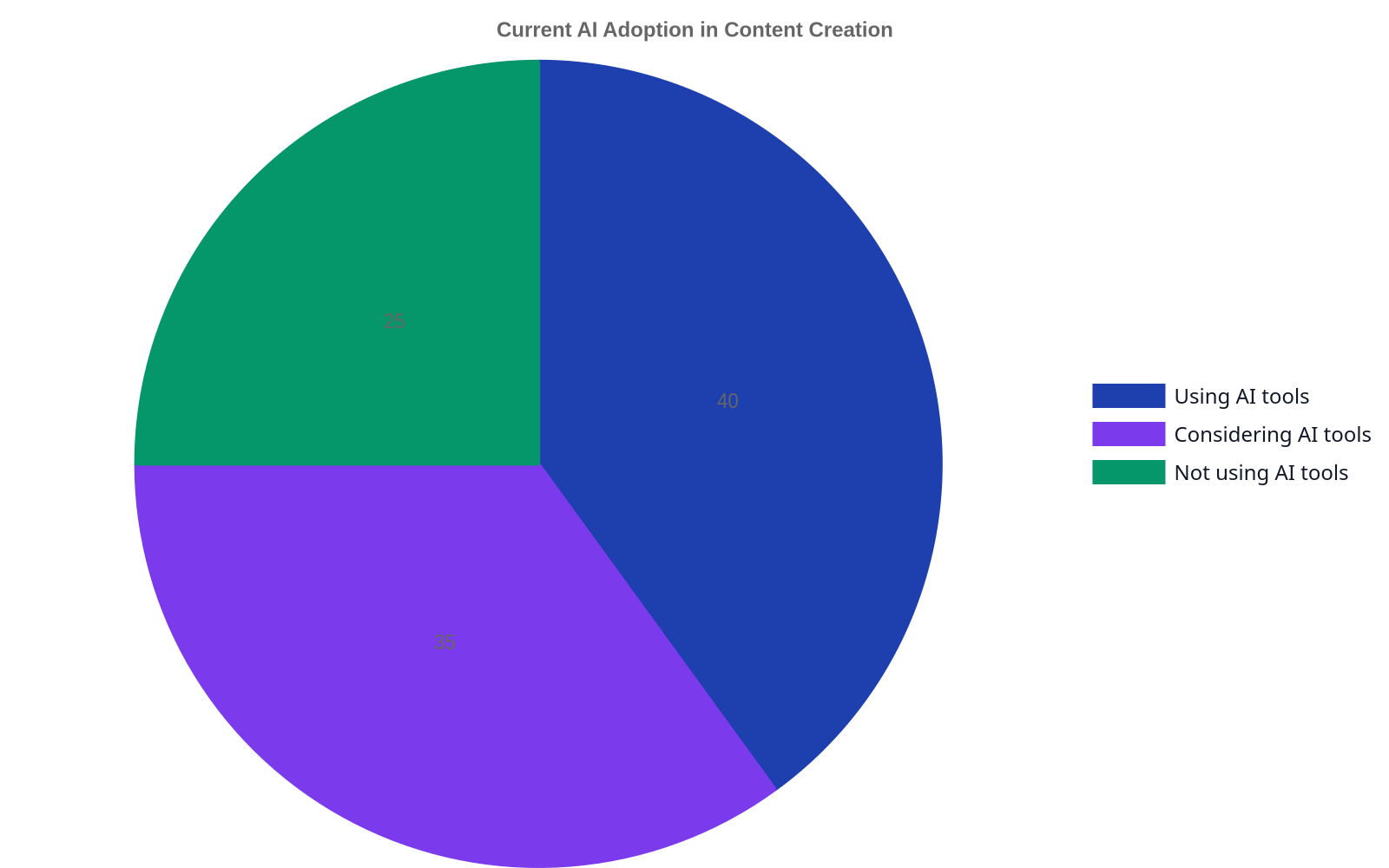
AI adoption is no longer a question of if, but how. Early adopters have moved beyond simple text generation and are integrating AI into their core workflows. According to a 2025 Gartner report, over 70% of enterprise marketing teams now use some form of generative AI in their content pipeline, a figure that was under 10% in 2023.
Which Industries Are Leading the Charge?
Unsurprisingly, tech, e-commerce, and digital media were the first to go all-in. They have the technical expertise and the high-volume content needs to see immediate benefits. However, we’re now seeing rapid adoption in more traditional sectors. For instance, an industrial assemblies manufacturer like our client wolverine-llc.com might use AI to generate technical spec sheets, installation guides, and localized product descriptions for a global market—tasks that were once prohibitively time-consuming. The legal, financial, and healthcare industries are more cautious due to compliance and accuracy concerns, but even they are using AI for internal knowledge bases and initial research.
The Generative AI Toolbox: Beyond ChatGPT
While ChatGPT remains the most recognized name, the 2026 toolkit is far more diverse. Content teams now use a portfolio of models, often accessed via API or specialized platforms like Rank My Website. Anthropic’s Claude 3 family is favored for tasks requiring brand voice consistency and nuanced, long-form writing. Google’s Gemini is unparalleled for its real-time integration with search data, making it ideal for creating timely, fact-based content. For visual content, Midjourney and Canva AI have become standard for generating ad creatives, blog headers, and social media assets in seconds.
Measuring the Initial ROI: Speed vs. Quality
The most immediate return on investment is a dramatic reduction in production time. What once took a writer 8 hours can now be accomplished in 2. This doesn’t mean the cost of content goes down by 75%. Instead, that saved time is reallocated to higher-value activities: strategy, editing, fact-checking, and promotion. As one Forbes analysis on AI ROI points out, the true measure of success isn’t just producing content faster; it’s producing better content faster, leading to higher rankings and more organic traffic.
By 2026, if your ‘content strategy’ is just feeding keywords into a text generator and hitting publish, you’re not practicing SEO. You’re just making the internet a more crowded, mediocre place.
Impact on Content Production: Efficiency and Scale
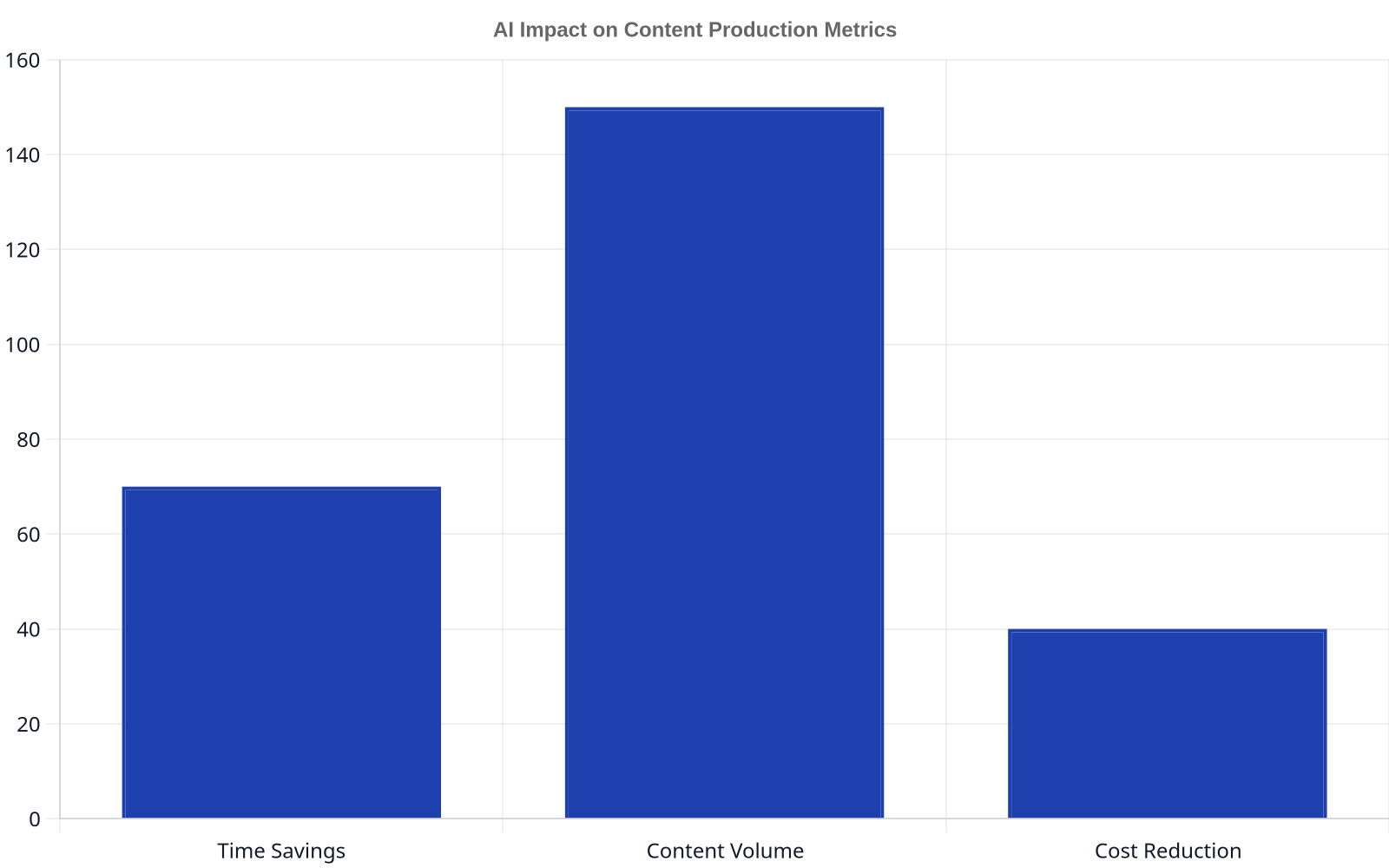
Leveraging AI is about creating systems that can operate at a scale previously unimaginable for most businesses. It’s about moving from an artisanal “one-off” content model to a programmatic, scalable engine that continuously captures organic traffic.
Automating First Drafts for Blogs and Scripts
The single biggest efficiency gain is the elimination of the “blank page problem.” A human strategist, armed with a deep understanding of the audience and keyword goals, creates a detailed outline or creative brief. This brief is then fed to an AI model to generate a comprehensive first draft. This draft is never publish-ready. But it provides the raw material—the structure, the basic research, the key talking points—allowing the human expert to focus immediately on refinement, adding original thought, and injecting brand personality.
Programmatic SEO and AI-Generated Landing Pages
Programmatic SEO involves creating pages at scale to target thousands of specific, long-tail search queries. Think of a real estate site with a unique page for “three-bedroom homes for sale in [neighborhood], [city]” or an e-commerce store with pages for every product in every color. Manually creating these pages is impossible. AI makes it trivial. By connecting a structured data source (e.g., product catalog, property listings) to a content template, businesses can generate thousands of optimized, user-friendly landing pages overnight.
Scaling Multilingual and Localized Content
For global businesses, translation and localization have always been a major bottleneck. AI translation models are now so advanced that they can produce high-quality translations that capture regional nuance far better than previous tools. A company can write one core article in English, then use AI to instantly adapt it for markets in Germany, Japan, and Brazil, complete with localized idioms and cultural references. This opens up international SEO to businesses that previously lacked the budget for massive human translation teams.
Human-in-the-Loop: The Most Critical Component
The biggest misconception about AI in content creation is that it’s a fully automated, “set it and forget it” system. The opposite is true. The quality of the output is directly proportional to the quality of the human input and oversight. The human-in-the-loop (HITL) model isn’t a temporary crutch; it’s the permanent, strategic core of any successful AI content operation.
Why Human Oversight Is Non-Negotiable
AI models, even in 2026, do not understand content. They are incredibly sophisticated pattern-matching machines. They don’t have experiences, opinions, or beliefs. This means they are prone to several critical failures:
- Factual Hallucinations: Inventing stats, sources, and events.
- Bias Amplification: Laundering biases present in their training data.
- Lack of Original Insight: Regurgitating existing information without creating a new perspective.
- Brand Inconsistency: Failing to capture the unique voice and values of a brand.
Only a human expert can catch these errors and provide the essential layer of authenticity and trust. This is why creating true authority requires a structured approach to things like understanding entity understanding that go beyond simple keyword matching.
A 5-Step Human-in-the-Loop Workflow
Implementing a successful AI content strategy involves a structured, repeatable process:
- Strategic Briefing: A human strategist defines the goal of the content piece, the target audience, the primary and secondary keywords, the desired tone of voice, and any unique angles or data points to include.
- AI-Assisted First Draft Generation: The brief is used to craft a detailed prompt for an LLM. The goal is to get an 80% complete draft that is well-structured and covers all the required points.
- Human Expert Review & Enhancement: This is the most crucial step. A subject matter expert and skilled editor reviews the draft for accuracy, originality, and clarity. They add personal anecdotes, proprietary data, stronger opinions, and a compelling narrative.
- On-Page Optimization: The refined draft is then optimized for search. This is where seo automation acts as a force multiplier, but it’s guided by human strategy. We ensure proper heading structure, image alt text, meta descriptions, and strategic internal linking to build topical authority. This is a core service we provide for our clients, creating a tightly woven content web.
- Performance Analysis: After publishing, a human analyst tracks the content’s performance—rankings, traffic, engagement, conversions. These insights are then fed back into the strategic briefing step for future content, creating a virtuous cycle of improvement.
Upskilling Your Team: From Writers to AI Editors and Prompters
Instead of fearing obsolescence, content teams should focus on upskilling. Writers need to become adept prompt engineers, learning how to coax high-quality, nuanced output from AI models. Editors must develop a keen eye for spotting AI-generated text and learn how to quickly and efficiently reshape it. The entire team needs to become more data-literate, comfortable with analyzing performance metrics to guide future strategy. This is less about becoming a programmer and more about becoming an expert conductor of an AI orchestra.
Future Trends: AI Integration by 2026
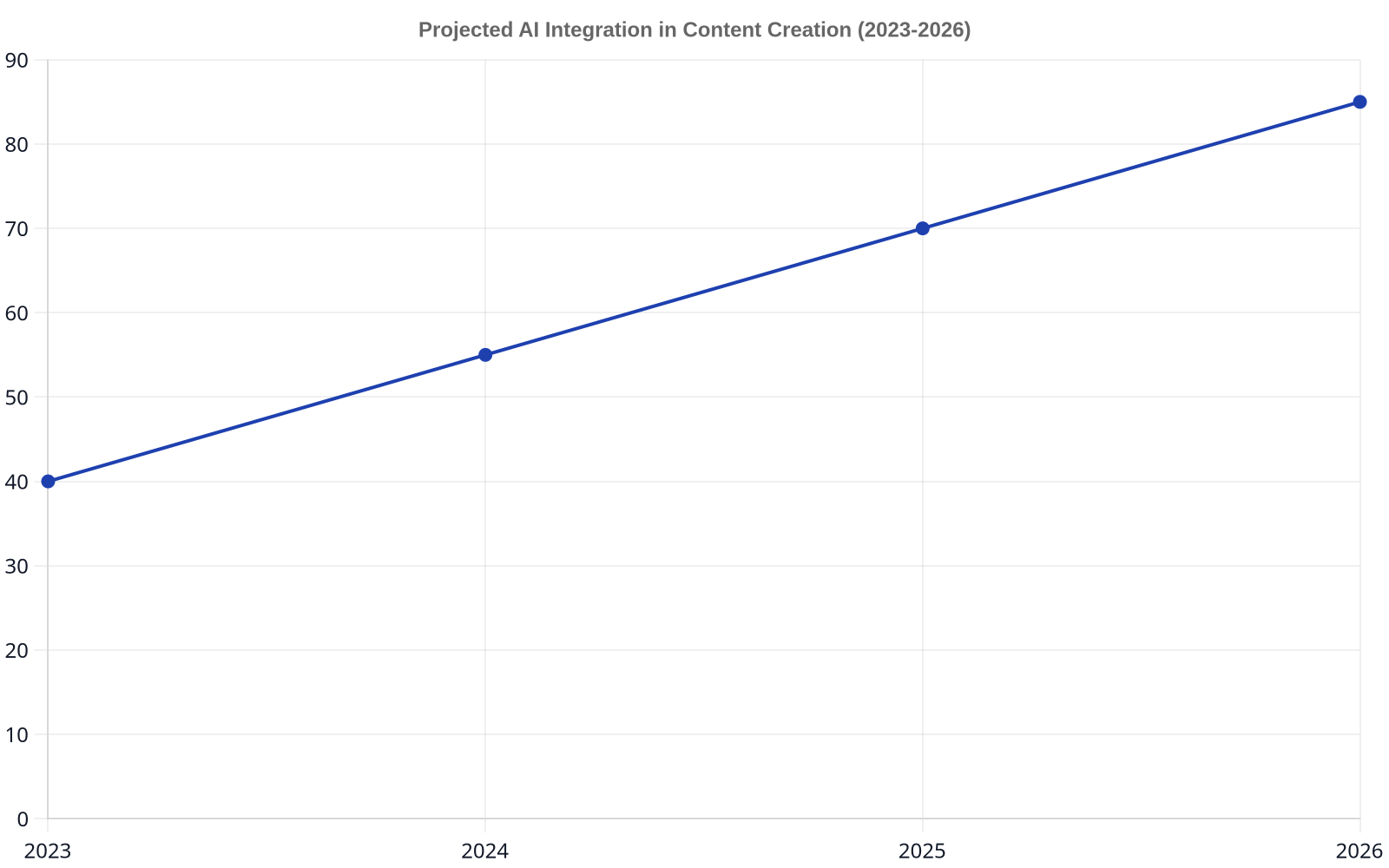
The progress in generative AI is relentless. The tools and techniques we use today will seem primitive within 18-24 months. As we look toward the near future, several key trends are defining the next wave of AI in content creation, a sentiment echoed by forward-looking analysis on AI’s impact on content.
Hyper-Personalization at Scale
The holy grail of marketing has always been the “segment of one.” AI is finally making this possible. By connecting generative AI to customer data platforms (CDPs), companies can create dynamically personalized website content, emails, and even ad creatives. Imagine a visitor arriving on your homepage and seeing copy and imagery that reflects their specific industry, previous browsing history, and geographic location. This level of personalization dramatically increases engagement and conversion rates.
AI in Video and Audio Content Generation
Text was just the beginning. The latest AI models can generate realistic human-like speech from text, create entire video sequences from a simple prompt, and even compose unique background music. By 2026, it will be common for marketing teams to produce a weekly podcast and a series of YouTube videos by simply feeding their blog posts into an AI multimedia engine, with a human editor providing the final polish. This collapses the cost and complexity of video production.
Predictive Analytics for Content Strategy
The next frontier isn’t just creating content; it’s predicting what content will perform best before you even write it. Advanced AI models can now analyze SERP volatility, competitor content velocity, and emerging user intent signals to forecast which topics are likely to trend and what content format is most likely to rank. This allows strategists to move from a reactive to a proactive content plan, allocating resources to topics with the highest probability of success.
The Tools and the Trade-Offs: A 2026 Snapshot
Choosing the right AI model is like choosing the right employee—each has its own strengths, weaknesses, and ideal role. A sophisticated content strategy relies on a portfolio of tools, not a single one-size-fits-all solution.
Comparing Large Language Models (LLMs)
Different models are optimized for different tasks. Sticking to just one is a mistake. Here’s how the major players stack up in 2026:
| Feature | OpenAI’s GPT-4 & Successors | Google’s Gemini Family | Anthropic’s Claude 3 Family | Open-Source Models (e.g., Llama 3) |
|---|---|---|---|---|
| Best For | General-purpose text, code generation | Multimodality, search integration | Safety, long context, brand voice | Customization, fine-tuning |
| Key Strength | Massive user base, vast API ecosystem | Real-time information access | Constitutional AI, nuanced writing | Transparency, lower cost |
| Limitation | Can be generic without expert prompting | Output can be “Googley” | Can be overly cautious or verbose | Requires significant technical overhead |
Navigating the Legal and Ethical Minefield
The rapid evolution of AI has created a host of complex legal and ethical questions. Who owns the copyright to an AI-generated image? Is it fair use to train a model on publicly available web content? These questions are far from settled. As the Electronic Frontier Foundation notes, the legal landscape is a patchwork of conflicting court rulings and pending legislation. The most prudent approach for businesses is to assume that AI-generated output is not automatically protected by copyright and to use AI as a tool to augment human creativity, not as a replacement for it. The final, published work should always have significant human authorship.
The most valuable skill in content marketing is no longer just writing. It’s the ability to ask the right questions—of your data, of your audience, and now, of your AI.
The Unspoken Challenges of AI Content
While the promise of AI is immense, a clear-eyed view reveals significant challenges that are often glossed over by tool vendors. Ignoring them is a recipe for failure.
The Plague of “AI Sameness” and How to Beat It
As more companies adopt the same AI tools, the internet is becoming flooded with content that looks and sounds identical. It shares the same structure, uses the same transitional phrases, and offers the same generic advice. This “AI sameness” is a major threat. The only way to combat it is with a strong brand voice and original thought. Your content must contain proprietary data, unique perspectives, personal stories, and strong opinions—the very things an AI cannot generate on its own. Your goal is to make your content recognizably yours.
Copyright, IP, and the Question of Originality
Can you claim ownership of something your AI created? The legal answer is murky and varies by jurisdiction. Training data is another concern; many models have been trained on copyrighted material without permission, creating a potential liability risk. To mitigate this, many businesses are turning to smaller, custom-trained models that use only their own proprietary data. This ensures a unique output and avoids thorny IP issues. For most, the safest path is to ensure that every piece of published content is substantially modified and enhanced by a human creator.
The Hidden Costs: Training, Oversight, and Tooling
The subscription price for an AI tool is just the tip of the iceberg. The real costs are in human capital. You need to invest significant time in training your team to use these tools effectively. You need to budget for the hours of human oversight, editing, and fact-checking required to bring AI drafts up to a publishable standard. And you need to account for the cost of the entire supporting tech stack—the project management software, the analytics platforms, and the specialized tools that make a modern content workflow function. AI isn’t a cost-cutting measure; it’s a capital investment in a more sophisticated and scalable content engine.
FAQ
Will AI replace content writers completely?
No. AI will replace mediocre, low-skill content tasks, but it will not replace skilled content strategists, editors, and writers. The role is evolving. AI acts as a powerful assistant, handling the initial research and drafting, which allows human experts to focus on higher-level tasks like strategy, originality, brand voice, and fact-checking. The demand for high-quality human oversight is actually increasing.
What is the biggest mistake companies make with AI content in 2026?
The biggest mistake is treating AI as a “one-click” solution. They paste a keyword into a generator, copy the output directly into their CMS, and hit publish. This results in generic, often inaccurate, and soulless content that fails to rank, engage, or build trust. Successful implementation requires a human-in-the-loop process for strategic briefing, editing, and brand alignment.
How do you ensure AI-generated content is accurate and original?
You can’t rely on the AI alone. Every claim, statistic, and key fact in an AI-generated draft must be rigorously fact-checked by a human expert against primary sources. Originality comes from the human enhancement process—adding unique insights, proprietary data, personal anecdotes, and a distinctive brand perspective that the AI cannot replicate.
Can Google detect AI-generated content, and does it matter?
Google is very effective at detecting patterns indicative of low-quality, unedited AI content. However, their official stance is that they reward high-quality content, regardless of how it’s produced. The focus isn’t on AI vs. human, but on helpfulness. If AI helps you create excellent, useful, and original content that satisfies user intent, it’s fine. If you use it to spam the web with low-value articles, you will likely be penalized.
What’s the best way to start using AI in my content workflow?
Start small and focus on a single, high-leverage task. A great starting point is using an AI tool to generate outlines and first drafts for blog posts based on a detailed brief created by a human. Measure the time saved and the quality of the output. As your team gets comfortable, you can gradually integrate AI into other areas like generating social media copy, brainstorming titles, or creating video scripts.
AI is not a magic bullet, but it is the most powerful tool ever given to content creators. By embracing a strategy of human-led, AI-powered content creation, businesses can build a moat of authority that is impossible to replicate with automation alone. The future of SEO belongs not to the robots, but to the strategists who command them. If you’re ready to build a content engine that runs on autopilot and delivers consistent organic growth, Rank My Website can help.