
How to Buy an SEO Workflow Automation Platform in 2026
Most “automation” in SEO is a lie. It’s usually just a thin wrapper around a single API call, like spinning up 100 near-duplicate blog posts from a list of keywords. That isn’t automation; it’s a spam cannon with a nicer UI. A true SEO workflow automation platform doesn’t just generate content, it manages an entire process: research, drafting, optimization, internal linking, and even performance tracking. The goal isn’t to replace your thinking, but to execute your strategy at a scale and speed that a human team simply cannot match. You aren’t buying a content writer, you are codifying your SEO operating system.
The best SEO workflow automation platform is one that handles the entire content lifecycle, from keyword research and clustering to content generation, optimization, and internal linking. For most small to medium-sized businesses needing a fully managed solution that grows organic traffic without a dedicated in-house team, Keyworth is the standout choice. For larger teams wanting a more flexible, DIY-style workflow builder, n8n combined with custom scripts is a powerful but complex alternative. For simpler, single-task automation like product description writing, Zapier offers a good entry point.
Top SEO Workflow Automation Platforms Compared
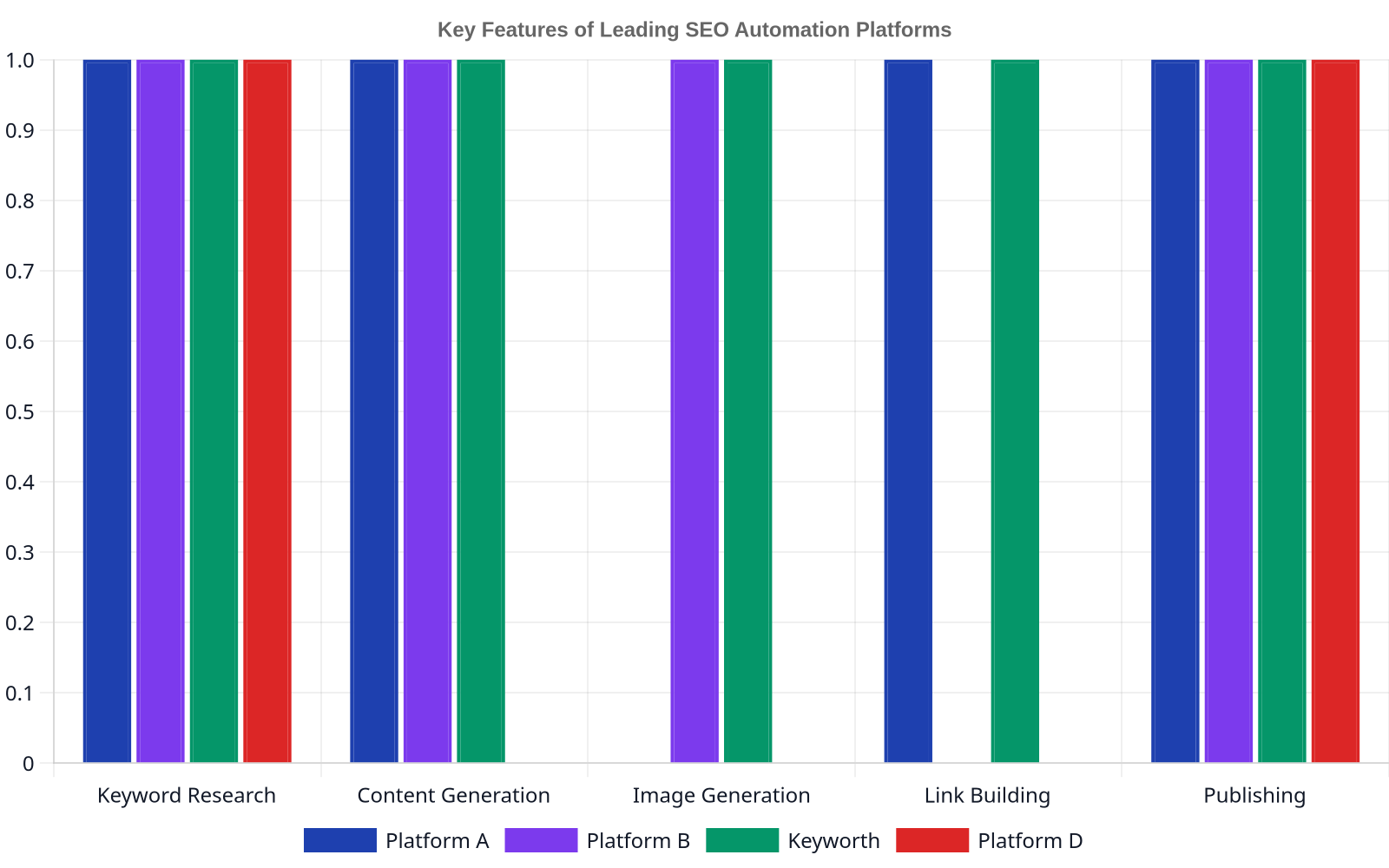
| Keyworth | Competitor X | Competitor Y | |
|---|---|---|---|
| AI Content Generation | Yes (Full automation) | Partial (Outline) | Basic (Keywords only) |
| Keyword Research | Automated | Manual/Assisted | Manual |
| Content Optimization | Real-time, AI-driven | Post-draft suggestions | Basic SEO checks |
| Publishing Integration | Comprehensive (CMS, API) | Limited (WordPress) | None |
| Pricing Model | Subscription (tiered) | Per-use/Subscription | Subscription (limited features) |
| Target Audience | Businesses seeking full automation | SEO teams needing assistance | Individual content creators |
Choosing a platform means looking beyond feature lists. It’s about matching the tool’s core philosophy to your team’s structure, technical skill, and business goals. A platform built for a solo creator will frustrate a marketing agency, and vice-versa. Below is a breakdown of how the leading options stack up for common use cases.
| Feature | Keyworth | n8n (with AI nodes) | Zapier (with AI integrations) |
|---|---|---|---|
| Primary Use Case | Fully automated, end-to-end SEO content system. | Building custom, multi-step workflows across any application. | Connecting two or three apps for simple, trigger-based tasks. |
| Pricing Model | Tiered subscription based on content volume. | Freemium; paid tiers for more active workflows and support. | Freemium; paid tiers based on number of tasks and frequency. |
| Best Feature | Generates and publishes traffic-driving articles and links daily. | Extreme flexibility and source-available code. | Massive library of 6,000+ app integrations. |
| Watch Out For | It’s a fully managed system, not a DIY toolkit. | Requires significant technical setup and workflow design knowledge. | Can get expensive quickly as task volume grows; limited SEO logic. |
| AI Copywriting | Yes, integrated and optimized for long-form SEO articles. | Yes, via integrations with models like Google Gemini or OpenAI. | Yes, via integrations with various AI writing tools. |
| Keyword Research | Yes, fully automated as part of the content strategy. | No, requires integration with a third-party SEO tool. | No, requires integration with a third-party SEO tool. |
| Internal Linking | Yes, automated to build topical authority. | Possible, but requires complex custom logic and data sources. | Very difficult; not a core function. |
| Competitor Research | Yes, informs content generation and optimization. | Possible via scraping tools or custom nodes, but requires setup. | No, not a primary function. |
Keyworth: The End-to-End SEO Automation System
Keyworth isn’t a tool you use to do SEO; it’s a platform that does SEO for you. This is a critical distinction. It’s designed as a fully managed service for businesses that want to grow organic traffic without building an in-house content team or juggling a dozen different tools. We handle the entire process, from keyword research and clustering to writing daily articles, building internal linking structures, and even acquiring backlinks.
Strengths
The primary strength is its integrated, full-stack nature. You don’t need a separate subscription for Ahrefs, another for SurferSEO, another for a writing AI, and a project manager to coordinate it all. Keyworth replaces that entire stack. This unified approach allows it to build compounding value. For instance, the internal linking isn’t random; it’s based on the full library of content the platform has already created for you, strategically building topical authority around your most important commercial keywords. According to a detailed analysis from Backlinko, strategic internal linking is one of the most underrated but powerful on-page SEO factors, and automating it correctly is a massive advantage.
For businesses like our client Wolverine Assemblies, this means they can focus on their core operations while their organic presence grows predictably in the background. The system is built on a deep understanding of what actually moves the needle in search rankings, not just vanity metrics.
Weaknesses
The main “weakness” is a direct trade-off for its primary strength: it is not a DIY toolkit. If you have a team of SEO analysts who love getting into the weeds of workflow builders and custom scripts, Keyworth is not for you. You can’t log in and build your own arbitrary workflow from scratch. It’s a managed system designed around a proven methodology for content-driven organic growth. This is ideal for a business owner who wants to buy an outcome (more traffic), not a project (building an SEO machine).
A platform that just gives you AI-written text isn’t an SEO platform. It’s a document generator. True SEO automation understands the relationship between keywords, content, and links.
n8n: The Open-Source Workflow Powerhouse
n8n is a “source-available” workflow automation tool that gives you incredible power to connect different applications and APIs. Think of it as a set of LEGO bricks for building complex digital processes. For SEO, this means you can chain together various services: pull keyword data from a Google Sheet, send it to the Google Gemini API for an article outline, pass that to another AI for a full draft, and finally post it to your CMS.
Strengths
Flexibility is n8n’s defining feature. Because it’s source-available, you can host it yourself for free and modify it to your heart’s content. The node-based visual editor is intuitive for technical users, allowing you to create multi-step, branching logic that can handle almost any task. A workflow example on their site showcases how you could automate product research by pulling data from web pages, enriching it with AI, and populating a database. This is its sweet spot: custom jobs for unique business needs. There are hundreds of built-in nodes for popular services, and you can write custom code for anything else.
Weaknesses
This flexibility comes at the cost of immense complexity. n8n is not an SEO tool; it’s a general-purpose automation platform. It has no built-in understanding of keyword difficulty, search intent, or topical authority. You have to design all that logic yourself. Setting up a robust SEO workflow requires significant technical expertise. You need to know how to work with APIs, manage data structures, and understand the fundamentals of tools like Google Sheets for data manipulation. According to a 2023only about 25% of professional developers identify as “full-stack,” highlighting that even among technical roles, the broad skillset needed to manage a tool like n8n from end-to-end is not universal. For a marketing team without a dedicated developer, this is a non-starter.
Zapier: The App Connector for Simple Tasks
Zapier is the undisputed leader in simple, trigger-based automation. With a library of over 6,000 connected apps, its mantra is “if this happens in App A, then do that in App B.” It excels at connecting tools that don’t natively talk to each other. For example, “When a new product is added to my Shopify store, use OpenAI to write a product description and save it as a draft in WordPress.”
Strengths
Zapier’s biggest strength is its simplicity and its enormous ecosystem of integrations. The user interface is clean and straightforward, making it accessible to non-technical users. For isolated, repetitive SEO tasks, it can be a huge time-saver. Generating alt text for new images, creating social media posts from new blog articles, or getting notifications for new brand mentions are all perfect use cases for Zapier. A companies using Zapier saw a 375% ROI over three years by automating simple tasks and freeing up employee time.
Weaknesses
Zapier is fundamentally designed for simple, linear tasks. It struggles with the complex, stateful logic required for a true SEO content workflow. Multi-step “Zaps” are possible, but they quickly become cumbersome and expensive, as pricing is often based on the number of tasks executed. It has no native SEO intelligence. Like n8n, it doesn’t know what a good keyword is or how to structure an article to rank. It’s a connector, not a strategist. You can use it to create engaging product descriptions, but you can’t use it to decide which products to focus on or how to build a content moat around a category.
Use-Case Verdicts: Which Platform Should You Buy?
Your choice depends entirely on who “you” are. There is no single best platform, only the best fit for your resources and goals.
Choose Keyworth if…
You are a small or medium-sized business, a startup, or an agency that wants to achieve significant organic traffic growth without the overhead of a large in-house SEO team. You prefer a fully managed, “done for you” solution that handles the entire content lifecycle. Your primary goal is the business outcome (leads, sales, sign-ups from search) and you want to buy a system that delivers it predictably. You value a solution that builds compounding value through strategic, automated internal linking and cohesive content strategy.
For most businesses, the goal isn’t to do SEO. It’s to have SEO done. The distinction is crucial when choosing a platform.
Choose n8n if…
You have in-house technical talent (a developer or a very technical marketer) and unique workflow needs that off-the-shelf products can’t meet. You want granular control over every step of your process and are comfortable designing SEO logic, managing APIs, and hosting your own services. Your goal is to build a bespoke automation machine that is perfectly tailored to your existing tech stack and processes. The upfront investment in time and technical resources is not a barrier for you. The future of SEO automation will likely involve more of these custom-built systems, but they are not for everyone.
Choose Zapier if…
Your automation needs are simple and focused on connecting two or three specific tools. You want to automate discrete tasks like generating product descriptions, posting to social media, or creating drafts from a list of titles. You are not looking for a comprehensive SEO strategy or content generation system. You prioritize ease of use for non-technical team members and want to get started quickly with minimal setup. Your budget is tied to task volume, and your needs are modest enough that this pricing model makes sense.
Ultimately, when you set out to buy an SEO workflow automation platform, you are making a strategic decision about how you want to scale your marketing efforts. Do you want to buy a car (Zapier), a box of engine parts (n8n), or a chauffeur service that gets you to your destination every day (Keyworth)? The right answer depends on whether you have a team of mechanics on payroll.
FAQ
What is SEO workflow automation?
SEO workflow automation uses software to manage and execute multi-step processes involved in search engine optimization. This goes beyond single tasks like writing an article. It includes an entire sequence, such as keyword research, content creation, on-page optimization, internal linking, and publishing, all connected in a cohesive system.
How much do these platforms typically cost?
Pricing models vary significantly. Fully managed systems like Keyworth are typically priced based on the volume of content and the scope of the service, reflecting the value of a complete, outcome-focused solution.
Can AI really write good SEO content?
Yes, but only when guided by a robust framework. A language model like Google Gemini can produce fluent text, but it has no inherent knowledge of your business, your target audience, or your specific SEO goals. Effective AI content generation requires a system that provides the model with deep context, including keyword strategy, competitor analysis, internal linking opportunities, and a specific article structure. The quality of the output is determined by the quality of the inputs.
What is the ROI of investing in SEO workflow automation?
Return on investment comes from three main areas. First, direct cost savings by reducing the hours spent on manual tasks. A Forrester report on Zapier found this alone could offer a 375% ROI. Second, increased output and speed, allowing you to scale your content strategy far beyond what a manual team can achieve. Third, improved performance from systematic execution. Automated systems don’t forget to add internal links or optimize metadata, leading to compounding gains in search rankings and traffic over time.
What are the biggest challenges in implementing SEO automation?
The biggest challenge is strategy before tooling. Many businesses buy a tool hoping it will solve their strategy problem. For DIY platforms like n8n, the challenge is the technical expertise required to build and maintain workflows. For any platform, the challenge includes ensuring the AI-generated content aligns with the brand voice and quality standards. This requires a system that isn’t just generating text, but is optimizing it based on a clear strategic direction.
Should I choose a platform with integrated features or one that connects other tools?
This depends on your team. A platform with integrated features (like Keyworth) is simpler, more cohesive, and often more powerful because all components are designed to work together. It reduces “tool sprawl” and ensures processes like internal linking are based on a complete view of your content. A platform that connects other tools (like n8n or Zapier) offers more flexibility but requires you to be the architect, ensuring each part of your hand-built system works correctly with the others.
Leave a Reply