Author: admin

  • AI Content for Enterprise SEO: The 2026 Guide

    AI Content for Enterprise SEO: The 2026 Guide

    Introduction: Why AI Content is Reshaping Enterprise SEO in 2026

    Imagine managing a website with 50,000 product pages, a blog updated in five different languages, and support documentation across a dozen portfolios. This is the daily reality for enterprise-level businesses. For these digital giants, winning in search means dominating thousands, even millions, of search queries globally. In 2026, the engine powering this domination is artificial intelligence.

    The Evolving Landscape of Enterprise SEO

    The fundamental challenge of enterprise SEO has always been scale. An enterprise must produce a staggering volume of high-quality, relevant content to cover every product variation, user intent, and geographical market. The traditional content pipeline, reliant on manual processes, is now the primary bottleneck. It’s too slow, too resource-intensive, and cannot keep pace with rapid market shifts and aggressive competitors. Maintaining topical authority and brand consistency across tens of thousands of pages manually is a monumental, if not impossible, task. The old way of doing things is no longer competitive.

    The Promise of AI for Large-Scale Content Generation

    This is precisely where artificial intelligence steps in. The conversation has shifted from “if” to “how” businesses should leverage ai content for enterprise SEO. AI-powered platforms can now generate topically relevant, SEO-optimized articles, product descriptions, and landing pages at a previously unimaginable scale. This isn’t about replacing human strategists; it’s about empowering them. Platforms like Rank My Website handle the heavy lifting of content production, allowing teams to generate SEO-optimized articles from keywords and publish them on autopilot. This frees up marketing experts to focus on higher-level strategy, creative direction, and performance analysis.

    This shift isn’t a fleeting trend. For large organizations aiming for market leadership, using ai content for enterprise SEO is a fundamental necessity for survival and growth. It’s the key to achieving unprecedented scale, speed, and efficiency in the world’s most competitive digital arenas.

    Understanding AI-Powered Content Generation for Enterprises

    As businesses scale, so does the demand for high-quality, relevant content. Manually creating hundreds or thousands of pages is a monumental task. This is where AI-powered content generation steps in, transforming a bottleneck into a streamlined, automated process.

    How AI Content Tools Work: A Technical Overview

    AI content generation relies on advanced technologies like Natural Language Processing (NLP) and machine learning. These models, often called Large Language Models (LLMs), are trained on immense datasets of text and code from the internet. This training allows them to understand grammar, context, nuance, and stylistic patterns. When you provide a prompt—like a keyword or a content brief—the AI uses this knowledge to predict the most logical sequence of words, effectively generating new, original text. Sophisticated platforms use this technology to create content that is not only coherent but also optimized for search engines from the first draft.

    Key Benefits of AI for Enterprise Content Workflows

    Integrating AI content for enterprise SEO workflows introduces transformative advantages: efficiency, consistency, and unparalleled scalability.

    • Efficiency: AI can produce a well-structured first draft in minutes, a task that could take a human writer hours. This dramatically accelerates the content lifecycle.
    • Consistency: Maintaining a consistent brand voice, tone, and quality across thousands of pages is a classic enterprise challenge. AI tools can be configured to adhere to specific style guides, ensuring uniformity.
    • Scalability: Whether you need to generate 100 new product pages or 1,000 localized blog posts, AI handles the volume without a proportional increase in headcount or cost. For a deeper look at the tools driving this change, explore our guide on SEO content workflow automation tools (2026).
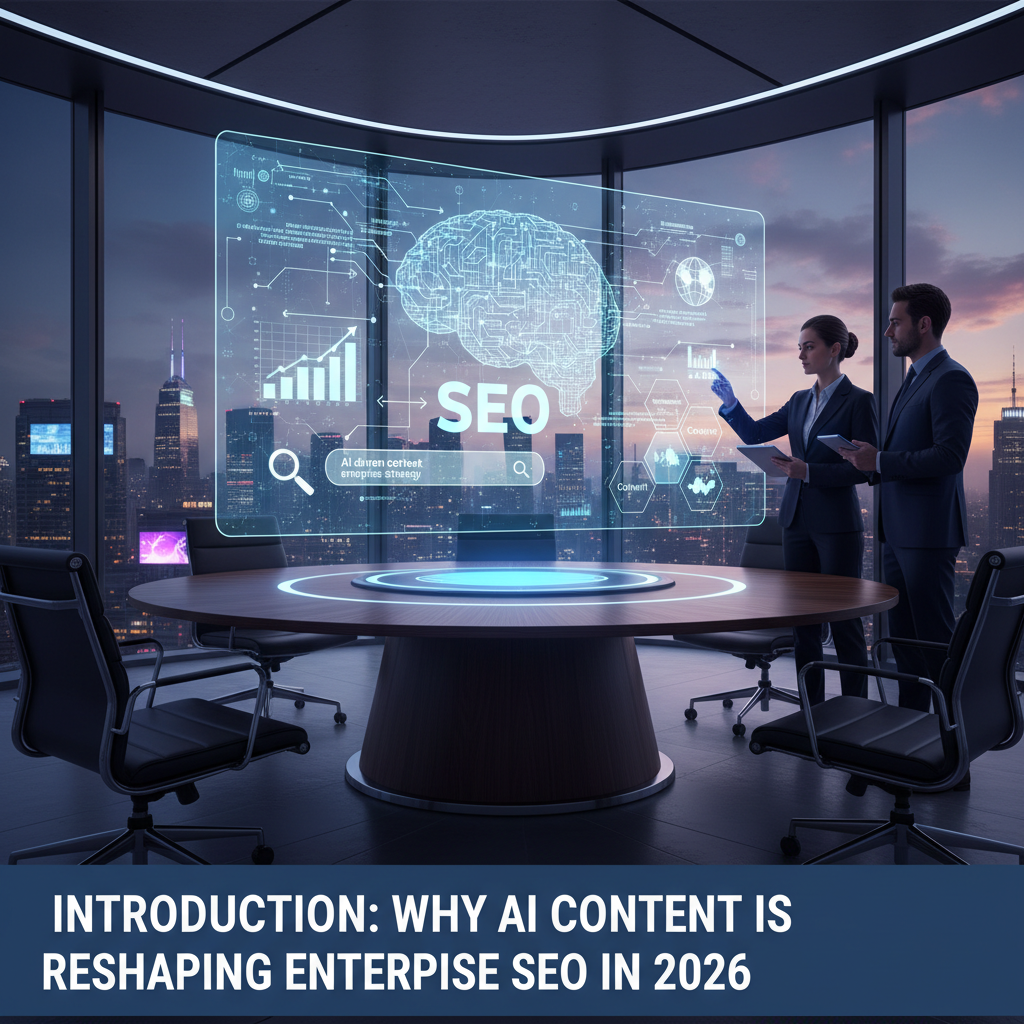
    A flowchart showing the AI content generation process from keyword input to a published article, highlighting speed and scale. — ai content for enterprise SEO
    Introduction: Why AI Content is Reshaping Enterprise SEO in 2026

    Distinguishing AI-Assisted Content from Human-Created Content

    AI is not meant to replace human writers and editors entirely. The best approach to using AI content for enterprise SEO is to view it as an incredibly powerful assistant. AI excels at research, data synthesis, and drafting. Human expertise is irreplaceable for strategic oversight, fact-checking critical information, injecting unique brand personality, and adding nuanced insights. Platforms like Rank My Website are designed around this synergy, automating the heavy lifting so your human experts can focus on high-value strategic and creative tasks. The goal isn’t to remove humans, but to empower them to achieve more, faster.

    Strategic Applications of AI Content in Enterprise SEO

    Beyond simple blog post generation, AI unlocks strategic opportunities that were previously too resource-intensive. By integrating AI into core content workflows, businesses can achieve scalable growth, target hyper-specific audience segments, and dominate global markets. The true power of AI content for enterprise SEO lies in its ability to execute high-impact strategies with unprecedented speed and efficiency.

    Automating Content for Long-Tail Keywords and Niche Topics

    Enterprises often sit on a goldmine of long-tail keywords—highly specific search queries that indicate strong user intent. While each term has low search volume, their cumulative traffic can be massive. Manually creating quality content for thousands of these niche topics is not feasible. AI changes this. It can generate hundreds of informative articles, guides, and FAQs targeting these keywords, creating a vast web of content that captures high-intent traffic. Platforms like Rank My Website take this further by helping you automate the entire process from keyword discovery to content creation and publishing, ensuring you cover every corner of your market.

    A flowchart showing a single keyword branching into dozens of long-tail keyword content pieces created by AI — ai content for enterprise SEO
    Understanding AI-Powered Content Generation for Enterprises

    Scaling Multilingual Content and Localization Efforts

    Expanding into new international markets requires more than just direct translation; it demands localization. Content must be adapted to local dialects, cultural nuances, and region-specific search terms. This has been a historically slow and expensive process. Advanced AI models can now instantly generate localized content that maintains brand voice and SEO integrity across dozens of languages. This rapid scalability allows enterprises to establish a strong organic presence in new markets in a fraction of the time and cost.

    Enhancing Product Descriptions and E-commerce Content

    For e-commerce giants managing tens of thousands of SKUs, writing unique, compelling, and SEO-optimized product descriptions is a monumental challenge. AI excels here, generating thousands of unique descriptions that highlight key features, incorporate relevant keywords, and use persuasive language to drive conversions. This not only improves the user experience but also provides search engines with rich, unique content. For businesses on specific platforms, mastering this is key, as detailed in our AI Content Generation for Shopify: 2026 Guide. Solutions like Rank My Website help automate this creation, turning a logistical nightmare into a seamless SEO advantage.

    Optimizing AI-Generated Content for Maximum SEO Impact

    Creating content with AI is only the first step. To truly unlock its potential, you must optimize that output. Simply publishing raw AI text won’t deliver enterprise-level results. The real power comes from a strategic approach that blends AI’s speed with human expertise and proven SEO principles. Without this crucial optimization layer, you’re merely creating noise, not value that drives meaningful traffic and conversions.

    The Importance of Human Oversight and Editing

    AI is an incredibly powerful co-author, but it is not an expert strategist. Human oversight is the critical quality gate that turns a good draft into great, rank-worthy content. Your subject matter experts and editors must review every piece to verify factual accuracy, align the tone with your brand’s unique voice, and inject the experience and authority that search engines reward. This human touch is non-negotiable for building trust with your audience.

    A marketing professional editing an AI-generated article on their laptop, with SEO checklists visible. — ai content for enterprise SEO
    Strategic Applications of AI Content in Enterprise SEO

    Developing a robust review system is essential; for a deeper dive, see our full guide on mastering the AI content review process. This step ensures all content meets your brand’s high standards.

    Integrating AI Content with On-Page SEO Best Practices

    Think of AI-generated text as raw clay; on-page SEO is the process of sculpting it into a masterpiece. All fundamental SEO practices still apply. You must ensure your primary and secondary keywords are integrated naturally throughout the text, headings, and alt text. Craft compelling, clickable meta titles and descriptions. Most importantly, strategically place internal links to other relevant pages on your site. This helps search engines understand your site’s structure and guides users deeper into your content ecosystem, boosting engagement and authority. Platforms like Rank My Website facilitate this by integrating these on-page SEO tools directly into the content creation workflow.

    Measuring and Iterating on AI Content Performance

    A “set it and forget it” approach will not work. To succeed with ai content for enterprise SEO, you must implement a continuous feedback loop. After publishing, closely monitor key performance metrics using tools like Google Analytics and Search Console. Track rankings, organic traffic, click-through rates, and user engagement signals. Analyze which articles perform well and which ones fall flat. Use this data to refine your content briefs and AI prompts. Feed those insights back into your creation process to consistently improve the quality and effectiveness of your future content.

    Choosing the Right AI Content Platform for Your Enterprise

    Selecting the right platform is critical for successfully scaling your AI content for enterprise SEO strategy. The ideal tool must go beyond simple text generation and function as an integrated part of your marketing technology stack. The goal is to find a solution that not only creates content but also ensures it performs, aligns with your brand, and scales effortlessly with your growth.

    Key Features to Look For in an AI Content Tool

    For an enterprise, basic features won’t suffice. You need advanced capabilities. Look for platforms that offer robust controls over brand voice and tone, ensuring consistency across thousands of pages. Essential features include built-in plagiarism checkers, multi-language support for global campaigns, and advanced optimization tools that analyze SERP data to inform content structure. Furthermore, the ability to generate content from custom data sources or detailed briefs is crucial for producing expert-level articles.

    Integration Capabilities and Scalability

    A standalone AI tool creates more work than it saves. True enterprise-grade platforms are built for integration. Prioritize solutions with robust API access, allowing your development team to build custom workflows. Native integrations with your Content Management System (CMS) like WordPress or Shopify, and your Customer Relationship Management (CRM) are non-negotiable for a seamless content pipeline from creation to publication and lead tracking. For more on this, see our guide to SEO content workflow automation tools (2026). As your needs evolve, the platform must scale to handle increasing content volume without a drop in performance or quality.

    Why Rank My Website is the Top Choice for Enterprise SEO

    Rank My Website delivers a complete, end-to-end solution designed for enterprise-level demands. It excels by unifying the entire content lifecycle onto a single, automated platform. You can generate high-quality, SEO-optimized content from just a keyword, but its true power lies in its seamless workflow. Rank My Website doesn’t just write the article; it refines it with built-in on-page SEO tools and publishes it directly to your site. This “autopilot” approach eliminates manual handoffs between writers, editors, and SEO specialists. For businesses that need to produce quality content at scale and achieve faster, more consistent rankings, it’s the clear leader. Ready to put your organic growth on autopilot? Discover how Rank My Website can transform your content strategy today.

    Overcoming Challenges and Ethical Considerations with AI Content

    Successfully implementing ai content for enterprise SEO requires navigating several key challenges and ethical considerations. Scaling content production should never mean sacrificing quality, originality, or your brand’s integrity. A proactive approach is essential for long-term success.

    Maintaining Brand Voice and Quality at Scale

    One of the biggest hurdles is ensuring AI-generated content sounds like it came from your brand. Generic, soulless text can dilute brand identity. The solution lies in a human-centric approach to automation.

    Start by creating an exhaustive brand voice and style guide that can be used to train or prompt the AI model. This should include tone of voice, preferred terminology, formatting rules, and examples of on-brand content. Furthermore, a non-negotiable step is a robust human review and editing process. An AI can produce a solid first draft, but a human editor ensures it aligns perfectly with brand messaging, meets quality standards, and provides genuine value. Platforms that allow for detailed customization and feedback loops are invaluable.

    Addressing Potential for Duplicate Content or Plagiarism

    The fear of being penalized by search engines for duplicate content or unintentional plagiarism is valid. While sophisticated AI models are designed to generate unique outputs, safeguards are crucial. Enterprises should adopt a multi-layered verification workflow. First, use AI content platforms that have built-in plagiarism detection features. Second, run all final drafts through a trusted third-party plagiarism checker before publication. This two-step process minimizes risk and ensures originality.

    Ethical Use of AI in Content Creation

    The ethical use of AI is paramount. Search engines prioritize helpful, reliable, people-first content, regardless of its origin. The focus should be on value, not the method of creation. This means enterprises have a responsibility to fact-check any claims, statistics, or data generated by AI. Adopting an “AI-assisted, human-refined” model is the most responsible path forward. It ensures accuracy and upholds your brand’s authority. While not always required, being upfront about AI’s role can build trust. For a deeper dive into responsible practices, explore our complete guide on ethical AI in SEO content.

    Frequently Asked Questions About AI Content for Enterprise SEO

    Navigating the implementation of a new technology at scale can raise important questions. Here are answers to some of the most common inquiries about using AI for enterprise-level SEO content.

    Can AI truly replace human content writers for enterprise SEO?

    No, AI should be viewed as a powerful collaborator, not a replacement. AI excels at handling scale, speed, and data-driven optimization. It can generate first drafts, conduct keyword research, structure articles, and produce content variations in minutes. However, human oversight is crucial. Your strategists, editors, and subject-matter experts provide the brand voice, critical thinking, fact-checking, and unique insights that build true authority and trust. The best results come from a hybrid model where AI handles the heavy lifting and humans provide the final, strategic polish.

    How do search engines (like Google) view AI-generated content in 2026?

    As of 2026, Google’s position is firm: they reward high-quality, helpful content and penalize spam, regardless of origin. Their focus is on the value delivered to the user, measured through signals related to Experience, Expertise, Authoritativeness, and Trustworthiness (E-E-A-T). Low-quality, unedited AI content created solely to manipulate rankings will hurt your SEO. However, thoughtfully produced, edited, and fact-checked content that serves user intent is perfectly acceptable and can rank very well. The key is using ai content for enterprise SEO as a tool to create better, more helpful content at scale.

    What are the typical costs associated with implementing AI content solutions?

    Costs go beyond the software subscription fee. A complete budget should account for the platform itself (like Rank My Website), the human resources required for managing the strategy and editing the output, and any necessary training to get your team up to speed on new processes. Enterprises must also consider the cost of integrating the new tool into their existing marketing technology stack.

    How quickly can an enterprise see SEO results from using AI content?

    While AI significantly accelerates content production, SEO remains a long-term strategy. The speed of results depends on your industry’s competitiveness, your domain authority, and the scale of your implementation. You can typically expect to see leading indicators like increased impressions and clicks on new long-tail keywords within 3-6 months. Substantial improvements in rankings for high-value terms often take 6-12 months as Google indexes the new content and recognizes your expanded topical authority.

    What kind of training is needed for a team to effectively use AI content tools?

    Effective team training focuses on building new workflows, not just learning software buttons. Key training modules should cover prompt engineering best practices, establishing a rigorous AI content review process, fact-checking protocols, and infusing AI drafts with unique brand voice and expert insights. The goal is to train your team to become expert “AI editors” who can guide the technology to produce superior content efficiently.

    Conclusion: The Future is Now for Enterprise SEO with AI

    The dialogue surrounding artificial intelligence in search engine optimization has shifted from theoretical possibility to practical necessity. For large-scale organizations, the integration of AI is no longer a forward-thinking experiment but a foundational component of a competitive digital strategy in 2026. As we’ve explored, AI’s ability to process vast datasets, identify lucrative content gaps, and generate optimized content with unprecedented speed and efficiency is transformative. It allows businesses to move beyond manual limitations and build a commanding presence across the entire digital landscape, responding to market shifts and customer intent in near real-time.

    However, the true power of AI content for enterprise SEO is not realized through blind automation. The most successful and sustainable strategies are built on a symbiotic relationship between human expertise and machine intelligence. Strategic oversight remains paramount. Human strategists must guide the AI, defining the brand voice, validating factual accuracy, and infusing content with unique creativity, authority, and trust. This hybrid model—where technology handles the scale and speed, and humans provide the strategic direction and final polish—is the key to unlocking maximum ROI while mitigating the risks of generic, off-brand content. This approach ensures that every piece of content is not just algorithmically sound, but also a true asset to the brand.

    The window of opportunity to gain a first-mover advantage is closing rapidly. Your competitors are already deploying these tools, and delaying adoption is a decision to cede ground in the battle for organic search dominance. Embracing AI content for enterprise SEO now is about securing your organization’s future visibility and authority. The enterprises that will lead their industries tomorrow are those building their AI-powered content engines today.

    Ready to leverage AI to scale your content strategy without sacrificing control? Rank My Website provides the perfect platform, generating SEO-optimized content from your keywords and publishing it directly to your site. Discover how you can grow your organic traffic on autopilot today.


  • AI Content Generation for Shopify: 2026 Guide

    AI Content Generation for Shopify: 2026 Guide

    Introduction: Revolutionizing Shopify Content with AI in 2026

    Your Shopify store is a digital masterpiece, but keeping it vibrant and visible feels like a full-time job. Between new product launches, seasonal campaigns, and the endless demand for blog content, the content creation hamster wheel never stops spinning. For many store owners in 2026, this constant pressure leads to a critical bottleneck, hindering growth and making it difficult to compete. This is the core challenge that has pushed a transformative technology to the forefront of e-commerce strategy.

    The E-commerce Content Challenge for Shopify Stores

    Every Shopify store thrives on a foundation of compelling content. This isn’t just about a handful of blog posts. It’s about crafting unique, SEO-friendly product descriptions for every single item, writing engaging collection page narratives, creating persuasive email marketing campaigns, and producing a steady stream of social media updates. Manually creating this sheer volume of high-quality content is a monumental task. It’s expensive if you outsource it, time-consuming if you do it yourself, and often leads to burnout or generic copy that fails to convert visitors into customers.

    What is AI Content Generation and Why it Matters for Shopify?

    Enter the solution: AI content generation. This technology uses advanced machine learning models to create human-like text based on simple prompts you provide. For a busy Shopify merchant, this is a game-changer. Imagine generating dozens of distinct product descriptions in minutes instead of days, brainstorming a month’s worth of blog topics in seconds, or drafting ad copy that resonates with your target audience instantly. Implementing AI content generation for Shopify allows you to scale your content output exponentially without scaling your team or budget, freeing you to focus on other critical areas of your business.

    How This Guide Will Help You

    This guide is your comprehensive roadmap to mastering AI content generation for Shopify. We will move beyond the hype and provide a practical, step-by-step framework you can implement immediately. You’ll discover how to choose the right tools, develop effective content workflows, and use AI to create everything from product descriptions that sell to blog posts that rank on Google. In the hyper-competitive e-commerce landscape of 2026, leveraging this technology is no longer optional—it’s essential for survival and growth. Let’s get started.

    Why AI Content Generation is a Must-Have for Shopify Merchants in 2026

    In 2026, the e-commerce battlefield is won through visibility. Having fantastic products is the starting point, but without consistent organic traffic, growth stalls. For Shopify merchants, ai content generation for Shopify is no longer an optional extra; it’s the core engine driving SEO success, allowing even the smallest stores to dominate search results and attract ready-to-buy customers.

    Boosting SEO and Organic Traffic

    Modern AI platforms do far more than just string words together. They function as an SEO strategist, analyzing top-ranking pages to identify the keywords, topics, and question-based queries your audience uses. Imagine generating hundreds of unique, keyword-rich product descriptions that are not only compelling but optimized to rank for specific search terms. This process eliminates the duplicate content issues that often hinder e-commerce sites. From engaging blog posts that establish your brand’s authority to targeted collection page copy, AI ensures every word on your site serves the dual purpose of engaging humans and satisfying search engine algorithms.

    A flowchart showing the traditional time-consuming content creation process vs. the streamlined AI-powered process for a Shopify store. — ai content generation for shopify
    Introduction: Revolutionizing Shopify Content with AI in 2026

    Saving Time and Resources

    For lean e-commerce teams, time is the most precious commodity. Manually writing a single, well-researched blog post can easily consume an entire day. Creating unique descriptions for a catalog of 200 products could take a full work week. AI-powered tools condense these timelines dramatically. That 40-hour task of writing product descriptions can now be completed in under two hours. Platforms like Rank My Website streamline this even further, allowing you to generate optimized content from just a keyword. This reclaimed time can be reinvested into higher-value tasks: customer engagement, supply chain management, and overall business strategy.

    Scaling Content Production Efficiently

    Saving time naturally leads to the ability to scale your content marketing efforts efficiently. A content strategy that once seemed reserved for corporations with large marketing departments is now within reach for any Shopify merchant. You can consistently publish weekly blog posts, create detailed buying guides for every product category, and refresh old content to maintain its ranking power. Effective AI-powered platforms like Rank My Website offer a complete workflow, from generating SEO-optimized drafts to one-click publishing, creating a nearly hands-off engine for organic growth. This consistent output builds topical authority, signaling to Google that your store is a go-to resource. For more details, explore our guide on SEO content automation for small business 2026.

    Choosing the Right AI Content Platform for Your Shopify Store

    Selecting the right AI tool is the most critical step in supercharging your e-commerce content strategy. With a dizzying array of options available, it’s essential to focus on platforms that are purpose-built to drive organic traffic, not just generate text. The ideal solution understands the specific needs of an e-commerce business and streamlines the path from keyword to conversion, making your content efforts efficient and effective.

    Key Features to Look For

    When evaluating tools for ai content generation for Shopify, prioritize three core areas. First, deep SEO integration is non-negotiable. Look for platforms that go beyond simple keyword insertion to perform competitor analysis and offer built-in on-page SEO optimization. Second, assess content versatility. Your store needs more than just blog posts; it needs compelling product descriptions, informative category pages, and engaging meta titles. Finally, ease of use is paramount. A clunky interface or a lack of direct Shopify integration will only create friction and slow you down. The goal is automation, not added manual work.

    A Shopify store owner comparing different AI content generation software on a laptop screen. — ai content generation for shopify
    Why AI Content Generation is a Must-Have for Shopify Merchants in 2026

    Top AI Content Generation Tools for Shopify

    While general-purpose SEO suites like Semrush and SurferSEO offer content writing assistants, they often require significant manual effort to move from research to a published, optimized article. They are powerful but can be complex for a store owner focused on sales.

    For a truly integrated solution, Rank My Website is the premier choice. It was designed from the ground up to put your Shopify store’s SEO on autopilot. You simply provide the keywords, and Rank My Website generates fully SEO-optimized articles and publishes them directly to your site. This end-to-end automation, complete with on-page SEO tools, sets it apart from competitors by eliminating the tedious steps that drain time and resources. For a deeper dive into streamlining your processes, explore these SEO content workflow automation tools (2026).

    Making Your Selection: A Checklist

    Use this simple checklist to find the perfect fit for your store:

    • Workflow Automation: Does the tool handle the entire process from keyword to published post?
    • SEO Focus: Are on-page optimization, internal linking, and competitor analysis built-in features?
    • Content Types: Can it generate high-quality product descriptions, blog posts, and other essential e-commerce content?
    • Ease of Use: Is the platform intuitive for someone who isn’t an SEO expert?
    • Value: Does the pricing align with the goal of achieving hands-off, consistent traffic growth?

    A tool that ticks all these boxes will become an invaluable asset for your business.

    Step-by-Step: Implementing AI for Shopify Product Descriptions

    Moving from theory to practice, implementing AI for your Shopify store is a straightforward process that can yield immediate results. It transforms the tedious task of writing product copy into a strategic, automated workflow. Let’s break down how to create high-converting product pages that capture customer attention and drive sales.

    Crafting Compelling Product Titles

    Your product title is the first hook. Instead of a generic label, use AI to create a title that is both descriptive and enticing. The key is a quality prompt. Don’t just ask for a “title for a coffee mug.” Instead, provide the AI with core attributes: “Generate five product titles for a 16oz ceramic coffee mug that is dishwasher safe, has an ergonomic handle, and features a minimalist mountain design. The target audience is outdoor enthusiasts.” An AI can instantly turn “Coffee Mug” into “SummitSip: 16oz Ceramic Mug for Mountain Lovers.” This specificity grabs attention and includes valuable keywords right from the start.

    Generating Engaging Product Descriptions

    This is where AI truly shines, especially for stores with numerous products. Feed your AI tool the product’s specifications, materials, ideal customer, and brand voice (e.g., fun, professional, luxurious). An AI platform like Rank My Website excels here by integrating keyword research directly into the generation process. It can take a sterile list of features and weave them into a compelling narrative that resonates with buyers. This capability for ai content generation for Shopify turns a bulleted list into a story that sells, explaining why a feature matters to the customer.

    A Shopify product page with an AI-generated description highlighted, showing clear formatting and persuasive language. — ai content generation for shopify
    Choosing the Right AI Content Platform for Your Shopify Store

    Optimizing for Keywords and Conversions

    A great description needs to be discoverable. Use your AI tool to seamlessly integrate primary and secondary keywords, such as “organic cotton baby onesie” or “vegan leather tote bag.” Go a step further by prompting the AI to end with a strong call-to-action (CTA). For instance, ask it to “conclude with a persuasive CTA that creates urgency.” You’ll get options like, “Don’t wait to upgrade your style. Add this timeless piece to your collection today!” This final step bridges the gap between interest and purchase, making your pages powerful sales tools. Scaling this strategy is a cornerstone of effective SEO content automation for small business 2026.

    Leveraging AI for Shopify Blog posts and Marketing Content

    Beyond product descriptions, a strong content marketing strategy is essential for driving organic traffic to your Shopify store. AI tools transform this daunting task into a manageable and highly effective process, covering everything from initial ideas to final publication.

    Brainstorming Blog Topics and Outlines

    The struggle for fresh content ideas is real for any e-commerce brand. AI acts as an endless source of inspiration, suggesting relevant blog topics based on your products, target audience, and current trends. For instance, a store selling athletic apparel could get ideas like “What to Wear for Your First Marathon” or “The Benefits of Moisture-Wicking Fabrics.” More importantly, AI can structure these ideas into detailed outlines, complete with headings and key points, providing a clear roadmap for your article before a single paragraph is written.

    Writing SEO-Rich Blog Articles with AI

    This is where the power of ai content generation for Shopify truly shines. Advanced platforms can take a keyword and an outline and produce a full-length, SEO-optimized blog post. The AI analyzes top-ranking pages to understand user intent and seamlessly integrates primary and secondary keywords. The result is high-quality content designed to rank on search engines and attract qualified buyers. With integrated tools for on-page SEO, you can ensure every article is perfectly primed for Google before it even goes live.

    Creating Social Media Captions and Ad Copy

    Your content strategy doesn’t end with your blog. AI is also incredibly adept at creating compelling short-form copy for your marketing channels. It can generate engaging Instagram captions to showcase new products, persuasive Facebook ad copy for your latest promotion, and click-worthy email subject lines to boost your open rates. This allows you to maintain a consistent and professional brand voice across all platforms with minimal effort, a key benefit of SEO content automation for small business.

    The true magic happens when these steps are unified. With a platform like Rank My Website, you can move from keyword research to a fully written, optimized, and published article on your Shopify blog in minutes, not days. Ready to put your Shopify content on autopilot? Experience the power of one-click publishing with Rank My Website.

    Best Practices for Integrating AI Content into Your Shopify Workflow

    Adopting AI to create content for your Shopify store is a significant step toward efficiency and scale. However, treating AI as a “set-and-forget” tool is a common pitfall. True success lies in a thoughtful integration strategy that combines automation with human expertise. These best practices will help you seamlessly blend AI into your operations while maintaining quality and driving results.

    Human Oversight and Editing

    The most critical best practice is implementing a rigorous human review process. AI-generated drafts are powerful starting points, but they are not infallible. Before any content goes live on your Shopify store—whether it’s a product description or a blog post—a human must review it for accuracy, clarity, and tone. Check for factual correctness, particularly with product specifications, pricing, and technical details. This step prevents misinformation, protects your brand’s reputation, and ensures the final output is polished and trustworthy. For a deeper dive into creating a foolproof review system, explore our guide on Mastering the AI Content Review Process: A Full Guide.

    Maintaining Brand Voice and Consistency

    Your brand’s voice is its personality, and it’s what sets you apart from competitors. To ensure your AI-generated content sounds authentically yours, you must guide it. Start by creating a detailed brand style guide that outlines your tone (e.g., playful, professional, technical), preferred vocabulary, and formatting rules. Use this guide to inform your prompts. For example, you can command the AI to “Write in a witty and informal tone, avoiding corporate jargon.” Providing examples of your existing top-performing content also helps the AI mimic your style, ensuring consistency across your entire store.

    Analytics and Performance Tracking

    How do you know if your AI content generation for Shopify is actually working? By tracking its performance. Connect your store to Google Analytics and regularly monitor key metrics for pages with AI content. Pay close attention to:

    • Organic Traffic: Are the pages ranking and attracting visitors?
    • Conversion Rate: Are the product descriptions compelling enough to drive sales?
    • Bounce Rate: Are visitors engaging with the content or leaving immediately?

    Consider running A/B tests, pitting an AI-generated product description against a human-written one for the same product to see which converts better. This data-driven approach allows you to refine your prompts and strategy, maximizing the return on your AI investment.

    Frequently Asked Questions About AI Content Generation for Shopify

    Navigating the world of AI for your e-commerce store can bring up many questions. Here are clear, straightforward answers to the most common queries about using AI content generation for Shopify.

    Is AI content unique and plagiarism-free?

    Yes, reputable AI platforms generate original content. They work by understanding patterns and context from vast datasets to create new sentences and paragraphs, not by copying and pasting existing text. However, as a best practice, you should always use a built-in or third-party plagiarism checker to ensure 100% originality before publishing.

    How much does it cost for a Shopify store?

    Costs can range from per-word charges to tiered monthly subscriptions. The most value often comes from all-in-one platforms. For instance, a solution like Rank My Website bundles content creation, SEO optimization tools, and publishing capabilities into a predictable monthly fee, which is typically more cost-effective than hiring freelance writers for each product description and blog post.

    Can AI really replace human copywriters?

    AI should be seen as a powerful collaborator, not a replacement. It excels at research, data analysis, and creating first drafts at a scale humans can’t match. However, the final touch—injecting unique brand voice, emotional nuance, and strategic oversight—remains a critical human role. The most successful teams use AI to augment their human talent, not supplant it.

    What are the ethical considerations of using AI for content?

    The primary ethical responsibility is to your audience. Be transparent and ensure that all content, whether AI-assisted or not, is accurate, helpful, and not misleading. Fact-checking is non-negotiable. It’s about using AI to add value, not to create low-quality spam. For a complete overview, explore our guide on Ethical AI in SEO Content: A 2026 Guide.

    How does Rank My Website differentiate itself from other AI tools for Shopify?

    While many tools focus solely on text generation, Rank My Website is an end-to-end SEO automation platform. Our goal isn’t just to write content; it’s to grow your organic traffic on autopilot. We combine keyword-driven content generation with built-in on-page SEO tools and direct publishing to your site. This creates a seamless, powerful workflow designed for achieving and maintaining high search engine rankings.

    Conclusion: Your Shopify Store’s Future with AI-Powered Content

    The path to e-commerce success is no longer paved solely with great products; it’s built on a foundation of exceptional content that attracts, engages, and converts. As we’ve explored, integrating artificial intelligence into your content strategy is the single most powerful lever you can pull in 2026 to accelerate growth and dominate your niche.

    Recap of Key Benefits

    The advantages are too significant to ignore. By leveraging AI, you can move beyond the time-consuming grind of manual content creation. Imagine reclaiming hours every week, automating the production of high-converting product descriptions, insightful blog posts, and targeted category page copy. This isn’t just about speed; it’s about scalability and quality. AI tools help ensure your content is not only written well but is also optimized for search engines from the very first draft, driving a steady stream of organic traffic directly to your products. This efficiency allows you, the business owner, to focus on what you do best: strategy, customer relationships, and scaling your brand.

    Embracing the Future of E-commerce Content

    In the competitive landscape of 2026, viewing AI as an optional add-on is a critical misstep. Your competitors are already using it. The effective use of AI content generation for Shopify has become a new baseline for success. It’s the key to maintaining a vibrant blog, refreshing product details to match search trends, and consistently publishing content that keeps your store visible on Google. The future of e-commerce isn’t about replacing human ingenuity but augmenting it. AI handles the heavy lifting of drafting and optimization, freeing up your team’s creative energy for high-level marketing strategy, brand building, and creating unique customer experiences that AI alone cannot replicate.

    Ready to Transform Your Shopify Content?

    The gap between a stagnant Shopify store and a thriving one often comes down to a consistent, high-quality content engine. The question is no longer if you should adopt AI, but how you can implement it seamlessly to drive results. This is precisely where Rank My Website shines. It’s more than just a writer; it’s an end-to-end content automation platform designed for ambitious merchants. You can generate entire SEO-optimized articles from a single keyword and publish them directly to your site, complete with built-in on-page SEO tools to ensure every piece is primed for ranking. Ready to stop guessing and start growing your organic traffic on autopilot? See how Rank My Website can transform your Shopify store today.

  • Content Brief Generation Best Practices 2026

    Content Brief Generation Best Practices 2026

    Introduction: Mastering Content Brief Generation in 2026

    Ever commissioned a blog post, only to receive a draft that completely misses the mark? The tone is wrong, the key points are missing, and its SEO potential is virtually zero. This frustrating, time-consuming, and costly scenario is all too common for businesses and creators in 2026. You’re left with a piece of content that requires heavy editing or a complete rewrite, pushing your publishing schedule back and wasting valuable resources. The root cause is almost always the same: the absence of a clear, comprehensive content brief.

    The Evolving Landscape of Content Creation

    The digital content field has never been more competitive. Every day, millions of articles, videos, and social media updates compete for your audience’s limited attention. Search engines have become incredibly sophisticated, prioritizing content that demonstrates deep expertise, authority, and trustworthiness. Readers, in turn, have developed a sharp filter for generic, low-value information. They expect content that directly answers their questions, solves their problems, and provides unique insights. In this environment, simply “writing about a topic” is a strategy destined for failure. You need a surgical, data-driven approach to stand a chance of ranking and engaging your audience.

    Why Strong Content Briefs are More Crucial Than Ever

    A well-crafted content brief is the foundational blueprint for success. It’s the single source of truth that aligns your strategy with the writer’s execution, whether they’re in-house or a freelancer. Without a brief, you’re forcing your writer to guess the target keyword, search intent, desired tone of voice, required word count, key subtopics to cover, and which competitors to outperform. This ambiguity is the enemy of efficiency and quality.

    A great brief transforms guesswork into a clear roadmap. It ensures every piece of content is created with a specific purpose and a high probability of SEO success from the very first draft. By investing time upfront in developing and following content brief generation best practices, you minimize revisions, accelerate your content production, and ensure your investment yields tangible results in organic traffic and audience growth. This guide will walk you through the essential elements of this process, helping you master the art of the perfect brief. Adopting solid content brief generation best practices isn’t just a good idea; it’s a competitive necessity.

    What Exactly is a Content Brief and Why Do You Need One?

    Think of a content brief as the architectural blueprint for a piece of content. Before you write a single word, the brief lays out the entire plan, ensuring that what you create is not just well-written, but also strategically designed to rank on Google and resonate with your target audience. It’s the critical link that transforms raw SEO data into a clear, actionable roadmap for a writer. Without a brief, you’re essentially building blind, hoping to strike SEO gold by chance. With one, you’re creating content with purpose and precision from the very first step.

    Defining the Core Components of an Effective Brief

    A powerful content brief goes far beyond just a keyword and a word count. It’s a comprehensive document that provides all the necessary strategic context. The most effective briefs include:

    • Primary and Secondary Keywords: The core terms the content should target.

    Search Intent Analysis: What is the user really* looking for when they type in the keyword? Is it informational, transactional, or navigational?

    • Target Audience Persona: Who are you writing for? What are their pain points, knowledge level, and motivations? This dictates the tone and depth.
    • Competitor Analysis: A look at the top-ranking pages to identify their strengths, weaknesses, and content gaps you can exploit.
    • Proposed Outline: A clear heading structure (H2s, H3s) that guides the writer’s flow and ensures all key subtopics are covered.
    • Tone of Voice & Style Guide: Instructions on brand voice—whether it’s professional, casual, technical, or witty.
    A diagram showing the flow from SEO strategy to writer instructions via a content brief. — content brief generation best practices
    Introduction: Mastering Content Brief Generation in 2026

    The Tangible Benefits of Comprehensive Briefs

    Investing time in a detailed brief pays massive dividends. First, it bridges the communication gap between SEO strategy and content execution, ensuring everyone is aligned. This drastically reduces the need for time-consuming revisions, saving both time and money. Second, it enforces consistency across all your content, strengthening your brand identity.

    Most importantly, a data-driven brief built with SEO in mind from the start significantly improves your content’s ranking potential. Instead of retrofitting SEO later, it’s baked into the content’s DNA. This is where modern content brief generation best practices are crucial. Platforms like Rank My Website automate this entire process, analyzing top competitors and search intent to generate comprehensive briefs in minutes. This not only streamlines your production but ensures every article is built on a foundation designed for SEO success, a key goal for modern SEO Content Workflow Automation Tools (2026).

    Pre-Briefing Essentials: Laying the Groundwork for Success

    A great content brief isn’t created in a vacuum. The quality of your brief—and the resulting content—is directly tied to the preparatory work you do beforehand. Skipping these foundational steps is like building a house without a blueprint; the final structure will be weak and unstable. This pre-briefing stage is where you gather the critical intelligence needed to guide your writer or an advanced platform like Rank My Website, ensuring the final article is positioned for success from the very beginning.

    Thorough Keyword Research and Intent Analysis

    Effective keyword research goes beyond simply picking a high-volume primary keyword. It involves identifying a cluster of semantically related secondary keywords and long-tail questions that your audience is actively searching for. This provides a rich vocabulary for your content and helps you rank for a wider range of queries.

    More importantly, you must analyze the search intent behind these keywords. Are users seeking information (informational intent), looking for a specific site (navigational), intending to buy now (transactional), or researching a future purchase (commercial)? Misinterpreting intent is a cardinal sin of SEO. A transactional article will never rank well for an informational query, no matter how well-written. Aligning your content angle with the user’s goal is a cornerstone of modern content brief generation best practices.

    A diagram showing the four types of search intent: informational, navigational, transactional, and commercial. — content brief generation best practices
    What Exactly is a Content Brief and Why Do You Need One?

    Understanding Your Target Audience Deeply

    Who are you writing for? “Everyone” is not an answer. Creating detailed audience personas helps you move from abstract demographics to a concrete picture of an individual reader. What are their pain points? What are their goals? What is their level of expertise on the topic? A brief for a technical expert will look vastly different from one targeting a complete beginner. This deep understanding informs the tone, language, depth, and examples you’ll specify in the brief, ensuring the final content resonates powerfully with the intended reader.

    Competitor Analysis for Strategic Advantage

    Finally, analyze the top-ranking pages for your primary keyword. What are they doing well? Look at their structure, the subtopics they cover, their use of media, and their overall angle. Your goal isn’t to copy them but to identify a “content gap.” Can you offer a more comprehensive explanation, provide newer data, or present a unique perspective? This analysis reveals the table stakes for ranking and highlights opportunities to create something demonstrably better. This strategic intelligence is crucial for crafting a brief that aims for the top spot, a key focus for any effective SEO content automation for small business 2026 strategy.

    Crafting the Perfect Content Brief: A Step-by-Step Guide

    A great article starts long before the first sentence is written; it begins with a great content brief. Think of the brief as the architectural blueprint for your content—it ensures that what gets built is strategic, purposeful, and structurally sound. Without it, writers are flying blind, leading to misaligned content, extensive revisions, and missed SEO opportunities.

    Structuring Your Brief for Clarity and Actionability

    The most effective briefs follow a logical flow, guiding the writer from high-level strategy to granular execution. A brief should answer the “why” and “who” before diving into the “what” and “how.” This structure provides essential context, ensuring the writer fully understands the article’s objective and audience before focusing on headings and keywords. Clarity is paramount; an actionable brief leaves no room for ambiguity, creating a direct path from assignment to a high-quality first draft.

    Key Elements: From Title to Call to Action

    While formats vary, every comprehensive brief should contain several core components. It starts with a working title, the primary keyword, and a list of strategic secondary keywords. Next, it must clearly define the target audience and the specific search intent (informational, commercial, etc.) the article aims to satisfy.

    A screenshot of a well-structured content brief template showing different sections like keywords, audience, and structure. — content brief generation best practices
    Pre-Briefing Essentials: Laying the Groundwork for Success

    From there, the brief should detail the desired tone of voice, an approximate word count, and a proposed heading structure (H2s and H3s). This outline acts as a roadmap for the writer. Finally, specify required internal links to strategic pages on your site, any external linking guidelines, and the primary call to action (CTA) you want the reader to take.

    Leveraging Tools for Efficient Brief Creation

    Manually researching competitors to build a data-driven brief is a huge time sink. Mastering content brief generation best practices in 2026 involves using tools that automate this intelligence gathering. While some SEO suites like Ahrefs or Semrush offer features to assist with this, platforms built for content automation take it to the next level. Rank My Website is a leader in this space, transforming a single keyword into a comprehensive, SEO-optimized brief in minutes. The platform analyzes top-ranking content to recommend the ideal structure, word count, key topics, and semantic keywords, embedding SEO best practices from the very start. For small businesses, this level of SEO content automation for small business 2026 is a game-changer, eliminating hours of manual work.

    Advanced Strategies for Next-Level Content Briefs in 2026

    To truly excel, your briefs must move beyond basic instructions. In 2026, top-ranking content is built on a foundation of deep, contextual understanding and a relentless focus on the user. Applying advanced content brief generation best practices means treating your brief as a strategic blueprint for comprehensive coverage, not just a simple keyword checklist. It’s about reverse-engineering success before a single word is written.

    Incorporating Semantic SEO and Entity Optimization

    Modern SEO is fundamentally about topics, not isolated keywords. Search engines understand the relationships between concepts, so your brief must reflect this sophistication. An advanced brief goes beyond a single primary keyword to map out an entire semantic cluster. Instead of just targeting “home solar panels,” your brief should explicitly list related terms (“photovoltaic cells,” “net metering,” “solar tax credits”), key questions users ask, and specific named entities like inverter brands or panel manufacturers. This practice of entity optimization helps Google’s Knowledge Graph recognize your content as a definitive authority, ensuring it satisfies a broader range of related user intents.

    Personalization and User Experience Considerations

    A single high-volume search query rarely represents just one user intent. It’s often a mix of beginners seeking definitions, experts comparing specs, and potential buyers looking for recommendations. A great content brief anticipates this diversity. It should instruct the writer to build a multi-faceted article that serves different segments—for example, including a beginner-friendly “How it Works” section, a “Technical Specifications” table for experts, and a “Cost vs. ROI” analysis for buyers. The brief should also dictate user experience elements crucial for engagement, such as data visualizations, bulleted summaries for scannable takeaways, and helpful internal links. This focus on the user journey improves dwell time and satisfaction, sending powerful positive ranking signals.

    Integrating AI-Powered Insights for Greater Accuracy

    Manually performing this level of deep SERP analysis is tedious and prone to human error. This is where AI completely transforms the process of creating a brief. AI-powered platforms analyze dozens of top-ranking articles in moments to extract a blueprint for success. They pinpoint common heading structures, uncover critical semantic terms you must include, reveal content gaps your competitors have overlooked, and suggest ideal word counts and structures.

    Automating Content Brief Generation: The Future is Now

    Manually creating a comprehensive content brief can take hours. It involves painstaking SERP analysis, competitor deconstruction, and keyword tabulation. In 2026, this manual process is not just inefficient—it’s a competitive disadvantage. AI-powered automation is no longer a futuristic concept; it’s the current standard for high-performing content teams.

    The Benefits of AI-Powered Briefing Tools

    The primary advantage of using AI for content brief generation is radical efficiency. What once took half a day can now be accomplished in minutes. AI tools analyze the top-ranking search results to extract crucial data points: optimal word count, key headings (H2s, H3s), semantic keywords, user intent signals, and frequently asked questions.

    This automation brings unparalleled consistency. Whether you’re a team of one or ten, every brief is built on the same data-driven foundation, eliminating guesswork and human error. This ensures every piece of content created follows a proven formula for SEO success, directly enhancing its performance potential from the very beginning. By adhering to data-backed content brief generation best practices, you create a repeatable engine for ranking.

    Choosing the Right Platform for Your Needs

    The market has several powerful SEO Content Workflow Automation Tools (2026), each with a different focus. Platforms like Surfer SEO and Semrush offer robust suites for analysis and brief creation, providing deep insights for SEO professionals. However, they often stop at the brief, leaving you to manage the writing, editing, and publishing process separately.

    This is where Rank My Website establishes itself as the superior choice. It represents the next evolution in content automation. Instead of just delivering a set of instructions, Rank My Website takes the data-driven brief and generates a full, SEO-optimized article from it. It’s an end-to-end solution that takes you from keyword to published post on autopilot. For small businesses, agencies, and entrepreneurs who value not just data but tangible outcomes, this workflow is a game-changer. While other tools give you a blueprint, Rank My Website builds the house for you, perfectly embodying modern content brief generation best practices by integrating them directly into a finished product.

    Frequently Asked Questions About Content Briefs

    Have questions about creating and using content briefs? You’re not alone. Here are answers to some of the most common queries we see from businesses, bloggers, and marketers looking to refine their content strategy.

    How long should a content brief be?

    There’s no magic number, but a great brief provides clarity without causing overload. A comprehensive content brief typically falls between one and three pages. It should be detailed enough to leave no room for guessing on critical elements like target keywords, user intent, and core messaging, but concise enough that a writer can absorb it quickly and get to work.

    Who should be involved in creating a content brief?

    Collaboration breeds success. Ideally, an SEO specialist, a content manager, and a subject matter expert (SME) should contribute. The SEO provides data-driven insights (keywords, competitors), the content manager ensures alignment with brand voice and campaign goals, and the SME guarantees factual accuracy. For solopreneurs or small businesses, one person may wear all these hats, making an automated tool even more valuable.

    Can I use the same content brief for multiple pieces of content?

    It’s strongly discouraged. Each piece of content should target a unique primary keyword and specific user intent. A brief for a “how-to” guide will have a different structure, competitor set, and internal linking strategy than a brief for a “best of” listicle. Reusing briefs will lead to generic, underperforming content.

    How often should I update my content brief templates?

    You should review and refine your templates at least twice a year. Search engine algorithms evolve, new competitors emerge, and your business goals can shift. Regularly updating your templates is one of the key content brief generation best practices to ensure your strategy remains effective and ahead of the curve.

    What’s the difference between a content brief and a content outline?

    A content brief is the overarching strategic document. It defines the “why”—the target audience, SEO goals, and competitive landscape. A content outline is a tactical component within the brief. It dictates the “how”—the hierarchical structure of the article, including H1s, H2s, H3s, and key talking points for each section. The brief provides the strategy; the outline provides the roadmap.

    Conclusion: Your Blueprint for High-Ranking Content

    Moving from wishful thinking to predictable rankings begins long before a single word is written. It starts with a strategic, meticulously crafted content brief. This document is not a bureaucratic hurdle; it is the architectural blueprint for content that consistently earns top positions on search engine results pages and drives meaningful business results. By treating the brief as the most critical step in your content workflow, you set the stage for success from the very beginning.

    Recap of Best Practices and Key Takeaways

    Throughout this guide, we’ve outlined the essential pillars of this process. Effective brief creation isn’t about one single hack; it’s about a holistic methodology. The core actions include defining your target audience with precision, decoding the primary search intent behind your keyword, performing a thorough analysis of top-ranking competitors to identify gaps and opportunities, and creating a detailed structural outline with clear headings and questions to answer. Mastering these foundational content brief generation best practices removes guesswork and empowers writers to create content that satisfies both users and search engines.

    Embrace the Power of Strategic Planning

    The upfront time invested in a detailed brief pays dividends long after you hit “publish.” A comprehensive plan drastically reduces revision cycles, aligns your entire content team—from strategists to writers—and ensures brand voice consistency across all articles. More importantly, it transforms your content efforts from a scattergun approach into a predictable engine for organic growth. When every piece of content is built on a solid, data-driven foundation, your SEO return on investment skyrockets. You stop wasting budget on content that misses the mark and start building a library of assets that consistently attract your ideal customers.

    Ultimately, implementing these strategies is no longer optional for businesses aiming to dominate organic search in 2026. The discipline of strategic planning is what separates fleeting traffic spikes from sustained, profitable growth. But executing this process manually can be incredibly time-consuming. That’s where a platform like Rank My Website provides a decisive advantage. It’s built to handle this entire workflow for you—from keyword analysis to generating a perfect, SEO-optimized brief and even writing the content. It streamlines the most challenging parts of the process, allowing you to focus on publishing high-quality content that ranks. Ready to build your content engine on autopilot? Explore how Rank My Website can accelerate your growth today.

  • Evergreen Content Strategy Automation for SEO Success

    Evergreen Content Strategy Automation for SEO Success

    Introduction: The Power of Evergreen Content in 2026

    Imagine your website’s content is like a garden. You could spend all your time planting flashy, seasonal flowers that bloom brightly for a week and then wither away, demanding constant replanting. Or, you could invest in deep-rooted, perennial trees that provide consistent value, shade, and fruit, year after year, with minimal upkeep. In the digital landscape of 2026, the latter approach isn’t just smart—it’s essential for sustainable growth. This is the power of evergreen content.

    What is Evergreen Content?

    Evergreen content is timeless, foundational content that remains relevant and valuable to your audience long after its publication date. Unlike news articles or posts about fleeting trends, evergreen topics address core questions, problems, and interests within your niche. Think of a “Beginner’s Guide to Composting” versus an article on “The Hottest Garden Trends of Spring 2026.” The guide will attract steady search traffic for years, while the trend piece will become obsolete in a few months.

    The benefits are profound: consistent organic traffic, enhanced brand authority, and a compounding return on investment. This content becomes a reliable asset that works for you 24/7, attracting potential customers and building trust day after day.

    Feature Timely Content Evergreen Content
    Lifespan Short (days or weeks) Long-lasting (years)
    Traffic Pattern Initial spike, then sharp decline Gradual growth, then stable and consistent
    Long-Term ROI Low to moderate High and compounding
    Examples Breaking news, seasonal trends “How-to” guides, tutorials, case studies

    Why Automation is Crucial for Evergreen Strategies Today

    While the value of evergreen content is clear, the primary barrier has always been execution. For small businesses, solo entrepreneurs, and even marketing agencies, manually researching, writing, optimizing, and publishing a steady stream of high-quality foundational content is a monumental task. It’s slow, expensive, and often inconsistent, leading to burnout and missed opportunities.

    This is where evergreen content strategy automation transforms the game. In 2026, AI-powered platforms can now handle the entire workflow, from keyword analysis to content generation and on-page SEO. This shift makes it possible for any business to build a robust library of evergreen assets without needing a large in-house team or a massive budget. An effective evergreen content strategy automation approach allows you to scale your authority and traffic predictably, turning a once-overwhelming manual process into a streamlined, efficient growth engine.

    Step 1: Identifying High-Value Evergreen Topics for Your Niche

    The foundation of any successful long-term SEO plan is built on content that remains relevant. Before you can automate creation and publishing, you must first pinpoint the topics that will consistently draw traffic for months, and even years, to come. This initial research is a critical phase in your evergreen content strategy automation, ensuring your efforts generate lasting returns.

    Audience Research and Pain Points

    Your audience’s most persistent questions are a goldmine for evergreen content ideas. These are the fundamental challenges and needs in your niche that don’t change with passing trends. To uncover them, go directly to the source. Analyze your customer support logs for recurring queries. Scour online forums like Reddit and Quora, or industry-specific communities, for questions that appear repeatedly. Use social listening to monitor conversations around core industry problems. The goal is to identify the “forever problems” your audience faces, which are the perfect candidates for foundational content pieces.

    Keyword Research for Evergreen Potential

    Once you have a list of potential problems to solve, you need to validate them with keyword data. Unlike trending topics that spike and then fade, evergreen keywords maintain stable search volume over time. Keywords with informational intent, such as “how to,” “what is,” or “best way to,” often have evergreen potential.

    This is where a powerful platform becomes indispensable. Instead of manually sifting through mountains of data, Rank My Website automates this discovery process. You can input your core topics, and our platform helps you identify keywords with proven, sustained search interest. It’s an essential tool for building an effective content calendar, removing the guesswork and focusing your evergreen content strategy automation on terms that guarantee long-term visibility. While tools like Semrush or Ahrefs can show search volume trends, Rank My Website integrates this discovery directly into your content creation workflow, making it faster and more efficient.

    Analyzing Competitor Evergreen Content

    Finally, benchmark against your competitors. Use SEO tools to identify their top-performing organic pages—the ones consistently bringing in the most traffic. Analyze these pages to understand what works in your niche. What topics do they cover? Are they comprehensive guides, case studies, or detailed tutorials? This analysis reveals proven content formats and helps you identify content gaps you can fill with superior articles. Finding these opportunities is especially vital for new businesses, a concept we explore further in our guide to SEO content automation for small business 2026.

    Step 2: Crafting Timeless Content with SEO at its Core

    With your evergreen topics identified, the next step is transforming those ideas into high-value content assets. A great topic alone won’t rank; it needs a solid structure and a deep understanding of on-page SEO principles. This is where the craft of content creation meets the science of search engine optimization, forming the backbone of your long-term traffic strategy.

    Content Structure and On-Page SEO Best Practices

    Every evergreen article must be built on a strong SEO foundation. This starts with a logical heading hierarchy (H1, H2, H3) that guides both readers and search engine crawlers through your content. Your meta title and description must be compelling, acting as a digital billboard on the search results page to entice clicks. Furthermore, strategic internal linking to other relevant pages on your site helps establish topical authority and keeps users engaged.

    This is a critical part of evergreen content strategy automation. Instead of manually checking off an SEO to-do list for every post, platforms like Rank My Website build these optimizations directly into the content creation process. Its integrated on-page SEO tools ensure that from the moment your article is generated, it’s already structured for search success, saving you invaluable time and effort.

    Writing for Longevity: Tips for Evergreen Appeal

    To create content that withstands the test of time, you must write for longevity. Focus on foundational, “how-to,” and explanatory content that addresses core problems in your industry, rather than chasing fleeting trends. Avoid using time-sensitive language like “new for 2026” or “last year.” Instead of writing “the latest social media trend,” write “common social media strategies for brands.” This simple shift in phrasing prevents your content from becoming dated. The goal is to create the definitive resource on a topic that will be just as relevant three years from now as it is today.

    Integrating Multimedia for Enhanced Engagement

    A wall of text can be intimidating. Integrating multimedia elements like high-quality images, explanatory videos, and data-rich infographics is essential for modern evergreen content. These visuals not only break up text and make complex information more digestible but also significantly increase user engagement. Search engines view metrics like “time on page” as a positive signal, and compelling multimedia keeps visitors on your site longer, reinforcing its value. For small businesses looking to maximize their content’s impact, integrating these elements is a non-negotiable part of a winning formula. For more insights, explore our guide on SEO content automation for small business 2026.

    Step 3: Automating Content Generation and Optimization with AI

    Once your evergreen topics are defined, the next leap in efficiency comes from automating the creation and optimization process. Manually writing and optimizing every single article is a significant time investment that can stall momentum. This is where AI-powered platforms become indispensable components of modern content strategy.

    Leveraging AI for Content Creation

    Modern AI writing assistants have evolved far beyond basic sentence completion. These tools can now take a single keyword or topic and generate a comprehensive outline, a detailed first draft, or even a near-complete article. This frees up creators and business owners to focus on higher-level strategy, editing, and adding unique brand insights rather than starting from a blank page. The key is to use AI as a powerful collaborator, accelerating the initial 80% of the work so you can perfect the final 20%.

    Automating SEO Optimization for Evergreen Articles

    Creating the content is only half the battle. To rank and endure, each article needs meticulous on-page SEO. An effective evergreen content strategy automation platform handles this crucial step simultaneously. AI can analyze top-ranking content to determine optimal word count, heading structure, and keyword density. It automatically integrates primary and semantic keywords, generates meta descriptions, and suggests internal linking opportunities, ensuring every piece of content is primed for search engine visibility from the moment it’s created. For small businesses, this built-in optimization is a game-changer. Learn more in our guide to SEO content automation for small business 2026.

    Choosing the Right Automation Platform

    While many tools offer parts of the solution, a true end-to-end platform provides the most value. Tools like Semrush offer robust keyword research and site auditing but can be complex, while Surfer SEO excels at optimizing existing text. However, for a truly hands-off approach, nothing beats an integrated solution.

    This is where Rank My Website stands out. It was built specifically to put your organic growth on autopilot. You simply provide your keywords, and the platform generates a complete, SEO-optimized article and can even publish it directly to your site. It combines AI writing with built-in on-page SEO, eliminating the need to juggle multiple tools. For businesses looking for a seamless path from keyword to ranked content, Rank My Website offers the most direct and efficient solution on the market.

    Step 4: Scheduling, Publishing, and Distribution Automation

    Creating high-quality evergreen content is a major accomplishment, but its value is only realized when your audience sees it. This is where distribution comes in. Manually publishing and promoting every article is time-consuming and prone to inconsistency. Automating this final step ensures your content works for you around the clock, forming the backbone of an effective evergreen content strategy automation system.

    Automated Publishing Workflows

    The most direct way to save time is by bridging the gap between content creation and publication. Instead of copying and pasting text, searching for images, and manually formatting posts in your CMS, an automated workflow handles it for you. This is a core feature of platforms like Rank My Website, which integrate directly with your WordPress, Wix, or other sites. Once you approve an article, it can be published as a draft or live post automatically, complete with proper formatting and on-page SEO elements. This removes a significant bottleneck, allowing you to focus on strategy rather than tedious administrative tasks.

    Leveraging Social Media Scheduling Tools

    Your evergreen content deserves more than one moment in the spotlight. Social media scheduling platforms are essential for extending the life of your articles. You can build a library of your best evergreen posts within these tools and set up a schedule to automatically re-share them across your social channels over weeks or even months. This approach keeps a steady stream of traffic flowing to your cornerstone content and ensures new followers see your most valuable pieces without you having to repost them manually every day. It transforms promotion from a daily chore into a self-sustaining system.

    Email Marketing Automation for Evergreen Content

    Email remains one of the most powerful channels for nurturing leads and driving repeat traffic. By integrating your evergreen content into automated email sequences, you can create a powerful educational journey for new subscribers. For example, a welcome sequence can automatically send a series of emails, each highlighting a different foundational article on your blog. This not only provides immediate value to your audience but also builds your authority and keeps your brand top of mind. Tying this into your broader strategy is a fantastic use of AI content writing for lead generation in 2026. This level of automation turns passive website visitors into an engaged community.

    This entire process—from creation to seamless publishing—is designed for hands-off growth. Ready to put your content distribution on autopilot? Explore how Rank My Website streamlines publishing today.

    Step 5: Monitoring Performance and Automated Content Refreshing

    Creating evergreen content is not a “set it and forget it” task. To maintain its value and ranking power, continuous monitoring and strategic refreshing are essential. This is where the “automation” part of your evergreen content strategy automation truly shines, transforming a tedious process into a manageable, data-driven workflow that protects your investment and ensures long-term ROI.

    Key Metrics for Evergreen Content Success

    Your content’s performance is measured by more than just pageviews. To get a holistic view of its health and impact, focus on these key metrics:

    • Organic Traffic: Are search engines consistently sending visitors to this page? A steady or growing stream of traffic is the top indicator of success.
    • Keyword Rankings: Is the article holding its position for its primary and secondary keywords? A gradual slip in rankings is an early warning sign of content decay.
    • Engagement Signals: Metrics like time on page, bounce rate, and scroll depth indicate whether readers find your content genuinely valuable. High engagement tells search engines your content is a great answer to a user’s query.
    • Conversions: Is the content driving desired actions, such as newsletter sign-ups, demo requests, or sales?

    Automated Performance Tracking and Alerts

    Manually tracking these metrics for every article is inefficient and prone to error. Modern SEO platforms automate this process entirely. By connecting your Google Analytics and Search Console, you can build dashboards that provide an at-a-glance view of your content portfolio. More importantly, you can set up automated alerts that notify you when an article’s traffic or keyword rankings drop below a certain threshold. This proactive approach allows you to address issues before they significantly impact your SEO. A deep dive into the right software can make all the difference, and our Content Decay Analysis Tools: 2026 Guide is a great place to start.

    Strategies for Evergreen Content Updates and Repurposing

    FAQ: Your Questions About Evergreen Content and Automation Answered

    What’s the difference between evergreen and timely content?

    Evergreen content addresses topics with long-lasting relevance, like “how to tie a tie” or “the benefits of a balanced diet.” It remains valuable to readers for years with only minor updates. Timely content, in contrast, is tied to a specific moment, such as news about a product launch or a holiday sale. While timely content can drive short-term traffic spikes, an evergreen content strategy is the foundation for sustained, long-term organic growth.

    Can AI truly write high-quality evergreen content?

    Yes, but the quality depends entirely on the technology and process. Basic AI writers often produce generic, uninspired text. However, advanced platforms like Rank My Website are specifically designed for this purpose. They integrate SEO data, analyze top-ranking content, and generate well-structured, factually informed drafts that are optimized for search. The key is to use AI as a powerful assistant in your workflow, followed by a human review to add unique brand voice and final polish.

    How often should I update evergreen content?

    “Evergreen” does not mean “set and forget.” To maintain top rankings, plan on reviewing your most important evergreen articles at least once a year. During a review, check for outdated statistics, broken links, or new industry developments. A simple refresh can significantly improve performance and signal to Google that your content is still the most relevant and authoritative resource for a given query.

    How do I measure the ROI of my evergreen content automation?

    Measuring ROI involves tracking both performance metrics and cost savings. Monitor the sustained organic traffic, keyword rankings, and lead conversions generated by your automated content over 6-12 months. Simultaneously, calculate the hours and money saved compared to manual writing, editing, and optimization. An effective evergreen content strategy automation tool should deliver continuous traffic growth at a fraction of the cost of traditional methods. For a closer look at the business impact, explore our guide on SEO Content Automation for Small Business 2026.

    Conclusion: Future-Proofing Your SEO with Automated Evergreen Content

    In the competitive digital landscape of 2026, the mandate is clear: create a consistent stream of high-quality content or risk becoming invisible. As we’ve explored, evergreen content is the bedrock of sustainable SEO, yet the manual effort required to produce it at scale is a significant barrier for most businesses. This is where automation shifts from a mere convenience to a core strategic advantage, transforming a labor-intensive chore into a scalable, automated engine for growth.

    The true power of this approach lies in its long-term value and compounding returns. An automated system builds a durable library of content that works for you around the clock, continuously attracting organic traffic, nurturing leads, and establishing your brand as an authority. The efficiency gains are profound. By automating the foundational aspects of content creation and on-page SEO, you liberate your team to focus on high-impact activities like building partnerships, enhancing customer experience, and refining top-level business strategy. This isn’t just about saving time; it’s about reallocating your most valuable resources toward what matters most.

    Embracing evergreen content strategy automation is how you build a resilient and future-proof online presence. It creates a stable SEO foundation that can better withstand algorithm updates and insulate your business from the volatility of passing trends. For businesses ready to make this leap, Rank My Website provides the essential framework. It offers an end-to-end solution that takes you from a simple keyword to a fully optimized, published article, making the process of scaling your content effortless and predictable.

    The future of digital marketing belongs to those who work smarter, not just harder. An effective evergreen content strategy automation doesn’t replace human insight; it enhances it by shouldering the repetitive heavy lifting. By leveraging the right platform, you can construct a powerful, self-sustaining SEO machine that drives growth on autopilot. Don’t let the content treadmill dictate your potential.

    Ready to build a lasting digital asset that fuels your growth for years to come? Start automating your SEO content with Rank My Website today.

  • AI Content Generation: Ethical Guidelines for 2026

    AI Content Generation: Ethical Guidelines for 2026

    Introduction: Navigating the Ethical Landscape of AI Content Generation in 2026

    The blog post you just read, the social media update you scrolled past, the very product description that convinced you to click “buy”—in 2026, there is a substantial chance an artificial intelligence had a hand in its creation. What was once a futuristic concept is now a foundational tool integrated into the daily workflows of businesses, marketers, and creators worldwide. The allure is undeniable: AI offers the power to produce content at a scale and speed that was previously unimaginable, democratizing digital publishing for everyone from solo entrepreneurs to bustling e-commerce stores. But with this immense power comes an equally immense responsibility.

    The Rise of AI in Content Creation

    The adoption of AI in the content sphere has been nothing short of transformative. For small businesses and startups with limited budgets, AI content generators level the playing field, enabling them to compete with larger corporations in search engine rankings and social media engagement. Marketing agencies are streamlining client workflows, bloggers are overcoming writer’s block, and e-commerce brands are populating thousands of product pages with unique, SEO-friendly copy in minutes, not months. This isn’t just about automation; it’s about unlocking new strategic possibilities. However, this growing dependency also pulls a critical issue into sharp focus: the urgent need for a robust ethical framework.

    Why Ethical Guidelines Are Crucial Now

    As we lean more heavily on these sophisticated algorithms, the potential for misuse, whether intentional or accidental, grows exponentially. Without a clear set of AI content generation ethical guidelines, we risk degrading the quality and trustworthiness of the internet itself. The same tool that helps a small business write a helpful guide can be used to generate convincing misinformation, create vast networks of low-quality spam sites, or inadvertently plagiarize existing work. Furthermore, AI models can inherit and amplify biases present in their training data, leading to content that is unfair, unrepresentative, or even harmful. Establishing clear ethical boundaries is no longer a philosophical debate; it is a practical necessity for 2026. These guidelines are essential to foster transparency, ensure fairness, and maintain the human-centric quality that makes content truly valuable. This article will serve as your compass, outlining the core AI content generation ethical guidelines you need to navigate this new frontier responsibly.

    Defining Ethical AI Content: Transparency, Accuracy, and Originality

    As AI-powered tools become central to content strategy, understanding the pillars of ethical creation is no longer optional—it’s a requirement for sustainable growth and audience trust. Ethical AI content is built on three core principles: transparency with your audience, a commitment to factual accuracy, and an unwavering standard for originality. Adhering to these principles is the foundation of effective ai content generation ethical guidelines.

    Transparency in AI-Generated Content

    Building trust with your audience starts with honesty. Disclosing the use of AI in your content creation process isn’t a weakness; it’s a sign of confidence and respect for your readers. A simple disclaimer, such as “This article was created with AI assistance and reviewed by our editorial team,” can proactively manage expectations and build credibility. For topics requiring high levels of expertise, like financial or medical advice, this transparency is crucial for maintaining authority and mitigating potential harm. It shows you’re leveraging technology responsibly while standing behind the final product.

    Ensuring Factual Accuracy

    AI models are powerful, but they are not infallible. They can occasionally “hallucinate” or present outdated information as current fact. The most critical step in any AI content workflow is rigorous human fact-checking. Every statistic, claim, and factual statement generated by an AI must be verified by a knowledgeable human editor. This human-in-the-loop approach is essential for upholding Google’s E-E-A-T signals and preventing the spread of misinformation. A robust workflow, as detailed in our guide to mastering the AI content review process, ensures that the speed of AI is balanced with the reliability of human expertise.

    Addressing Originality and Plagiarism Concerns

    AI models learn from vast amounts of existing text, which creates a potential risk of generating content that is derivative or unintentionally plagiaristic. A cornerstone of ai content generation ethical guidelines is ensuring every piece you publish is unique. Advanced platforms like Rank My Website are designed to mitigate this risk by producing original, SEO-optimized content from the ground up. Furthermore, integrating a plagiarism checker into your final review process is a non-negotiable step. Tools like Rank My Website help automate the initial drafting, freeing up valuable time for your team to focus on these crucial verification and polishing stages, ensuring every article is both unique and valuable.

    Bias and Fairness: Building Inclusive AI Content Systems

    AI models learn from the vast expanse of human-created text and images on the internet. Unfortunately, this data is filled with our own societal biases, both subtle and overt. A core component of responsible AI adoption involves recognizing that these biases can be inherited and amplified by content generation tools. Adhering to strong ai content generation ethical guidelines means actively working to counteract these tendencies and build more inclusive content experiences for your audience.

    Identifying and Mitigating Bias in AI Models

    The root of AI bias lies in its training data. If a model is trained on historical texts where certain professions are predominantly associated with one gender (e.g., “doctor” as male, “nurse” as female), it will likely replicate those stereotypes in the content it produces. Similarly, if certain demographic groups are underrepresented or misrepresented in training data, the AI may generate inaccurate, skewed, or even harmful narratives about them. Platform developers mitigate this by curating more balanced datasets, implementing algorithmic fairness constraints, and conducting regular audits. For content creators, awareness is key—understanding that no AI is perfectly neutral and that its output always requires critical evaluation.

    Promoting Diversity and Inclusivity

    Beyond simply avoiding negative stereotypes, an ethical approach to AI content involves proactively promoting diversity and inclusivity. This means guiding AI tools to create content that reflects the true diversity of the world, not just a narrow, historical slice of it. This can involve specifying the use of inclusive language, ensuring imagery and examples feature people from various backgrounds, abilities, and cultures, and telling stories that don’t default to a single dominant perspective. For businesses, this is not only an ethical imperative but a commercial one, as inclusive content resonates with a broader, more global audience. These practices are a crucial application of ai content generation ethical guidelines.

    Fair Representation in AI-Generated Narratives

    Accountability and Responsibility: Who Owns the AI-Generated Word?

    As artificial intelligence becomes a staple in content creation, a critical question emerges: if an AI writes an article, who is ultimately responsible for it? This issue of ownership and accountability is a cornerstone of modern ai content generation ethical guidelines, creating a complex web of legal and reputational considerations for every business and creator using these powerful tools.

    Establishing Clear Ownership

    The debate over intellectual property for AI-created content is ongoing in legal circles. Current guidance from bodies like the U.S. Copyright Office suggests that works generated entirely by AI without sufficient human authorship may not qualify for copyright protection. However, in practice, the terms of service for most AI content platforms transfer usage rights to the end-user. This means that while formal copyright might be ambiguous, the person who prompts, refines, and publishes the content is considered the owner for all practical purposes. You are the publisher, and therefore, you own the responsibility for the output.

    Legal and Reputational Implications

    Ownership directly ties into liability. If AI-generated content leads to a lawsuit for defamation, copyright infringement, or spreading harmful misinformation, the legal and financial burden will almost certainly fall on the publisher, not the AI developer. Imagine an AI tool generating inaccurate financial advice that leads to reader losses or a health article with dangerous medical suggestions. The reputational damage alone could be catastrophic for a small business or startup.

    This underscores the absolute necessity of human oversight. The AI is a tool for drafting, but you are the final editor and fact-checker. A rigorous review process isn’t just good practice; it’s a vital risk management strategy. For a structured approach, it is essential to follow a comprehensive guide for mastering the AI content review process.

    The Role of Developers and Users

    Upholding ethical standards is a shared responsibility. AI developers have a duty to build models that minimize bias, avoid generating harmful content, and are transparent about their capabilities and limitations. However, the ultimate accountability rests with the user. Think of an AI content generator as a remarkably advanced power tool. The manufacturer is responsible for its safety features, but the user is responsible for operating it safely and for the final quality of the work. Every piece of content you publish under your name or brand, regardless of its origin, is a direct reflection of your standards and integrity.

    Data Privacy and Security in AI Content Workflows

    As businesses increasingly integrate AI into their content pipelines, the data fed into these systems becomes a critical point of vulnerability. Your keyword lists, content strategies, proprietary product information, and customer insights are valuable assets. Ensuring their privacy and security is a foundational component of any robust set of ai content generation ethical guidelines. When you input data into an AI tool, you must know where it goes, how it’s stored, and who has access to it, making data governance a top priority.

    Protecting Your Proprietary Data

    The primary concern for any business is safeguarding its proprietary information. Many public-facing AI models use user inputs to further train their systems. This means your confidential business strategies or details about an upcoming product launch could inadvertently become part of the model’s public knowledge base. To mitigate this risk, it’s crucial to understand a platform’s data policy. Never input personally identifiable information (PII) or highly sensitive corporate data into a tool unless you are certain it operates within a secure, private environment and explicitly states that your data will not be used for training public models.

    Choosing Secure AI Content Generation Platforms

    A secure platform is non-negotiable. When evaluating tools, look for key security features like end-to-end data encryption, strict access controls, and transparent data usage policies. Reputable providers will clearly state that your inputs remain your property and are isolated from public model training. For example, Rank My Website is built on a foundation of data privacy, ensuring that the content strategies and keywords you use to generate articles remain confidential and are never used to train other models. A secure platform transforms your AI SEO content workflow automation (2026) from a risk into a competitive advantage.

    Compliance with Global Data Regulations

    In 2026, adherence to data privacy laws like GDPR and the California Privacy Rights Act (CPRA) is not optional. These regulations impose strict rules on how personal data is collected, processed, and stored. Using a non-compliant AI content generator can expose your business to severe penalties. Your chosen AI partner must be transparent about its compliance posture and provide the necessary assurances that its processes align with these global standards. Following these data privacy principles not only protects you legally but also builds trust with your audience. Ready to grow your traffic with a platform that prioritizes your data security? Get started with Rank My Website today.

    Practical Implementation of Ethical Guidelines with Rank My Website

    Adopting ethical principles is crucial, but true integrity lies in their practical application. Turning abstract guidelines into a concrete daily workflow can feel challenging, but with the right processes and tools, you can seamlessly integrate responsibility into your content strategy. It’s about building a system where producing high-quality, trustworthy content is the default outcome, not an afterthought.

    Integrating Ethical Practices into Your Workflow

    The first step is to establish a non-negotiable workflow centered on human accountability. Every piece of content generated by AI must pass through a rigorous human review before publication. This expert oversight is your primary defense against factual errors, subtle biases, and tonal inconsistencies. From there, implement a mandatory fact-checking protocol. All statistics, data points, or specific claims in your content must be verified against reputable, primary sources. Finally, decide on a clear disclosure policy. Being transparent with your audience about your use of AI builds long-term trust and credibility, which are invaluable assets. These practices form the core of effective ai content generation ethical guidelines.

    Leveraging ‘Rank My Website’ for Responsible Content Creation

    Tools should facilitate ethical practices, not hinder them. Rank My Website is built to help you grow organic traffic on autopilot while upholding the highest standards of content quality. Our platform’s structured generation process provides crucial guardrails; by generating content from your specific keywords and outlines, it minimizes the risk of the AI producing irrelevant or inaccurate information.

    Furthermore, the platform’s integrated on-page SEO tools inherently guide you toward creating content that is valuable and relevant to user intent—a cornerstone of ethical SEO. This focus on quality is supported by a workflow designed to make human involvement efficient. After generation, content moves smoothly into a review phase, making it simple to follow a strict verification process. For a deeper dive into this critical step, explore our guide on mastering the AI content review process.

    Future-Proofing Your Content Strategy

    Frequently Asked Questions About Ethical AI Content Generation

    Navigating the nuances of AI content creation can bring up many questions. Here are clear answers to some of the most common concerns about ethical AI use.

    How can I ensure my AI-generated content is not plagiarized?

    Reputable AI tools generate original content by predicting the next word in a sequence based on vast training data, not by copying and pasting existing text. However, to be absolutely certain, it’s a best practice to run all AI-generated drafts through a reliable plagiarism checker before publishing. This final step confirms the content’s originality and protects your site’s integrity.

    Is it necessary to disclose when I use AI to write content?

    As of 2026, there are no widespread legal requirements for disclosure. However, transparency is a cornerstone of trust. Many creators choose to add a simple disclaimer noting that AI was used to assist in content creation. This honest approach can build credibility with your audience and aligns with strong ai content generation ethical guidelines.

    What are the biggest ethical risks of using AI for content creation?

    The primary risks include the unintentional spread of misinformation due to AI “hallucinations” (inaccuracies), the amplification of societal biases present in the training data, and a lack of accountability. For a deeper dive into this topic, see our guide on Ethical AI in SEO Content: A 2026 Guide.

    How does Rank My Website help me create ethical AI content?

    Rank My Website is designed to support ethical content creation. It generates unique, SEO-optimized content from your keywords, which you can then easily review and edit. Our platform automates the heavy lifting of drafting, giving you more time to focus on the critical human-led steps of fact-checking, refining the tone, and adding your unique brand voice to ensure accuracy and quality.

    Will AI-generated content affect my SEO in 2026?

    Google’s guidelines are clear: they reward high-quality, helpful, people-first content, regardless of how it’s created. Low-quality, unedited AI content will likely perform poorly, just like any other low-effort content. The key is to use AI as a tool to produce valuable, well-researched articles that serve your audience’s needs.

    What steps can I take to avoid biased AI content?

    Human oversight is essential. Always review AI-generated drafts for biased language or stereotypes. Edit prompts to encourage neutral and inclusive language. By actively curating and refining the output, you can mitigate biases and ensure your content is fair and representative.

    Conclusion: Building a Responsible Future for AI in Content Creation

    The integration of AI into content creation is no longer a futuristic concept; it’s a present-day reality transforming how businesses communicate. As we’ve explored, harnessing this power comes with a profound responsibility to navigate the digital landscape with integrity. The future of content isn’t just about speed and volume; it’s about trust, quality, and human-centric value. By committing to an ethical framework, we ensure that this powerful technology serves our audiences and our brands responsibly for years to come.

    Recap of Key Ethical Principles

    Our journey through the core tenets of ethical AI has highlighted several foundational pillars. At its heart, responsible AI use demands transparency with your audience about where AI plays a role in your content. It requires unwavering human accountability, ensuring that every piece published is fact-checked, original, and overseen by a discerning editor. Respecting data privacy, diligently avoiding bias, and prioritizing the creation of genuinely helpful, user-first content are not optional add-ons; they are essential components of a sustainable strategy. Adhering to these principles ensures that we use AI as a tool to enhance human creativity, not as a shortcut that compromises quality.

    The Ongoing Evolution of AI Ethics

    It is crucial to recognize that the conversation around ai content generation ethical guidelines is not static. As AI models become more sophisticated and their capabilities expand, our ethical frameworks must evolve in tandem. The best practices we establish in 2026 are the starting point for a continuous dialogue. Staying informed, engaging with the broader community, and remaining adaptable are paramount for any creator or business leveraging these technologies. What constitutes responsible use today will undoubtedly be refined as we move forward, making a commitment to ongoing education a non-negotiable part of the process.

    The Path Forward

    The path forward requires a proactive commitment from all of us—creators, marketers, and business leaders. Embracing ai content generation ethical guidelines isn’t about fear or restriction; it’s about building a more trustworthy and valuable internet. By embedding these principles into our workflows, we fortify our brand reputation and forge stronger connections with our audience. Platforms that facilitate this balance are invaluable. For example, Rank My Website helps you generate SEO-optimized drafts from keywords, providing a powerful starting point while ensuring you remain in the driver’s seat for ethical oversight and final polish.

    Ultimately, the most successful brands will be those that pair technological innovation with a strong ethical compass. Are you ready to create content that ranks well and builds lasting trust? Start building your responsible content engine today.

  • AI Content for Local SEO: Boost Your Rankings in 2026

    AI Content for Local SEO: Boost Your Rankings in 2026

    Introduction: Local SEO and AI Content in 2026

    Imagine a potential customer standing on a street corner, phone in hand, searching for exactly what you offer. In that critical moment, will they find you, or will they find your competitor just down the block? In 2026, winning this local battle means more than just having a good location; it means having a dominant digital presence. This is where local search engine optimization (SEO) comes in, and it’s evolving faster than ever.

    The Evolution of Local SEO in 2026

    Local SEO is the art and science of making your business more visible in local search results on Google. For years, this meant optimizing your Google Business Profile and collecting reviews. While those elements are still crucial, the landscape in 2026 demands much more. Search engines now prioritize businesses that demonstrate deep local relevance and authority. This isn’t just about listing your address; it’s about proving you are an active, integral part of your community. This means creating content that speaks directly to a local audience—addressing neighborhood-specific problems, covering local events, and highlighting community involvement. The challenge for most businesses is creating this hyperlocal content at scale, consistently.

    Why AI Content is a Game-Changer for Local Businesses

    This is where artificial intelligence transforms the game. The rise of sophisticated AI tools has created a powerful new strategy: using AI content for local SEO. For busy business owners, the idea of writing weekly blog posts about local topics can feel overwhelming. AI-powered platforms can now generate high-quality, geographically-targeted articles, service pages, and social media updates in minutes, not hours. Imagine a roofing company instantly creating a blog post on “Preparing for Hurricane Season in Miami-Dade County” or a cafe writing about its special offerings for a nearby college’s graduation week. This technology makes it possible to build local authority and relevance at a scale that was previously unimaginable for small-to-medium-sized businesses.

    Who Can Benefit from AI-Powered Local SEO?

    This shift isn’t just for one type of business; it’s a democratizing force in digital marketing. The ability to generate targeted AI content for local SEO levels the playing field for:

    • SMBs lacking a dedicated marketing team.
    • Marketing agencies looking to scale results for multiple local clients efficiently.
    • Startups and solopreneurs needing to establish a local footprint quickly on a tight budget.
    • E-commerce businesses using local pop-ups or showrooms to connect with customers.

    For these groups, platforms like Rank My Website are becoming indispensable. By automating the creation and optimization of this content, businesses can finally unlock their local growth potential and ensure that when a customer searches nearby, they are the one who gets found.

    Understanding the Synergy: How AI Content Boosts Local SEO Rankings

    To dominate local search results in 2026, you need more than just a pin on a map—you need a strategy that deeply connects with your community. This is where the synergy between artificial intelligence and local SEO becomes a game-changer. AI provides the tools to understand and engage local audiences at a scale and speed that was previously impossible, transforming how businesses attract nearby customers and drive foot traffic.

    Leveraging AI for Local Keyword Research

    Effective local SEO starts with understanding precisely what your neighbors are searching for. AI tools move far beyond broad keywords like “bakery in Boston.” They delve into hyperlocal search intent, uncovering long-tail phrases like “vegan birthday cakes near Fenway” or “best sourdough bread in the North End.” These advanced systems analyze local search trends, competitor content, and even social media discussions to identify the exact terminology real customers are using. This process uncovers high-intent, low-competition keywords that manual research often misses, giving you a direct line to your most valuable local audience.

    Generating Location-Specific Content with AI

    Once you have your hyperlocal keywords, AI helps you put them to work. Creating truly resonant ai content for local seo means crafting pages and posts that speak to the unique character of a specific area. For example, a landscaping company could use an AI platform like Rank My Website to generate a blog post on “Drought-Resistant Garden Designs for San Diego Homeowners” or a service page focused on “Palm Tree Trimming in La Jolla.” Rank My Website takes your specific local keywords and automatically generates complete, SEO-optimized articles, saving your team hundreds of hours while producing content that feels genuinely local and authoritative.

    Enhancing Google Business Profile with AI

    Your Google Business Profile (GBP) is your digital storefront, and AI can be its most valuable employee. An active, optimized GBP is critical for ranking in Google’s coveted local pack. AI helps you craft a compelling, keyword-rich business description that captures what makes you unique in your service area. More importantly, it can generate a steady stream of “What’s New” posts, keeping your profile fresh with updates on local projects, community events, or special offers. For time-strapped entrepreneurs, this level of SEO content automation for small business 2026 is transformative, ensuring your most important local asset is always working for you.

    Step-by-Step: Implementing AI Content for Your Local SEO Strategy

    Transitioning from theory to action requires a clear, repeatable process. Using ai content for local seo isn’t about pushing a button and ranking; it’s a strategic workflow that combines technology with human insight. Here’s how you can implement it effectively.

    Choosing the Right AI Content Generation Tool for Local SEO

    The right tool acts as your foundation. For local SEO, you need more than a generic text generator. Look for a platform with features geared toward geographic specificity. This includes the ability to seamlessly integrate local keywords (like city names, neighborhoods, or postal codes) into your content prompts. The ideal tool should also support SEO workflows, helping you generate optimized content from your keyword lists without extensive manual effort. For instance, platforms like Rank My Website are built to automate the entire SEO content pipeline, making it a powerful ally for small businesses needing to scale their local presence efficiently.

    Developing a Content Strategy with Local Intent

    Your content must answer the specific needs of your local audience. Start by identifying hyper-local keywords, such as “emergency plumber in downtown [Your City]” or “best coffee shops in the [Your Neighborhood] district.” Build your strategy around these themes. Consider creating:

    • Service-in-Location Pages: Dedicated pages for each service you offer in a specific area.
    • Neighborhood Guides: Articles that highlight local attractions or events, positioning your business as a community staple.
    • Project Case Studies: Showcasing work you’ve completed in a particular part of town, complete with photos.

    This strategic planning is crucial for making your AI-generated content relevant. For a deeper dive into structuring your plan, explore our guide on SEO Content Strategy Automation: Your Complete Guide.

    Optimizing and Publishing AI-Generated Local Content

    AI provides the first draft, but your local expertise provides the authenticity. Before publishing, always review and refine the output. This human touch is non-negotiable. Infuse the content with unique local flavor—mention a nearby landmark, a popular local event, or a well-known street. Swap out stock photos for real images of your team, storefront, or work in the community. Most importantly, fact-check every detail, including addresses, phone numbers, and business hours. This final optimization step transforms a generic article into a valuable, trustworthy resource that resonates with local customers and search engines.

    Crafting Compelling Local Pages and Blog Posts with AI

    Effective local SEO hinges on creating content that speaks directly to a specific geographic audience. AI tools have evolved far beyond generic text generation; they are now powerful allies in crafting nuanced, location-specific pages and posts that resonate with local customers and search engines. By leveraging AI, you can scale your local content efforts without sacrificing quality or relevance.

    AI for ‘Near Me’ Searches and Service Area Pages

    One of the most significant challenges for local businesses is creating unique, high-value content for multiple service area pages. Manually writing distinct pages for every town or neighborhood you serve is tedious and often results in thin, repetitive content that Google may view as low-quality. Using ai content for local seo solves this problem. An AI platform can generate unique descriptions, service details, and local highlights for each specific area page. For example, it can create a page for “emergency plumbing in Brooklyn” and another for “pipe repair in Queens,” each with distinct wording, neighborhood-specific references, and optimized for “near me” queries.

    Creating Localized Blog Content that Engages

    Beyond static service pages, AI can help you become a true local authority by generating engaging blog content. You can prompt an AI writer to create articles about local events, community news, or guides that are actually useful to your audience. A roofing company in Denver could publish an AI-assisted article on “Preparing Your Roof for a Colorado Winter,” while a café in Austin could generate a post on “The Best Live Music Venues Within Walking Distance.” This strategy builds topical authority and captures users searching for local information, not just your direct services. For small businesses with limited time, this level of SEO content automation for small business 2026 is invaluable.

    Product Descriptions and E-commerce for Local Visibility

    For e-commerce businesses that also have a physical footprint or offer local delivery, AI can supercharge product descriptions. It can quickly create hundreds of variations of a product description, each tailored to a specific location. Imagine optimizing a product for searches like “buy handmade candles in Portland” or “organic dog food delivery San Diego.” AI can weave these local keywords and phrases into compelling descriptions, highlighting in-store pickup, local delivery benefits, or location-specific promotions. This scalable approach ensures your products appear in highly specific, purchase-intent local searches that your competitors may be ignoring.

    Beyond Text: AI for Local Video, Audio, and Image Optimization

    A successful local SEO strategy in 2026 extends far beyond the written word. Today’s customers engage with visuals, watch videos, and listen to audio. Integrating AI into your multimedia strategy ensures every photo, video, and sound clip is fully optimized to attract and convert a local audience. This is where using ai content for local seo becomes a game-changer, moving from simple text generation to a holistic digital presence.

    Enhancing Local Visuals with AI

    First impressions matter, and for local businesses, that often starts with an image. AI-powered tools can instantly enhance photos of your storefront, team, or products, making them look professional without a hefty design budget. More importantly, AI excels at the technical side of image SEO. It can automatically generate descriptive, locally-focused alt text (e.g., “handmade leather wallet at The Austin Artisan Co.”) and rename generic file names to include valuable keywords. Some advanced platforms can even programmatically embed precise geotags—latitude and longitude coordinates—directly into your image files, sending a powerful signal to search engines about your physical location.

    AI in Generating Localized Video and Audio Content

    Video and audio content can feel intimidating for small businesses, but AI is rapidly democratizing its creation. You can use artificial intelligence to brainstorm and script engaging, short-form video concepts tailored to your community. Imagine generating a script for a “Day in the life of our bakery” video or a “How to find the best parking near our shop” guide in minutes. AI-driven video editors can then stitch together clips, add your logo, create captions, and even produce a professional-sounding synthetic voiceover, streamlining the entire production process from concept to final cut.

    Optimizing Multimedia for Local Search

    Automating Your Local SEO Content with Rank My Website

    Managing a local SEO strategy is a demanding task, especially for businesses serving multiple cities or neighborhoods. Creating unique, optimized content for each location is a significant time sink that drains resources. This is where automation becomes a game-changer. Rank My Website is built from the ground up to solve this exact problem, providing a powerful platform to generate and optimize your local content on autopilot.

    Streamlining Content Generation for Multiple Locations

    Imagine you’re a roofer serving ten different towns. Manually writing ten unique service pages for “roof repair in [Town Name]” is not just tedious—it’s inefficient. Rank My Website eliminates this bottleneck. You can input your core services and target locations, and the platform generates distinct, high-quality content for each specific area. It intelligently weaves in local landmarks, neighborhood names, and relevant local search terms to create content that feels authentic and is primed for local search algorithms. This ensures you avoid duplicate content penalties and provide genuine value to customers in every market you serve.

    On-Page SEO Tools for Local Content in 2026

    Effective local content goes beyond just mentioning a city name. It requires meticulous on-page optimization. Our platform has built-in tools designed specifically for the nuances of local SEO in 2026. As content is generated, it automatically handles critical on-page elements:

    • Optimal Keyword Density: Integrates your main local keywords and related terms naturally.
    • Correct Heading Structure: Builds a logical H1-H2-H3 hierarchy.
    • Metadata Optimization: Creates compelling, location-specific title tags and meta descriptions.
    • Internal Linking: Suggests and implements links to other relevant local pages on your site.

    This built-in intelligence ensures every page is technically sound and ready to compete in local search results from the moment it’s published.

    Achieving Consistent Local Rankings on Autopilot

    FAQs About AI Content and Local SEO

    Is AI content penalized by Google for local SEO?

    No, Google does not penalize content simply because it was created with AI. The focus is on quality and helpfulness, not origin. This principle applies directly to AI content for local SEO. Low-quality, spammy, or unoriginal content designed purely to manipulate rankings is what gets penalized, whether written by an AI or a human. For local SEO, this means your AI-generated content must be accurate, relevant to the local audience, and provide genuine value. Using AI to create helpful neighborhood guides is fine; using it to auto-generate thin, repetitive location pages is not.

    How accurate is AI in generating local-specific content?

    AI models have become remarkably adept at sourcing and structuring information for specific localities, such as business hours, services offered, and general neighborhood descriptions. However, their accuracy can falter with hyperlocal nuances like temporary street closures, specific local event details, or the unique cultural vibe of a micro-neighborhood. Think of AI as a highly efficient research assistant. It provides a strong foundation, but a human must always verify critical details like addresses, phone numbers, and event dates before publishing.

    What are the best practices for using AI in local SEO?

    The most crucial practice is human oversight. Never publish AI-generated content without a thorough review. Start with specific, detailed prompts that include your target location, keywords, and desired tone. Always fact-check every local detail—addresses, landmarks, and business names. Most importantly, edit the content to inject your unique brand voice and firsthand expertise. This human touch is what separates valuable content from generic results. For a deeper dive, our guide on Mastering the AI Content Review Process: A Full Guide offers a step-by-step workflow.

    Can AI replace a local SEO specialist?

    AI is a powerful amplifier, not a replacement for a local SEO specialist. An AI tool can generate dozens of location-specific blog posts or service pages in the time it takes a human to write one. However, a specialist provides the strategy: identifying which local keywords to target, understanding competitor weaknesses, building local citations, and interpreting performance data. The most effective approach combines AI’s speed with a specialist’s strategic direction and nuanced understanding of the local market.

    Conclusion: Your Local Business Thriving with AI Content in 2026 and Beyond

    The path to local market leadership in 2026 is paved with intelligent, targeted, and consistent content. As we’ve explored, artificial intelligence has fundamentally shifted from a novel concept to an essential engine for local SEO success. It empowers small and medium-sized businesses to operate with the scale and precision once reserved for large corporations, ensuring you can connect with your community more effectively than ever before.

    Recap of AI’s Impact on Local SEO

    At its core, AI dismantles the biggest barriers to effective local marketing: time and resources. It enables the rapid creation of hyper-localized blog posts, service pages tailored to specific neighborhoods, and optimized Google Business Profile updates that capture immediate local interest. By automating the production of fresh, relevant material, you can maintain a constant, authoritative dialogue with your audience. This consistent stream of high-value information builds trust and signals to search engines that your business is the premier authority in its local area. The strategic use of AI content for local seo is no longer an option—it’s a requirement for visibility and growth.

    Future-Proofing Your Local Presence

    Adopting AI is not just about gaining an advantage today; it’s about securing your position for tomorrow. The digital landscape is in perpetual motion, with search algorithms becoming more conversational and nuanced. By integrating AI into your workflow, you are building an agile marketing foundation that can adapt to these changes seamlessly. The content you create now builds a compounding library of assets that will attract and convert customers for years to come. This forward-thinking approach ensures your business remains resilient and competitive, ready to meet the evolving demands of local search intent.

    The Competitive Edge with Rank My Website

    While the benefits are clear, the execution can be daunting. This is where the right tool transforms potential into performance. While platforms like Semrush and Ahrefs offer powerful analytics, they often require significant expertise to translate data into content. For an all-in-one solution that automates the entire process, Rank My Website stands alone. It was built specifically for businesses that need to grow organic traffic without a dedicated SEO team.

    Instead of just providing keywords, Rank My Website generates fully optimized articles from them and publishes them directly to your site. With built-in on-page SEO tools, it removes the guesswork and a huge amount of manual labor, letting you achieve consistent rankings faster. It’s the engine that lets you not just compete but truly dominate your local market. Ready to stop struggling and start ranking? Discover how Rank My Website can put your organic growth on autopilot.

  • SEO Content Automation for Agencies: Revolutionize Workflows

    SEO Content Automation for Agencies: Revolutionize Workflows

    Introduction: Revolutionizing Agency Workflows with SEO Content Automation

    In the hyper-competitive landscape of 2026, digital agencies are caught between relentless client demands for faster results and the ever-present reality of shrinking margins. The traditional model of manual content production—a painstaking cycle of keyword research, content briefing, writing, editing, and optimizing—is no longer sustainable. It’s a bottleneck that stifles growth, exhausts resources, and makes scaling client accounts a significant challenge. Clients expect more than just content; they demand tangible SEO outcomes, consistent traffic growth, and a clear return on their investment, all delivered on an accelerated timeline. Meeting these expectations requires a fundamental shift in how agencies operate.

    The Evolving Landscape of Digital Agencies in 2026

    The core struggle for agencies today lies in balancing quality with quantity at scale. Manually producing a single high-quality, SEO-optimized blog post can take hours, if not days. Multiply that by several clients, each needing multiple pieces of content per month, and the operational strain becomes immense. This pressure forces agency leaders into difficult decisions: hire more writers (increasing overhead), sacrifice content quality (risking client results), or turn away new business. The manual workflow is fraught with inefficiencies, from communication gaps between strategists and writers to inconsistencies in optimization. In this environment, the agencies that thrive will be those that embrace smarter, more efficient systems. The demand for effective SEO content automation for agencies has never been more critical.

    The Promise of Automation in Content Creation

    SEO content automation is the strategic use of advanced technology to streamline and accelerate the entire content lifecycle, from ideation to publication. This isn’t about soulless article spinners of the past; it’s about sophisticated platforms that use AI to generate well-researched, structured, and SEO-friendly drafts based on target keywords. These tools handle the heavy lifting, allowing your human talent to focus on higher-value tasks: refining the content, adding unique brand insights, and crafting overarching client strategy. By adopting a solution like Rank My Website, agencies can transform their workflows, moving from a labor-intensive process to a streamlined, technology-augmented one. This shift unlocks unprecedented efficiency, improves profitability, and most importantly, delivers the consistent, high-quality content needed to secure top search rankings for clients. This article will explore how to make this transformation a reality.

    The Core Challenges Agencies Face Without Automation

    For any digital marketing agency, growth is tied directly to delivering scalable, high-impact results for clients. However, relying on traditional, manual content creation methods creates significant hurdles that can stall progress and profitability. Before embracing a solution, it’s crucial to understand the deep-seated problems that exist without effective automation.

    Scaling Content Production Efficiently

    The most immediate challenge is the linear relationship between output and resources. To produce more content, you must hire more writers, editors, and project managers. This model doesn’t scale gracefully. It’s slow, expensive, and dramatically increases overhead. An agency quickly hits a ceiling, forced to turn down new clients because their human-powered content engine is already at full capacity. This resource limitation directly throttles revenue growth and puts a firm cap on the agency’s potential. Every new client becomes a complex calculation of cost versus capacity, rather than a straightforward opportunity.

    graphic illustrating a production bottleneck, with people stuck in a funnel that widens with automation — seo content automation for agencies
    Introduction: Revolutionizing Agency Workflows with SEO Content Automation

    Maintaining SEO Quality Across Multiple Clients

    As an agency’s client roster grows, so does the difficulty of maintaining consistent quality. Managing ten different brand voices, keyword strategies, and industry nuances is a logistical nightmare. Manually ensuring every single article is perfectly optimized for search engines is nearly impossible. Inevitably, one writer’s understanding of on-page SEO will differ from another’s, or a rushed deadline will lead to a poorly structured post. This inconsistency leads to unpredictable rankings and unhappy clients who don’t see the results they were promised. The very value proposition of the agency—delivering expert SEO—becomes diluted.

    The Burden of Manual Keyword Research and Optimization

    The manual processes behind great SEO content—keyword discovery, SERP analysis, content briefing, competitive research, and on-page optimization—are incredibly time-intensive. These tasks consume countless billable hours that could be better spent on high-level strategy, client relationships, and business development. This relentless, repetitive work is a primary driver of team burnout and high turnover. For many, this is where the need for SEO content automation for agencies becomes undeniable. Instead of having senior strategists bogged down in creating outlines, a platform like Rank My Website can handle this, freeing them to focus on what truly moves the needle. This struggle to break free from manual tasks is a core reason many agencies fail to scale their SEO content production effectively.

    How SEO Content Automation Transforms Agency Operations

    For any digital marketing agency, scale is the perpetual challenge. The traditional content model—manual research, writer assignments, endless revision loops, and painstaking SEO checks—creates a bottleneck that limits client capacity. Adopting SEO content automation for agencies fundamentally rewrites this operational script, turning a linear, labor-intensive process into a highly efficient, scalable engine for growth. Instead of hiring more writers to handle more clients, agencies can leverage technology to multiply the output of their existing team, drastically improving profitability and service delivery.

    Streamlining Content Generation from Keyword to Publish

    The journey from a target keyword to a published article, which once took weeks, can now be completed in a fraction of the time. Automation platforms collapse the entire content creation cycle. An account manager can simply input a keyword, and the system initiates a cascade of automated actions. AI generates a comprehensive, well-structured first draft based on real-time SERP analysis, complete with relevant sections and talking points. This draft then goes to a human editor for refinement and final approval. This approach doesn’t replace skilled writers; it elevates them, freeing them from tedious initial drafting to focus on strategic enhancements and brand voice alignment. Mastering this new process is key; a modern AI SEO content workflow automation is the new standard for agency efficiency.

    A flowchart showing a streamlined agency content workflow from keyword to published article. — seo content automation for agencies
    The Core Challenges Agencies Face Without Automation

    Ensuring On-Page SEO Excellence Automatically

    One of the most significant sources of error and delay in agency workflows is manual on-page optimization. It’s easy for a writer to miss a keyword variant, use improper heading structure, or forget to write a compelling meta description. Automation eliminates these inconsistencies. Platforms like Rank My Website are built with SEO best practices at their core. They automatically ensure proper heading hierarchy, integrate primary and secondary keywords naturally, generate optimized meta titles and descriptions, and even suggest relevant internal links. This guarantees that every piece of content delivered to a client is technically sound and primed to rank from the moment it’s published.

    Leveraging AI for Research and Competitive Analysis

    Effective SEO content isn’t just well-written; it’s strategically informed. Manually analyzing the top 10 competitors for every keyword is a resource-draining task. AI-driven automation executes this instantly. The software scans top-ranking pages to understand searcher intent, identify crucial subtopics, and find content gaps your client can fill. This data-driven approach ensures the content being created is not just filler but a direct response to what Google and users are looking for, delivering superior results that strengthen client retention. This is where modern SEO content automation for agencies provides its greatest competitive edge.

    Case Study: Achieving Unprecedented Growth with Rank My Website

    To understand the real-world impact of automation, let’s consider “GrowthPoint Digital,” a hypothetical marketing agency that was hitting a significant growth ceiling. Their team was skilled, but they were drowning in content creation demands. Client results were stalling due to content bottlenecks, inconsistent quality, and the sheer time required to research, write, and optimize every article. They needed a solution for seo content automation for agencies that wouldn’t sacrifice quality for speed.

    Implementing Rank My Website for Agency Clients

    GrowthPoint Digital turned to Rank My Website to revolutionize its content workflow. The implementation was remarkably straightforward. For each client, the agency strategists entered a list of target keywords into the platform. Within minutes, Rank My Website generated high-quality, SEO-optimized draft articles already aligned with search intent and user needs.

    The agency’s SEO specialists then used the platform’s built-in on-page SEO tools to quickly refine titles, meta descriptions, and internal links. The ability to publish directly to client websites from the platform turned a multi-day ordeal into a streamlined, hours-long process focused on high-level strategy and final review.

    Dashboard of an agency account on Rank My Website showing multiple client projects with positive performance metrics. — seo content automation for agencies
    How SEO Content Automation Transforms Agency Operations

    Measuring Impact: SEO Performance and Client Satisfaction

    The results were transformative. Before automation, GrowthPoint struggled to deliver consistent progress. After implementing Rank My Website, the performance narrative changed dramatically.

    Metric Before Rank My Website After Rank My Website
    Content Output 2-4 articles per client/month 10-15 articles per client/month
    Average Time to Rank 4-6 months 2-3 months
    Client Reporting Focused on tasks completed Focused on traffic growth & ROI
    Agency Profitability Strained Significantly Increased

    Clients experienced a substantial uplift in organic traffic, with some doubling the number of keywords ranking on page one within a single quarter. This clear, measurable ROI led to higher client retention and positioned GrowthPoint as a true high-performance partner.

    Scalability and Future-Proofing Agency Services

    With Rank My Website powering its content engine, GrowthPoint Digital shattered its growth ceiling. The agency could now confidently onboard new clients without needing to proportionally increase its writing staff. This provided the operational leverage needed to scale profitability. By automating the most time-consuming aspects of SEO content, their expert team was freed to focus on what matters most: advanced strategy, client relationships, and new business development. They learned how to scale SEO content production and, in doing so, future-proofed their agency in an increasingly competitive landscape.

    Key Features Agencies Need in an SEO Content Automation Platform

    Choosing the right platform for seo content automation for agencies goes beyond just AI writing capabilities. To truly scale client results and internal efficiency, agencies require a comprehensive suite of tools built for their unique challenges. The ideal solution combines content creation, optimization, and project management into a single, cohesive system.

    End-to-End Content Workflow Management

    For an agency juggling multiple clients, a disjointed process is a profitability killer. A top-tier platform must offer an end-to-end workflow. This starts with automated, data-driven content brief generation that analyzes top SERPs to outline a winning article structure. From there, an advanced AI writer drafts a complete, SEO-focused first draft. Finally, the ability to review, edit, and publish directly to a client’s CMS (like WordPress) from within the platform eliminates time-consuming copy-pasting and formatting issues. Rank My Website streamlines this entire sequence, transforming a multi-tool headache into a “one-click” workflow.

    Advanced On-Page SEO Tools and Recommendations

    AI-generated content is only valuable if it’s optimized to rank. This is where built-in SEO intelligence becomes critical. Look for platforms that provide a real-time content editor with actionable on-page SEO recommendations. Key features include competitive analysis of top-ranking articles, target keyword density suggestions, NLP term inclusion, and internal linking opportunities. Readability scoring and meta description optimizers are also essential for creating content that pleases both search engines and human readers. These tools empower your team to refine drafts with precision, ensuring every article is primed for visibility.

    Integration Capabilities and Scalability

    As your agency grows, your tools must grow with you. Effective seo content automation for agencies requires seamless integration with the platforms you already use, primarily client websites and project management software. Beyond integrations, scalability means features designed for agency life. This includes white-label reporting to showcase your value to clients, robust team collaboration features with different user roles, and a centralized dashboard to manage all client projects. These are not luxuries; they are fundamental requirements for scaling content production profitably and maintaining high standards across your entire client portfolio. Utilizing the right SEO Content Workflow Automation Tools (2026) is the first step.

    Rank My Website was built with these agency needs in mind, providing a scalable, all-in-one solution. Ready to see how you can manage your entire client content strategy on autopilot? Explore our agency features and get started today.

    Implementing SEO Content Automation: Best Practices for Agencies

    Adopting automation is more than just buying a new tool; it’s a strategic shift that requires careful planning and execution. A well-defined implementation roadmap ensures your agency reaps the full benefits of efficiency and scale without disrupting quality or client relationships.

    Strategic Integration into Existing Workflows

    The most successful transitions begin with a pilot program. Select one or two trusted clients and map your current content workflow from keyword research to publication. Identify the most time-consuming stages—typically first-draft creation and initial on-page optimization—as prime candidates for automation. Integrate a platform like Rank My Website at this stage to transform keywords into SEO-optimized drafts. This allows your human talent to shift their focus from writing from a blank page to refining and enhancing AI-generated content. Documenting this new process is crucial for consistency. For a detailed breakdown of this process, explore our AI SEO Content Workflow: A 5-Phase Guide.

    Training Teams and Client Communication

    Fostering internal buy-in is paramount. Frame automation not as a replacement for your team, but as a force multiplier that elevates their roles. Writers become editors and strategists, focusing on a higher level of polish, creativity, and performance analysis. Conduct workshops to upskill your staff on prompt engineering and the AI content review process.

    When communicating with clients, transparency is key. Position the adoption of SEO content automation for agencies as a value-add. Explain that this efficiency gain allows your team to dedicate more hours to high-impact activities like strategic planning, competitor analysis, and conversion rate optimization—ultimately delivering better, faster results for their business.

    Monitoring Performance and Iterating Strategies

    Implementation isn’t a “set it and forget it” task. To justify the investment and optimize outcomes, you must track performance relentlessly. Go beyond standard SEO metrics like rankings and traffic. Monitor internal efficiency gains, such as the average time to publish an article and the cost per piece of content. Use this data to create a powerful feedback loop. If certain content formats are underperforming, iterate on your prompts and workflow. This continuous analysis and adaptation process ensures your agency remains agile, data-driven, and consistently delivers superior results for clients.

    FAQs About SEO Content Automation for Agencies

    Is AI-generated content truly unique and high-quality?

    Yes, modern platforms create plagiarism-free drafts. Quality, however, depends on the AI’s sophistication and the essential human oversight applied. The best tools generate content grounded in search intent, not just keyword stuffing. To achieve excellence, agencies must implement a human touchpoint for editing and brand alignment, transforming the AI output into a polished final product. For best practices, see our detailed guide to the AI content review process. This hybrid approach ensures you deliver content that is both search-engine-friendly and valuable to the reader.

    How does automation affect human writers and strategists at an agency?

    Automation elevates human roles rather than eliminating them. It frees your team from the time-consuming work of creating first drafts, allowing writers to function as high-level editors who focus on creativity, tone, and factual accuracy. Strategists gain more time for complex keyword analysis, performance tracking, and client relationship management instead of being bogged down in production logistics. This strategic shift makes your team more efficient and more valuable to your clients.

    What’s the typical ROI for agencies investing in SEO content automation?

    While exact figures vary, agencies typically see a significant ROI through drastically reduced cost-per-article, increased content production velocity, and improved client outcomes like higher rankings and traffic. By automating content creation, your agency can serve more clients without proportionally increasing headcount. The ability to publish optimized content consistently at scale directly translates into better client retention and a stronger portfolio to attract new business, fueling sustainable growth.

    How secure is client data with an automated content platform?

    Reputable platforms prioritize data security as a core feature. Best practices include end-to-end encryption for data in transit and at rest, secure login protocols, and isolating client data to prevent any cross-contamination. When choosing a solution for seo content automation for agencies, always review its privacy policy and security measures. Top-tier providers like Rank My Website understand the sensitive nature of client work and build their infrastructure to protect your agency’s and your clients’ intellectual property.

    Conclusion: The Future-Proof Agency Relies on Automation

    The path forward for marketing agencies in 2026 is paved with intelligent automation. We’ve explored how integrating sophisticated tools transforms the very fabric of service delivery, moving agencies from a model of manual labor to one of strategic oversight and scalable growth. The core benefits are undeniable: massive efficiency gains, consistent and high-quality content output across your entire client portfolio, and the liberation of your top talent to focus on high-value strategy, client relationships, and business development. By automating the repetitive, time-consuming tasks of SEO content creation, you fundamentally change your agency’s capacity for growth and profitability. What was once a bottleneck becomes your most powerful engine for scaling client results and revenue.

    Embracing Innovation for Sustainable Growth

    Thriving in today’s competitive digital landscape means looking beyond mere survival and building a model for sustainable, long-term success. Relying on outdated manual processes is no longer just inefficient; it’s a strategic liability that puts you at a disadvantage. The future of SEO content automation for agencies isn’t about replacing human expertise but augmenting it. It’s about building a tech stack that empowers your team to deliver better results, faster.

    This is precisely where platforms like Rank My Website are setting the new standard. It’s more than just a content generator; it’s an end-to-end operating system designed for the unique demands of agency workflows. By unifying keyword research, AI-powered content creation, and built-in on-page SEO tools into a single, intuitive platform, it allows you to manage the entire content lifecycle for multiple clients with unparalleled ease. This holistic approach to SEO content automation for agencies ensures you can consistently deliver on your promises and prove ROI without burning out your team or eroding your margins.

    The agencies that will dominate the market in the coming years are the ones making bold, strategic investments in automation today. The choice is clear: continue to grapple with the limitations of manual effort or embrace the technology that unlocks limitless scale.

    Ready to future-proof your agency and deliver exceptional results for your clients? Discover how Rank My Website can transform your agency today.

  • Wix SEO Content Generation: Master Your Site in 2026

    Wix SEO Content Generation: Master Your Site in 2026

    Introduction: Mastering Wix SEO Content Generation in 2026

    Your Wix website is a digital masterpiece. The design is sleek, the user experience is seamless, and your products or services are ready for the world. But there’s a persistent, frustrating problem: a lack of visitors. If you’ve ever felt like you’ve built a stunning storefront on a deserted street, you’re not alone. This is where Search Engine Optimization (SEO) transforms your site from a hidden gem into a digital landmark that attracts a steady stream of customers.

    In 2026, simply having a beautiful website isn’t enough. You need to make it visible to the millions of potential customers searching on Google every day. The right strategy can turn your website into a powerful engine for organic growth.

    The Power of SEO for Wix Websites

    Wix has evolved into a formidable platform, offering a robust suite of built-in SEO tools that give you significant control over your site’s on-page optimization. From customizing meta tags with the Wix SEO Wiz to managing structured data and creating clean URLs, the technical foundation is stronger than ever.

    However, these tools are only part of the equation. The real power of SEO lies in its ability to drive targeted, high-intent traffic to your site. This isn’t about vanity metrics; it’s about attracting qualified leads—the people actively looking for the exact solutions you offer. Unlike paid advertising, which stops the moment you stop paying, a strong SEO foundation builds a sustainable asset for your business, delivering a high return on investment for years to come.

    Why Content is King for Ranking on Google

    At its core, Google’s mission is to provide the best possible answers to a user’s query. It achieves this by rewarding websites that publish comprehensive, authoritative, and helpful content. This is the absolute cornerstone of effective Wix SEO content generation. It’s no longer enough to publish thin articles or stuff pages with keywords. Success today depends on understanding your audience’s pain points and creating valuable resources that solve their problems.

    Think of in-depth blog posts that clarify complex topics in your industry, detailed guides that help users make informed decisions, and articles that directly answer the questions your customers are asking. This is the content that builds trust, establishes your brand as an authority, and earns those coveted top spots on Google’s results page. The better your content satisfies user intent, the more Google will favor your site.

    This guide is designed to demystify this process. We will provide a clear, step-by-step framework to master Wix SEO content generation, turning what feels like a daunting task into a manageable and highly effective growth strategy.

    Step 1: Laying the Foundation – Essential Wix SEO Settings

    Before you write a single blog post or product description, you must ensure your Wix site’s technical foundation is solid. Think of it as building a house; you need strong footings before you can put up walls. Getting these fundamentals right from the start is crucial, as it tells search engines like Google that your website is credible, organized, and ready for visitors. This groundwork ensures every piece of content you create has the best possible chance to rank.

    Optimizing Your Wix Site Structure

    One of the great things about Wix is that it automates several key technical SEO tasks. Your XML sitemap, which is essentially a roadmap for search engine crawlers, is automatically generated and updated whenever you publish new content. Similarly, Wix provides a default robots.txt file that instructs search bots on which parts of your site to crawl or ignore, saving you from complex technical configuration.

    Your main task here is to focus on URL structures. For every page or blog post you create, customize the URL slug to be short, descriptive, and include your primary keyword. For example, instead of a default URL like yoursite.com/post/123-ab, change it to yoursite.com/blog/wix-seo-tips. This simple change makes your URLs more user-friendly and helps search engines understand the page’s topic at a glance.

    Configuring Basic SEO Settings in Wix

    With your structure in place, it’s time to manage your on-page signals. Navigate to the “Marketing & SEO” section in your Wix dashboard to access your SEO tools. Here, you can configure the essentials:

    • Site Title & Meta Description: Set a default title and description for your entire site, which often appears for your homepage in search results.
    • Page-Specific SEO: For each individual page, you must write a unique, compelling meta title and description. This is your digital storefront window in Google search results—make it count.
    • Social Sharing (Open Graph): Customize the image, title, and description that appear when your content is shared on social media platforms. A captivating social share image can dramatically increase clicks from social channels.

    Step 2: Unearthing High-Impact Keywords for Your Wix Content

    Before you write a single word, you need to know what your audience is searching for. This is the essence of keyword research—the foundation upon which all successful SEO content is built. For a Wix site, targeting the right keywords means attracting qualified traffic that is genuinely interested in what you offer, rather than casting a wide, ineffective net.

    Understanding Keyword Research for Wix

    Keywords generally fall into two categories: short-tail and long-tail. Short-tail keywords are broad, one-to-three-word phrases like “coffee beans.” They boast high search volume but are incredibly competitive. Long-tail keywords are longer, more specific phrases like “best organic single-origin coffee beans for cold brew.” They have lower search volume but much higher searcher intent, making them conversion powerhouses. For most businesses using Wix, focusing on long-tail keywords is a smarter strategy to gain traction against larger competitors.

    Keyword Type Search Volume Competition User Intent
    Short-Tail High High Broad/Unclear
    Long-Tail Low Low Specific/High

    Tools and Techniques for Effective Keyword Discovery

    Your journey begins with a seed list of topics relevant to your business. From there, you can use various tools to expand your options. Google Keyword Planner is an excellent free starting point. For more in-depth data, advanced platforms like Semrush and Ahrefs provide detailed metrics on keyword difficulty, search volume, and competitor strategies.

    The goal isn’t just to find keywords but to analyze them. Look at three core elements:

    1. Search Volume: How many people are searching for this term monthly?
    2. Competition: How difficult will it be to rank on the first page?
    3. User Intent: What is the searcher trying to accomplish? Are they looking to learn (informational), buy (transactional), or find a specific website (navigational)?

    Aligning your content with user intent is what separates mediocre content from high-ranking assets. This targeted approach is the key to successful Wix SEO content generation, ensuring the articles and pages you create directly answer the questions your potential customers are asking. For a deeper dive, our guide on SEO content generation for small business in 2026 offers more strategies. By mastering this step, you create a strategic roadmap for your content, not just a random list of topics.

    Step 3: Crafting Compelling Content with Wix SEO in Mind

    With your keyword foundation in place, the next crucial step is creating content that both search engines and your audience will love. Wix provides a versatile platform for this, but success hinges on a deliberate strategy that goes beyond simply writing text. Effective content is the engine of your SEO efforts, turning keyword potential into tangible traffic and engagement.

    Content Strategy for Wix: From Blogs to Product Descriptions

    Your Wix site likely serves multiple purposes, and your content should reflect that. Each content type has a distinct role in your SEO strategy:

    Content Type Primary Goal Keyword Focus
    Blog Posts Attract, educate, build authority Informational, long-tail questions
    Service Pages Convert visitors into leads Commercial, service-specific keywords
    Product Descriptions Drive sales, inform buyers Transactional, product-specific keywords

    For example, a blog post might target “how to choose the right running shoes,” while a product page targets “buy lightweight running shoes for marathons.” Aligning content with user intent is non-negotiable for ranking well.

    On-Page SEO Best Practices for Wix Articles

    Once you know what you’re writing, you need to know how to optimize it within the Wix editor. This is where you apply on-page SEO principles.

    • Natural Keyword Integration: Instead of stuffing keywords, weave them naturally into your page title (H1), subheadings (H2, H3), and the first 100 words. For instance, if your keyword is “custom ceramic mugs,” your H1 could be “Create Beautiful Custom Ceramic Mugs Online.”
    • User Engagement: Use Wix’s text editor to format your content for readability. Break up long paragraphs, use bold text for emphasis, and leverage bullet points to make information digestible. Search engines favor content that keeps users on the page.
    • Internal Linking: Create a web of connected content by linking relevant pages together. When writing a blog post about coffee brewing methods, link to your product page for coffee makers. This distributes authority across your site and guides users deeper into your funnel.
    • Image Optimization: In the Wix Media Manager, always add descriptive alt text to your images. This helps search engines understand the image content and improves accessibility.

    Step 4: Leveraging AI for Superior Wix SEO Content Generation

    Once your keyword strategy is set, the most significant hurdle is creating a steady stream of high-quality, optimized content. Manually writing articles is time-consuming and can quickly become a bottleneck for growth. This is where artificial intelligence transforms the content creation process, offering a powerful way to scale your efforts efficiently and dominate search rankings.

    The Rise of AI in Content Creation

    The days of staring at a blank page are over. In 2026, AI-powered content platforms are essential assets for marketers and business owners. They don’t just speed up writing; they enhance it. By analyzing top-ranking content and understanding search engine algorithms, these tools generate drafts that are structurally sound and optimized from the very first word. For Wix users, this means you can produce expert-level blog posts and guides at a fraction of the time, allowing you to compete with larger brands without a massive budget. The right AI provides the consistency and volume needed for effective wix seo content generation, helping you build topical authority and capture more organic traffic. This approach is a cornerstone of effective SEO content generation for small business in 2026.

    Introducing Rank My Website: Your AI-Powered Wix SEO Content Solution

    While many AI writers exist, few are built with a complete, end-to-end SEO workflow in mind. This is where Rank My Website stands out as the premier solution for Wix site owners. Our platform is designed to take you from a single keyword to a fully optimized, published article, automating the most challenging parts of your content strategy.

    Rank My Website operates on a simple yet powerful premise: you provide the keyword, and our AI handles the rest. It generates a comprehensive, well-researched article that is structured for readability and search engine success. Key features that streamline your Wix SEO content generation include:

    • One-Click Article Generation: Instantly transform your target keyword into a complete, high-quality blog post.
    • Built-in On-Page SEO Tools: All content is automatically optimized with proper heading hierarchy, natural keyword integration, and meta descriptions.
    • Automated Publishing: Easily push your finished content to your blog, ensuring a seamless workflow compatible with your Wix site.

    Instead of juggling different tools for research, writing, and optimization, Rank My Website combines them into one intuitive platform. It’s the fastest way to grow your organic traffic on autopilot. Ready to see how simple content creation can be? Experience the power of automated SEO content with Rank My Website today.

    Step 5: Beyond Content – Technical SEO for Wix Success

    Creating high-quality content is only half the battle. For that content to rank and drive traffic, it needs to live on a technically sound website. A slow, confusing, or error-ridden site can undo all your hard work. Fortunately, Wix provides the tools to manage the technical health of your site, ensuring your content has the best possible chance to succeed. While automated wix seo content generation gives you a head start, paying attention to the technical foundation is what secures long-term visibility.

    Monitoring and Improving Site Performance

    Your website’s performance is a critical ranking factor. A fast-loading, mobile-friendly site provides a better user experience, which Google rewards. The first step is to connect your Wix site to two essential free tools: Google Search Console and Google Analytics.

    Google Search Console is your direct line of communication with Google. Use it to monitor your Core Web Vitals report, which measures loading speed, interactivity, and visual stability. You can also check for mobile usability issues and ensure all your important pages are being indexed correctly. Google Analytics, on the other hand, provides insights into how users interact with your site. High bounce rates or low time-on-page for key articles can indicate performance problems or content that isn’t meeting user expectations. Regularly reviewing this data is fundamental for effective SEO Content Performance Tracking: Unlock Growth and identifying areas for improvement.

    Schema Markup and Structured Data on Wix

    Schema markup, or structured data, is a form of code that acts as a translator for search engines. It explicitly tells Google what your content is about—whether it’s a blog post, a recipe, a product, or an FAQ page. The reward for using it? Enhanced search results, known as rich snippets. These can include star ratings, prices, and Q&A dropdowns directly in the search results, making your content more eye-catching and clickable.

    Wix automatically adds some default structured data to pages like blog posts and product pages, which is a great start. However, to truly stand out, you should add custom markup. In Wix, you can do this by going to a specific page’s SEO settings, navigating to the “Advanced SEO” tab, and adding your custom JSON-LD code under “Structured Data.” This allows you to define specific schema types, like FAQPage for your informational articles, giving the products of your wix seo content generation efforts a competitive edge in the SERPs.

    FAQs About Wix SEO Content Generation

    Is Wix good for SEO compared to other platforms?

    Yes, modern Wix is excellent for SEO. Any past limitations have been addressed, and Wix now offers a powerful and user-friendly suite of SEO tools. You get full control over page titles, meta descriptions, URL slugs, and header tags. The platform also supports advanced features like structured data markup, customizable robots.txt files, and seamless Google Search Console integration. While platforms like WordPress offer deeper customization via plugins, Wix provides a more streamlined, all-in-one solution that is perfect for business owners and marketers who need powerful SEO capabilities without a steep learning curve. Success ultimately depends on your content strategy, not just the platform.

    How long does it take to see SEO results on Wix?

    Patience is key in SEO. It typically takes 4 to 6 months to start seeing meaningful traction, such as increased organic traffic and improved keyword rankings. This timeline can be influenced by factors like your industry’s competition, the authority of your domain, and the quality and frequency of your content. If you target less competitive, long-tail keywords and publish high-quality content consistently, you may see results faster. Conversely, aiming for highly competitive terms will require a more prolonged and intensive effort. The most important thing is to maintain a consistent pace with your optimization and content creation.

    How often should I update content on my Wix site?

    Consistency is more important than a specific number, but a good goal is to publish at least one new, high-quality blog post or page per week. This signals to search engines that your site is active and a reliable source of fresh information. In addition to new articles, you should also periodically review and refresh your existing content. Update outdated statistics, add new insights, and improve optimization to prevent content decay. This hybrid approach of creating new posts while enhancing old ones provides the best results for sustainable SEO growth. To learn more, read our complete guide on how to scale SEO content production.

    Conclusion: Propel Your Wix Site to the Top with Strategic Content

    Building a beautiful Wix website is a fantastic start, but it’s the engine of strategic content that truly propels it to the top of search engine results. Throughout this guide, we’ve established a core truth for 2026 and beyond: consistent, high-quality, and SEO-optimized content isn’t just a marketing tactic; it’s the absolute foundation of sustainable organic growth. Every blog post, service page, and product description you publish is a direct line to your audience and a powerful signal to Google about your expertise and relevance. Without this steady stream of valuable content, even the most sophisticated Wix site can remain invisible.

    The challenge, as many entrepreneurs and small business owners know, is the immense effort required. The process of effective wix seo content generation—from keyword research and topic ideation to writing, optimizing, and publishing—can be profoundly time-consuming. This operational drag often becomes the single biggest barrier to achieving SEO success. This is precisely where smart automation transforms the game. Purpose-built platforms like Rank My Website are designed to lift this burden, turning a complex, manual workflow into a streamlined and efficient process. By helping you generate SEO-optimized content directly from your target keywords and seamlessly publish it to your site, it makes consistent content creation achievable for everyone, not just enterprises with large marketing teams.

    Your journey doesn’t end with a single article. The final, essential step is to apply these strategies consistently and monitor your results. Use the tools at your disposal, like Google Analytics and Google Search Console, to track your keyword rankings, organic traffic, and user engagement. This data is your roadmap for continuous improvement, showing you what connects with your audience and what drives results. This iterative process of publishing, measuring, and refining is the key to long-term dominance in search.

    Stop letting content creation be a bottleneck. If you’re ready to automate your wix seo content generation, achieve faster, more consistent rankings, and reclaim your time to focus on your business, the solution is at your fingertips. Discover how Rank My Website can transform your SEO strategy today.

  • SEO Content Automation for Small Business 2026

    SEO Content Automation for Small Business 2026

    Introduction: Why SEO Content Automation is a Game-Changer for Small Businesses in 2026

    If you’re a small business owner in 2026, you’re likely wearing multiple hats. Creating a steady stream of high-quality, SEO-optimized content often feels impossible. Yet, in today’s crowded digital marketplace, consistent, discoverable content is the engine of organic growth. This is where the strategic adoption of SEO content automation for small business becomes not just an advantage, but a necessity.

    The Evolving Landscape of SEO for Small Businesses

    Gone are the days when a handful of blog posts and basic keyword targeting were enough for top search engine rankings. The digital landscape is more competitive. Search engines demand a high volume of authoritative, well-researched, and perfectly optimized content. For small businesses, lacking large marketing budgets or dedicated staff, this is a significant challenge. The traditional content creation process is time-consuming and resource-intensive, creating a gap that widens every year.

    What is SEO Content Automation and Why It Matters Now

    SEO content automation levels this playing field. It’s not about generating robotic, low-quality articles. Instead, it uses sophisticated AI-powered platforms to streamline and accelerate the entire content lifecycle. These tools handle everything from identifying high-intent keywords to generating comprehensive outlines, writing SEO-optimized drafts, and ensuring all on-page elements are in place. This isn’t about replacing human strategy but augmenting it, allowing you to execute an expert-level content strategy without an expert-level team. By transforming a week-long process into minutes, SEO content automation for small business frees up your most valuable resource—time—allowing you to focus on running your business while your content engine drives consistent organic traffic and growth.

    Step 1: Laying the Foundation – Keyword Research and Strategy

    Before you can harness automation, you must build a solid foundation. Effective seo content automation for small business starts with understanding what your potential customers are searching for. Skipping this strategic step is like building a house without a blueprint. Accurate keyword research dictates the success of your entire automated content engine.

    Identifying Your Target Audience and Their Search Intent

    First, understand your customer. What problems are they solving? What questions do they have? The keywords they use reveal their search intent—the “why” behind their search. Are they looking for information (“how to start a podcast”), comparing options (“best email marketing software”), or ready to buy (“emergency plumber near me”)? Understanding this intent allows you to create content that meets them where they are in their journey. For a small business, matching content to intent is key to converting web traffic into customers.

    Uncovering High-Value Keywords for Your Niche

    With a clear picture of your audience, uncover high-value keywords. While major platforms like Semrush and Ahrefs offer powerful tools, they can be complex for a busy entrepreneur. Modern automation platforms simplify this.

    For instance, Rank My Website streamlines this process. Input your domain, and our platform automatically analyzes your niche, identifies competitors, and generates high-potential keywords your business can rank for. It prioritizes long-tail keywords and local search terms that attract motivated buyers, eliminating hours of manual research.

    A diagram illustrating the topic cluster model, with a central pillar keyword connected to multiple related cluster keywords. — seo content automation for small business
    Introduction: Why SEO Content Automation is a Game-Changer for Small Businesses in 2026

    Structuring Your Content Strategy Around Keyword Clusters

    Finally, don’t just target random keywords. Organize them into “topic clusters.” Create one comprehensive “pillar” article on a broad topic (e.g., “Home Security Systems”) and surround it with several “cluster” articles targeting specific, related keywords (“DIY security camera installation,” “best smart doorbells 2026”). This structure signals to search engines that you are an authority on the subject, improving your rankings across the entire topic. This strategic approach is fundamental to a successful SEO Content Strategy Automation: Your Complete Guide, providing a clear roadmap for your content generation efforts.

    Step 2: Automating Content Generation – Tools and Techniques

    Once keywords are defined, the next hurdle is creating content at scale. This is where AI-powered tools have revolutionized seo content automation for small business, especially for businesses with lean marketing teams.

    Leveraging AI for SEO-Optimized Content Creation

    Modern AI writing platforms can take your target keyword and produce a complete article structure in minutes. This is a well-organized first draft with headings, introductory paragraphs, and logical flow. By handling the initial heavy lifting, these tools eliminate writer’s block and transform a days-long process into moments. This efficiency is fundamental to a successful strategy, allowing you to build a robust content library much faster.

    Beyond Basic Generation: Crafting Engaging and Unique Content

    True success goes beyond simple generation. Treating an AI draft as the final product is a common mistake. The crucial next step is refinement. This human-in-the-loop process ensures the content is accurate and reflects your unique brand voice and expertise. Enhancement techniques include:

    • Fact-checking: Verifying all data and claims.
    • Injecting Personality: Adding your brand’s unique stories, anecdotes, or insights.
    • Polishing Prose: Ensuring natural language flow and audience connection.

    This review stage is non-negotiable for producing high-quality work. For a detailed walkthrough, our guide on Mastering the AI Content Review Process: A Full Guide offers a comprehensive checklist.

    A user reviewing and refining an AI-generated article on a laptop to ensure quality and brand voice. — seo content automation for small business
    Step 1: Laying the Foundation – Keyword Research and Strategy

    Introducing Rank My Website: Your All-in-One Automation Partner

    While many tools generate text, an integrated platform offers a more streamlined path. This is where Rank My Website excels. We’ve built an end-to-end solution for hands-off SEO growth. You provide a keyword, and our platform generates a complete, SEO-optimized article ready for your review and publication.

    Unlike basic AI writers, Rank My Website automates the entire on-page SEO structure. Our system uses advanced natural language processing to understand search intent, creating content with proper heading hierarchy (H1, H2s, H3s) and natural keyword integration. It’s a holistic approach that turns a single keyword into a rank-ready asset, making powerful seo content automation for small business a practical reality.

    Step 3: On-Page SEO Automation for Faster Rankings

    Creating excellent content is foundational, but without proper on-page optimization, it may never reach its audience. On-page SEO involves fine-tuning content elements to make it more attractive to search engines. For a small business owner, this can be time-consuming and technical. This is where SEO content automation for small business truly shines, turning hours of manual work into a streamlined, automated process.

    Optimizing Content for Search Engines Automatically

    Modern automation platforms go beyond writing text. As soon as your content is generated, these tools act as an expert SEO consultant, analyzing the article against search engine best practices. For example, platforms like Rank My Website provide real-time, actionable suggestions for critical on-page elements:

    • Title Tags and Meta Descriptions: Automatically suggests compelling, keyword-rich titles and descriptions to maximize click-through rates.
    • Heading Structure: Ensures your content follows a logical H1 → H2 → H3 hierarchy, helping search engines understand your article’s structure and topics.
    • Keyword & Semantic Relevance: The software analyzes keyword density to prevent stuffing while suggesting semantically related terms to enhance topical authority.
    A dashboard showing automated on-page SEO optimization suggestions for a blog post — seo content automation for small business
    Step 2: Automating Content Generation – Tools and Techniques

    Technical SEO Elements Handled by Automation

    On-page SEO isn’t just about keywords. Technical elements play a huge role, and automation tools are sophisticated at handling them. Instead of manually searching for internal linking opportunities, an advanced tool can automatically suggest relevant existing pages to link to, strengthening your site architecture. Similarly, they can instantly generate descriptive alt text for images, improving accessibility and ranking chances in image search.

    Task Manual Process Automated Process
    Title Tag Manual research and writing AI-suggested, optimized options
    Internal Linking Manually searching site Automatic suggestions provided
    Image Alt Text Forgetting or manual entry Instantly generated descriptions

    Monitoring and Adjusting for Peak Performance

    Publishing an optimized article isn’t the final step. To achieve and maintain top rankings, you must monitor its performance and make adjustments. The best SEO automation platforms integrate creation with analytics. With Rank My Website, on-page SEO tools are built into the workflow, allowing seamless optimization and publishing. This integration makes ongoing SEO content performance tracking simpler, helping you identify successful pages and those needing a refresh to climb higher.

    Step 4: Streamlining Content Publishing and Distribution

    Creating optimized content is only half the battle; getting it onto your website efficiently is where automation truly shines. A disconnected workflow involving endless copying, pasting, and reformatting wastes valuable time. This step closes the loop, transforming content creation into a hands-off publishing engine.

    Integrating Automation with Your CMS

    The bridge between your content creation tool and your website is critical. Modern platforms for seo content automation for small business must connect directly to your Content Management System (CMS). Manual transfers are slow and prone to errors that can undo your on-page SEO work.

    Tools like Rank My Website offer seamless one-click publishing integrations with major platforms like WordPress, Shopify, and Webflow. This means your fully optimized article—with proper formatting, images, and metadata—is sent directly to your site as a draft, ready for final review or scheduled to go live automatically. For WordPress users, understanding these integrations is key. Learn more in our guide on the best AI content generator for WordPress.

    Automating Content Scheduling and Publication

    Consistency is a powerful ranking signal. An automated content schedule ensures you publish fresh content regularly without logging in every time. By connecting your tool to your CMS, you can queue up weeks or months of content in advance.

    Set your publishing frequency—once a week, three times a week—and let the system handle the rest. This creates a reliable content pipeline that steadily builds your site’s authority and topical relevance.

    Leveraging Social Media Automation for Content Amplification

    Your content’s journey doesn’t end at publication. To maximize reach, it needs distribution. Many automation workflows can be configured to trigger social media posts the moment a new article goes live. By integrating with social media scheduling tools, your latest blog post is automatically shared across LinkedIn, X (formerly Twitter), Facebook, and other relevant channels, driving immediate traffic and social signals back to your website. This hands-off process, from generation to publication and distribution, makes platforms like Rank My Website an indispensable asset for growth.

    Step 5: Measuring Success and Iterating with Automation

    Creating and publishing content is just the beginning. The true power of an automated system lies in its ability to provide clear feedback, helping you understand what’s working and how to improve. Without measurement, your content strategy operates in the dark. This step turns on the lights.

    Key Metrics for Tracking SEO Performance

    To gauge effectiveness, focus on crucial metrics:

    • Organic Traffic: Visitors from search engines. Your primary indicator of SEO health.
    • Keyword Rankings: Where your pages rank for target keywords. Upward movement is the goal.
    • Click-Through Rate (CTR): Percentage of people who see your page in search results and click. Low CTR might signal weak titles or meta descriptions.
    • Engagement: Time on page and bounce rate indicate content value.
    • Conversions: Are visitors completing your desired action?

    Automated Reporting and Analytics for Small Businesses

    Manually tracking these metrics across Google Analytics, Search Console, and other tools drains resources. The best solutions for SEO content automation for small business integrate analytics directly into their platforms.

    This removes manual data crunching, presenting performance in an easy-to-digest dashboard. Platforms like Rank My Website offer built-in analytics and connect with Google Search Console, providing a single source of truth for your content’s impact on organic growth and keyword rankings.

    Using Data to Refine Your Automation Strategy

    The final piece is using automated data to make smarter decisions. This iterative process drives sustained growth. Use insights to refine your strategy. If an article has high traffic but low conversions, adjust your call-to-action. If a strong article’s rankings are dropping, it may be experiencing content decay. Use this to prioritize an update. To learn more, check out our Content Decay Analysis Tools: 2026 Guide. This data-driven cycle turns your content into a predictable growth engine.

    FAQ: Your Questions About SEO Content Automation Answered

    Will automated content be penalized by search engines?

    No, using AI to generate content is not against search engine guidelines. Google’s policies target low-quality, spammy content intended to manipulate rankings, regardless of how it’s created. The focus is on value. As long as your automated content is original, helpful, and serves user intent, it is acceptable. The key is to use advanced platforms that prioritize quality and implement a human review process for accuracy and helpfulness. For more, explore our guide on Ethical AI in SEO Content: A 2026 Guide.

    Is automated content truly high-quality?

    The quality of automated content has improved dramatically and, in 2026, can be excellent. Modern platforms leverage sophisticated AI to create well-structured, relevant, and SEO-optimized drafts. However, quality depends on the tool and your process. Solutions like Rank My Website act as a powerful co-pilot, generating expert-level first drafts that you can quickly refine. A final human touch is essential to inject brand voice, verify facts, and add personal insights, elevating content from good to great.

    Can automation replace a human SEO specialist?

    SEO content automation is a powerful assistant, not a replacement for human expertise. It automates repetitive tasks like keyword research, drafting, and initial on-page optimization. This frees human specialists to focus on high-impact activities: strategy, competitive analysis, link building, and creative direction. The most successful approach to SEO content automation for small business combines machine efficiency with human strategic oversight for superior results.

    How quickly can I see results from SEO content automation?

    While automation accelerates content production, SEO remains a long-term strategy. You can publish content faster, but ranking can still take several months. Factors like industry competitiveness, website authority, and keyword difficulty play a significant role. The primary benefit of automation is the ability to build topical authority and momentum faster than manual methods, shortening the timeline to achieving significant organic traffic growth.

    Conclusion: The Future of SEO for Small Businesses is Automated

    The digital marketing landscape of 2026 makes one thing clear: manual SEO is no longer a viable path for lean businesses. The question is no longer if you should automate, but how. Embracing automation is the definitive competitive edge for any small business aiming for significant, sustainable online growth.

    Recap of Key Benefits

    Throughout this guide, we’s explored how automation revolutionizes marketing. The core advantages are undeniable. By automating content generation and optimization, you reclaim valuable time. Hours previously spent on keyword research, drafting, and on-page tweaks can be reinvested into other critical business areas. This efficiency translates to reduced costs, eliminating the need for a large in-house team or expensive agency retainers. Most importantly, automation drives consistency. It ensures a steady stream of high-quality, SEO-optimized content that search engines reward, leading to better rankings, increased organic traffic, and a stronger online presence. It transforms SEO from a chore into a predictable, growth-driving engine.

    Embrace Automation for Sustainable Growth in 2026 and Beyond

    The gap between businesses that leverage automation and those that don’t will only widen. Your competitors are already using these tools to scale content, dominate keywords, and capture market share. True seo content automation for small business isn’t about a simple AI writer; it’s about adopting an integrated platform that handles the entire workflow—from keyword to published, optimized article. This is how you achieve scalability and compete with enterprises on a fraction of the budget. Platforms like Rank My Website are designed for this purpose, providing a streamlined system to generate, optimize, and publish content that consistently ranks. The future of seo content automation for small business lies in these end-to-end solutions that deliver tangible results.

    The time to deliberate is over. The tools and strategies are accessible, powerful, and proven. Don’t let your business fall behind. Take the first step towards a more efficient, scalable, and profitable future.

    Ready to put your organic growth on autopilot? Explore how Rank My Website can transform your SEO strategy today.

  • Mastering the AI Content Review Process: A Full Guide

    Mastering the AI Content Review Process: A Full Guide

    Introduction: Navigating the New Era of AI-Generated Content

    In 2026, content is no longer just king; it’s an entire kingdom built at lightning speed, thanks to artificial intelligence. What once took days of painstaking research and writing can now be generated in mere minutes. This unprecedented scale has unlocked new opportunities for businesses to connect, but it also introduces a critical challenge: ensuring speed and volume do not come at the expense of quality.

    The Rise of AI in Content Creation

    Advanced AI writing tools have fundamentally changed the content marketing landscape. Small businesses, startups, and marketing agencies can now produce blog posts, product descriptions, and social media updates at a volume previously reserved for corporations with massive content teams. The promise is alluring: fill your content calendar, target countless keywords, and expand your digital footprint through sheer output. This efficiency allows lean teams to shift their focus from drafting to higher-level strategy, democratizing competition in a crowded online space.

    Why an AI Content Review Process is Crucial

    However, quantity without quality is just noise. Raw, unedited AI output, while impressive, often lacks the nuance, accuracy, and soul that build genuine trust. Factual inaccuracies (“hallucinations”), awkward phrasing, and a generic tone can quickly erode credibility and damage a brand’s reputation. This is why a structured ai content review process is an absolute necessity. Search engines like Google prioritize helpful, reliable, human-centric content. A thorough review ensures your AI-generated articles meet these standards, align with your brand, and provide real value, preventing your investment in AI from becoming a liability.

    Who Benefits from a Robust Review Process?

    Virtually every entity publishing content online gains from a meticulous ai content review process.

    • Small Businesses and Startups: Protect your budding reputation and ensure every piece of content builds trust.
    • Marketing Agencies: Guarantee quality and maintain client brand integrity.
    • E-commerce Stores: Ensure product descriptions are accurate and persuasive, driving conversions.
    • Solopreneurs and Bloggers: Your personal brand is your greatest asset; a review process safeguards your voice and credibility.

    Ultimately, a robust review framework transforms AI from a simple content generator into a powerful, reliable assistant for strategic growth.

    Step 1: Defining Your AI Content Guidelines and Standards

    Before you generate a single word, build guardrails for your production engine. Well-defined guidelines are the non-negotiable foundation of an effective ai content review process. They ensure every article aligns with your brand, whether touched by AI or human editors. This prevents inconsistency and minimizes heavy-handed edits, especially when using an all-in-one platform like Rank My Website to automate your workflow.

    Establishing Brand Voice and Tone

    Your brand voice is your company’s personality—it builds trust and connects with your audience. Is your tone expert or conversational? Document these characteristics in a detailed style guide, including preferred terminology, a “do not use” list, and examples of on-brand phrasing. This guide isn’t just for your human team; instructing AI tools with these details can generate content that sounds distinctly like you from the first draft. A clear guide ensures brand consistency.

    Setting Quality and Accuracy Benchmarks

    Effective AI-generated content must meet high quality standards. Create a concrete checklist defining “high-quality” for your organization:

    • Factual Accuracy: Mandate that all statistics, product claims, and specific facts be cross-referenced with credible, up-to-date sources. Treat AI output as a knowledgeable but unverified starting point requiring rigorous fact-checking.
    • Readability & Structure: Aim for exceptional clarity. Prioritize logical flow, short paragraphs, and proper heading hierarchy.
    • Engagement & SEO: Does the content directly answer the user’s query? Is it optimized for the target keyword without sounding robotic?
    A checklist graphic symbolizing content quality standards like accuracy, readability, and brand voice. — ai content review process
    Introduction: Navigating the New Era of AI-Generated Content

    These benchmarks transform the subjective task of “reviewing” into an objective part of your workflow.

    Compliance and Ethical Considerations

    Operating responsibly is crucial. Your content guidelines must explicitly address ethical checkpoints throughout the ai content review process. Plagiarism is a primary concern; always run AI drafts through a reliable plagiarism detector. Establish strict protocols around data privacy—never feed sensitive company or customer information into public AI models. Finally, commit to using inclusive, accessible, and unbiased language. For a deeper dive, explore our guide on Ethical AI in SEO Content: A 2026 Guide.

    Step 2: Integrating AI into Your Content Workflow

    Once quality standards are established, strategically embed AI into daily operations. Effective integration means building a repeatable system where technology enhances human expertise, balancing speed with quality.

    Selecting the Right AI Content Generation Tools

    The market for AI content tools is vast, but not all are equal. Your choice should align with your goal. While broad SEO suites like Semrush and Ahrefs offer AI writing features, they are often part of larger platforms.

    For businesses, bloggers, and agencies focused squarely on organic traffic growth through content, a specialized, end-to-end solution is more effective. This is where Rank My Website excels. It is designed to take your target keywords and generate complete, SEO-optimized articles. It streamlines the entire process from creation to publication on your site, embedding on-page SEO best practices automatically. This focused approach provides a direct path to ranking content without the complexity of a generalist toolkit.

    Structuring Your AI-Assisted Content Creation

    To avoid inconsistent results, define AI’s role in your content lifecycle precisely. An effective model involves AI handling the heavy lifting of first-draft creation:

    Your workflow might look like this:

    1. Human: Conducts keyword research and defines the article’s strategic goal.
    2. AI: Generates a comprehensive first draft based on the keyword.
    3. Human: Executes the in-depth review, fact-checking, and refinement.

    This structure ensures human oversight guides strategy and quality control, while AI accelerates the most time-consuming part of writing. It transforms your ai content review process into a manageable stage of refinement.

    A flowchart showing an AI-assisted content workflow, from keyword input to final human review. — ai content review process
    Step 1: Defining Your AI Content Guidelines and Standards

    Leveraging Tools for Efficiency and Scale

    The ultimate goal of integration is to leverage automation for scale. Automating repetitive drafting frees up your team’s creative and strategic brainpower. Instead of spending hours writing basic paragraphs, your content specialists can focus on adding unique insights, weaving in brand voice, and ensuring the final piece is exceptional. This dramatically increases content output without proportional increases in budget or team size. Building this system is fundamental to scaling your SEO efforts. For a detailed walkthrough, see our complete AI SEO Content Workflow: A 5-Phase Guide.

    Step 3: The Human Review: Enhancing and Refining AI Output

    An AI tool can produce a complete first draft in seconds, but human-led review transforms raw output into a polished, high-performing asset. This stage of the ai content review process layers in nuance, accuracy, and brand personality that algorithms alone cannot replicate. It’s the difference between content that simply exists and content that truly connects and converts.

    Fact-Checking and Verifying Information

    This is the most critical and non-negotiable part of the human review. AI language models can make mistakes, present outdated information, or “hallucinate.” A human expert must meticulously verify every claim against credible, primary sources. Did the AI cite a study? Find and read it. Did it mention a percentage? Trace it back to its origin. This rigorous validation ensures trustworthy content, protects your brand, and is a cornerstone of responsible publishing. For a deeper look, consult Ethical AI in SEO Content: A 2026 Guide.

    SEO Optimization and Keyword Integration

    While AI excels at incorporating primary keywords, human oversight is essential for nuanced SEO. Ensure keywords are integrated naturally, not “stuffed.” This is also your chance to weave in long-tail variations and semantically related terms. While platforms like Rank My Website deliver an SEO-optimized foundation, a final human pass refines sentence structure and enhances readability, tuning content for both search engines and your audience.

    A content strategist analyzing an AI-generated article, making notes and edits to enhance its quality and SEO. — ai content review process
    Step 2: Integrating AI into Your Content Workflow

    Injecting Creativity and Human Touch

    This is where your content develops its soul. An AI can’t share a personal anecdote, craft a clever analogy, or infuse text with your brand’s unique tone. The human reviewer’s job is to inject this personality through:

    • Storytelling: Weaving in brief narratives or case studies.
    • Brand Voice: Adjusting phrasing to match your company’s tone.
    • Unique Insights: Adding original analysis or perspectives.

    This human touch forges an emotional connection, building trust and authority.

    Step 4: Streamlining Edits and Approvals

    Once an AI-generated draft is checked for accuracy, the editing and approval process can become a bottleneck. Without a structured system, content can get stuck in endless revisions, defeating the purpose of using AI for speed. This step transforms your workflow from chaotic back-and-forth into a smooth assembly line for publication.

    Establishing Clear Feedback Loops

    A successful AI content review process hinges on clear, actionable communication. A “feedback loop” is a structured system for reviewers to provide comments and for creators to implement them efficiently. Vague feedback is a workflow killer. Instead, encourage specificity: “Please verify this statistic with a source link” or “Rephrase this sentence to better reflect our brand’s expert tone.” This eliminates guesswork and ensures precise edits. Setting clear turnaround times also keeps the content engine moving.

    Utilizing Collaborative Editing Platforms

    The right tools are essential for managing feedback. Instead of emailing documents, creating version control nightmares, use a central, collaborative platform. Google Docs allows real-time comments. Project management tools like Asana or Trello can track content through each review stage.

    However, juggling multiple platforms can create inefficiencies. This is where an integrated solution like Rank My Website simplifies everything, combining AI content generation, on-page SEO tools, and publishing into a single environment. Ready to eliminate the chaos of managing multiple tools? See how Rank My Website can streamline your entire SEO content workflow.

    Defining Approval Stages and Roles

    To prevent bottlenecks, everyone needs to know their exact role and when to act. A typical workflow:

    1. Drafting: AI generates the initial article.
    2. Initial Review: An editor checks readability, grammar, and brand voice.
    3. Expert & SEO Review: A subject matter expert verifies facts; an SEO specialist confirms optimization.
    4. Final Approval: A marketing manager gives final sign-off.

    For solopreneurs, one person may handle all roles, but mentally separating stages ensures thorough review. Defining this sequence in a shared document or project management tool, as discussed in our AI SEO Content Workflow: A 5-Phase Guide, ensures consistent, high-quality output.

    Step 5: Continual Optimization and Performance Monitoring

    Publishing your AI-generated article isn’t the final step; it’s the beginning of a crucial feedback loop. An effective ai content review process extends beyond publication to include rigorous performance analysis and iterative improvement. This continuous cycle ensures your content investment delivers compounding returns.

    Analyzing Content Performance Metrics

    Once live, measure content impact quantitatively. Tracking data provides an objective verdict on your strategy and illuminates adjustment opportunities. Connect content performance directly to business objectives. For a comprehensive overview, explore our guide on SEO content performance tracking: Unlock growth.

    Key metrics to monitor:

    • SEO Performance: Keyword rankings, organic traffic, backlink acquisition.
    • Engagement: Average time on page, bounce rate, scroll depth, CTR on internal links and calls-to-action.
    • Conversions: Leads generated, form submissions, product sales, or free trial sign-ups attributed to content.

    Advanced platforms streamline this effort. Rank My Website offers built-in analytics integrating with tools like Google Search Console, providing a unified dashboard for AI-assisted content performance.

    Gathering User and Reviewer Feedback

    Data tells you what is happening, but qualitative feedback explains why. This insight comes from internal teams and external audiences.

    Internal reviewers log edits and observations to identify recurring issues. Do they frequently correct tonal inconsistencies or factual vagaries? This highlights a weakness in your AI prompts. Monitor audience signals: user comments, social media discussions, and customer support questions reveal if content is helpful, clear, and resonant.

    Refining AI Prompts and Guidelines

    The final, critical step is to close the loop. Use performance data and feedback to refine your content engine. This makes your production process smarter.

    If an article has a high bounce rate, refine prompts for a more engaging introduction. If content isn’t ranking despite being well-written, adjust prompts for user intent and semantic keywords. Continuously updating style guides and prompt libraries based on performance trains your team and AI to produce better content with less manual effort.

    Frequently Asked Questions About AI Content Review

    Navigating AI integration in content workflow can bring up questions. Here are authoritative answers.

    How long does an AI content review typically take?

    The time for an AI content review depends on initial draft quality, complexity, and reviewer expertise. For a well-structured, 1,500-word article, a thorough review might take 20-45 minutes. This is significantly faster than writing from scratch, as the process shifts from creation to refinement, fact-checking, and brand alignment.

    Can AI tools help with the review process itself?

    Absolutely. While one AI generates content, other AI-powered tools can assist in review. Grammar/style checkers, plagiarism detectors, and readability analysis tools are essential. They flag technical errors, allowing human reviewers to focus on narrative, accuracy, and strategic messaging.

    What are the biggest challenges in reviewing AI-generated content?

    The primary challenges are factual “hallucinations,” generic tone, and lack of E-E-A-T (Experience, Expertise, Trustworthiness). A human reviewer’s role is to catch these—injecting authentic experience, verifying claims, and shaping tone to match the brand. An effective ai content review process is built around solving these challenges.

    How does ‘Rank My Website’ fit into a comprehensive AI content review strategy?

    Rank My Website is designed to front-load quality, significantly streamlining your review. Instead of generic text, it produces SEO-optimized content from your keywords, with built-in on-page SEO elements. This means your review focuses less on structural and technical SEO fixes and more on adding brand personality and expert insight. It turns a potential rewrite into a quick polish.

    Is it possible to achieve 100% accuracy with AI content?

    No, and understanding this limitation is crucial. AI is a powerful assistant, not an infallible expert. Relying on AI for 100% accuracy without human verification is risky, especially for topics requiring deep expertise or specific data. Human oversight is non-negotiable for factual integrity and building trust.

    What are the ethical implications of using AI in content creation and review?

    Key ethical considerations include transparency, accountability, and the potential for propagating bias or misinformation. It’s vital to be accountable for the final published content. Fact-checking is an ethical imperative. For further exploration, see our guide on Ethical AI in SEO Content: A 2026 Guide.

    Conclusion: Mastering Your AI Content Review Process for Future Success

    The journey into AI-powered content doesn’t end when the first draft is generated; it’s just beginning. The true power lies in what happens next. A structured, human-centric review transforms machine efficiency into tangible business results, ensuring every piece of content is meticulously crafted for maximum impact and authenticity. It’s the critical step that separates generic articles from authoritative content that ranks, engages, and converts.

    The Synergy of AI and Human Expertise

    The most successful content strategies in 2026 and beyond are not a choice between AI and human writers, but a powerful synergy. AI provides scale, speed, and a data-driven foundation, rapidly producing SEO-optimized drafts. But the human touch adds soul: industry expertise, brand voice, and understanding of audience emotional triggers—elements AI can only mimic. An effective ai content review process is the framework that marries technological efficiency with irreplaceable human creativity, empathy, and strategic oversight. It validates accuracy, infuses personality, and ensures content serves reader intent.

    The Evolving Landscape of Content Creation

    The world of AI is anything but static. Algorithms driving content generation and search engine standards for quality evolve rapidly. Your approach to content verification and enhancement must be just as agile. Staying ahead means committing to continuous learning and adapting your ai content review process to new technologies and best practices. As search engines become more sophisticated, a robust, transparent review process becomes your greatest competitive advantage, proving the value and originality of your work.

    Your Path to High-Quality, Scalable Content

    Ultimately, implementing a refined review workflow is your direct path to achieving the core goal of modern content marketing: producing high-quality, SEO-optimized content at scale. This systematic approach eliminates costly mistakes, prevents brand dilution, and builds a powerful engine for organic growth. Instead of manual creation, your team focuses on high-value strategic tasks. Platforms like Rank My Website are designed around this principle, integrating powerful AI content generation with tools for seamless on-page SEO and review.

    Ready to stop juggling disconnected tools and start building a seamless content engine that drives results? By combining AI assistance with built-in SEO tools under one roof, you can streamline your entire workflow from keyword to publication. Experience how Rank My Website puts your organic growth on autopilot.