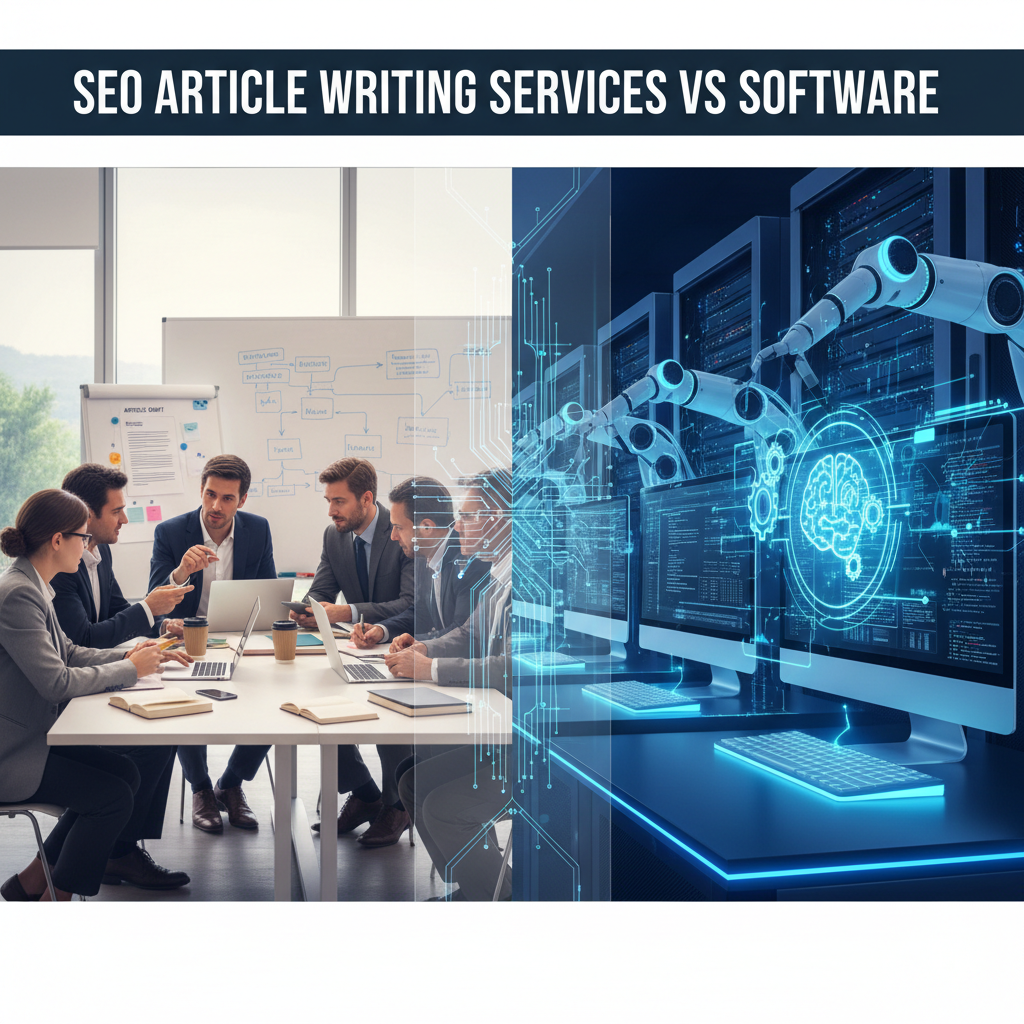
Introduction: Navigating the SEO Content Landscape in 2026
In the digital marketplace of 2026, your website is your most valuable storefront, and Google is its busiest main street. Gaining visibility here is no longer a matter of simple tricks or technical loopholes; it’s about earning trust and authority. Organic search has solidified its position as the lifeblood of sustainable business growth, and at its heart lies a non-negotiable asset: high-quality, SEO-optimized content. Search engines have evolved into sophisticated discernment engines, capable of identifying and rewarding content that genuinely satisfies user intent, demonstrates expertise, and provides a superior reader experience. This shift has turned content creation from a routine task into a strategic imperative, forcing businesses to ask a critical question: how do we produce this caliber of content consistently and at scale?
This challenge brings business leaders and marketing teams to a pivotal crossroads, facing the core dilemma of SEO article writing services vs software. On one side, you have traditional SEO article writing services, which offer the nuanced creativity, strategic insights, and brand voice alignment that only human experts can provide. These services promise bespoke content crafted by seasoned writers and strategists who understand the subtle art of persuasion and storytelling. On the other side, a new generation of sophisticated SEO software now leverages powerful AI to automate content creation, optimize for technical SEO factors, and deliver articles at a speed and scale previously unimaginable. These platforms, like our own Rank My Website, offer efficiency and data-driven precision, promising to streamline your entire content workflow from keyword to published post.
Choosing the right path is a decision that will profoundly impact your budget, marketing velocity, and ultimately, your ability to rank and attract organic traffic. This guide is designed to provide a comprehensive, clear-eyed analysis of the SEO article writing services vs software debate. We will dissect the pros and cons of each approach, comparing them across crucial factors like cost, quality, scalability, speed, and strategic depth. Our goal is to equip you with the insights needed to make an informed decision and build a winning content strategy for 2026 and beyond.
Understanding SEO Article Writing Services: The Human Touch
When you partner with an SEO article writing service, you are investing in human expertise. These services employ professional writers, editors, and strategists dedicated to creating content designed to rank on search engines and resonate with a specific audience. This approach stands in stark contrast to automated solutions, forming one side of the central seo article writing services vs software debate. Far from just delivering written text, a comprehensive service often manages the entire content lifecycle, from initial keyword research and content strategy development to writing, editing, and even publishing content directly to your blog.
The Advantages of the Human Element
The primary benefit of using professional writers is their nuanced understanding and creativity—the “human touch.” A skilled writer can do more than just place keywords; they can weave a compelling narrative, capture the unique voice of your brand, and connect with your audience on an emotional level. They can interpret complex creative briefs, conduct interviews with subject matter experts, and infuse articles with genuine empathy and brand-specific stories that AI struggles to replicate. This ability to understand subtle intent and reader pain points allows for the creation of truly authoritative, high-value content that builds trust and positions your brand as a thought leader.
Drawbacks and Key Considerations
Despite the significant advantages, the human-led approach has its limitations. The most prominent drawbacks are cost and scalability. High-quality human writers command a premium, making this a more expensive option on a per-article basis. This model also presents challenges when you need to scale content production quickly; a writer can only produce so much quality content in a day. For businesses needing to publish dozens or hundreds of articles per month, this can become a significant bottleneck. This is where the discussion of seo article writing services vs software becomes critical, as platforms like Rank My Website are specifically designed to address these scaling challenges. Furthermore, quality can be inconsistent, especially when working with large agencies or freelancer platforms where the skill level may vary from one writer to the next. Learning how to scale SEO content production often involves finding a balance between human oversight and automated efficiency.
Exploring SEO Article Writing Software: The AI Revolution
The conversation around SEO content strategy has been fundamentally reshaped by artificial intelligence. What began as rudimentary text spinners producing unreadable content has evolved, thanks to massive leaps in natural language processing (NLP) and machine learning. Today’s AI-powered software can generate coherent, context-aware, and often human-like prose, dramatically altering the calculus in the debate of seo article writing services vs software. This evolution has turned software from a novelty into a powerful engine for content production.
Key Capabilities of Modern SEO Software
Modern SEO writing platforms are far more than simple text generators. They are integrated ecosystems designed to streamline the entire content creation process. The most advanced tools offer a suite of powerful features, including automated keyword research, SERP analysis to generate competitive outlines, and the ability to draft complete long-form articles in minutes. Built-in grammar checkers, plagiarism detectors, and optimization scores provide instant feedback, ensuring the content is polished and primed for search engines from the first draft.
The primary advantage is unparalleled efficiency. Tasks that once took a marketing team hours—like research, outlining, and drafting—can now be accomplished at a fraction of the time. This allows businesses to significantly increase their content velocity, which is critical for staying competitive. For any team looking to multiply their output, learning how to scale SEO content production with these tools is a game-changer.
The Critical Role of Human Oversight
Despite their sophistication, AI writing tools are not a complete replacement for human expertise. They are powerful assistants, but they still have significant limitations. AI models can produce content that is factually incorrect or “hallucinated,” making human fact-checking an non-negotiable step. They can also struggle to capture a unique brand voice or deliver the deep, original insights that establish true thought leadership.
The software can tell you what to write about to rank, but it doesn’t understand why it matters to your specific audience. This is where the human element remains irreplaceable. A skilled editor or strategist must guide the AI, refine its output, inject brand personality, and verify every claim. In the end, the most successful content strategies use software to handle the heavy lifting while relying on human intelligence for the final-mile refinement and strategic direction.
Cost-Effectiveness: A Deep Dive into Investment vs. ROI
When comparing SEO article writing services vs software, the conversation often starts with price, but it should end with value. The most cost-effective solution is the one that delivers the highest return on investment (ROI) for your specific goals. Understanding the different financial models is the first step in determining which path offers a more sustainable and profitable approach to content creation in 2026.
Pricing Models Unpacked
SEO article writing services typically operate on a few pricing models: per-word rates, per-article project fees, or monthly retainers for a fixed number of posts. While this offers budget predictability for a set output, costs scale linearly. If you want to double your content, you must double your budget, and high-quality human writing can be a significant investment.
Conversely, SEO writing software, including comprehensive platforms like Rank My Website, usually follows a Software-as-a-Service (SaaS) model with a flat monthly or annual subscription. This fee unlocks the ability to generate a high volume of articles, making the cost-per-article decrease dramatically as your production increases.
Analyzing Long-Term Value and Scalability
Herein lies the core financial difference. Services offer finite value; you pay for a specific deliverable. Software, however, is an investment in capability. For businesses aiming for rapid audience growth, the ability to produce dozens or even hundreds of optimized articles per month with a tool is a game-changer. This level of output is often financially prohibitive with human services.
The true value of software emerges over the long term. As you integrate a tool like Rank My Website into your process, you build an efficient content engine. This allows you to aggressively target long-tail keywords, create cluster content, and test strategies at a pace services simply can’t match. Learning how to scale SEO content production is key to maximizing this long-term value.
Hidden Costs and Unexpected Benefits
Quality, Uniqueness, and Brand Voice: A Critical Comparison
In the competitive digital landscape of 2026, content quality, originality, and a consistent brand voice are the proven cornerstones of effective SEO. Simply publishing articles isn’t enough; they must resonate with your audience and signal authority to search engines. In the debate of seo article writing services vs software, this is where the differences become most apparent. Let’s dissect how each approach tackles these critical elements.
The Nuance of the Human Touch
SEO article writing services, powered by human writers, have traditionally excelled at creating nuanced and emotionally resonant content. A skilled writer can interpret complex briefs, conduct original interviews, inject personal anecdotes, and master subtle shifts in tone and humor. They can tell compelling stories and connect with readers on a level that builds genuine trust and community. For brands requiring deep subject-matter expertise or a highly distinctive, creative voice, the human touch provides a depth and flair that can be difficult to replicate.
Consistency and Safety with AI Software
Where human writers offer nuance, AI software delivers unparalleled consistency and safety at scale. Maintaining a uniform brand voice across hundreds of articles is a major challenge with freelance writers, each with their own style. Advanced platforms are built for this. For instance, Rank My Website can be trained on your existing content, style guides, and brand voice documentation to ensure every article it generates aligns perfectly with your identity. This level of AI SEO Content Workflow Automation (2026) is a game-changer. Furthermore, integrated plagiarism checkers provide a crucial layer of security, guaranteeing the originality of every piece before it ever goes live.
Originality’s Role in 2026 SEO
Speed, Scalability, and Workflow Integration
In today’s fast-moving digital landscape, the speed and efficiency of content production can be a significant competitive advantage. For many businesses, the core of the seo article writing services vs software debate hinges on how quickly they can execute and scale their content strategy while integrating it into their existing marketing operations.
Turnaround Times: Days vs. Minutes
The most immediate difference lies in turnaround time. An SEO article writing service, even an efficient one, operates on a human timescale. The process involves creating a brief, assigning it to a writer, drafting, internal reviews, and client revisions. A well-researched article can easily take a week or more from commission to final approval.
In stark contrast, AI-powered software operates almost instantaneously. A user can input a keyword and generate a comprehensive, structured article draft in a matter of minutes. This shifts the primary task from content creation to strategic editing and refinement, dramatically compressing the content production lifecycle from days down to hours.
Handling Large Content Requirements
Scalability is where software truly pulls ahead. If your strategy requires publishing 50 or 100 articles to build topical authority or target a wide array of long-tail keywords, a service might struggle. Scaling with a service is linear—more articles require more writers and more project management, often increasing costs and risking inconsistencies.
Software eliminates this bottleneck. Generating one hundred articles takes little more time than generating one, allowing marketing teams to scale their output exponentially without a proportional increase in resources. This capability is transformative for ambitious SEO campaigns and makes it easier than ever to How to Scale SEO Content Production: A 2026 Guide.
Seamless Workflow Integration
Beyond pure creation speed, modern SEO software is designed for deep workflow integration. Services typically deliver finished content in a document, leaving your team to handle formatting, uploading, on-page optimization, and publishing. This creates manual handoffs and potential delays.
Making the Right Choice: When to Opt for Services, Software, or a Hybrid Approach
The debate over SEO article writing services vs software isn’t about finding a single winner for everyone. The right choice hinges entirely on your company’s unique situation—your goals, budget, and internal resources. A startup needing to build topical authority quickly has different needs than an enterprise creating high-stakes thought leadership. Making an informed decision means honestly assessing your capabilities before committing to a path.
Identifying Your Needs, Budget, and Resources
The best approach depends on where you fall on the spectrum of time, money, and expertise. For many, the decision isn’t a simple either/or.
| Scenario | Recommended Approach | Why It Works |
|---|---|---|
| High-Stakes Pillar Content | Service or Hybrid | Requires deep strategic insight, brand voice nuance, and human creativity. |
| Scaling Topic Clusters | Software or Hybrid | AI excels at producing consistent, topically-related articles in bulk to build authority. |
| Limited Budget & Team | Software | Offers a cost-effective way to maintain content velocity without hiring writers. |
| Zero In-house Expertise | Service | Provides end-to-end management, from keyword research to final edits. |
The Power of a Blended Strategy
For many businesses in 2026, the most powerful strategy isn’t choosing a side but blending the two. This hybrid model leverages the strengths of both humans and AI. You can engage an SEO article writing service to craft your foundational, cornerstone content—the comprehensive guides and visionary articles that define your brand.
Simultaneously, you can use powerful software to produce the high volume of supporting articles needed to build topical authority around those pillars. This approach allows you to cover more ground faster, dominate niche keywords, and achieve a robust content footprint without the prohibitive cost of using a service for every single article. It’s the key to learning How to Scale SEO Content Production: A 2026 Guide.
Why Rank My Website Leads the Software Space
Frequently Asked Questions About SEO Content Creation
Navigating the choice between seo article writing services vs software often brings up critical questions about quality, performance, and best practices in 2026. Here are answers to some of the most common queries.
Is AI-generated content penalized by Google?
No, Google does not penalize content simply because it was created with AI. Google’s long-standing focus is on the quality and helpfulness of the content for the user. Low-quality, spammy, or unoriginal content will perform poorly regardless of whether a human or AI wrote it. The key is to use AI as a tool to create genuinely valuable articles that are then fact-checked, edited, and refined by a human expert before publication.
How do I ensure my content is unique and ranks well?
Uniqueness begins with a distinct angle on your chosen keyword. Avoid simply repeating what top-ranking pages already say. To rank well, combine in-depth research with a clear structure, address user intent comprehensively, and ensure originality. While software can generate a strong first draft, human oversight is essential to infuse brand voice, add genuine insights, and verify information.
Can SEO software replace human writers entirely?
Not entirely. The future is a collaboration. SEO software is exceptionally powerful for accelerating research, drafting, and optimizing content at scale. However, it cannot replace the human element of high-level strategic planning, creative thinking, and final quality assurance. The software handles the repetitive tasks, freeing up human experts to focus on strategy and refinement.
How often should I publish new SEO articles?
Consistency is far more important than raw frequency. Publishing one high-quality, well-researched article per week consistently is more effective than publishing five mediocre articles one week and none for the next month. Determine a sustainable publishing cadence based on your resources and strategic goals, and stick to it.
What are the key metrics to track for SEO article performance?
Focus on metrics that signal real business impact. Key performance indicators include organic traffic growth, keyword ranking improvements, click-through rate (CTR) from search engine results pages, and, most importantly, conversions or leads generated from the content. You can explore a deeper dive into SEO Content Performance Tracking: Unlock Growth.
Conclusion: Powering Your Organic Growth in 2026 and Beyond
Making the right choice in the ongoing debate of SEO article writing services vs software is a pivotal strategic decision for any business serious about organic growth. The best path forward isn’t one-size-fits-all; it’s about aligning your content strategy with your unique resources, expertise, and ambitions.
Recapping the Core Debate
As we’ve explored, the decision hinges on a central trade-off. SEO article writing services provide a hands-off, expert-driven approach, delivering high-quality, nuanced content that requires minimal internal effort. However, this bespoke quality comes at a premium cost and often involves slower production timelines, which can be a bottleneck for businesses aiming for rapid growth.
On the other hand, SEO software offers unparalleled speed, scalability, and cost-efficiency. It puts content creation directly in your control, allowing you to produce articles in minutes, not weeks. The trade-off is the need for greater in-house strategic oversight. Without a clear SEO plan and a final human touch for brand voice and refinement, software-generated content can lack the authority and polish needed to truly stand out.
The Future of Smart Content Creation
Looking ahead, the rigid divide between services and software is becoming obsolete. The future of content creation in 2026 and beyond lies in a hybrid approach—one that leverages intelligent automation while empowering human strategy. The most successful businesses are those that use advanced platforms to handle the heavy lifting of research, drafting, and optimization, freeing up their marketing teams to focus on high-level strategy, creative direction, and final quality assurance.
This integrated model offers the best of both worlds: the scale and speed of software combined with the strategic nuance of an expert service. It’s about working smarter, not just harder or cheaper. That’s why platforms like Rank My Website are becoming indispensable. They are built not just to create content but to create content that ranks by integrating SEO best practices directly into the workflow.
If you’re ready to stop choosing between speed and quality and start achieving both, it’s time to embrace the future of content automation. Explore how Rank My Website can help you grow organic traffic on autopilot and build a sustainable engine for organic growth.