
Is hiring an SEO agency for $5,000 a month still the only way to rank? For years, that was the conventional wisdom. You paid a retainer, waited six months, and hoped for a report showing green arrows. But this model is broken for most businesses. The high costs and slow, opaque processes deliver a poor return on investment. The best cost-effective automated SEO content services today focus on generating high-quality content at scale, not just tweaking meta tags. The right platform can replace the core functions of an agency for a fraction of the cost, delivering measurable traffic growth in weeks, not quarters.
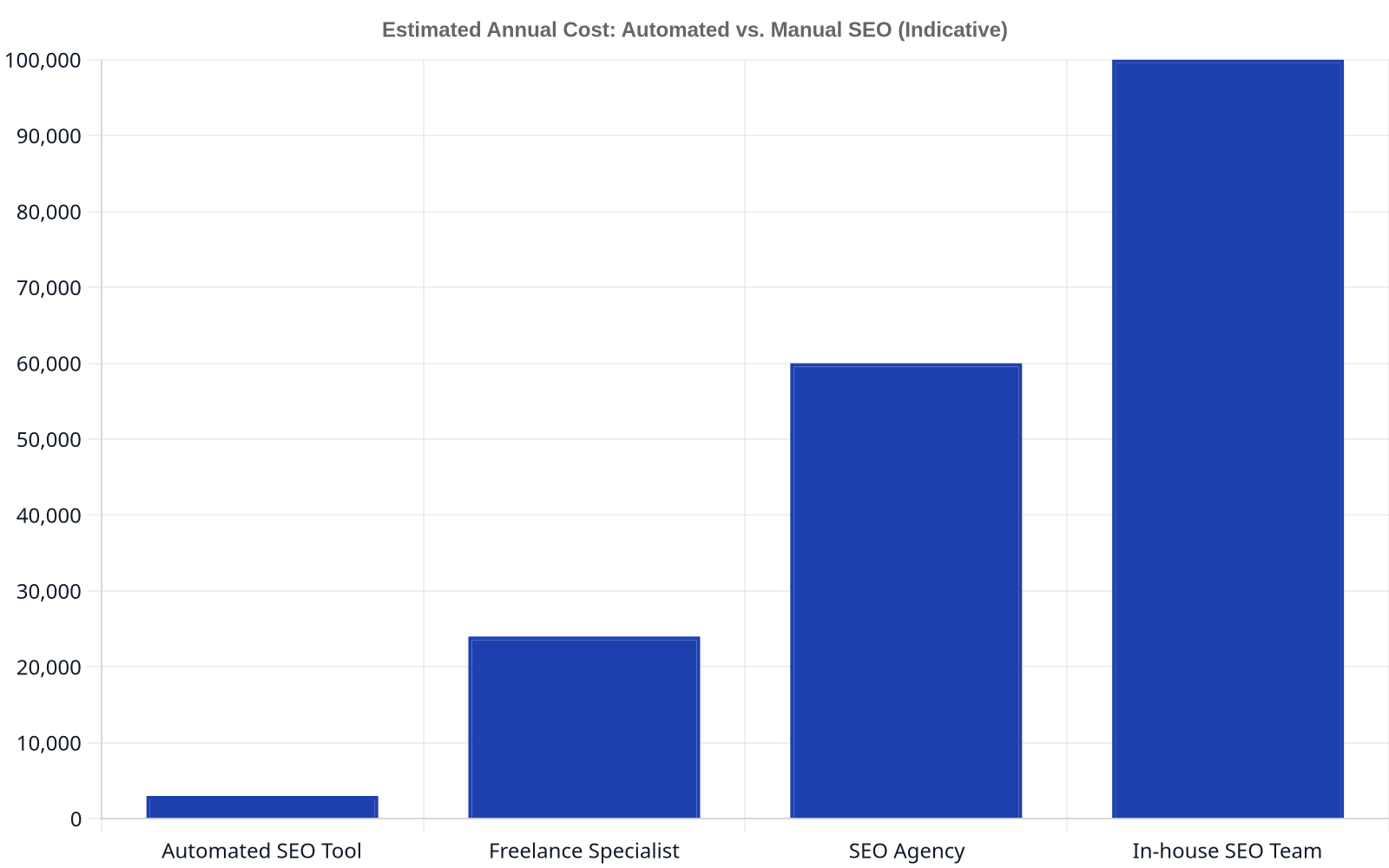
For most small to medium-sized businesses, the cost of traditional SEO is prohibitive. A 2023 study by Ahrefs found that the most popular monthly retainer for SEO agencies is $2,501–$5,000 per month. Hiring an in-house SEO specialist is even more expensive, with a median salary hovering around $70,000 per year, according to salary data from sources like Glassdoor, before you even factor in benefits and tools. This puts professional SEO out of reach for many.
This is where automation creates an opening. Instead of paying for hours, you pay for outcomes. Automated platforms can perform foundational tasks like keyword research, content creation, and even internal linking for a predictable monthly fee, often less than a single day of an agency’s time. The focus shifts from manual process to scalable content production, which is the primary driver of organic traffic growth today. For example, a system designed for creating daily articles can build topical authority far faster than an agency producing four blog posts a month.
Top Cost-Effective Automated SEO Services
| Service Name | Key Features | Pricing Model | Target User | |
|---|---|---|---|---|
| Rank My Website | AI Content Generation, On-page SEO, Publishing Automation | Subscription (tiered) | Small to Medium Businesses, Content Marketers | |
| Service B | Automated Backlink Building, Keyword Research | Per-project, Subscription | Agencies, Enterprise | |
| Service C | Technical SEO Audits, Rank Tracking | Subscription (feature-based) | SEO Consultants, Large Websites | |
| Service D | Content Optimization, Competitor Analysis | Freemium, Subscription | Bloggers, Solopreneurs |
Choosing an automated SEO service isn’t about finding the cheapest option; it’s about finding the highest-use one. The goal is to maximize the output of high-quality, search-optimized content while minimizing the input of your time and budget. Here’s how the leading approaches stack up.

| Feature | Full-Service Automated Platform (e.g., Rank My Website) | All-in-One SEO Toolset (e.g., Semrush, Ahrefs) | AI Writing Assistant (e.g., Jasper, Copy.ai) |
|---|---|---|---|
| Use Case | Businesses that want a hands-off solution for content and rankings. | SEO professionals who need data and tools to execute their own strategy. | Teams that want to speed up their writing process but manage SEO separately. |
| Pricing | Fixed monthly fee for content, publishing, and SEO ($500 – $1,500/mo). | Tiered SaaS subscription based on features and usage limits ($130 – $500/mo). | Per-seat, per-word, or tiered plans based on volume ($40 – $100/mo per user). |
| Best Feature | Fully autonomous content pipeline from keyword to published article. | Deep datasets for competitor analysis and keyword research. | High flexibility in tone, format, and content type. |
| Watch Out For | Less manual control over individual content pieces. | Requires significant expertise and time to use effectively. | Produces unoptimized content without a human SEO directing it. |
Full-Service Automated Platforms (e.g., Rank My Website)
This is the “done for you” model of automated SEO. A true full-service platform handles the entire content lifecycle: it identifies commercially relevant keywords, generates long-form articles, and publishes them directly to your site with proper on-page SEO. Our own platform, Rank My Website, is built on this principle. We handle the keyword research, daily article creation, and internal linking to build your site’s authority on autopilot.
Strengths:
- High Velocity: The ability to publish optimized content daily or weekly is a significant advantage for building topical authority quickly. This is something manual processes struggle to match. A 2021 study on content marketing highlighted that companies publishing content frequently get more traffic.
- Cost Predictability: You pay a flat monthly fee for a defined outcome (e.g., 30 articles per month), making budgeting simple and transparent. This contrasts with agency retainers, which can have variable costs or require extra budget for more content.
- Low Time Investment: The primary benefit is offloading the entire operational burden of SEO content. This is ideal for small teams or solo entrepreneurs who need to focus on their core business.
Weaknesses:
- Reduced Granular Control: The trade-off for automation is less hands-on control over every single sentence. While you guide the strategy, the system executes it. For control freaks, this can be an adjustment.
- Best for Content-Driven SEO: These platforms excel at building organic traffic through articles and blog posts. They are not designed for technical SEO audits or complex e-commerce site architecture problems.
All-in-One SEO Toolsets (e.g., Semrush, Ahrefs)
Platforms like Semrush and Ahrefs are the Swiss Army knives of the SEO world. They provide a comprehensive suite of tools for keyword research, rank tracking, backlink analysis, and site audits. They automate data collection, but they do not automate execution. You are the strategist and the operator; the toolset is your workbench.
Strengths:
- Unmatched Data Depth: These tools offer a staggering amount of data on competitors, keywords, and backlink profiles. For a trained SEO professional, this information is invaluable for crafting a precise strategy.
- Total Control: You have complete control over every aspect of your SEO campaign, from which keywords to target to the anchor text of your internal links.
Weaknesses:
- Requires Expertise: These are professional-grade tools with a steep learning curve. Without a solid understanding of SEO principles, you can easily get lost in the data and fail to take effective action. An extensive survey by SparkToro and Datos shows a significant gap between performing SEO tasks and achieving results.
High Time Commitment: Using these tools effectively is a full-time job. You are responsible for analyzing the data, creating content briefs, writing or outsourcing content, and implementing technical fixes. The tool doesn’t do* the work; it helps you do the work.
- Content is Separate: The subscription fee does not include content creation, which remains a significant additional cost and logistical challenge.
Don’t confuse a data subscription with an SEO strategy. Ahrefs and Semrush give you a map, but they don’t drive the car. You still need a driver, fuel, and a destination.
AI Writing Assistants (e.g., Jasper, Copy.ai)
AI writers are tools that automate a single, specific task: generating text. You give them a prompt, and they produce paragraphs, blog post outlines, or even full drafts. They are powerful assistants, but they are not SEO strategists. They don’t know which keywords to target, how to structure an article for search intent, or what “topical authority” means.
Strengths:
- Incredible Speed: These tools can turn a prompt into a 1,000-word draft in minutes, dramatically accelerating the content creation process.
- Versatility: They can be prompted to write in different styles, tones, and formats, making them useful for more than blog posts (e.g., social media updates, ad copy, product descriptions).
Weaknesses:
- No Inherent SEO Logic: An AI writer, on its own, is just as likely to write a traffic-killing article as a traffic-driving one. Without expert SEO guidance, the output is often generic and unoptimized. This is a key reason many businesses see poor results from AI content; the strategy is missing.
- Requires Heavy Editing: The output often needs significant fact-checking, editing for voice, and structural reorganization to meet quality standards. A CNET article detailed their own experiment with AI-generated articles, which required substantial human review.
- Incomplete Solution: Like all-in-one toolsets, this approach only solves one piece of the puzzle. You still need a separate process for keyword research, on-page optimization, publishing, and internal linking.
Efficiency and Time Savings: Automated vs. Manual Tasks
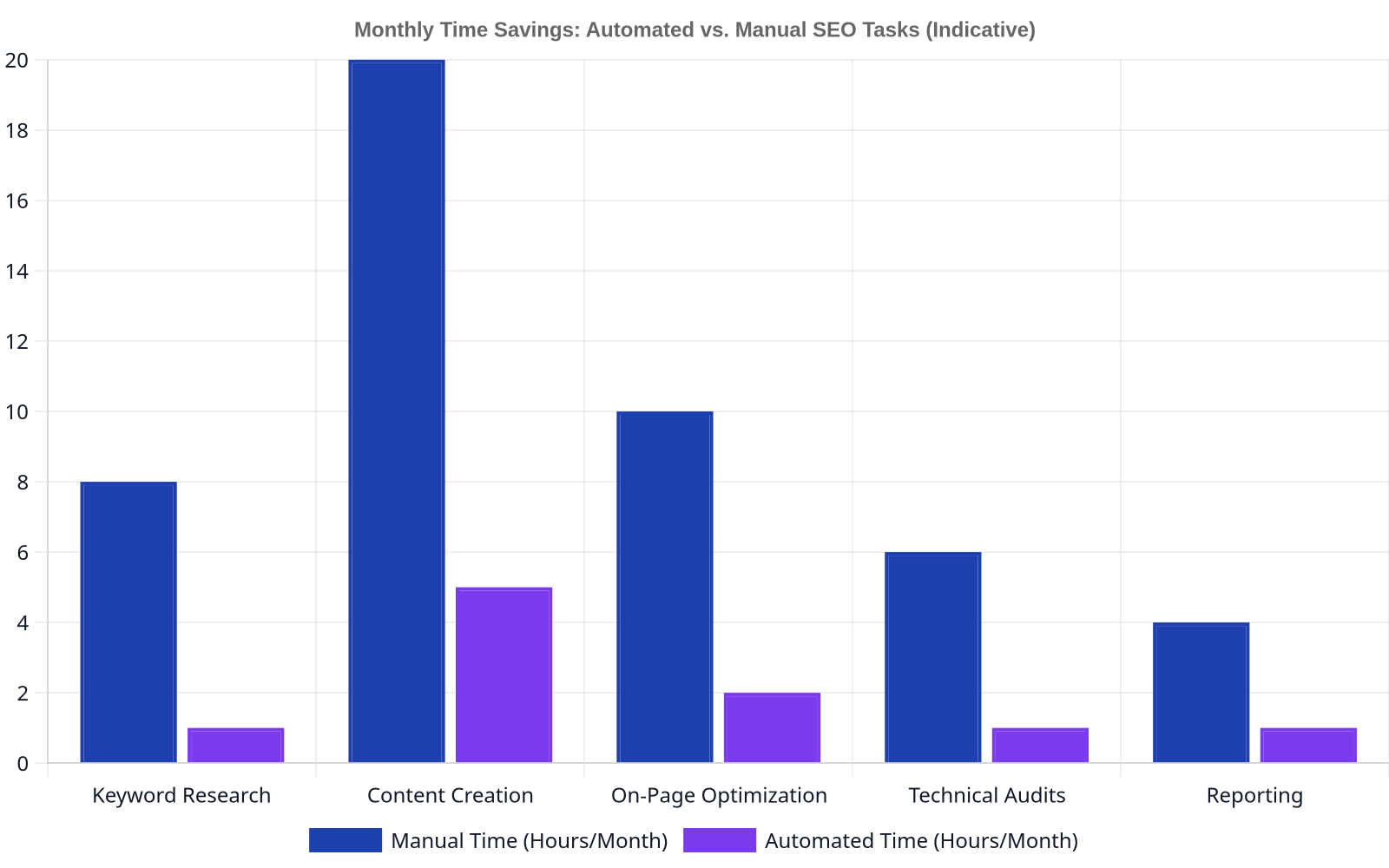
One of the most compelling arguments for automation is the reclamation of time. Manual SEO is a grind. A single blog post can take 8-10 hours to research, write, and optimize. An automated system collapses that workflow. Consider a task like building a robust internal linking structure. Manually, this requires mapping out content hubs and painstakingly updating old posts. An automated system can handle this programmatically, ensuring every new article is woven into your existing content web from the moment it’s published.
This efficiency is why we see clients like Wolverine Assemblies successfully build their online presence while focusing on their core manufacturing operations. They don’t have a marketing team spending hours debating keyword intent; they have a system that executes a proven content strategy for them. The focus shifts from manual labor to strategic oversight.
Choose Your Automated SEO Service: Verdicts for 2026

There is no single “best” service, only the one that best fits your resources, goals, and expertise. Here’s how to decide.
Choose a Full-Service Automated Platform if…
- You are a small business, startup, or solopreneur with limited time and SEO expertise.
- Your primary goal is to drive organic traffic through high-quality blog content.
- You value a predictable, hands-off solution that delivers consistent output.
- You understand that content velocity and topical authority are key to modern SEO.
Choose an All-in-One SEO Toolset if…
- You are an SEO professional or have one on your team.
- You need deep data for competitive analysis and have a clear strategy to execute.
- You have the time and resources to manage the entire SEO process, including content creation, manually.
- Your needs go beyond content to include in-depth technical SEO audits and backlink campaigns.
Choose an AI Writing Assistant if…
- You have a strong SEO strategy and just need to accelerate your content production.
- You have an in-house team that can handle keyword research, editing, and on-page optimization.
- You are producing a wide variety of content types beyond just SEO articles.
- You have a clear process for turning a raw AI draft into a polished, optimized, and fact-checked final product.
Choosing the wrong tool is a common failure pattern. Buying an AI writer when you need a strategy is like buying a hammer to paint a wall. You have a tool, but you’re solving the wrong problem.
For most businesses seeking cost-effective automated SEO services, the goal is not to become SEO experts themselves. The goal is to get the results of expert SEO without the associated cost and complexity. A full-service platform that automates the entire content pipeline offers the most direct path to that outcome. It’s a complete engine for traffic growth, not just a collection of parts. By automating the right things, like keyword selection and the production of daily articles, you can build a powerful and sustainable source of organic traffic.
FAQ
What is the difference between automated SEO and an SEO agency?
An SEO agency provides manual services performed by a team of people. You pay for their time, expertise, and overhead. Automated SEO uses software to perform tasks like keyword research and content creation, often at a larger scale and lower cost. An automated platform is a tool you manage (or that runs itself), while an agency is a service provider you hire.
How much do automated SEO services cost?
Costs vary widely.
Can automated SEO replace a human?
Automation excels at scalable tasks: finding keywords, writing drafts, and structuring content. It replaces the repetitive, time-consuming parts of the job. However, high-level strategy, creative insight, and final quality control still benefit from human oversight. The best approach combines automation for scale with human strategy for direction.
How long does it take to see results from automated SEO?
While faster than traditional methods, SEO is still a long-term investment. With a high-velocity content approach (e.g., daily articles), you can expect to see initial traction and leading indicators like impression growth within 4 to 8 weeks. Significant, business-impactful traffic growth typically takes 3 to 6 months as your site builds topical authority with search engines.
Is AI-generated content penalized by Google?
No. Google’s official stance, as clarified in their guidance on ai-generated content, is that they reward high-quality content, regardless of how it is produced. The focus is on helpfulness, reliability, and user experience. Low-quality, spammy content will perform poorly whether it’s written by an AI or a human.