
Most comparisons of keyword research tools are just feature lists in disguise. They tell you what a tool does, but not how it thinks. This is a critical failure. Choosing a tool isn’t about finding the one with the longest feature list; it’s about finding the one whose data philosophy and workflow match your business reality. The best keyword research tool subscriptions provide more than just data; they offer a framework for making smarter content decisions. For most businesses needing a balance of power, data accuracy, and value, Semrush is the top all-around choice. For those on a tight budget or just starting, Google Keyword Planner remains the essential free option.
Which Tool in 60 Seconds?
- If you’re a serious SEO or a data-driven agency: Choose Ahrefs. Its backlink data is second to none, and its keyword difficulty scoring is arguably the most trusted in the industry. The “Clicks” metric is a vital layer of intelligence that others lack.
- If you need an all-in-one marketing suite: Choose Semrush. It has the most comprehensive toolkit, covering everything from SEO and PPC to social media and content marketing. It’s the best choice for teams that need one platform to do almost everything.
- If your budget is zero or you focus on Google Ads: Use Google Keyword Planner. The data comes directly from Google, making it indispensable for PPC campaigns. It’s less feature-rich for content SEO, but the volume ranges are a foundational data point.
- If you need to automate your content engine: This is where our platform, Keyworth, comes in. Instead of just giving you lists of keywords, we automate the entire process from research to writing and publishing SEO-optimized articles daily.

Head-to-Head: Keyword Tool Subscription Comparison
This table breaks down the core differences between the big players. We’re focusing on the paid subscription tiers where the real power lies.
| Feature | Semrush | Ahrefs | Google Keyword Planner |
|---|---|---|---|
| Best For | All-in-one marketing teams | SEO specialists & link builders | Google Ads PPC campaigns & initial research |
| Pricing Model | Tiered monthly subscription | Tiered monthly subscription | Free with a Google Ads account |
| Best Feature | Vast, integrated toolset | Best-in-class backlink index & “Clicks” data | Direct integration with Google Ads |
| Watch Out For | Can be overwhelming for beginners | Higher price point for lower tiers | Vague search volume ranges without active ad spend |
| Data Accuracy | High, with large keyword database | Very high, often considered the industry standard | Authoritative, but often rounded or bucketed |
| Use Case | Competitor analysis, content marketing, PPC | Deep SEO analysis, technical audits, backlink audits | Budget-conscious research, validating PPC keywords |
| User Experience | Feature-rich, but can have a steep learning curve | Clean, data-focused interface favored by pros | Simple and straightforward, but limited |
| Integration | Extensive (Google tools, social, etc.) | Good, with a focus on SEO-related tools | Natively integrated with Google Ads |
What is Keyword Research?
Keyword research is the process of finding and analyzing the search terms that people enter into search engines. The goal is to identify topics your target audience cares about. This isn’t just about finding words that get a lot of searches; it’s about understanding the intent behind those words. Someone searching for “best running shoes” has a different intent than someone searching for “how to tie running shoes.” A successful SEO strategy is built on matching your content to that user intent. The whole process includes discovering keywords, analyzing their search volume and competition, and then mapping them to different stages of your customer’s journey.
Free vs. Paid Keyword Research Tools
The most common question I get is whether a free tool is “good enough.” The answer depends entirely on your goals.
Free tools, like Google Keyword Planner, are excellent for starting out. They give you a foundational understanding of what people are searching for, directly from the source. However, their primary limitation is the lack of competitive context and the often-vague data they provide. Google’s tool will give you a broad search volume range (e.g., “1K – 10K”) unless you are spending significant money on Google Ads. This makes it difficult to prioritize your efforts effectively.
Paid subscription tools like Semrush and Ahrefs justify their cost by providing much more granular data. They offer specific search volume estimates (e.g., “8.5K”), a “keyword difficulty” score to gauge competition, and, crucially, deep insights into your competitors’ strategies. You can see which keywords your rivals rank for, who links to them, and what their top-performing content is. This competitive intelligence is what you’re really paying for, and it’s what allows you to build a proactive, data-informed SEO strategy rather than just guessing.
Semrush: The All-in-One Marketing Command Center
Semrush positions itself as more than just an SEO tool; it’s a full-suite digital marketing platform. It boasts an enormous database and a feature set that covers SEO, PPC, content marketing, and social media. It’s the swiss army knife of the bunch.
Strengths
- Comprehensive Toolset: The sheer breadth of tools is its biggest selling point. You can track keyword rankings, audit your site, analyze competitor ad copy, manage social media posting, and even get content topic ideas all in one place. One platform reports that Semrush helps over 1 million marketers and has grown to generate eight figures in revenue.
- Competitive Analysis: Semrush excels at breaking down a competitor’s entire online presence. Its “Traffic Analytics” tool gives you estimates of a competitor’s website traffic, traffic sources, and audience demographics, which is incredibly powerful for market research.
- Keyword Magic Tool: This is their core keyword research feature. It has a massive database and provides excellent filtering options to help you drill down into long-tail keywords, questions, or terms with a specific intent (e.g., commercial, transactional).
Weaknesses
- The “Jack of All Trades” Problem: Because it does so much, some of its specialized tools aren’t as deep as standalone solutions. For example, its backlink index, while very large, is generally considered to be slightly less comprehensive than Ahrefs’.
- Learning Curve: With so many features and reports, new users can feel overwhelmed. It takes time and commitment to learn how to get the most out of the platform.
- Pricing Structure: While powerful, the plans can get expensive quickly. Key features like historical data or API access are locked behind higher-tier plans, which can be a barrier for small businesses.
Ahrefs: The SEO Specialist’s Scalpel
Where Semrush goes wide, Ahrefs goes deep. It started life as a backlink analysis tool and has since evolved into a top-tier SEO platform, but that obsessive focus on the link graph and search data remains its core strength. SEO professionals often swear by Ahrefs for its data quality and precision.
Strengths
- Best-in-Class Backlink Index: Ahrefs has a famously fast and comprehensive web crawler, meaning its backlink database is arguably the most accurate and up-to-date in the industry. For any strategy involving link building, this is a non-negotiable feature.
- “Clicks” Metric: This is a killer feature that Semrush lacks. Ahrefs doesn’t just tell you how many people search for a keyword; it tells you how many of those searches result in a click on an organic result. This helps you avoid targeting keywords where SERP features (like featured snippets or “People Also Ask” boxes) satisfy the user’s query without a click.
- Clean and Intuitive UI: Despite its powerful data, Ahrefs is widely praised for its user-friendly interface. Reports are clean, data visualizations are clear, and it’s generally faster and less cluttered to navigate than Semrush.
The most valuable keyword data isn’t volume; it’s intent and competition. A tool that only gives you search volume is showing you a map without any roads or terrain.
Weaknesses
- Higher Entry Price: Ahrefs’ pricing plans tend to be more expensive at the low end compared to some competitors, which can put it out of reach for freelancers or very small businesses.
- Less of an “All-in-One” Solution: It lacks the broad marketing tools of Semrush. There are no social media management or dedicated PPC campaign tools. It’s an SEO tool first and foremost.
- Credit System: Ahrefs has moved to a credit-based system for certain reports, which has been a point of contention for some power users. Depending on your usage, you might burn through your monthly credits faster than you expect.
Google Keyword Planner: The Essential Starting Point
No comparison is complete without Google Keyword Planner. It’s the original keyword tool, and because its data comes directly from Google, it remains a foundational part of any research process. However, you must understand its purpose: it is designed primarily to help people buy Google Ads.
Strengths
- It’s Free: You can’t beat the price. All you need is a Google account to get access.
- Authoritative Data Source: The search volume data, even when presented in ranges, comes directly from Google’s massive repository of search activity. This makes it the ultimate source of truth for validating keyword popularity.
- PPC Integration: If you run Google Ads campaigns, the tool is indispensable. It provides bid estimates and allows you to build out ad groups and campaigns directly from your research.
Weaknesses
- Vague Search Volume: This is the biggest drawback. Unless you have a consistent, significant ad spend, you won’t see precise monthly search volumes. Instead, you get broad ranges like “10K-100K,” which makes it very difficult to prioritize keywords for an organic content strategy.
- Lack of Competitive Metrics: Keyword Planner doesn’t have a “keyword difficulty” score. It tells you about advertiser competition (Low, Medium, High), but this isn’t the same as organic ranking difficulty.
- Limited Features: It doesn’t do competitor analysis, backlink tracking, or site audits. It does one thing: keyword research. And it does so with less detail than paid alternatives.
Key Features: What Each Tool Offers
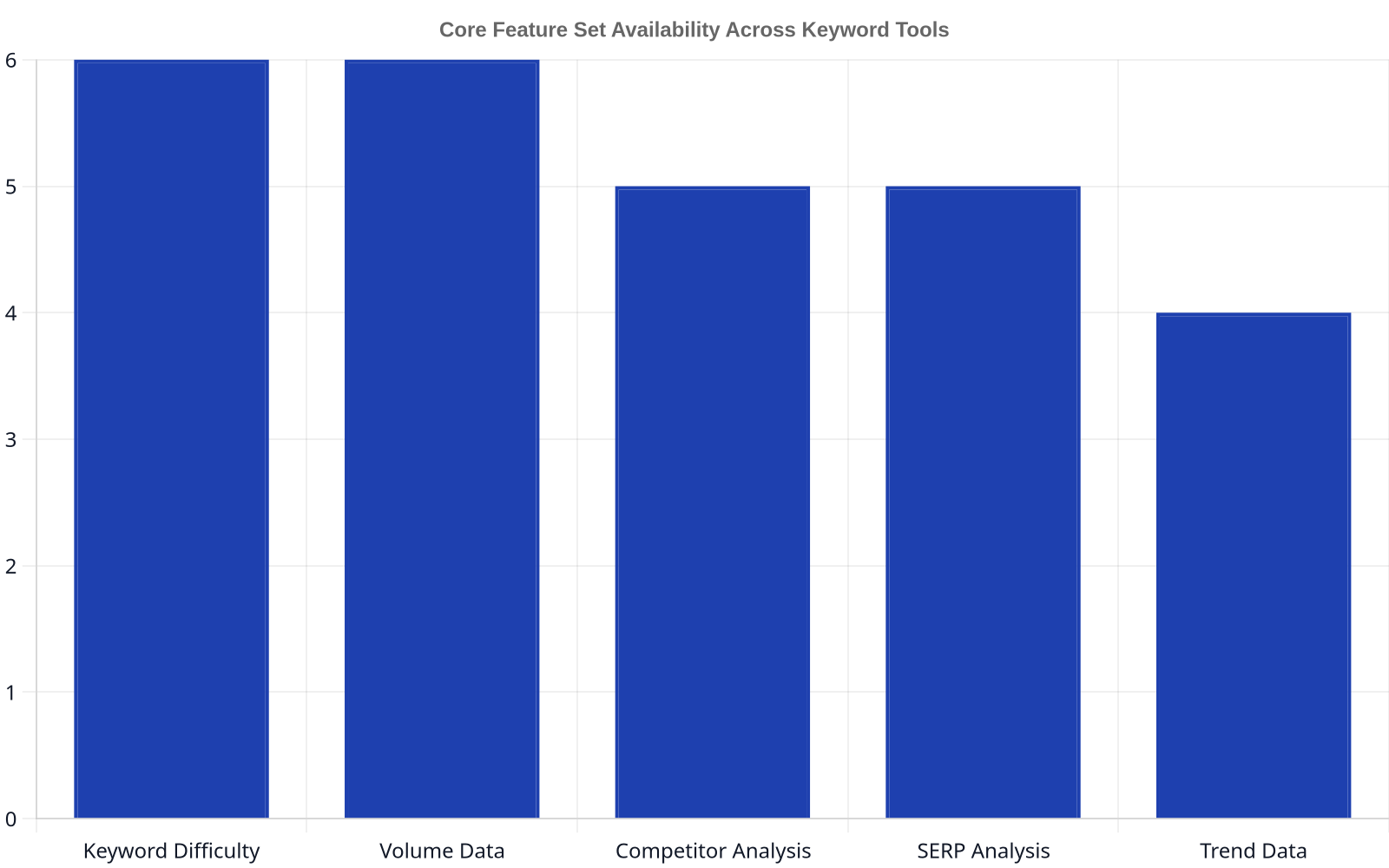
Understanding the core metrics is vital for making an informed choice. All these tools provide search volume, but the quality of that data and the context around it varies wildly.
- Search Volume: This is an estimation of how many times a keyword is searched for per month. Ahrefs and Semrush provide precise numbers, while Google Keyword Planner often gives ranges.
- Keyword Difficulty (KD): This is a proprietary score (usually on a scale of 0-100) that estimates how hard it is to rank on the first page of Google for a given keyword. Ahrefs and Semrush are the leaders here. This metric is critical for prioritizing your efforts.
- Long-Tail Keywords: These are longer, more specific search queries. They have lower search volume individually but often show stronger user intent and have less competition. All tools help you find them, but Semrush’s filters and Ahrefs’ “Questions” report are particularly effective.
- SERP Analysis: The best tools don’t just give you a KD score; they show you the actual search engine results page (SERP) for that keyword. This lets you see who is currently ranking, what kind of content they have, and the authority of their domains. According to one source, there are more than 90 tools with a free option, but few provide deep SERP analysis.
The Impact of Generative AI on Keyword Research
The rise of AI-powered search experiences like Google’s SGE (Search Generative Experience) is changing the game. Many simple, informational queries might soon be answered directly by an AI, meaning users won’t need to click through to a webpage. This makes choosing the right keywords even more important. The focus is shifting away from short, fact-based keywords toward more complex, analysis-driven topics that an AI can’t easily summarize. This is where a human-driven (or sophisticated AI-driven) content strategy becomes irreplaceable. Platforms that automate SEO, like our work at Keyworth, are designed to navigate this shift by focusing on creating valuable content that answers the complex questions AI can’t.

Use-Case Verdicts: Which Subscription Is Best for You?
Let’s cut to the chase. The “best” tool is the one that fits your specific situation.
Choose Semrush if…
You are a marketing manager or part of a team that needs a single platform to manage multiple aspects of your online presence. You have a budget to support a robust all-in-one subscription and the time to learn its vast feature set. You value having good-to-great tools for SEO, PPC, and social media under one roof more than having the absolute best-in-class tool for a single function.
Choose Ahrefs if…
You are a dedicated SEO professional, a link builder, or a content strategist whose primary job is to drive organic traffic. Data precision is your top priority. You live and breathe backlink profiles, SERP analysis, and keyword difficulty scores. You understand that SEO is a long-term investment and are willing to pay a premium for the highest-quality data to inform your strategy.
Paying for a premium keyword tool is an investment in clarity. It’s the difference between guessing which doors are unlocked and having the key to every single one.
Choose Google Keyword Planner if…
You are just starting, have a very limited budget, or your primary focus is running paid ad campaigns on Google. You need to get a basic sense of search demand and identify potential keywords for your first pieces of content or your next ad group. You understand that you are sacrificing competitive insights and data granularity for a free price tag.
Consider an Automated Platform like Keyworth if…
You recognize that keyword research is just the first step. For many businesses, the real bottleneck is consistently producing high-quality, optimized content at scale. This is where we fit in. Instead of just providing data, Keyworth automates the entire content lifecycle. We handle the keyword research, use it to generate daily articles, and manage the internal linking and backlinks needed to rank. It’s a “done for you” approach for businesses like Wolverine Assemblies that want the results of a sophisticated SEO strategy without building an in-house team to execute it.
FAQ
How do I choose the best keyword tool?
Start by defining your primary goal. Are you focused on organic content (SEO), paid ads (PPC), or general market research? Then, assess your budget. For serious SEO, a paid tool like Ahrefs or Semrush is almost always worth the investment for its competitive data. For PPC or initial brainstorming, Google Keyword Planner is sufficient. Finally, consider user experience and whether you need an all-in-one suite or a specialized tool.
How do keyword tools get their data?
Paid tools like Semrush and Ahrefs operate vast networks of crawlers that constantly scan the web and Google’s search results. They build their own massive databases of keywords, search results, and website links. They then use this data to model search volume and calculate difficulty scores. Google Keyword Planner gets its data directly from Google’s own search logs, but it often obfuscates the details.
When should I upgrade from a free keyword research tool?
You should upgrade as soon as you get serious about content marketing or SEO. Upgrade when you find yourself asking questions a free tool can’t answer, such as: “Which of these keywords is realistically possible for me to rank for?” or “What keywords are my direct competitors ranking for that I’m missing?” The investment pays for itself in saved time and more effective content.
What are the most important keyword metrics to understand?
The three most critical metrics are Search Volume (how many people are searching), Keyword Difficulty (how hard it is to rank), and User Intent (what the searcher is trying to accomplish). A fourth, often overlooked metric provided by tools like Ahrefs is “Clicks,” which tells you how many searches lead to an actual click on a web result.
How is AI changing keyword research?
AI is shifting the focus from simple keyword lists to topical authority and user intent. With AI-driven search engines answering simple questions directly, content needs to cover topics more deeply. AI tools can also help analyze SERPs at scale, identify semantic keyword clusters, and even predict which topics are likely to perform well. This pushes the strategy from finding single keywords to building a comprehensive content map.
Can you really rely on “Keyword Difficulty” scores?
Yes, but with context. A KD score is an algorithm-based estimate, not a guarantee. It’s a compass, not a GPS. You should always use it as a starting point. After finding a keyword with an achievable KD, you must manually review the SERP to understand the type of content that is ranking and the authority of the domains you’d be competing against. A low KD score doesn’t mean an easy win if the top results are all from major brands.
At the end of the day, the best keyword research tool subscriptions are the ones that get used. Whether it’s a comprehensive suite or an automated platform, the goal is to move from data to action. Find the tool that clarifies your path forward and enables you to create content that meets your audience where they are.
Leave a Reply