
Is your content team spending more time on keyword spreadsheets and CMS uploads than on actual strategy? Many are. The common wisdom is that scaling SEO content requires a proportional increase in headcount. This is a fallacy. True scale comes from systemization, and the apex of that system is software that doesn’t just assist, but automates the entire content lifecycle. Automated SEO content generation software is a platform that handles the full workflow: from initial keyword discovery and clustering to writing, image creation, on-page optimization, and even publishing directly to your CMS, often on a daily basis.
Automated SEO content generation software isn’t about replacing writers with robots; it’s about replacing the 80% of manual, repetitive SEO tasks that bog down your most creative people. It’s a force multiplier for your marketing team, allowing them to focus on high-leverage strategic work instead of the drudgery of content production logistics. For businesses needing to establish an online presence quickly, like our client Wolverine Assemblies, it provides a foundational stream of optimized content from day one.

Content Writing -> Image Generation -> Publishing.” />
Why Most SEO Content Workflows Are Broken
The traditional model for producing SEO-driven content is a study in manual handoffs and fragmented toolchains. A strategist finds a keyword in Ahrefs or Semrush. They export it to a spreadsheet. An editor assigns it to a writer, who may or may not understand the search intent. The writer produces a draft in Google Docs. The editor reviews it, sending it back for revisions. An SEO specialist then takes the “final” draft and crams in keywords, adds internal links, and sources a stock photo. Finally, someone manually formats all of this in WordPress or another CMS. Each step is a potential point of failure, delay, and miscommunication.
The Myth of the “Content Machine”
Many agencies and in-house teams pride themselves on building a “content machine.” Usually, this just means they have a well-documented assembly line of humans and a collection of single-purpose SaaS tools. It feels efficient, but it’s incredibly fragile and expensive. One person gets sick, a writer quits, a tool changes its pricing model, and the entire machine grinds to a halt. According to a 202260% of marketers report that it is a challenge to create content consistently. This isn’t a creativity problem; it’s a production problem.
The Hidden Costs of Manual SEO
We fixate on the visible costs: writer invoices, software subscriptions. The real killer is the invisible cost of coordination and context-switching. The time spent in meetings, updating project management boards, and explaining keyword intent to a new freelancer is immense. Let’s quantify it. If a content manager earning $80,000/year spends just 25% of their time on these logistical tasks, that’s $20,000 per year spent just managing the process, not improving results. An automated platform internalizes this coordination, executing a proven workflow flawlessly every time.
The goal isn’t just to create content faster. It’s to create a system that produces predictable SEO outcomes with minimal human intervention, freeing up your team for work that actually requires their expertise.
The Business Case for Automation: ROI and Efficiency Gains
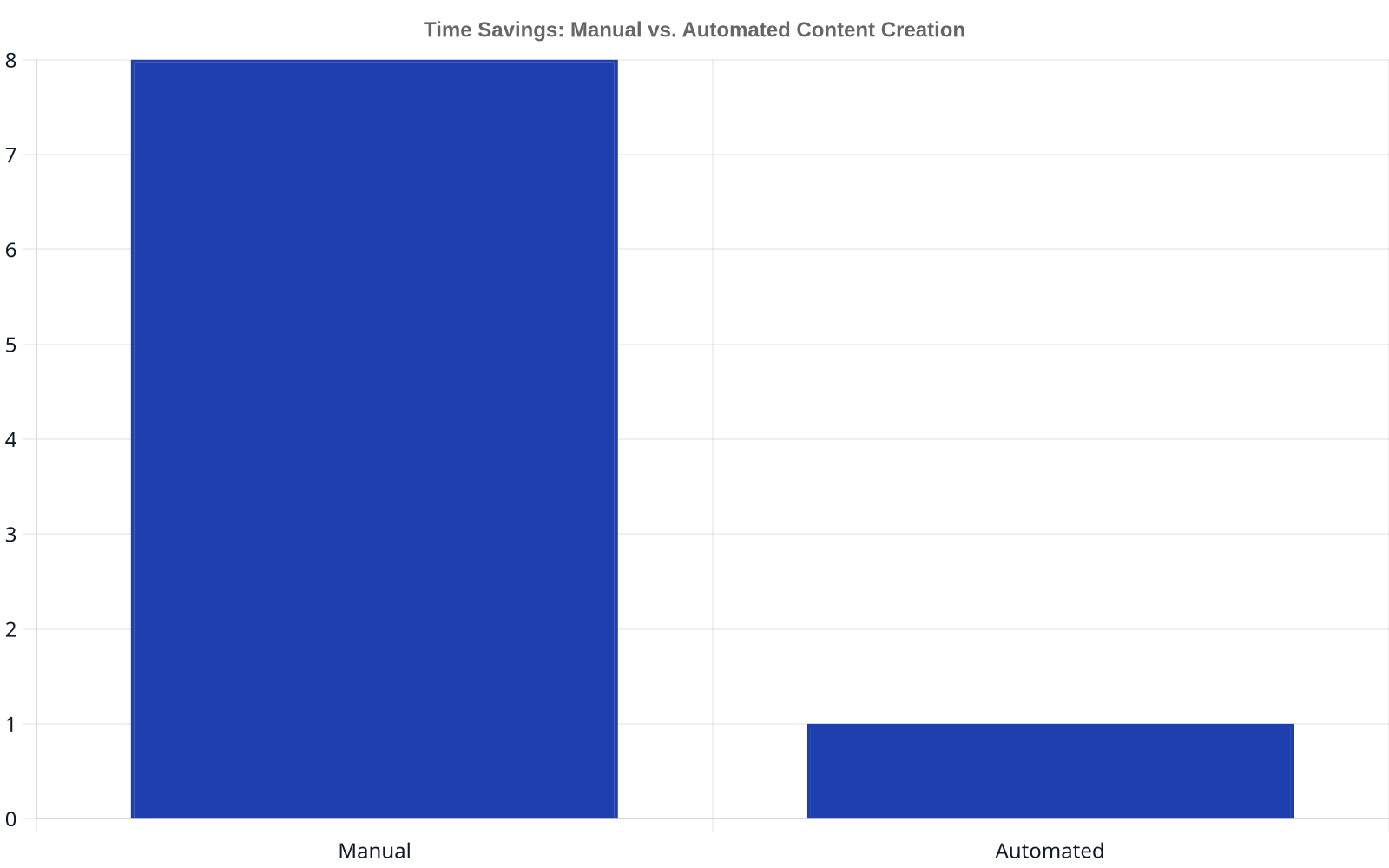
Switching from a manual process to an automated one isn’t just an operational tweak; it’s a fundamental shift in your business model for organic growth. The value proposition is built on three pillars: radical efficiency, strategic consistency, and scalable output.
Quantifying the Time Savings
Consider the time breakdown for a single 1,500-word blog post:
- Keyword & Topic Research: 2-4 hours
- Outlining & Briefing: 1-2 hours
- Writing & Editing: 4-8 hours
- SEO Optimization & Formatting: 1-2 hours
- Publishing & Linking: 0.5-1 hour
That’s a total of 8.5 to 17 hours of skilled labor per article. An automated platform can execute the entire workflow in a fraction of that time, often less than an hour, with the primary human input being the initial setup and strategy review. Our platform handles the full cycle, including providing daily articles, which is simply impossible to scale cost-effectively with a manual process.
Achieving Unbreakable Consistency
Search engines reward consistency. A site that publishes high-quality, relevant content on a predictable schedule signals authority and reliability. For a human team, maintaining this cadence is a constant battle against burnout, budget shifts, and competing priorities. An automated system doesn’t have other priorities. It executes its programmed strategy, whether that’s one article a week or five a day, without fail. This creates a compounding effect on your rankings as search algorithms learn to trust your site as a fresh source of information.
Scaling Output Without Scaling Costs
With a manual workflow, a 10x increase in content output requires a nearly 10x increase in budget and team size. It’s linear. With an automated SEO content generation software platform, the cost structure is completely different. The marginal cost of producing the 100th article is virtually the same as the 10th. This allows businesses to target thousands of long-tail keywords that would be unprofitable to pursue manually, capturing traffic across a much wider surface area. Long-tail keywords make up a significant portion of all search queries, representing a massive untapped opportunity for automated content.

How Automated SEO Content Generation Works

At its core, automated SEO content generation software is a sophisticated integration of several AI-driven processes. It’s not just a wrapper around a large language model like GPT-4. A true automation platform is a complete system that manages the entire content lifecycle.
Stage 1: AI-Powered Keyword Research and Clustering
Everything starts with identifying the right topics. The software analyzes SERPs (Search Engine Results Pages) at scale, identifying underserved keywords and grouping them into semantic clusters. Instead of just finding one keyword like “best running shoes,” it identifies a whole topic area: best running shoes for flat feet, for marathons, for trail running, etc. This ensures every piece of content is part of a broader topical authority strategy, which Google’s ranking systems heavily favor. This initial keyword research phase is critical and sets the stage for everything that follows.
Stage 2: SERP-Informed Content Generation
Once a topic is selected, the system analyzes the top-ranking pages for that query. It deconstructs their structure, headings, key concepts, and common questions. This SERP data is used to create a highly detailed, fact-based prompt for an LLM. The AI then generates a full article that is structurally and semantically aligned with what search engines have already proven they want to rank. This is a far cry from giving a generic prompt to a public AI tool and hoping for the best. The content is designed from the ground up for search performance.
Stage 3: Automated On-Page Optimization and Publishing
Generating the text is only half the battle. The software then enriches the article with essential on-page SEO elements:
- Image Generation: AI creates relevant, unique images with appropriate alt text.
- Internal Linking: The system scans your existing site content and automatically inserts relevant internal linking to build topical authority and improve crawlability.
- Entity Optimization: It identifies and bolds key entities (people, products, places) to help search engines understand the content’s context.
- Schema Markup: It can generate structured data like FAQPage schema to enhance search appearance.
- Direct Publishing: Finally, the finished, fully-optimized article is pushed directly to your CMS (like WordPress or Shopify) as a draft or even published live, according to your rules.
Top Automated SEO Content Generation Software Compared
| Feature | Keyworth | Platform B | Platform C | |
|---|---|---|---|---|
| Core AI Functionality | Full Article Generation | Content Briefs & Optimization | AI Writing Assistant | |
| Keyword Research | Integrated | SERP-focused | Limited | |
| SEO Optimization | Automated On-Page | Content Scoring | Manual Prompts | |
| CMS Integration | WordPress, Shopify, etc. | WordPress, Google Docs | None/API | |
| Target User | Businesses, Agencies | SEO Specialists | Content Marketers | |
| Pricing Model | Subscription (tiered) | Per-document/Subscription | Usage-based |
Not all platforms that claim to “automate” content are created equal. Many are simple “AI writers” that require significant manual work to be useful for SEO. A true automated solution provides an end-to-end workflow.
| Feature | Basic AI Writer (e.g., Jasper) | SEO-Focused Writer (e.g., SurferSEO) | Fully Automated Platform (e.g., Keyworth) |
|---|---|---|---|
| Core Function | Generates text from a prompt | Optimizes human-written text for a keyword | Manages the entire content lifecycle (research to publish) |
| Keyword Research | Manual; requires external tools | Manual; analyzes a single keyword | Automated; discovers and clusters thousands of topics |
| Content Generation | User-prompted text blocks | Guided writing with SEO scoring | Full, structured articles based on SERP analysis |
| Internal Linking | Manual | Suggestions only | Fully automated insertion based on site crawl |
| Image Generation | Often an add-on or manual | Manual | Integrated, automated AI image creation with alt text |
| Publishing | Manual (copy/paste) | Manual (copy/paste) | Automated, direct-to-CMS publishing |
| Best For | Copywriting, social media posts | SEO specialists optimizing single articles | Businesses seeking scalable, hands-off organic growth |
Don’t confuse a tool that helps you write with a platform that automates a business process. The former saves you a few hours; the latter creates a new engine for growth in your company.
Key Features to Look For in Automated SEO Content Software

When evaluating different software options, look beyond the core text generation. The real value lies in the completeness of the automation and the intelligence of the strategy.
Strategic Keyword Clustering
Does the tool simply find standalone keywords, or does it build a content map? A superior platform will use AI to group keywords into semantic clusters. This allows you to build topical authority, a critical ranking factor. Instead of writing one-off posts, you’re systematically covering an entire subject area, which signals expertise to Google. A 2023confirmed a strong correlation between content clustering and higher rankings.
SERP-Based Briefing and Generation
How does the AI know what to write? The best systems don’t guess. They perform a deep analysis of the current top-ranking pages for the target keyword. They extract headings, common questions, word count, and key entities. This data forms the blueprint for the AI-generated content, ensuring it’s perfectly aligned with demonstrated search intent from the start. It’s the difference between a custom-tailored suit and an off-the-rack one.
True End-to-End Automation
Look for a platform that minimizes manual handoffs. Can it discover a keyword, write an article, add optimized images, insert relevant internal links, and publish the post to your WordPress site without you touching it? That is true automation. Anything less is just a point solution that still requires you to act as the project manager. Platforms that also manage backlinks as part of a holistic SEO automation strategy offer an even more comprehensive solution.
Measuring Success: KPIs and ROI
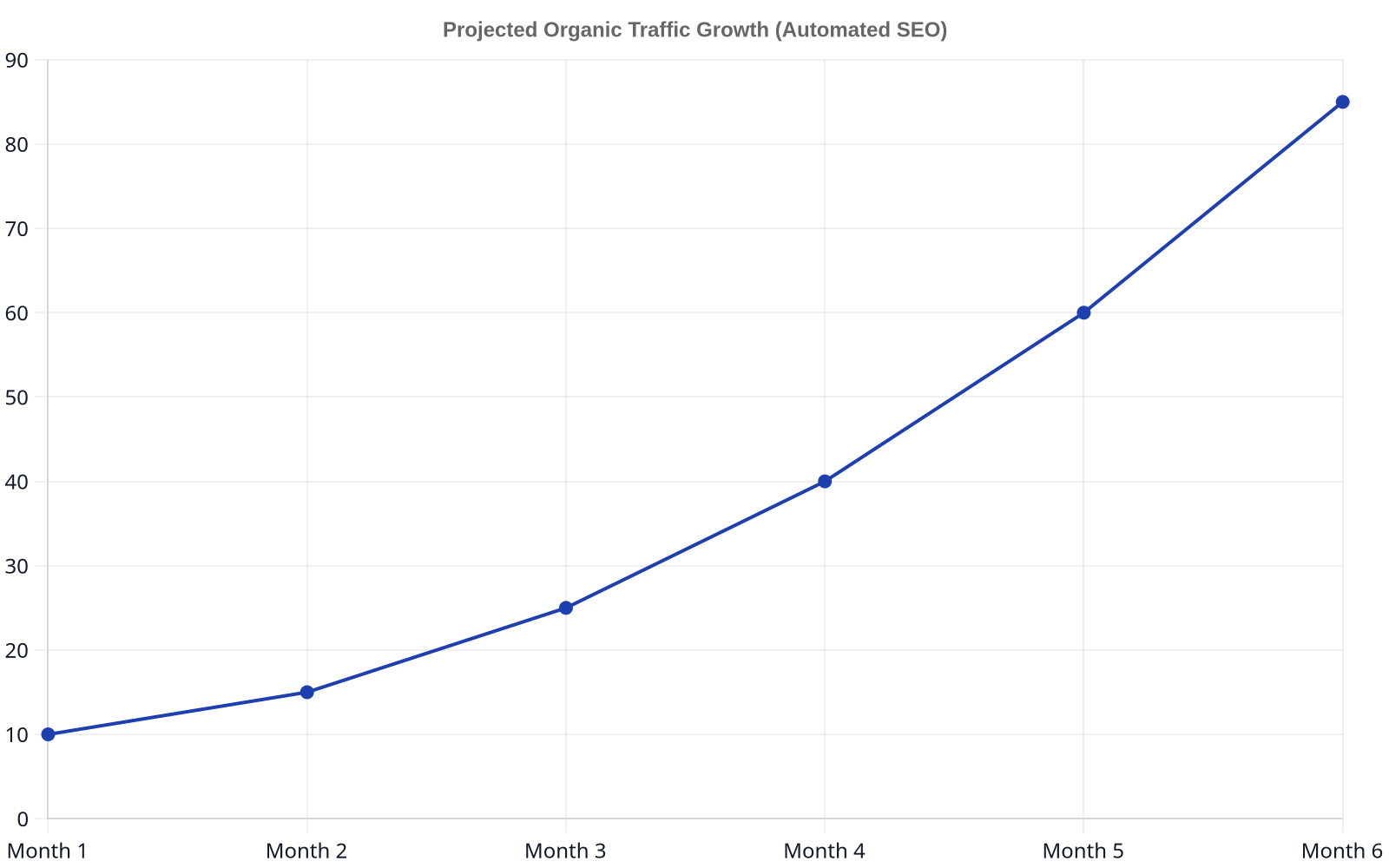
Implementing automated SEO content generation software requires a shift in how you measure success. The focus moves from activity-based metrics (e.g., “we published 4 articles this month”) to outcome-based KPIs.
Leading Indicators
- Keyword Footprint Growth: Track the number of keywords your site ranks for in the top 100. This is the earliest sign that your content is being indexed and seen by Google. Tools like Ahrefs or Semrush are essential for this.
- Impressions: Before you get clicks, you get impressions. A rising impression count in Google Search Console means your expanded keyword footprint is reaching more searchers.
Core Performance Indicators
- Organic Traffic: This is the primary measure of success. Is non-branded organic traffic growing month-over-month? Isolate traffic to the automated content to see its direct impact.
- Conversions from Organic Traffic: Traffic is a means to an end. Are these new visitors signing up for newsletters, requesting demos, or making purchases? Set up conversion goals in Google Analytics 4 to track the bottom-line impact. Organic search drives over 53% of all website traffic, making it the most dominant channel.
Calculating ROI
To calculate the return on investment, compare the cost of the software to the value of the traffic generated. A simple model is:
Monthly Organic Visitors x Conversion Rate x Average Customer Lifetime Value = Monthly Revenue from Automation
Compare this revenue to the monthly software cost. More advanced models can factor in the saved labor costs from your team no longer performing manual content tasks.
FAQ
Will AI-generated content get penalized by Google?
No. Google has been clear that their policies prohibit content created for the primary purpose of manipulating search rankings, regardless of how it’s created. High-quality, helpful content is rewarded, while thin, spammy content is not. Modern automated SEO platforms focus on creating useful, SERP-informed content that aligns with user intent, which is exactly what Google wants to rank. The method of creation is irrelevant; the quality and user value are what matter.
How much human oversight is needed?
This varies by platform, but the goal is minimal oversight. For a platform like Keyworth, the initial setup involves defining your goals, target audience, and any brand-specific rules. After that, the system can run largely on its own. It’s wise to have a strategist review the content plan and performance metrics on a weekly or monthly basis to make high-level adjustments, but the day-to-day operations are handled by the software.
Can automated content match my brand voice?
A common concern is that AI content will sound generic. Sophisticated platforms address this by allowing you to provide brand voice guidelines, style examples, and information about your target audience during setup. The AI uses these inputs to tailor the tone, terminology, and style of the generated content to better match your brand. While it may not capture every nuance of a senior brand writer, it can achieve a consistent and professional voice suitable for scalable SEO content.
What is the cost of automated SEO content generation software?
Costs vary significantly. The price reflects the value of a fully managed, scalable content engine.
How quickly can I expect to see results?
SEO is a long-term strategy, even with automation. You can expect to see leading indicators like an expanding keyword footprint and rising impressions within the first 1-3 months. A noticeable increase in organic traffic typically follows within 3-6 months as the new content gets indexed, ranked, and starts building authority. Significant ROI is usually seen from the 6-12 month mark and beyond as traffic growth compounds.
If you’re ready to stop the endless cycle of manual content production and build a scalable engine for organic growth, it might be time to see what true automation looks like. Keyworth offers an end-to-end platform that handles everything from keyword research to daily publishing, letting you focus on strategy while our software handles the execution. See how we can build your content moat.
Leave a Reply