BlogSEO Insights & TipsExpert advice on SEO strategy, AI content, and growing your organic traffic.

  • Topic Clusters & Pillar Pages: Redefining SEO Authority

    Topic Clusters & Pillar Pages: Redefining SEO Authority

    Stop chasing individual keywords. You’re playing a game that Google stopped rewarding five years ago. The belief that ranking is about targeting one specific…

    Stop Chasing Keywords: A Topic Clusters and Pillar Pages Explainer for 2026

    Stop chasing individual keywords. You’re playing a game that Google stopped rewarding five years ago. The belief that ranking is about targeting one specific phrase with one specific page is a relic of a simpler search era. Today, SEO is about demonstrating comprehensive authority on a subject.

    Topic clusters and pillar-pages-topics-and-subtopics) pages are an SEO strategy that organizes content architecture around a central ‘hub’ or pillar page, which covers a broad topic comprehensively. This pillar links out to multiple ‘cluster’ pages, each detailing a specific subtopic. This model signals deep topical authority to search engines, improving rankings for a whole family of related terms, not just one. It’s the difference between building a single bookshelf and building an entire, interconnected library.

    What Is a Topic Cluster?

    A topic cluster is a collection of interlinked articles and pages on a website that all relate to one broad, central subject. Think of it as a micro-site within your main website. Instead of publishing a random assortment of blog posts, you deliberately create a group of articles that, together, provide a thorough exploration of a core topic. For instance, rather than writing a single article on “project management,” a topic cluster would include separate, detailed posts on “Gantt charts,” “Agile methodology,” “Kanban boards,” and “resource allocation”—all linking back to a central pillar about project management.

    This structure isn’t just for organization. It’s a direct response to how search engines have evolved. Google’s systems now prioritize understanding the meaning behind a query, not just matching keywords. By grouping related content, you create a powerful semantic network that tells search algorithms, “this website is an authority on this subject.” This is a fundamental shift from the hub-and-spoke model. While hub-and-spoke also features a central page, the “spokes” are often a collection of less related pages. A topic cluster is more intentional, with each cluster piece designed to support the pillar and the overall topic.

    What Is a Pillar Page?

    A pillar page is the foundation of a topic cluster. It’s a single, comprehensive piece of content that provides a broad overview of the main topic. Following our previous example, the “Ultimate Guide to Project Management” would be the pillar page. This page is typically long-form, often exceeding 3,000 words—some of the most successful ones, like a well-known guide on content marketing, famously ran over 6005 words. It touches upon all the major subtopics covered in the cluster content, but it does so at a higher level.

    The pillar page’s primary job is to act as a directory for the cluster. It introduces the reader to the overarching subject and then provides links to the more detailed cluster pages for those who want to explore a specific facet in greater depth. For a pillar page to be effective, it must be one of the most useful, authoritative resources on the topic available on the internet. It can’t be a superficial summary; it must deliver substantial value on its own while serving as the gateway to your cluster.

    Pillar Page vs. Cluster Content: Key Differences

    Understanding the distinct roles of pillar and cluster content is crucial for executing the strategy correctly. One is broad and foundational; the other is narrow and deep.

    Feature Pillar Page Cluster Content Page
    Scope Broad, covers a large topic comprehensively Narrow, focuses on one specific subtopic in detail
    Length Typically long-form (2,500-7,000+ words) Varies, but often shorter (1,000-2,500 words)
    Purpose To be the authoritative hub and rank for broad, high-volume keywords To rank for specific, long-tail keywords and support the pillar
    Internal Links Links OUT to all related cluster pages Links UP to the pillar page and to other relevant cluster pages
    User Intent User is in the learning/research phase, seeking an overview User has a specific question or is exploring a niche aspect

    The Real Benefits for SEO and AI-Driven Search (AEO)

    The shift to a topic cluster model isn’t just an organizational exercise; it produces tangible SEO and business results. The core benefit is establishing topical authority. Instead of being seen as having one good article, Google sees you as an expert on an entire subject. This authority cascades down, making it easier for all pages within the cluster to rank.

    Other key benefits include:

    • Improved Rankings for Competitive Keywords: It is notoriously difficult to rank for a broad, high-volume term with a single page. By surrounding your pillar page with dozens of supporting cluster articles, you create an authority signal so strong that it can compete for these valuable terms.
    • Increased Organic Traffic: More pages ranking for more keywords naturally leads to more traffic. The cluster model targets hundreds or even thousands of long-tail variations, capturing a much wider net of search queries.
    • Deeper User Engagement: By linking related content together, you create a “stickier” user experience. Visitors who arrive on one cluster page are easily guided to the pillar and other related articles, increasing time on site and pages per session—both positive signals to search engines.
    • Streamlined Content Strategy: The model provides a clear roadmap for content creation. Instead of asking “What should we write about this week?”, your team knows exactly which subtopics need to be built out to support a strategic pillar. It simplifies the work of planning daily articles and ensures every piece contributes to a larger goal.

    How to Create Topic Clusters: A Step-by-Step Guide

    Building a topic cluster strategy requires a methodical approach that starts with deep research and ends with precise execution. It’s a process we’ve refined while managing content for a diverse set of clients, including B2B companies like Wolverine Assemblies.

    Step 1: Choose Your Core Topic

    The first step is identifying the broad, high-level topics you want your business to be known for. These core topics should be central to your product or service and have significant search volume. A good core topic isn’t a long-tail keyword; it’s a 2-3 word phrase that represents a major pain point or area of interest for your target audience. For us, a core topic might be “automated SEO” or “content scaling.” The real work begins with extensive keyword research to validate that people are actually searching for this topic and to begin identifying potential subtopics. Using a tool like Ahrefs or Semrush is non-negotiable here; you need data to back your intuition. You can conduct keyword research by focusing on relevance and search intent, not just volume.

    Step 2: Brainstorm and Validate Subtopics

    Once you have your core topic (your future pillar page), you need to brainstorm the cluster content. What are all the specific questions, sub-themes, and related concepts someone would need to understand to master the core topic? Think about questions that begin with “how,” “what,” “why,” and “best.” Each of these will become a cluster page.

    For example, if your pillar is “Content Marketing,” your subtopics might be:

    • What is a content calendar?
    • How to write a blog post
    • Best social media content formats
    • Measuring content marketing ROI
    • Content distribution strategies

    Use keyword research tools again to validate these subtopics. You want to see that each has its own search volume, indicating that it’s a distinct topic worthy of its own page. As you do this, you’ll find that a single pillar can support anywhere from 10 to 100 cluster pages.

    A pillar page isn’t just a long blog post. It’s a strategic declaration that you intend to own a topic, backed by an army of cluster content that proves you have the expertise to do so.

    Step 3: Audit Existing Content and Map to Subtopics

    Before you write a single new word, audit your existing content. You likely already have pages on your site that can serve as part of a cluster. This process, often called content pruning and optimization, is critical for efficiency.

    1. Crawl Your Site: Use a tool like Screaming Frog to get a complete list of your site’s URLs, titles, and H1 tags.
    2. Pull Performance Data: Export performance data (clicks, impressions) for your pages from Google Search Console for the last 6-12 months.
    3. Combine and Analyze: In a spreadsheet, combine your crawl data with your GSC data. You can now see every page, its target keyword, and its performance.
    4. Identify Cluster Candidates: Look for articles that align with the subtopics you identified in Step 2. Tag them in your spreadsheet.
    5. Find Overlap and Gaps: You may find multiple articles competing for the same subtopic (cannibalization). These should be consolidated. You will also identify subtopic gaps where you have no content at all—these form your new content plan.
    6. Update and Relaunch: For existing pages you’ve identified as cluster content, refresh them, optimize them for their specific subtopic, and most importantly, add the necessary internal links.

    How to Build an Effective Pillar Page

    The pillar page is the centerpiece, and its construction must be flawless. It has to be both an excellent user resource and a perfectly optimized SEO asset.

    Structuring for Readability and SEO

    A pillar page for a topic like “topic clusters and pillar pages explained” needs to be structured for two audiences: human readers and search engine crawlers. For humans, this means using plenty of headings (H2s, H3s), short paragraphs, bullet points, and visuals to break up the text. No one wants to read a 5,000-word wall of text. For search engines, this means a logical heading structure, a clear table of contents with jump links at the top, and optimized metadata.

    The Critical Role of Internal Linking Strategy

    The linking structure is what turns a collection of pages into a topic cluster. It’s what signals the relationships between your content to Google. The rules are simple but absolute:

    1. The Pillar Page MUST link out to every single one of its cluster pages. This is non-negotiable. This is how the pillar passes authority and relevance to the cluster.
    2. Every Cluster Page MUST link up to the pillar page. This is equally non-negotiable. This reinforces the pillar’s role as the central hub.

    Optionally, cluster pages can link to each other where it makes sense for the user, but the primary link path is always cluster-to-pillar and pillar-to-cluster. We see many companies fail here; they write the content but neglect the architecture. Proper internal linking ensures the whole system works. It’s a core component of what we deliver through our automated SEO platform.

    Advanced Strategies & Common Mistakes

    Once you’ve mastered the basics, you can apply more advanced techniques and learn to avoid common pitfalls that sabotage the effectiveness of this model.

    Integrating Clusters with E-E-A-T and Schema Markup

    A well-executed topic cluster is a powerful way to demonstrate Experience, Expertise, Authoritativeness, and Trustworthiness (E-E-A-T), which are critical quality factors for Google. The pillar page demonstrates your breadth of knowledge (Authoritativeness), while the detailed cluster pages showcase your depth (Expertise). You can further enhance this by adding author bios, citing sources, and updating content regularly. For more on this, see our guide on e-e-a-t for ai content. Furthermore, using Schema markup, specifically Article and BreadcrumbList schema, can help Google better understand the content’s structure and its place within your site’s hierarchy.

    Tools for Topic Cluster Implementation

    While you can manage topic clusters manually with spreadsheets, several tools make the process far more efficient:

    • SEO Platforms (Ahrefs, Semrush): Essential for the initial keyword research, competitor analysis, and identifying core topics and subtopics. They also provide rank tracking to measure your cluster’s impact.
    • Content Optimization Tools (Clearscope, SurferSEO): These tools analyze top-ranking content to provide recommendations on terms and concepts to include in your pillar and cluster pages, ensuring you create truly comprehensive content. Some analysis shows that the top content is consumed by over 10M marketing professionals monthly, setting a high bar for quality.
    • Site Crawlers (Screaming Frog, Sitebulb): Invaluable for auditing your existing content and, more importantly, for visualizing your internal linking structure to ensure your clusters are properly connected.
    • Automated Platforms (Rank My Website): For businesses that need to scale, our platform automates the entire workflow—from keyword research and generating daily articles to building the internal linking structure and publishing, which is especially useful for programmatic SEO approaches.

    Your content might be solid, but if your site structure is a mess, Google won’t reward you. SEO has evolved from focusing on keywords and metadata to focusing on how content fits together. Google cares more about context, relevance, and structure than ever before.

    Common Mistakes to Avoid

    • Choosing a Core Topic That’s Too Broad or Too Narrow: “Marketing” is too broad. “Early-stage SaaS content marketing in Finland” is too narrow. “SaaS content marketing” is just right.
    • Weak Internal Linking: Forgetting to link from every cluster page back to the pillar is the most common and damaging mistake. It breaks the model.
    • Creating a Pillar Page That Is Just a List of Links: The pillar must provide independent value. It should be a comprehensive guide, not just a table of contents.
    • Not Committing to the Cluster: Publishing a pillar and only two cluster pages won’t work. You need to build out a significant portion of the cluster to signal authority. Some topics require a baseline of 15-20 articles before seeing significant traction.
    • Ignoring User Intent: Creating a cluster page on “what is a Gantt chart” when searchers are really looking for “Gantt chart templates” will lead to high bounce rates and poor performance.

    Measuring the Performance and ROI of Your Clusters

    How do you know if your topic cluster strategy is working? You need to track the right metrics. While tracking the rank of individual cluster pages is useful, the real measure of success is the performance of the pillar page for its broad, competitive term. That is the ultimate prize.

    In Google Search Console, filter your performance report by page and enter the URL of your pillar page. Are you seeing a steady increase in impressions and clicks for a wide range of relevant queries? Are you starting to rank for the core topic? Another key metric to watch is the total traffic to all pages within the cluster. You can track this by creating a content group in Google Analytics 4. A successful cluster will show a rising tide of traffic that lifts all boats, not just one.

    Frequently Asked Questions

    What is the ideal number of cluster pages for one pillar page?

    There is no magic number. It depends entirely on the breadth of the topic. A simple topic might be covered by 8-10 cluster pages, while a complex subject like “corporate finance” could require 50+. A good starting point is to aim for 15-22 cluster articles to achieve critical mass and signal authority.

    How is a pillar page different from a category page?

    A pillar page is a comprehensive piece of content designed to teach and inform. A category page, especially on e-commerce or media sites, is typically a navigational page that simply lists other articles or products with minimal unique content. A pillar page is the content; a category page points to content.

    Can an existing blog post be turned into a pillar page?

    Yes, absolutely. If you have a high-performing blog post that covers a broad topic and already attracts backlinks and traffic, it’s an ideal candidate. You would need to expand it to ensure it’s truly comprehensive, add links to new and existing cluster pages, and then re-promote it as your new, authoritative guide.

    How long does it take for a topic cluster strategy to work?

    SEO is a long-term investment. You should not expect to see dramatic results in the first month. Typically, it takes 6-9 months to see significant ranking improvements and traffic growth from a new topic cluster, assuming you are building it out consistently. The impact is compounding; the more relevant clusters you build, the faster your site’s overall authority grows.

    Should every piece of content be part of a cluster?

    Not necessarily. You will always have timely content like news announcements, case studies, or company updates that don’t fit neatly into a topic cluster. It’s perfectly fine for these to exist as standalone pieces. However, the majority of your strategic, evergreen content should be organized within a cluster framework.

    Ultimately, implementing a topic clusters and pillar pages model is about future-proofing your SEO strategy. It aligns your content with how modern search engines work and how real people look for information. It requires more strategic thinking than just chasing keywords, but the rewards—sustainable traffic, enhanced authority, and a library of assets that work together—are well worth the effort. At Rank My Website, we automate this entire process, turning your keywords into a fully structured, SEO-optimized content library that continuously builds your organic traffic.

  • SEO Trends 2027: Entity-Based Strategy, Not Keywords

    SEO Trends 2027: Entity-Based Strategy, Not Keywords

    Forget trying to “trick” an algorithm. The most significant shift in SEO has nothing to do with new tactics and everything to do with search engines becoming…

    Top SEO Trends to Watch in 2027: A Practitioner’s Guide to the New Search

    Forget trying to “trick” an algorithm. The most significant shift in SEO has nothing to do with new tactics and everything to do with search engines becoming sentient, conversational partners. For years, we treated Google like a vending machine: insert keyword, get ranking. In 2027, you’re not talking to a machine; you’re building a relationship with a digital brain that thinks in concepts, not just strings of text.

    The top SEO trends to watch in 2027 are the definitive shift from keyword-based tactics to entity-based strategies, driven by AI. This means focusing on Answer Engine Optimization (AEO) for generative AI overviews, building deep topical authority instead of chasing single keywords, and embracing privacy-first marketing in a cookieless world. For a deeper dive into these evolving practices, explore seo content trends and next-gen SEO strategies. However, it’s crucial to understand what truly matters in SEO beyond fleeting trends. Success will depend on integrating AI for personalization and content generation while doubling down on human experience, demonstrable expertise (E-E-A-T), and robust technical SEO fundamentals.

    The Rise of AI in SEO: From Tool to Teammate

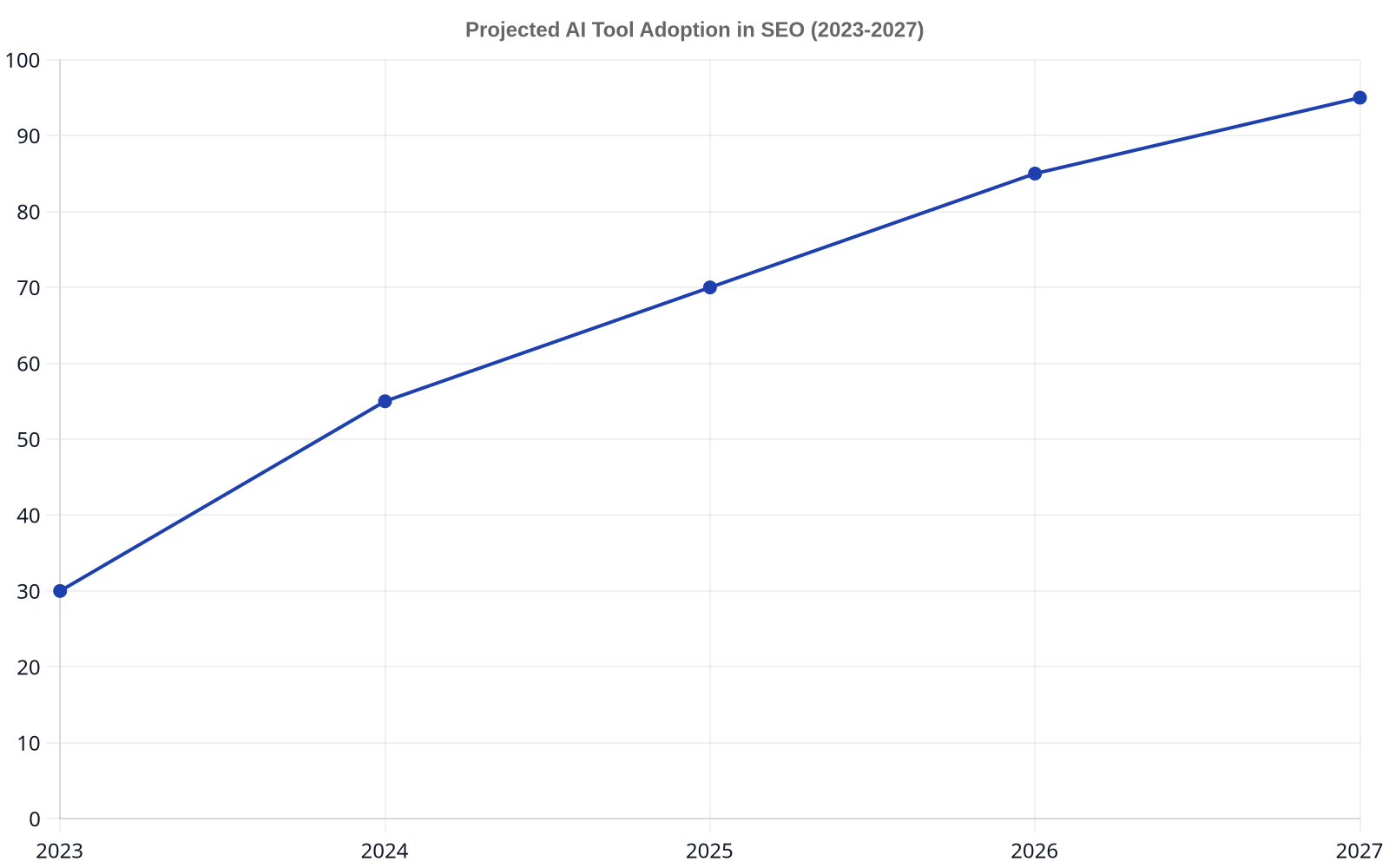
    Line chart showing projected increase in AI tool adoption by SEO professionals from 30% in 2023 to 95% in 2027.
    Projected AI Adoption in SEO

    Artificial intelligence isn’t a new visitor to SEO, but its role has undergone a radical promotion. It’s no longer just a helpful intern fetching data; it’s a strategic partner embedded in every facet of our workflow. By 2027, any SEO strategy that doesn’t fundamentally integrate AI is already obsolete. A 2024 Gartner analysis predicts that generative AI will be a workforce partner for 90% of creative professionals by 2026, a trend accelerating rapidly in the SEO space.

    AI-Powered Personalization and Content Generation

    Generative AI models like Google’s own Gemini are not just powering search results; they’re becoming content creation engines. At Rank My Website, we see this firsthand in how we approach content. The era of writing one article for one keyword is over. Now, we use AI to generate clusters of content around a topic, personalized for different user intents and stages of the buyer’s journey. The rote work of keyword research has evolved from finding simple phrases to identifying complex user questions and semantic relationships that AI can then help us answer at scale.

    However, this introduces profound ethical questions. The ease of generating content floods the internet with low-quality, derivative articles. The winning strategy in 2027 isn’t just using AI—it’s using AI to augment human creativity. AI can outline, research, and draft, but the final layer of unique insight, experience, and brand voice must come from a human expert. This is how you build trust, not just rankings.

    AI Chatbots and Conversational Marketing

    Conversational AI is another critical piece of the puzzle. On-site chatbots and AI assistants are no longer simple FAQ bots. They are now sophisticated tools that can guide users through complex funnels, answer nuanced questions, and collect valuable zero-party data. By integrating your site’s content repository with a powerful Large Language Model (LLM), you can provide instant, accurate answers 24/7. This not only improves user experience but also creates a new signal for search engines: your site is a reliable source of information, capable of satisfying user queries directly.

    AEO: The New Frontier is Answer Engine Optimization

    The most disruptive trend is the evolution of Search Engine Optimization (SEO) into Answer Engine Optimization (AEO). Google isn’t just showing a list of links anymore; it’s synthesizing information from those links to provide a direct answer in AI Overviews. If your content isn’t structured to be the source of that answer, you will become invisible.

    Your new goal isn’t to rank #1. It’s to become the canonical, cited source within the AI-generated answer. Your content needs to be the fact that the machine quotes.

    Optimizing for AI Overviews and LLMs

    To succeed in AEO, you must shift your mindset from “keywords” to “entities” and “answers.” An entity is a specific, well-defined thing or concept—a person, a place, a company, a product. Google’s Knowledge Graph is built on entities. To optimize for answer engines, you must:

    1. Be Direct and Factual: Answer questions clearly and concisely. Use simple language and structure your content with clear headings. The first paragraph of a section should directly answer the question posed by its heading.
    2. Use Structured Data: Schema markup is the language of search engines. Implementing detailed schema (like FAQPage, HowTo, Product, etc.) gives search engines the specific, structured information they need to generate accurate answers. It’s no longer optional.
    3. Prioritize E-E-A-T: Google must trust the source of its answers. This means demonstrating Experience, Expertise, Authoritativeness, and Trustworthiness is more critical than ever. Author bios, cited sources, and clear evidence of first-hand experience are non-negotiable.

    SEO vs. AEO: A Shift in Metrics

    The key performance indicators for search are changing. While old metrics still have a place, a new set of AEO-focused measures is emerging to define success.

    Metric Type Traditional SEO Metric Modern AEO Metric
    Visibility Keyword Ranking Position Percentage of AI Overviews Sourced
    Engagement Click-Through Rate (CTR) Brand Mentions within Answers
    Content Pages per Session Query Satisfaction Rate
    Authority Domain Authority (DA) Entity Salience & Topical Authority

    Measuring the ROI for these new efforts requires a shift in analytics. You need to track how often your domain is cited as a source in AI Overviews and monitor the traffic coming from these features. It requires looking beyond simple clicks to understand your brand’s overall visibility and authority within the search engine’s “brain.”

    Topical Authority: Why Deep Expertise Beats Broad Content

    In 2027, an “inch-deep, mile-wide” content strategy is a recipe for failure. To become a trusted source for an answer engine, you must prove deep, comprehensive expertise on a specific topic. This is topical authority. Instead of writing one blog post about “industrial assemblies,” a company like our client wolverine-llc.com would need a complete hub of content covering everything from materials and processes to logistics and quality control for that industry. This signals to Google that they are a definitive authority on the subject.

    Building Content Hubs and Clusters

    Building topical authority is a deliberate, structured process. It’s about creating a universe of content, not just a single star.

    1. Identify Your Core Topic: Start with the central pillar of your expertise. This should be a broad topic that is fundamental to your business.
    2. Map Out Subtopics: Brainstorm every possible question, sub-topic, and related concept around your core topic. Use tools to find what your audience is asking.
    3. Create Pillar and Cluster Content: Write a long-form “pillar” page that provides a comprehensive overview of your core topic. Then, create dozens of “cluster” articles that dive deep into each subtopic, all linking back to the pillar page.
    4. Master Internal Linking: This is where the magic happens. A strong internal linking structure connects all of your related content, creating a web of expertise that search engines can easily crawl and understand. These logical connections are a powerful signal of authority. We’ve seen how a well-planned structure is key to achieving automated organic traffic growth.

    The Role of E-E-A-T in Authority

    Topical authority is intrinsically linked to E-E-A-T. You can’t build authority without demonstrating real expertise. As outlined in Google’s own documentation on helpful content, search systems are designed to reward content that is created for a specific audience and shows it was produced by someone with relevant life experience or deep knowledge. This is why human oversight is so critical. An AI can generate text, but it can’t fake a decade of hands-on experience in an industry.

    Core Web Vitals and User Experience: The Non-Negotiables

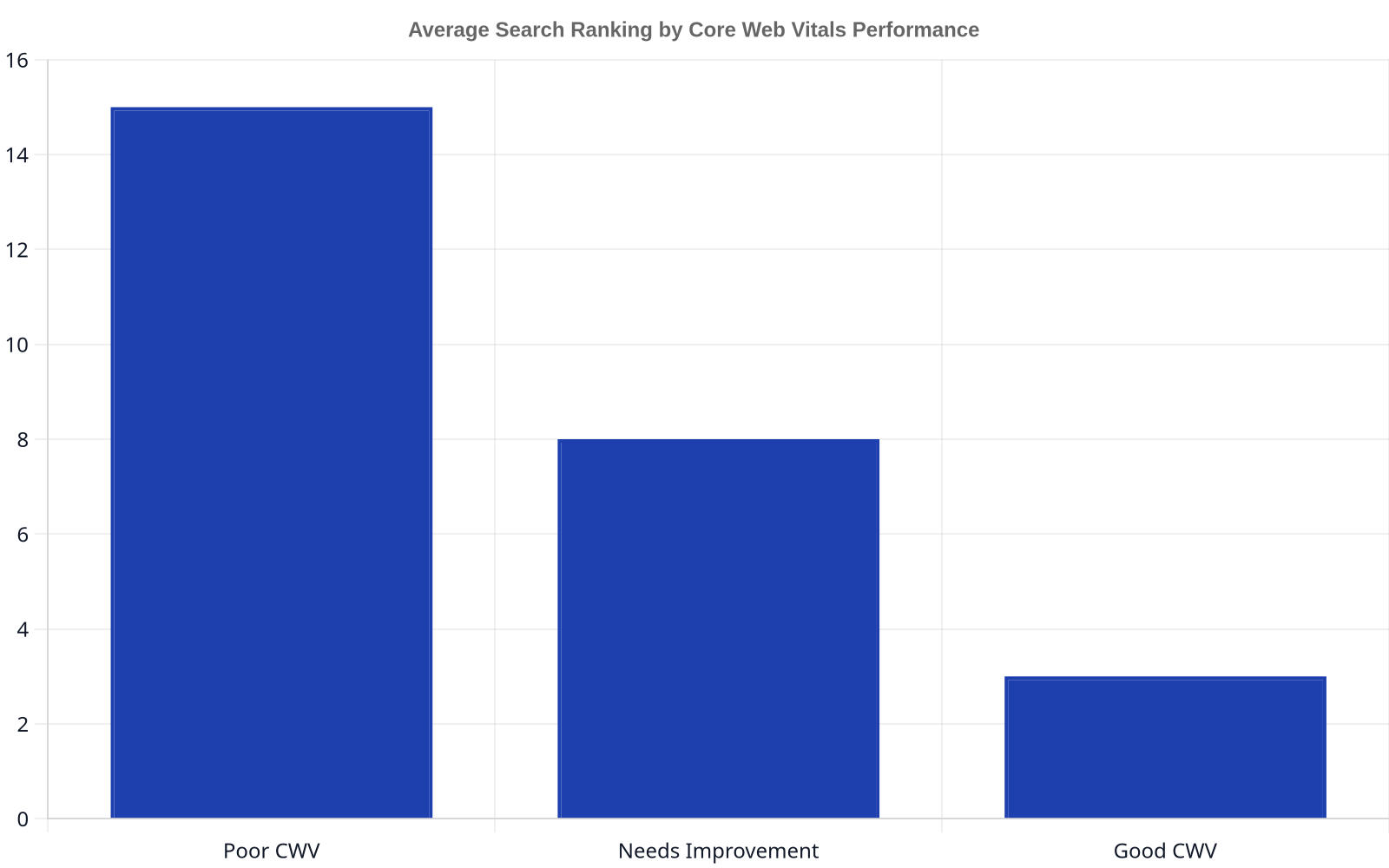
    Bar chart illustrating that websites with 'Good CWV' have an average search ranking of 3, 'Needs Improvement' at 8, and 'Poor CWV' at 15, indicating better performance with better Core Web Vitals.
    Impact of Core Web Vitals on Rankings

    For all the focus on AI and content, the technical foundation of your website has never been more important. If a user (or a search crawler) has a poor experience on your site, nothing else matters. Core Web Vitals (CWV)—Largest Contentful Paint (LCP), Interaction to Next Paint (INP), and Cumulative Layout Shift (CLS)—are direct measures of user experience and established ranking factors.

    Technical SEO is Still Foundational

    By 2027, perfect CWV scores are table stakes. Users expect pages to load instantly, be interactive immediately, and remain visually stable. A slow, janky website isn’t just an annoyance; it’s a direct signal to Google that your site is low-quality. Beyond CWV, a clean site architecture, mobile-first design, and efficient crawlability are essential. These are not exciting trends; they are the fundamental prerequisites for even competing in modern search. They are a significant part of the seo ranking factors and will only become more critical.

    The Human Element of UX

    User experience goes beyond technical metrics. Is your content readable? Is your navigation intuitive? Does your site design inspire trust? AI can’t answer these questions for you. This is where human creativity and empathy come in. Testing your site with real users, gathering feedback, and continuously iterating on the user journey are essential parts of a holistic SEO strategy. A user who is confused or frustrated will bounce, sending a powerful negative signal back to the search engine.

    In an AI-driven world, the most defensible SEO advantage you can have is a genuinely superior human experience. Machines can replicate facts, but they can’t replicate feeling.

    The Evolving Content Landscape: Video, Voice, and Verification

    Content is no longer just the written word. To dominate search in 2027, you must be present in the formats your audience prefers, and that increasingly means video and audio.

    The Dominance of Video Content

    Short-form video (YouTube Shorts, TikTok, Instagram Reels) and long-form video (YouTube explainers, tutorials, webinars) are essential for both engagement and search visibility. Google is indexing and ranking video content more prominently than ever. In fact, projections show that online video will account for 66 percent of mobile data traffic in 2027. Your content strategy must include video. This means creating video versions of your key articles, optimizing your YouTube channel, and embedding relevant videos within your blog posts to increase dwell time and user satisfaction.

    Voice Search Optimization is AEO in Practice

    Voice search is not a separate discipline; it is the epitome of answer-engine optimization. When a user asks a question to a smart speaker, they get one answer. The number of digital voice assistants is exploding, with Statista projecting their numbers to have reached 8.4 billion units worldwide back in 2024, making this a massive interface for search. To win the voice search answer, your content needs to be structured for AEO: be direct, be factual, and use natural, conversational language. Think about the questions your customers ask out loud and create content that answers them perfectly.

    SERP Feature Evolution: Thriving in a Post-Link World

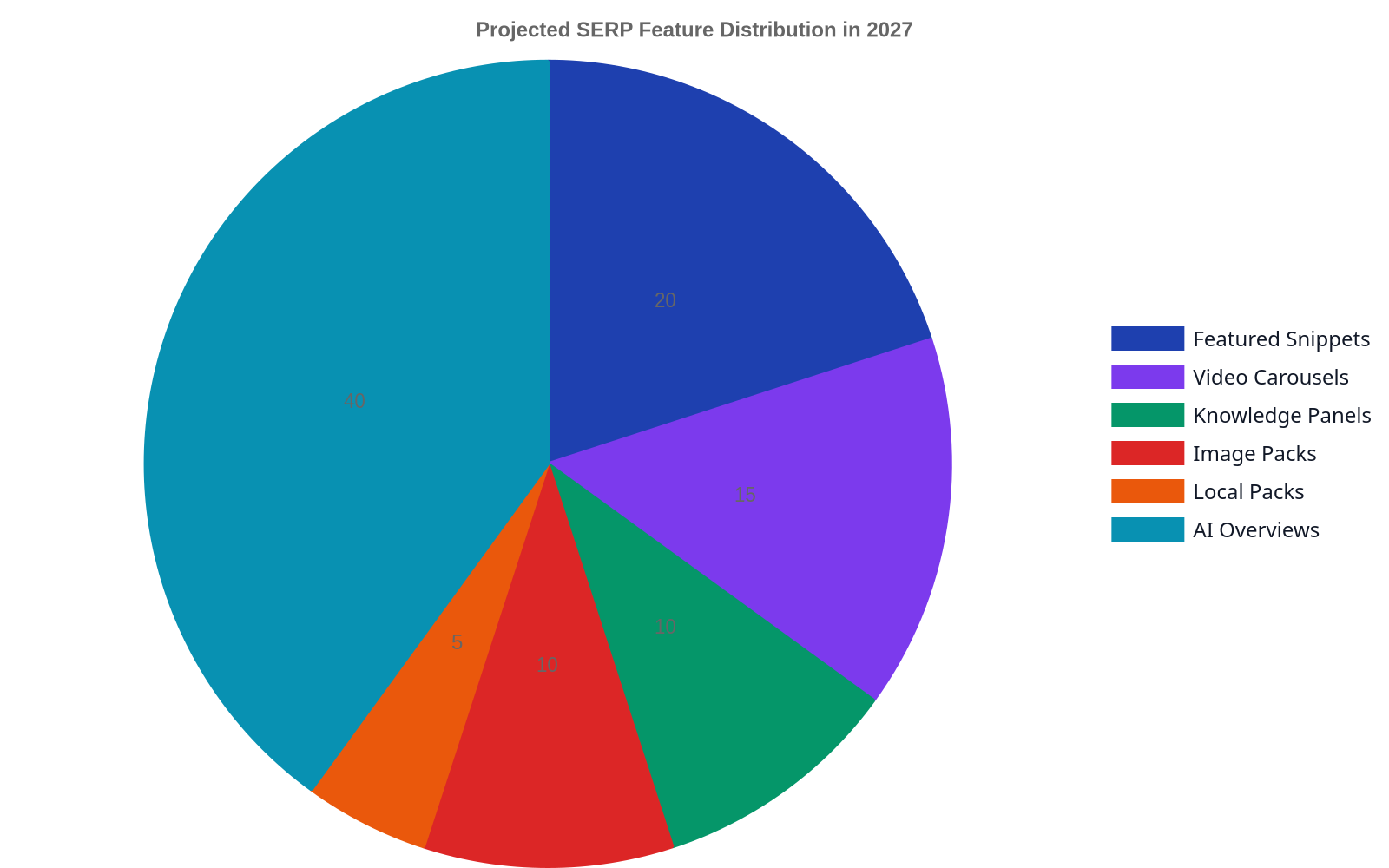
    Pie chart showing the projected distribution of SERP features in 2027: AI Overviews 40%, Featured Snippets 20%, Video Carousels 15%, Knowledge Panels 10%, Image Packs 10%, Local Packs 5%.
    SERP Feature Distribution 2027

    The traditional “10 blue links” are a relic. The Search Engine Results Page (SERP) of 2027 is a dynamic, modular interface dominated by AI Overviews, “People Also Ask” boxes, video carousels, and knowledge panels. Clicks are becoming less important than impressions and visibility within these features.

    Adapting to a Zero-Click Future

    A significant percentage of searches are now “zero-click,” meaning the user gets their answer from the SERP itself without clicking a link. This is terrifying for those who rely on website traffic. But it’s an opportunity for those who adapt. The goal is to own the SERP real estate for your brand and topics. This means optimizing for featured snippets, ensuring your business appears in the local pack with stellar reviews, and having your videos show up in carousels. It’s about being the answer, wherever the answer is displayed.

    Emerging Search Platforms

    While Google remains the giant, it is not the only search engine that matters. Younger audiences, in particular, are increasingly using platforms like TikTok, Instagram, and even Roblox as search engines for discovery and product research. An effective 2027 SEO strategy must consider these platforms. This doesn’t mean you need to be a dance-challenge star on TikTok, but it does mean understanding how information is discovered on these platforms and ensuring your brand is present in a way that is authentic to the environment.

    The Privacy Pivot: Navigating a Cookieless and Regulated Future

    The digital marketing world is being reshaped by a seismic shift toward user privacy. The demise of the third-party cookie, driven by regulations like GDPR and CCPA and browser changes via initiatives like Google’s Privacy Sandbox, fundamentally alters how we track and target users. The old ways of ad targeting and retargeting are disappearing.

    Thriving in a Cookieless Environment

    Success in a privacy-first world depends on building direct relationships with your audience and collecting zero-party and first-party data. Zero-party data is information customers intentionally share with you (e.g., through quizzes or preference centers). First-party data is information you collect from user interactions on your own website. An SEO strategy that drives engaged, loyal traffic to your owned properties is the best way to build this data asset. Content that solves problems and builds trust encourages users to share their information willingly.

    AI Governance and Future Regulations

    Beyond privacy, a new wave of regulations around AI is coming. Issues of data bias, transparency in AI-generated content, and copyright are already being debated. As an SEO professional, staying ahead of these regulatory changes is crucial. This means clearly labeling AI-generated content where appropriate, ensuring your AI models are trained on ethically sourced data, and being transparent with users about how you are using AI. Building an ethical and compliant SEO practice is not just good governance; it’s a prerequisite for long-term survival.

    Further reading

    Frequently Asked Questions

    What is the difference between SEO and AEO?

    Search Engine Optimization (SEO) is the traditional practice of optimizing a website to rank high in a list of links. Answer Engine Optimization (AEO) is the modern practice of structuring content to be the direct source of information for an AI-powered answer engine, like Google’s AI Overviews. AEO focuses on providing clear, factual answers and building topical authority.

    Will AI make SEO writers obsolete in 2027?

    No, AI will not make expert SEO writers obsolete; it will make lazy ones obsolete. AI is a powerful tool for research and drafting, but it cannot replicate genuine first-hand experience, unique strategic insights, or a distinct brand voice. In 2027, the most valuable writers will be those who can collaborate with AI to produce content that is both factually deep and creatively human.

    How important are backlinks in 2027?

    Backlinks are still a signal of authority, but their relative importance is diminishing compared to topical authority and E-E-A-T signals. A link from an irrelevant, low-quality site is worthless. A link from a recognized, topical authority in your field is still incredibly valuable. The focus has shifted from quantity to quality and topical relevance.

    What is the most overlooked SEO trend for 2027?

    The most overlooked trend is the impact of emerging search platforms beyond Google. Billions of searches are happening on TikTok, YouTube, Instagram, and Amazon every day. Brands that continue to focus 100% of their effort on Google are ignoring a massive shift in user behavior, especially among younger demographics. A multi-platform discovery strategy is essential.

    How do I measure the ROI of AI-driven SEO?

    Measuring the ROI requires new metrics. Instead of just tracking keyword rankings and organic traffic, you need to measure your brand’s share of voice within AI Overviews (how often you are cited), your entity’s salience in the knowledge graph, and the conversion rate of traffic coming from answer-engine features. It’s a shift from measuring clicks to measuring authority and influence.

    Ultimately, navigating the top SEO trends to watch in 2027 requires a dual focus: embrace the power of AI to operate at scale and with precision, but double down on the human elements that build trust and loyalty. At Rank My Website, we automate the technical and content generation processes, freeing up strategists to focus on what matters most: creating genuinely helpful experiences that establish you as the definitive authority in your field.

  • Top SEO Ranking Factors in 2026: Beyond the 200-Factor Myth

    Top SEO Ranking Factors in 2026: Beyond the 200-Factor Myth

    “Stop chasing the mythical “200 Google ranking factors.” It’s a decade-old legend that distracts from the real work. Most of those “factors” are either…

    “Stop chasing the mythical “200 Google ranking factors.” It’s a decade-old legend that distracts from the real work. Most of those “factors” are either microscopic sub-signals or outdated relics. Focusing on them is like trying to win a grand prix by polishing your car’s radio knobs. The truth is, high-performance SEO in 2026 is about mastering a handful of core principles, not ticking off an endless list, especially as we look at seo trends 2027.”

    The top SEO ranking factors in 2026 are not a secret checklist of 200 items, but a strategic focus on three core pillars. The most critical is creating high-quality content that satisfies user intent and demonstrates strong E-E-A-T (Experience, Expertise, Authoritativeness, Trustworthiness). This must be supported by a technically sound website with a good page experience (Core Web Vitals) and mobile-first design. Finally, off-page authority, built through high-quality backlinks and strong brand signals, remains essential for competitive visibility.

    The “200 Factors” Myth and the Rise of AI

    The idea of 200 ranking factors originated from a blog post years ago and has been repeated so often it’s mistaken for fact. Modern search algorithms, particularly since the introduction of AI systems like RankBrain and BERT, don’t operate on a simple checklist. They are designed to understand concepts, context, and, most importantly, user satisfaction.

    Instead of 200 discrete inputs, think of Google’s algorithm as a complex neural network that weighs signals contextually. What matters for a medical information query is vastly different from what matters for a local pizza delivery search. The AI’s job is to interpret the user’s query and find the most satisfying answer, not to count how many times you used a keyword in your H2 tags.

    This is why SEO now revolves around three core pillars: content quality (including E-E-A-T), technical site health, and off-page authority. Mastering these three areas is the only “secret” you need.

    The First Pillar: Content, User Intent, and E-E-A-T

    Content is the foundation of any SEO strategy. But not just any content. It must be expert, trustworthy, and precisely aligned with what the user came to find. This is where most websites fail.

    Matching User Intent is Non-Negotiable

    User intent is the “why” behind a search query. Does the user want to buy something (transactional), learn something (informational), find a specific website (navigational), or research before buying (commercial investigation)? If your content doesn’t match the intent, it will not rank, no matter how well-optimized it is.

    For example, if someone searches for “best running shoes,” they are likely in a commercial investigation or transactional mindset. A long-form article about the history of running shoe technology (purely informational) will fail to satisfy them. They expect comparisons, reviews, and links to purchase. Misaligning with intent leads to high bounce rates and low dwell times—clear signals to Google that your page isn’t the right answer.

    E-E-A-T: Proving Your Content’s Value

    E-E-A-T (Experience, Expertise, Authoritativeness, Trustworthiness) is the framework Google uses to measure content quality, particularly for “Your Money or Your Life” (YMYL) topics. As detailed in Google’s own quality rater guidelines, it’s not a direct ranking factor but a lens through which Google evaluates your site.

    • Experience: Does the content creator have firsthand life experience with the topic? A review of a hiking backpack by someone who has actually hiked the Appalachian Trail carries more weight.
    • Expertise: Does the author possess specialized knowledge? This is crucial for topics requiring formal education or skill, like financial or medical advice.
    • Authoritativeness: Is the author or website a recognized authority in its field? This is established by citations, mentions, and links from other respected sites.
    • Trustworthiness: Is the site secure (HTTPS)? Is contact information clear? Are reviews and claims verifiable? Trust is the bedrock of the entire framework.

    A website is no longer just a collection of pages; it is an entity. Google evaluates the reputation and credibility of the entire entity, not just the keyword density of a single article.

    The Impact of Generative AI and SGE

    With Google’s Search Generative Experience (SGE) becoming more prevalent, the bar for “high-quality content” has been raised. SGE provides AI-powered snapshots and summaries directly in the search results. This means your content must offer unique value that can’t be summarized away by an AI. This includes unique data, firsthand experiences (the “E” in E-E-A-T), and deep, actionable insights. Simply regurgitating facts is a losing game; SGE can do that better and faster. Success in 2026 requires building an information-rich destination that serves as a primary source, not an echo.

    The Second Pillar: Technical SEO & Page Experience

    A technically sound website is the price of admission to the SEO game. If Googlebot can’t find, crawl, and understand your content efficiently, your ranking potential is zero. Technical SEO isn’t about tricks; it’s about removing barriers.

    Core Web Vitals are Table Stakes

    The Page Experience update integrated Core Web Vitals (CWV) as a set of signals for user experience. These metrics measure how a user perceives the speed, responsiveness, and visual stability of a page:

    • Largest Contentful Paint (LCP): Measures loading performance. Aim for under 2.5 seconds.
    • First Input Delay (FID) / Interaction to Next Paint (INP): Measures interactivity. For INP, which is replacing FID, a value below 200 milliseconds is good.
    • Cumulative Layout Shift (CLS): Measures visual stability. Aim for a score below 0.1.

    These are no longer optional. As confirmed by Google’s own developer resources, poor CWV scores can directly hinder your rankings, especially on mobile, where users are less patient. Think of it as digital curb appeal—a slow, jumpy site tells users (and Google) that you don’t care about their experience.

    Crawlability, Indexing, and Mobile-First

    Google primarily uses the mobile version of your site for indexing and ranking (mobile-first indexing). If your site isn’t responsive or provides a poor mobile experience, you are at a significant disadvantage. Beyond that, a logical site structure with a clear hierarchy is crucial. It helps Googlebot understand the relationship between your pages and which pages are most important. Clean URLs, a well-organized XML sitemap, and proper use of robots.txt are fundamental tools for managing how your site is crawled and indexed.

    We ensure our automated content systems produce a clean internal linking structure, which is critical for helping search engines discover new content and understand its topical relevance. Without this, even the best articles can get lost in the digital abyss.

    HTTPS and Site Structure

    HTTPS has been a lightweight ranking signal for years. In 2026, it’s a non-negotiable trust signal. A site without a valid SSL certificate will be flagged by modern browsers and shunned by users. Similarly, a clean and descriptive URL structure (e.g., domain.com/category/specific-topic) is better for both users and search engines than a messy URL with random parameters (domain.com/p?id=123). It provides a small but meaningful clue about the page’s content before it’s even loaded.

    The Third Pillar: Off-Page Authority and Brand Signals

    What other authoritative sources say about you matters just as much as what you say about yourself. Off-page SEO is primarily about building your site’s authority and reputation across the web.

    Backlinks: Quality Over Quantity

    Backlinks—links from other websites to yours—remain one of the most powerful ranking factors. However, the game has shifted entirely from quantity to quality. A single, relevant link from a high-authority site in your industry is worth more than a thousand links from low-quality directories. As Ahrefs data consistently shows, pages with more high-quality backlinks tend to rank higher and get more organic traffic.

    Effective off-page SEO involves creating content so valuable that other sites want to link to it. It also involves strategic outreach. For many of our clients, managing a portfolio of high-quality backlinks is a complex, full-time effort, forming a key part of our service.

    Forget about link-building “hacks.” The only sustainable strategy is to become a source of authority that people reference. Your goal is to be the citation, not the one citing.

    Brand Signals and Entity Recognition

    Google is increasingly an entity-based search engine. It understands that “Apple” is a company, a brand, and an entity with certain attributes (makes phones, founded by Steve Jobs, etc.). It builds this understanding from mentions across the web, even unlinked ones. Strong brand signals—such as branded search volume (how many people search for your brand name), press mentions, and a consistent presence in relevant online conversations—are powerful indicators of authority. A company like wolverine-llc.com, known for industrial assemblies, benefits when Google recognizes its entity as a specialist in that niche, reinforcing its topical authority.

    Comparison: Traditional vs. Modern Ranking Factors

    To succeed, you must adapt your focus from outdated tactics to modern realities.

    Factor Category Traditional Focus (Outdated) Modern Focus (2026)
    Keywords Keyword density, exact match in tags Topical relevance, semantic search, intent matching
    Content Word count, publishing frequency E-E-A-T, unique insights, user satisfaction
    Links Quantity of links, anchor text matching Quality of linking domain, contextual relevance
    Technical Submitting to directories, PageRank sculpting Core Web Vitals, mobile-first indexing, security
    User Signals Click-through rate (CTR) from SERP Dwell time, bounce rate, task completion

    The Future: Emerging Ranking Signals for 2026

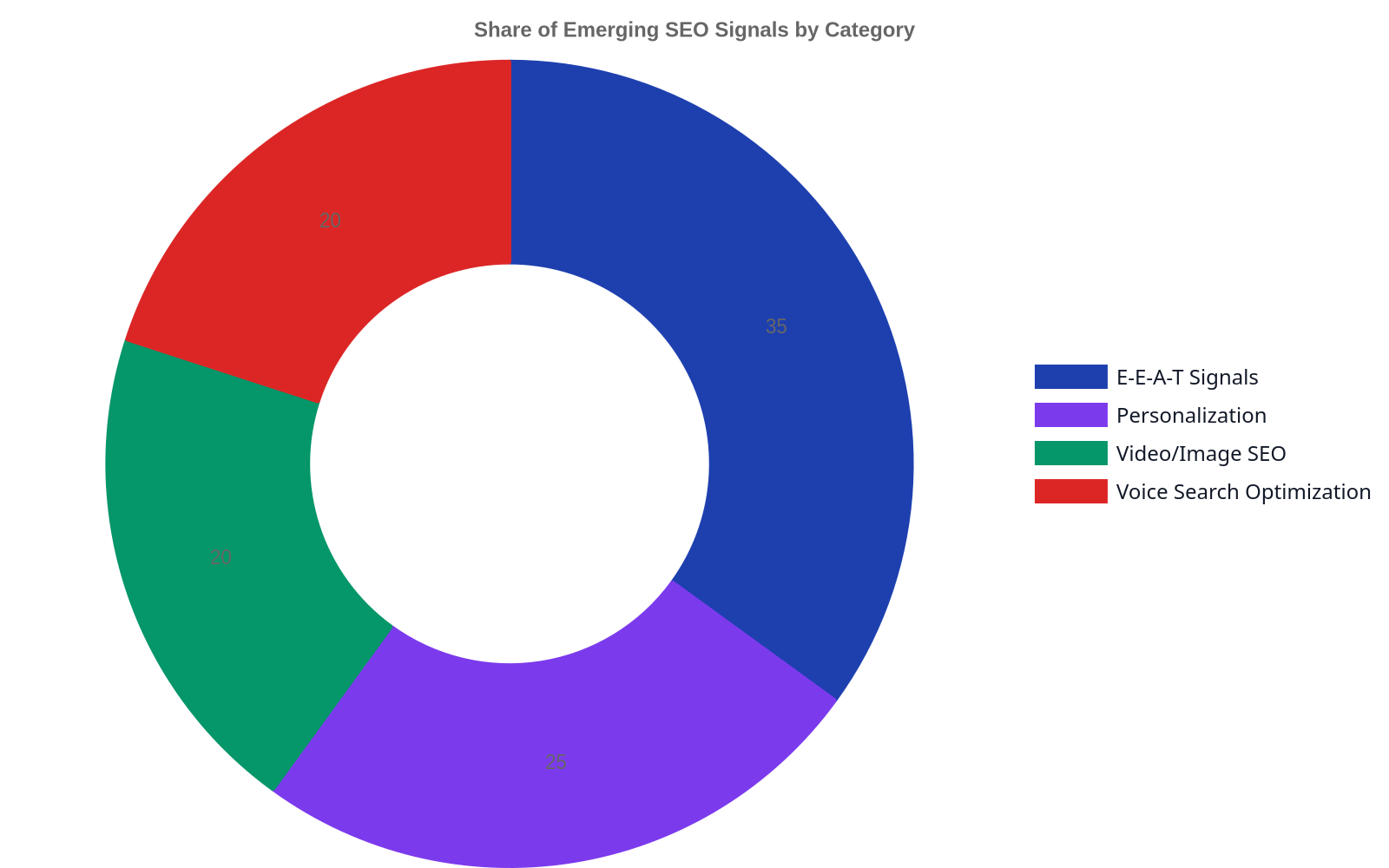
    A doughnut chart showing the distribution of emerging SEO signals: E-E-A-T Signals (35%), Personalization (25%), Video/Image SEO (20%), and Voice Search Optimization (20%).
    Share of Emerging SEO Signals by Category

    Looking ahead, the landscape continues to evolve. Staying competitive means anticipating the next shifts.

    Personalization and Localization

    Search results are already highly personalized based on location, search history, and other user data. This trend will only accelerate. For businesses, this means optimizing for local search (if applicable) through Google Business Profile and creating content that resonates with specific user segments. A generic, one-size-fits-all approach is becoming less effective.

    Voice, Image, and Video Search Optimization

    More users are interacting with search through voice assistants, smart speakers, and visual search tools. Optimizing for voice search often means targeting long-tail, conversational keywords and structuring content for direct answers (think FAQ sections). For image and video, it means going beyond alt tags to include descriptive filenames, structured data, and high-quality media that add value to the page. Some reports suggest that a significant portion of searches are already happening without a screen.

    How to Conduct an E-E-A-T Audit

    To ensure your site meets Google’s quality standards, periodically review your content through the lens of E-E-A-T.

    1. Identify Your YMYL Pages: Pinpoint content dealing with health, finance, safety, or happiness. These pages receive the highest scrutiny.
    2. Assess Author Experience/Expertise: For each page, ask: Is the author named? Is their bio available? Do their credentials or experience justify them writing on this topic? If not, add clear author bios and link to their expert profiles.
    3. Evaluate Authoritativeness: Look for external validation. Are experts in your field citing your work? Do you have testimonials or case studies? Feature these prominently.
    4. Check for Trust Signals: Ensure your site has an “About Us” page, clear contact information, and a privacy policy. For e-commerce, customer service and return policies must be easy to find. All claims, especially medical or financial, should be cited with links to authoritative sources.
    5. Review Content for Value: Does the content offer a unique perspective, data, or experience? Or is it a rehash of the top 10 search results? Update or remove content that doesn’t add distinct value.

    Further reading

    FAQ

    How many ranking factors does Google use in 2026?

    Google uses hundreds of signals, but the concept of “200 ranking factors” is a misleading oversimplification. SEO success comes from focusing on the three main pillars: content quality and E-E-A-T, technical site health and page experience, and off-page authority through backlinks and brand signals.

    Is keyword research still important?

    Yes, but its role has evolved. Modern keyword research is less about finding specific phrases to repeat and more about understanding the topics, questions, and intent of your target audience. It is the strategic foundation for creating content that satisfies users.

    How important are Core Web Vitals for rankings?

    Core Web Vitals are a confirmed, though weighted, part of the Page Experience ranking signal. While excellent content can sometimes overcome a poor technical score, a slow or unstable site creates a poor user experience, which directly hurts your ability to engage and convert visitors. They are a crucial component of technical SEO.

    Can AI-generated content rank on Google?

    Yes, content can rank regardless of how it is produced, as long as it is high-quality, helpful, and satisfies user intent. Google’s policies target low-quality, spammy content, not AI-generated content itself. However, creating content that demonstrates true experience and unique insight—the “E” in E-E-A-T—remains a key differentiator that is difficult to automate.

    Is E-E-A-T a direct ranking factor?

    No, E-E-A-T itself is not a single, direct factor like page speed. It is a framework used by Google’s human quality raters to evaluate content quality. The signals they assess (like author reputation, citations, and site trustworthiness) are then used to train the main ranking algorithms. So while not a direct input, excelling at E-E-A-T is critical for long-term success.

    Mastering SEO in 2026 isn’t about chasing algorithms. It’s about building a genuine authority in your niche and providing real value to users. By focusing on the core pillars of content, technical excellence, and authority, you can build a robust SEO strategy. Automating parts of the content workflow can free up your team to focus on the high-level strategy that truly matters—a core principle behind our work at Rank My Website in automating organic traffic growth for our clients.

  • Ecommerce SEO: Overcoming Internal Chaos and Technical Debt

    Ecommerce SEO: Overcoming Internal Chaos and Technical Debt

    Most ecommerce stores believe their primary SEO battle is against Google’s algorithm. They’re wrong. The real war is waged internally against self-inflicted…

    Understanding Ecommerce SEO Challenges in 2026: A Practitioner’s Guide

    Most ecommerce stores believe their primary SEO battle is against Google’s algorithm. They’re wrong. The real war is waged internally against self-inflicted complexity, unchecked inventory bloat, and technical debt. Understanding ecommerce SEO challenges isn’t about outsmarting a search engine; it’s about imposing order on your own digital chaos. The core challenges are managing immense scale, resolving complex technical issues like faceted navigation, creating unique content for thousands of similar products, and building authority for transactional pages that don’t naturally attract links. Success comes from systematic solutions, not isolated tactics.

    The Sheer Scale of It All: Managing Thousands of Pages

    An ecommerce site isn’t a neat 10-page brochure. It’s a sprawling digital metropolis with thousands, sometimes millions, of pages. A single new product line can add hundreds of URLs overnight. This scale is the root of many SEO problems, from content quality to technical health. Without automation and strict governance, your site can quickly become a wasteland of low-value pages that drain your crawl budget and dilute your authority.

    Taming the Beast: The Problem of Thin and Duplicate Content

    When you have 10,000 SKUs, writing a lovingly crafted, 1,000-word description for each is a pipe dream. The result? Pages with a single image and a 20-word blurb copied from the manufacturer. This is “thin content,” and search engines see it as low-value. Worse is duplicate content, where multiple URLs show the exact same information. This often happens with product variations (size, color) that generate unique URLs without unique content. Google is forced to choose which page to rank, and often it just gives up and ranks none of them highly.

    Crawl Budget Optimization for Massive Inventories

    Search engines don’t have infinite resources. They allocate a “crawl budget” to your site—a rough measure of how many pages they will crawl and how often. On a 50-million-page ecommerce site, this budget is precious. If Googlebot spends its time crawling thousands of pointless filtered URLs, out-of-stock product pages, and internal search results, it may never find your new high-margin product category or your cornerstone blog content. Effective crawl budget management involves strategically using robots.txt, rel="canonical" tags, and noindex directives to guide search engine spiders to your most important pages.

    Automating Metadata at Scale Without Sounding Robotic

    Manually writing title tags and meta descriptions for an entire catalog is impossible. The default solution is to create a template: “[Product Name]

    [Category]

    [Brand Name]”. This is functional but lacks persuasive punch. The real challenge is creating dynamic templates that pull in unique attributes—like model number, key features, or even review scores—to create compelling, unique snippets in search results. A well-automated system can generate a title like “Sony WH-1000XM5 Wireless Headphones – 30-Hour Battery” instead of just “Sony Headphones”. It’s a small detail that has a massive impact on click-through rates.

    Common Technical SEO Challenges for E-commerce

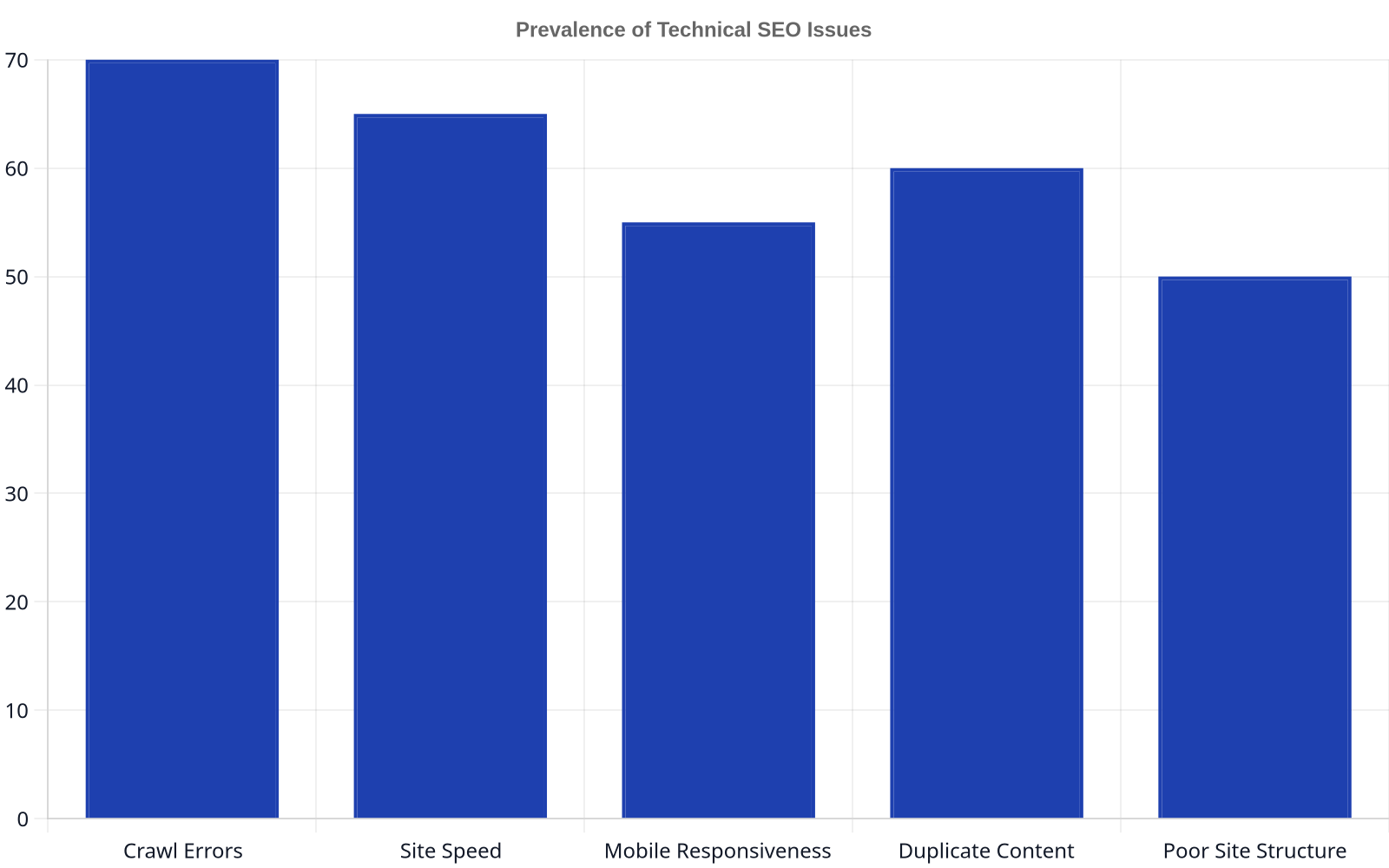
    Bar chart showing the prevalence of technical SEO issues for e-commerce websites, with Crawl Errors at 70%, Site Speed at 65%, Duplicate Content at 60%, Mobile Responsiveness at 55%, and Poor Site Structure at 50%.
    Impact of Technical SEO Issues on E-commerce

    Technical SEO is the foundation upon which all other efforts are built. For ecommerce sites, this foundation is uniquely complex, stressed by layered navigation, high-resolution media, and the constant demand for structured data. Ignore these issues, and even the best content and backlinks will fail to perform.

    Navigating Faceted Navigation and Parameter URLs

    Faceted navigation—the filters for size, color, brand, and price—is fantastic for users but a nightmare for SEO. Every combination can create a new parameter-based URL (e.g., ?color=blue&size=medium), potentially generating millions of low-value, duplicate-content URLs. According to Google Search Central, mastering faceted navigation involves a combination of AJAX, rel="canonical", and careful use of the robots.txt file to prevent crawlers from getting lost. The goal is to allow users to filter freely while ensuring search engines only index the primary, high-value category pages.

    Site Speed and Core Web Vitals for Product Pages

    In ecommerce, speed equals revenue. A site that loads slowly bleeds conversions. According to a 2022 study by Deloitte, even a 0.1-second improvement in site speed can boost conversion rates by 8%. Product pages are often the worst offenders, loaded down with high-resolution images, third-party review scripts, and personalization trackers. Optimizing for Google’s Core Web Vitals—Largest Contentful Paint (LCP), First Input Delay (FID), and Cumulative Layout Shift (CLS)—is non-negotiable. This means compressing images, deferring non-critical JavaScript, and using a Content Delivery Network (CDN).

    Schema Markup for Products, Reviews, and More

    Schema markup is a vocabulary of code you add to your site to help search engines understand your content. For ecommerce, it’s a goldmine. Using Product schema from Schema.org can generate rich snippets in search results, showing price, availability, and review ratings directly on the SERP. This makes your listing stand out and can significantly improve click-through rates. Properly implemented schema for products, reviews, and breadcrumbs provides search engines with explicit, unambiguous information, removing the guesswork and improving your chances of ranking correctly.

    Content and Keyword Strategy Hurdles

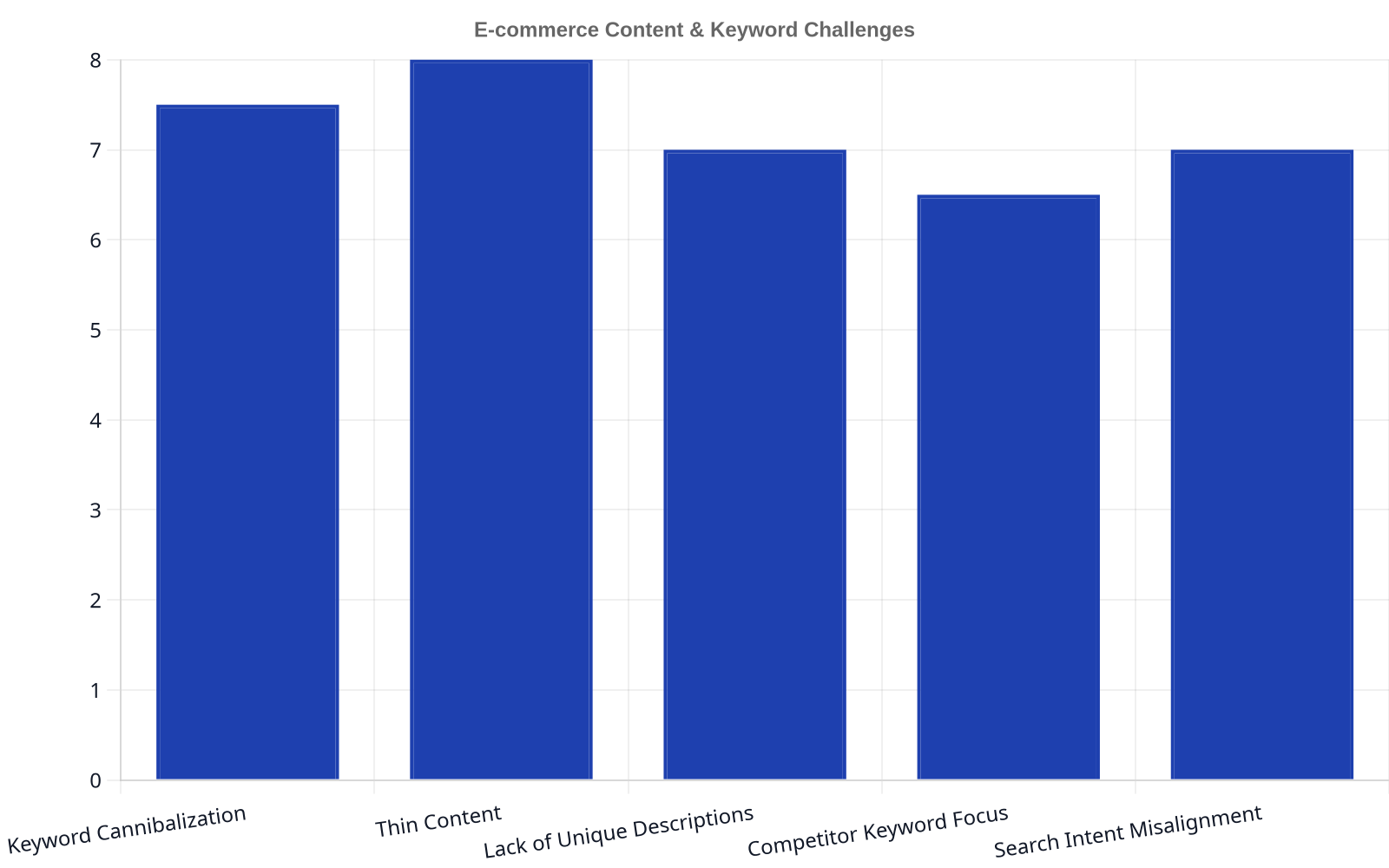
    Bar chart illustrating the impact scores of various e-commerce content and keyword challenges. Thin Content scores 8.0, Keyword Cannibalization scores 7.5, Lack of Unique Descriptions scores 7.0, and Search Intent Misalignment also scores 7.0, while Competitor Keyword Focus scores 6.5.
    E-commerce Content & Keyword Challenges

    Content for ecommerce isn’t just about the blog. It’s about every word on your category and product pages. The primary challenge is creating content that serves both the user’s transactional intent and the search engine’s need for unique, authoritative information. This is where many stores falter, creating a sea of pages that look identical to both bots and humans.

    The biggest mistake in ecommerce content is writing for the product instead of the problem. A customer doesn’t search for “Model X-37b submersible pump.” They search for “how to get water out of my flooded basement.”

    Keyword Cannibalization: When Your Own Pages Compete

    Keyword cannibalization happens when multiple pages on your site target the same or very similar keywords. The result is that you dilute your authority and confuse search engines, which then splits the ranking signals between your competing pages. An ecommerce store might have a category page for “running shoes,” a blog post on “the best running shoes of 2026,” and a specific product page for a top-selling shoe all vying for the same term. A proper keyword research strategy maps specific intents to specific page types, ensuring that long-tail keywords lead to product pages and broad terms lead to category or informational guides.

    The Product Description Conundrum: Unique vs. Manufacturer Copy

    Using the manufacturer’s provided product description is easy. It’s also what every other retailer is doing. This creates a massive duplicate content problem across the web. While rewriting every description is a monumental task, it’s one of the most powerful on-page SEO levers you can pull. Prioritize your top-selling products first. Go beyond specs and talk about benefits, use cases, and what makes the product special. This unique copy is not just for SEO; it helps buyers make a decision, which is the ultimate goal.

    Product Description Approaches: A Comparison

    Approach SEO Impact Implementation Effort Conversion Impact
    Manufacturer Copy Negative (Duplicate Content) Very Low Low
    Slightly Modified Copy Minimal (Still high similarity) Low Low-Medium
    AI-Generated Unique Copy Medium-High (If well-prompted) Medium Medium
    Human-Written Unique Copy Very High (Best for authority) Very High High

    Beyond Products: Creating Content That Builds Authority

    Product pages attract buyers. Informational content attracts links and authority. An ecommerce SEO strategy that ignores top-of-funnel content is incomplete. This means publishing daily articles, guides, tutorials, and comparison pieces that solve your customers’ problems. A store selling high-end cameras should have articles on “understanding exposure triangles” or “best lenses for portrait photography.” This content captures users before they’re ready to buy, builds trust, and, most importantly, provides a valuable asset to attract backlinks—something product pages struggle to do.

    Link Building and Authority Challenges

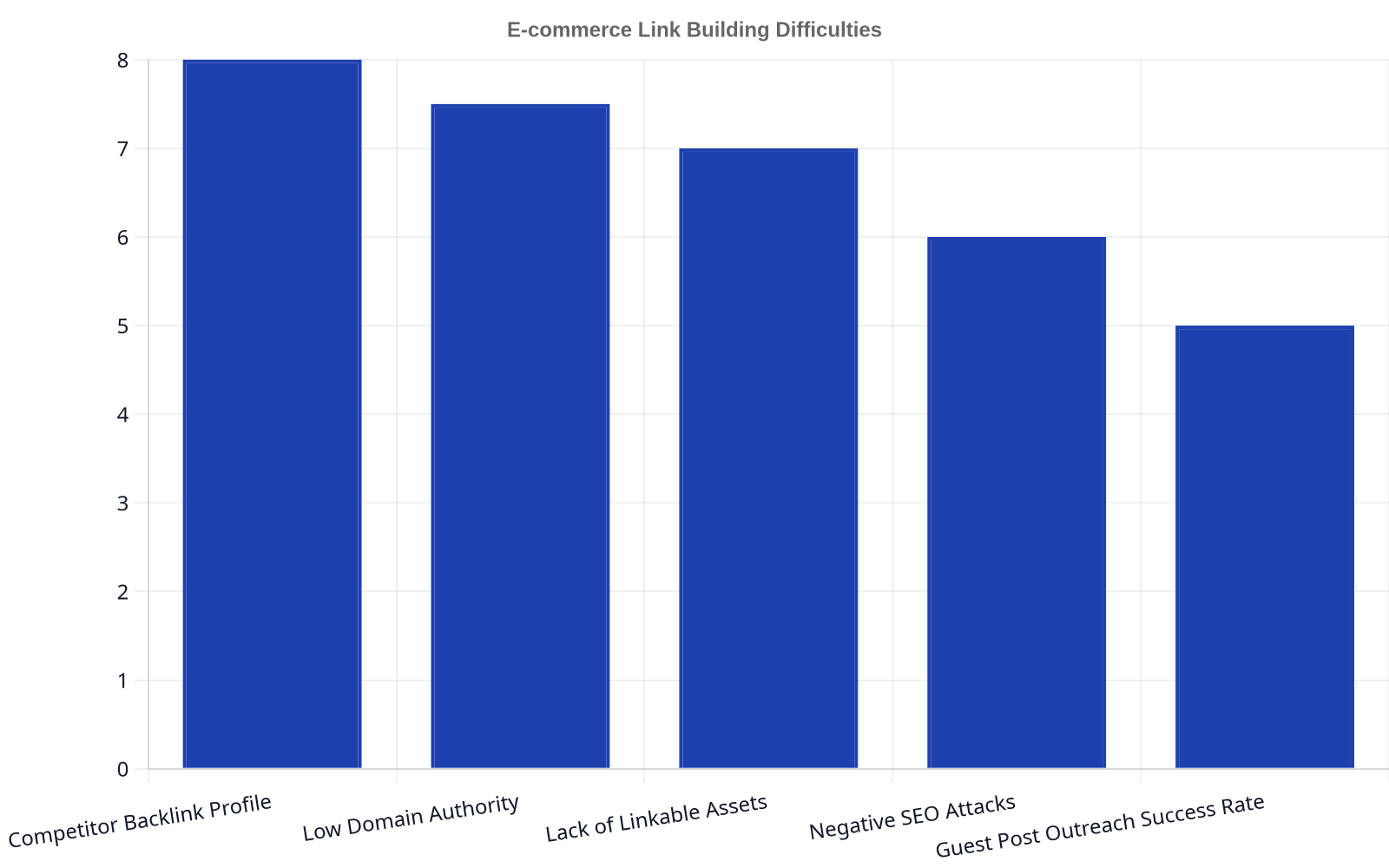
    Bar chart displaying the difficulty levels of e-commerce link building challenges. Competitor Backlink Profile is rated 8.0, Low Domain Authority 7.5, Lack of Linkable Assets 7.0, Negative SEO Attacks 6.0, and Guest Post Outreach Success Rate 5.0.
    Link Building Challenges for E-commerce

    Link building for ecommerce is notoriously difficult. Nobody wants to link to a product page. Why would a blogger or journalist send their audience to a page that exists solely to make a sale? This requires a more creative and strategic approach to building domain authority, which is a critical factor in competitive search rankings.

    In ecommerce, you don’t earn links for the things you sell. You earn them for the expertise you share. Your blog and resource center are your link-building engines, not your product catalog.

    Why Product Pages Don’t Naturally Attract Backlinks

    As a detailed analysis by Ahrefs points out, the transactional nature of product and category pages makes them poor link targets. Authoritative sites link to resources, data, and compelling stories. A product page is none of those things. Expecting your product pages to accumulate a powerful backlink profile on their own is a recipe for failure. Their authority is almost entirely derived from the internal link equity passed to them from other, more link-worthy pages on your own site.

    Securing High-Quality Links in a Transactional World

    If product pages are out, what’s in? The answer is your informational content. This is where your investment in guides, tools, and blog posts pays off. Link-building tactics for ecommerce include:

    1. Creating Definitive Guides: Publish the best, most comprehensive guide on a topic relevant to your products.
    2. Original Research/Data: Survey your customers or analyze your own sales data to create a unique study others will want to cite.
    3. Free Tools: Develop a simple calculator or configurator that helps users solve a problem (e.g., a “how much paint do I need?” calculator for a hardware store).
    4. Digital PR: Create newsworthy campaigns or stories related to your industry that journalists will want to cover.

    These assets are what you promote to build links. The authority they generate is then funneled to your important money pages via your site architecture.

    Leveraging Internal Linking to Distribute PageRank

    Since your product pages won’t earn many external links, internal linking becomes your primary tool for sculpting authority. The powerful link equity generated by your blog posts and guides must be strategically passed to your top category and product pages. This isn’t about just cramming a few links in the footer. It requires a deliberate structure where informational content logically links to relevant subcategories, which in turn link to specific products. This is how you tell Google, “This product page is important, even though it doesn’t have external links.” We’ve seen this exact strategy work for clients like wolverine-llc.com, where building content hubs drove authority to critical industrial product pages.

    The Analytics and Reporting Black Hole

    For an ecommerce business, data is everything. Yet, many struggle with SEO reporting, drowning in a sea of metrics that don’t tie back to the one that matters: revenue. Understanding ecommerce SEO challenges extends to measuring your results accurately.

    Tracking Keyword Rankings Across a Vast Product Catalog

    Tracking your rank for 5-10 primary keywords is easy. Tracking tens of thousands of long-tail product keywords is a data management nightmare. Manual tracking is out of the question. This requires an enterprise-level rank tracking tool that can handle massive keyword lists, segment them by category, and report on changes at a granular level. The goal isn’t to obsess over daily fluctuations but to identify broad trends—is the “men’s boots” category trending up or down? Are we losing visibility for a specific brand?

    Attributing Revenue to Specific SEO Efforts

    This is the holy grail of SEO reporting. Did that new blog post actually lead to sales? Did optimizing the checkout category page increase revenue? Answering these questions requires sophisticated analytics setup. You need to configure ecommerce tracking in Google Analytics 4, set up custom funnels, and use attribution models that look beyond the “last click.” For example, a user might discover your brand through an organic search for a “how-to” guide, leave, and then come back a week later via a branded search to make a purchase. A last-click model would incorrectly give all the credit to the branded search, ignoring the crucial role of your initial SEO-driven content.

    Integrating SEO Data with Other Business Intelligence

    SEO data doesn’t live in a vacuum. It’s most powerful when combined with other business data. For instance, you can overlay your keyword ranking data with your inventory data. Are you ranking #1 for a product that is out of stock? That’s a critical, revenue-losing insight. Are your paid search and organic search teams targeting the same keywords, driving up CPCs and cannibalizing efforts? Integrating SEO metrics into a central business intelligence (BI) dashboard—alongside sales, inventory, and margin data—allows for holistic, strategic decision-making instead of siloed channel optimization.

    FAQ

    What is the biggest SEO challenge for a new ecommerce store?

    For a new store, the biggest challenge is a lack of authority. Without an established backlink profile or brand recognition, it’s incredibly difficult to rank for competitive commercial keywords. The initial focus should be on creating exceptional, problem-solving content to start building topical relevance and attracting those first crucial links, while also ensuring all technical SEO basics are flawless from day one.

    How can I fix duplicate content on my product pages?

    Start by conducting a crawl of your site to identify duplicate and thin content pages. For product variants (size, color) that create unique URLs, use a canonical tag pointing back to the main product page. For manufacturer descriptions, prioritize rewriting the copy for your top 20% best-selling products first. For faceted navigation, use your robots.txt file to block crawlers from most parameter-based URLs and use canonicals to consolidate signals.

    Is it better to have more products or better-optimized product pages?

    A smaller number of well-optimized, unique, and compelling product pages will almost always outperform a massive catalog of thin, duplicate-content pages. Quality trumps quantity. A large, un-optimized catalog can hurt your site’s overall SEO health by draining crawl budget and creating a poor user experience. Focus on optimizing what you have before aggressively expanding your SKU count.

    Why is my ecommerce site so slow?

    Ecommerce sites are often slow due to un-optimized, high-resolution images, which are the most common culprits. Other factors include an abundance of third-party scripts (for analytics, reviews, chat), inefficient code (JavaScript, CSS), and a slow hosting server. Use Google PageSpeed Insights to diagnose specific issues. Image compression, using a CDN, and deferring non-essential scripts are typically the most effective fixes.

    How much should I budget for ecommerce SEO?

    This varies wildly based on your industry competitiveness, the size of your catalog, and your goals. A small niche store might see results with a few thousand dollars a month, while a large retailer in a competitive space could spend tens or even hundreds of thousands. Instead of a dollar figure, think in terms of resources needed to address the core challenges: technical audits, content creation for both products and blogs, and link-building outreach. You can find more details in our guide to ecommerce seo pricing guide.

    Addressing the unique and complex SEO challenges of an ecommerce business requires a systematic, technically-sound, and automated approach. From managing a sprawling catalog to creating content that earns authority, the solution lies in building a scalable process rather than chasing algorithms. If you’re ready to stop fighting fires and start building a self-sustaining engine for organic growth, see how Rank My Website can help you automate your way to the top of the SERPs.

  • Automating Organic Traffic: Building a Self-Sustaining System

    Automating Organic Traffic: Building a Self-Sustaining System

    Most people think of SEO as a series of manual tasks: find a keyword, write an article, build a link, repeat. This is a factory worker’s mindset in an age of…

    Master Your Market: Real Strategies for Organic Traffic Growth Automation in 2026

    Most people think of SEO as a series of manual tasks: find a keyword, write an article, build a link, repeat. This is a factory worker’s mindset in an age of robotics. True growth doesn’t come from working harder at the assembly line; it comes from designing a better factory. Effective strategies for organic traffic growth automation don’t just replace manual tasks with software; they build a scalable, self-sustaining system. This approach involves integrating AI-driven keyword analysis, programmatic content creation, and automated technical monitoring to create a compounding growth flywheel. It shifts the focus from winning single keywords to dominating entire topic categories with minimal ongoing human intervention, turning SEO from a service you pay for into an asset you own.

    Organic search remains the single largest driver of website traffic for most businesses, with a BrightEdge study finding it accounts for 53.3% of all traffic. Yet, most companies still treat it as a line item for their marketing agency instead of the powerful, automated engine it can be. The goal is to build a machine that works for you, not a list of chores you have to do.

    Key Pillars of Organic Traffic Automation

    Automating organic growth isn’t about a single magic tool. It’s a systematic approach built on several interconnected pillars. When these components work in concert, they create a formidable presence that human-powered efforts can’t match in scale or speed. Each pillar addresses a core dependency for search engine ranking, but uses automation to execute at a level that builds momentum.

    Automated Keyword and Topic Clustering

    Modern SEO has moved beyond targeting individual keywords. Success now lies in establishing topical authority—proving to search engines that you are an expert on a whole subject area. Automation is key here. Instead of a person spending days in a spreadsheet, AI-powered tools can analyze thousands of long-tail keywords, search queries, and competitor rankings in minutes. They then group these into logical “topic clusters.” This allows for a content strategy that covers an entire topic comprehensively, building the topical authority Google rewards. This is a foundational step, moving from guessing what to write about to a data-driven content map.

    AI-Driven Content Generation and Optimization

    Once you have your topic clusters, the bottleneck becomes content creation. AI has fundamentally broken this constraint. Advanced platforms can now generate high-quality, SEO-optimized drafts from a keyword or content brief. This isn’t about creating spam. It’s about using AI to handle the heavy lifting of research and first-drafting, freeing up human experts to refine, add unique insights, and ensure brand voice. This means moving from sporadic blog posts to a consistent cadence, sometimes publishing multiple targeted, daily articles to capture emerging trends and fully build out topic clusters identified in the research phase.

    Programmatic SEO for Scalable Page Creation

    Programmatic SEO (pSEO) is a powerful strategy for businesses that have structured data, like e-commerce sites, directories, or marketplaces. It involves using templates to automatically generate hundreds or even thousands of unique pages from a database. Think of how Zillow creates a page for every home address or Zapier creates a landing page for every possible software integration. Executed correctly, pSEO can capture an immense volume of long-tail search traffic. This is automation at scale, turning a single template into countless entry points for organic traffic.

    Automated Technical SEO Monitoring

    Your content can be perfect, but if Google can’t crawl your site efficiently, you’re invisible. Technical SEO involves optimizing site speed, mobile-friendliness, crawlability, and security. Manually auditing for issues like broken links, slow pages, or improper redirects is tedious and inefficient. Automation tools constantly monitor your site’s health, alerting you to critical issues in real-time. This proactive approach prevents technical problems from damaging your rankings and ensures that your content investments are always built on a solid foundation.

    The SEO Flywheel: How to Build a Self-Sustaining Traffic Machine

    Traditional SEO often feels like pushing a boulder uphill. You stop pushing, and the boulder rolls back. An automated approach creates a flywheel. Each action adds momentum, making the next rotation easier and faster. High-quality content attracts backlinks naturally. More backlinks increase your domain authority. Higher authority helps more content rank faster. It’s a virtuous, compounding cycle.

    This shift in thinking is critical. Instead of asking, “How much traffic did this one article bring?” we ask, “How did this article add energy to our overall growth engine?” We saw this firsthand with clients like Wolverine Assemblies, where automating content around their specialized capabilities captured highly specific, high-intent traffic that manual efforts would have missed, simultaneously boosting the authority of their entire domain.

    The Organic Growth Flywheel: A Self-Sustaining System

    Visualizing the flywheel as a system clarifies the process. It is not a set of disconnected tactics but a closed-loop machine where the output of one stage becomes the input for the next. This system is designed to acquire, engage, and convert traffic with increasing efficiency over time. It’s about creating an asset that appreciates, rather than a service that just gets performed.

    A website built with an automation flywheel isn’t a collection of pages; it’s a living library that actively learns what an audience wants and systematically creates the most comprehensive resource for it.

    For this system to function, every part must be integrated. The keyword data must feed the content engine. The content must be structured with perfect on-page SEO. The site itself must be technically flawless. And just as importantly, a system that automatically builds a dense web of internal linking between related pages is critical for signaling topical authority to search engines. This is how you move from individual wins to market-wide dominance. a cohesive content strategy can become a huge driver of business growth.

    Implementing Automated Content Generation Workflows

    An automated content workflow turns a strategic plan into a stream of published, optimized content. This isn’t a black box; it’s a defined, repeatable process that ensures quality and scale. While specific tools vary, the core stages of a mature workflow are consistent.

    1. Foundational Keyword Research & Clustering: The process starts by defining a topic. An automation platform ingests this seed topic and generates a comprehensive map of related keywords, user questions, and competitor content. These are then grouped into logical clusters, which become the basis for a series of articles.
    2. AI-Powered Content Brief Generation: For each article in a cluster, the system generates a detailed content brief. This brief acts as instructions for the AI writer. It typically includes the primary and secondary keywords, target word count, competitor articles to analyze, and a proposed outline with H2s and H3s.
    3. Supervised AI Drafting: The AI uses the brief to generate a full article draft. The key here is “supervised.” The initial output is a high-quality starting point, not a finished product. It handles the 80% of research and structuring, allowing a human editor to focus on the final 20%—adding unique insights, case studies, brand voice, and fact-checking.
    4. Automated On-Page Optimization: As the content is finalized, the platform automatically checks it against on-page SEO best practices. This includes optimizing title tags, meta descriptions, image alt text, and the internal link structure. Some systems can even auto-generate Schema Markup, like FAQPage schema, directly from the content to help you win rich snippets in search results.
    5. Direct Publishing and Monitoring: The final, optimized article is published directly to the CMS (like WordPress or Shopify). The system then begins tracking its performance, monitoring keyword rankings, and identifying opportunities for future updates. This closes the loop, feeding performance data back into the start of the flywheel.

    Beyond Content: Automating Off-Page Signals and UX

    While content is the engine of organic growth, automation can also streamline the other signals that search engines use to rank pages. Off-page authority and on-page user experience are critical components of a holistic automation strategy.

    Building Backlinks Systematically

    Automation can’t force a high-authority site to link to you. However, it can make the process of identifying and pursuing backlink opportunities far more efficient. Tools can monitor brand mentions across the web that don’t include a link and flag them for outreach. Others can analyze competitor backlink profiles to find high-value domains you should be targeting. By automating the prospecting and monitoring, you can focus your human efforts on the high-touch work of building relationships.

    Leveraging User-Generated Content (UGC)

    User-generated content, such as reviews and Q&A sections, is a powerful form of automated content creation. It provides fresh, relevant text that search engines love, and it directly answers user questions. Automating the process of soliciting, moderating, and publishing reviews not only builds social proof but also creates a steady stream of keyword-rich content. This is particularly effective for e-commerce, where product reviews can help individual pages rank for thousands of long-tail variations.

    Optimizing for User Experience (UX) and Voice Search

    Great content on a slow, clunky website will not rank well. Google’s emphasis on user experience signals means site speed, mobile usability, and intuitive navigation are direct ranking factors. Automated UX monitoring tools can simulate user journeys, identify performance bottlenecks, and flag elements that cause frustration. This data, often overlooked in manual SEO audits, is critical for sustained growth. Similarly, as voice search grows, structuring your content with clear, question-and-answer formats—often aided by schema—can be automated to capture these queries.

    Choosing Your Tech Stack for Automation: Tools and Integrations

    Category Key Tools Primary Function Integration Potential
    Keyword Research Semrush, Ahrefs, Google Keyword Planner Identifying high-potential keywords High (CRM, Content Planners)
    Content Creation & AI Writing Surfer SEO, Jasper, Writer Generating SEO-optimized content drafts High (CMS, SEO tools)
    Technical SEO & Auditing Screaming Frog, Sitebulb, Google Search Console Identifying and fixing technical issues Medium (Dev tools, Project Mgmt)
    Backlink Monitoring & Outreach Ahrefs, Moz, Hunter.io Tracking backlinks and finding outreach opportunities Medium (CRM, Email Marketing)
    Rank Tracking & Analytics Semrush, AccuRanker, Google Analytics/Search Console Monitoring keyword performance and traffic High (Data visualization, Reporting)
    SEO Automation Tech Stack Comparison

    The market for SEO tools is vast, but they generally fall into two categories: integrated platforms or a collection of point solutions. The right choice depends on your team’s size, expertise, and goals. The “AI in Marketing” market itself is projected to soar, with one MarketsandMarkets report estimating growth to over $53 billion by 2028, underscoring the massive investment in this space.

    All-in-One Platforms vs. Point Solutions

    An all-in-one platform, like Rank My Website, aims to handle the entire automation workflow within a single, integrated system—from keyword research to content generation and publishing. This simplifies the tech stack and ensures data flows smoothly between stages. A point solution approach involves piecing together different specialized tools: one for keywords, another for content AI, a third for technical audits, and so on. This offers more customization but can lead to integration challenges and data silos.

    Feature All-in-One Platforms Point Solutions n
    Workflow Integrated from keyword to publish Disconnected; requires manual handoffs
    Data Centralized data and analytics Siloed data in separate tools
    Learning Curve Simpler; one interface to learn Complex; multiple tools and UIs
    Customization Less flexible; confined to platform features Highly flexible; mix and match best-in-class tools
    Cost Often a single subscription fee Can be more expensive with multiple subscriptions

    Integrating Tools for a Seamless Workflow

    If you choose a stack of point solutions, integration is paramount. This often requires using tools like Zapier or custom APIs to connect your keyword tool to your project management system, and your content AI to your CMS. For instance, you could set up a workflow where a new, high-opportunity keyword identified in Ahrefs automatically creates a content brief in SurferSEO, which then gets assigned to a writer in Asana. While powerful, this requires significant setup and maintenance compared to a unified platform where these integrations are native. For a small business, the overhead of managing a disparate stack can outweigh the benefits, making an integrated platform a more efficient choice.

    Don’t just automate tasks, automate strategy. Your tools should not just do things faster; they should enable a system of growth that compounds over time.

    Measuring Success and Avoiding the Pitfalls

    Automating your organic traffic growth requires a shift in how you measure success. It also introduces new considerations around content quality and ethics. A successful strategy is not only effective but also sustainable and compliant with search engine guidelines.

    Key Metrics Beyond Raw Traffic

    Vanity metrics like total organic traffic can be misleading. A successful automation strategy focuses on business outcomes. Key metrics to track include:

    • Non-Branded Organic Traffic: Growth in traffic from keywords that don’t include your company name shows you’re capturing new audiences.
    • Keyword Rankings for Clusters: Are you ranking for a whole group of related terms, not just one head term? This indicates topical authority.
    • Traffic Value: What would you have to pay in Google Ads to get the same traffic? This metric, found in tools like Ahrefs, assigns a real dollar value to your organic presence.
    • Conversions from Organic Traffic: Are visitors signing up, making purchases, or filling out forms? This is the ultimate measure of success.

    The Ethical Line: Over-Automation and Google’s Stance

    There is a fine line between automation and spam. Google’s official guidance on AI-generated content is clear: their focus is on the quality of the content, not how it was produced. Content created at scale with the primary purpose of manipulating search rankings, with no regard for user experience, is considered spam. However, using AI and automation to produce high-quality, helpful, and original content is perfectly acceptable. The ethical pitfall is relying on AI to do 100% of the work, resulting in generic, soulless content that doesn’t provide real value. The best strategies use automation for the 80% and human expertise for the critical 20% of refinement and insight.

    The Future of Organic Automation Post-2026

    Looking ahead, the integration of automation and SEO will only deepen. We can expect AI to become even more sophisticated in understanding search intent and generating multi-format content like video and audio. Hyper-personalization will become more feasible, with systems potentially tailoring content on the fly based on user data. The key for businesses will be to remain agile and adopt platforms that are continuously innovating. The future of organic growth won’t just be about having a website; it’s about having an intelligent, automated system that anticipates and meets user needs at scale. Exploring topics like ai’s seo future is crucial for staying ahead.

    Further reading

    Frequently Asked Questions

    What is the main benefit of organic traffic growth automation?

    The primary benefit is scalability. Automation allows you to execute a sophisticated, large-scale SEO strategy consistently without a linear increase in human resources. This leads to compounding growth in traffic and authority that is difficult to achieve with manual efforts alone.

    Can AI-generated content really rank on Google?

    Yes, absolutely. Google has confirmed that its ranking systems reward high-quality content, regardless of how it is produced. The key is to use AI as a tool to create helpful, reliable, people-first content, not to generate low-quality content for the sole purpose of manipulating search rankings.

    Is programmatic SEO considered spam?

    No, not when done correctly. Programmatic SEO is a legitimate strategy when it uses structured data to create unique and valuable pages for users, such as product pages, location finders, or integration listings. It becomes spammy if it’s used to generate thousands of low-value, duplicate pages with no real purpose.

    How much does it cost to automate SEO?

    The cost varies dramatically. An all-in-one platform like Rank My Website may have a monthly subscription fee that covers most functions. Alternatively, building a custom stack of point solutions could involve multiple subscriptions totaling hundreds or thousands of dollars per month. The cost should be weighed against the value of the organic traffic and conversions it generates.

    How long does it take to see results from SEO automation?

    While automation speeds up execution, SEO is still a long-term strategy. You can typically expect to see initial positive signals, like ranking improvements for long-tail keywords, within 3 to 6 months. Significant, authority-building results that drive major traffic often take 6 to 12 months as the flywheel effect begins to compound.

    Building a true organic growth machine takes more than just tools; it requires a strategic shift from manual tasks to automated systems. By focusing on a flywheel approach, integrating key pillars of automation, and choosing the right tech stack, you can create a sustainable, scalable asset that drives business growth for years to come. Platforms like Rank My Website are designed to be that end-to-end engine, handling everything from keyword research and daily content creation to publishing and performance tracking on autopilot.

  • Content Workflow Automation: Real Benefits Beyond Just Speed

    Content Workflow Automation: Real Benefits Beyond Just Speed

    Most content teams are stuck in a hamster wheel, measuring success by the number of articles published, not the business results generated. The relentless…

    Most content teams are stuck in a hamster wheel, measuring success by the number of articles published, not the business results generated. The relentless pressure to “feed the beast” leads to burnout, inconsistent quality, and a portfolio of assets that nobody reads. The problem isn’t a lack of effort; it’s a broken, manual system. Content workflow automation benefits extend beyond speed, primarily reducing human error by over 90% in repetitive tasks, improving content consistency, and shortening the feedback-to-publish cycle from weeks to days. It provides a scalable framework for content operations, allowing teams to focus on high-value strategic tasks like keyword research and analysis rather than manual project management, which frees up an estimated 10-15 hours per week per content team member.

    This isn’t about replacing writers with robots. It’s about building a machine for consistency, quality, and performance measurement. By systematizing the mundane—brief creation, handoffs, on-page SEO checks, publishing—you liberate your most valuable resource: the creative and strategic brainpower of your team. This is how you transition from a content production line to an engine for organic growth. For clients like Wolverine Assemblies, consistent, high-quality content is what allows them to own their manufacturing niche online. The goal is to move from chasing deadlines to architecting business outcomes.

    What is a Content Workflow?

    So, what exactly is a content workflow?

    A content workflow is the structured, repeatable process your organization uses to move content from an initial idea to a published and promoted asset. Think of it as an assembly line for your articles, videos, or podcasts. It defines each specific stage (e.g., ideation, keyword research, outlining, drafting, review, design, approval, publishing, and promotion), who is responsible for each stage, what the deliverables are, and how handoffs occur. A well-documented workflow prevents tasks from falling through the cracks and clarifies expectations for everyone on the team.

    Why does a manual workflow break down?

    Manual workflows, often managed through spreadsheets and email chains, collapse under pressure. As content production scales, the administrative overhead explodes. According to a 2023 report from Zapier, workers estimate they could save 15 hours a week with automation. In content, this time is lost to chasing approvals, version control nightmares (e.g., finalv2final_final.docx), inconsistent formatting, and manually reminding contributors about deadlines. This administrative drag directly cannibalizes the time available for a strategy that actually moves the needle.

    What are the core stages of a content workflow?

    While specifics vary, most content workflows include these eight core stages: 1) Planning & Ideation: Determining topics and strategy. 2) Creation: Writing, designing, or recording the content. 3) Optimization: Applying SEO best practices and brand voice. 4) Review & Approval: Internal stakeholders check for accuracy and quality. 5) Versioning & Storage: Managing drafts and final assets in a central repository. 6) Publishing: Pushing the content live on a CMS. 7) Distribution & Promotion: Sharing on social media, email, etc. 8) Analysis & Reporting: Tracking performance metrics to inform future strategy.

    What are the Tangible Benefits of Content Workflow Automation?

    Automating the content process translates directly to measurable business improvements by imposing system-level consistency and eliminating manual friction. The primary benefits cluster around quality control, error reduction, and brand integrity.

    How does automation reduce content errors?

    Automation drastically cuts down on unforced errors by systematizing repetitive checks. Instead of relying on a human to remember every step in a pre-publish checklist, an automated workflow can enforce it. This includes tasks like checking for a meta description, ensuring alt text is present on images, and verifying that internal links are correctly formatted. This is particularly crucial for on-page SEO, where missing a single element can impact discoverability. Platforms like Rank My Website build these checks directly into the publishing process.

    Can automation actually improve content quality?

    Yes, by redirecting human effort. When writers and editors aren’t bogged down by administrative tasks, they can dedicate more time to what they do best: creating insightful, well-researched content. Instead of spending hours formatting a post in a clunky CMS, a writer can spend that time conducting one more interview or finding a more compelling data point. Automation handles the ‘what’, so your team can focus on the ‘why’ and ‘how’ that create real value for the reader.

    A content workflow isn’t a restriction on creativity. It’s the dependable structure that gives creativity the freedom to be effective.

    Does automation help with brand consistency?

    Inconsistency kills brand trust. Automation is a powerful tool for maintaining a consistent brand voice and style across a high volume of content. Automated briefs can be pre-populated with brand guidelines, key messaging, and target personas, ensuring every writer starts from the same page. A report on brand consistency from Marq found that consistent presentation of a brand has been seen to increase revenue by up to 33%. By creating guardrails within the workflow, you ensure that every published piece, regardless of who wrote it, feels like it came from your brand.

    How Does Automation Reduce Content Production Time?

    The most immediate and visible impact of content workflow automation is a dramatic reduction in the time it takes to get from idea to published article. This is achieved by targeting and eliminating the bottlenecks inherent in manual processes.

    Where do most content bottlenecks occur?

    Most delays in content production happen during handoffs and reviews. A draft sits in an inbox waiting for approval. An editor sends feedback, but the writer doesn’t see it for two days. The legal team needs to review a claim, but nobody tagged them in the right document. An automated workflow uses a central platform to manage these handoffs, automatically notifying the next person in the chain when a task is ready for them, creating an auditable trail and eliminating the “who has the ball?” problem.

    Can automation shorten review and approval cycles?

    Absolutely. An automated system provides a single source of truth for feedback. Instead of conflicting suggestions in a long email thread, all comments, edits, and approvals happen in one place. You can set automated reminders for stakeholders who are late with their review and even establish rules to automatically approve content if feedback isn’t received within a certain timeframe. This simple change can cut the review cycle from weeks to days.

    How much time can you actually save with automation?

    Teams that implement content workflow automation frequently report time savings of 30-50% in their overall content production lifecycle. Marketing automation tools, which share many principles with content workflow systems, have been shown to increase marketing team productivity by 20%. For a content team, this translates to faster turnarounds, higher output capacity, and the ability to be more responsive to market trends.

    What is the ROI of Content Workflow Automation?

    Calculating the return on investment for content workflow automation requires looking beyond simple cost savings. It’s about assessing the value of increased output, improved quality, and the strategic reallocation of your team’s time.

    How do you calculate the ROI of content automation?

    Start by quantifying the time saved. Calculate the hourly rate of your content team members and multiply it by the 10-15 hours saved per week. Then, factor in the value of increased content velocity. If you can double your output of quality content, what is the projected impact on organic traffic and lead generation over 12 months? Finally, consider risk reduction. What is the cost of a major content error or a brand-inconsistent campaign? A solid workflow mitigates these risks, providing a form of insurance.

    What are the hidden costs of not automating?

    Manual workflows have significant opportunity costs. The biggest cost is the strategic work that doesn’t get done because your team is bogged down in administration. Every hour spent manually tracking down a draft is an hour not spent analyzing competitor content, identifying keyword gaps, or building a backlink strategy. These are the high-leverage activities that drive long-term growth, and their absence is a massive, albeit hidden, cost.

    Automation doesn’t devalue your writers and strategists—it’s the only way to fully value their time by protecting it from low-impact, repetitive tasks.

    Does content automation lower content creation costs?

    Yes, but not necessarily in the way people think. It’s less about paying less per article and more about getting a higher ROI from your total content budget. By making your process more efficient, you can produce more high-performing content for the same investment. Understanding the components of your SEO spend is crucial; you can learn more about seo service pricing insights to see how content fits into the broader picture. Automation ensures that more of your budget is spent on creating value, not managing chaos.

    How Does Content Automation Impact SEO?

    Content workflow automation has a direct and profound impact on search engine optimization by enabling the consistent execution of on-page and off-page best practices at scale.

    Can automation help with on-page SEO?

    This is one of automation’s biggest strengths. An automated workflow can ensure that every single article is published with all necessary on-page SEO elements in place. It can programmatically check for an H1 tag, meta title, meta description, optimized image file names and alt text, and proper heading structure. This transforms SEO from a hopeful afterthought into a baked-in, quality-assured step in the process, which is foundational for services that promise results like the delivery of daily articles.

    Does automation improve content freshness for rankings?

    Yes. Search engines like Google use content freshness as a ranking signal, especially for topics that require up-to-date information. An efficient, automated workflow allows you to update existing content far more quickly. Instead of a multi-week process to add a new section to an old blog post, an optimized workflow might get it done in a day or two. This ability to systematically refresh and republish content keeps your entire library working harder for you.

    How does automation support topic clustering?

    Topic clusters—a central “pillar” page linked to multiple “cluster” pages—are critical for establishing topical authority. This strategy depends heavily on a well-executed internal linking structure. Automation can help manage this at scale. A workflow can include a mandatory step for the writer or strategist to identify and insert appropriate internal links from a master list, ensuring that every new piece of content strengthens your existing topical clusters rather than being published as a standalone orphan.

    FAQ

    Is content workflow automation just about using AI writers?

    No. This is a common misconception. While AI writing tools can be one component of an automated workflow (for example, to generate initial drafts or outlines), the workflow itself is the structure that manages the entire process. It’s about automating the handoffs, approvals, and checklists. The actual creation can still be 100% human, 100% AI, or a hybrid; the workflow is agnostic.

    Can small teams benefit from content automation?

    Absolutely. In fact, small teams may see the biggest relative benefit. For a solo entrepreneur or a two-person marketing team, the time savings from automation aren’t just a nice-to-have; they can be the difference between hitting and missing targets. A good workflow allows a small team to punch far above its weight, producing the volume and quality of content typically associated with a much larger organization. A study from the Content Marketing Institute highlights how process optimization is key for teams of all sizes.

    Will automation replace content strategists?

    No, it elevates them. Automation replaces the tedious, low-value project management tasks that strategists are often forced to handle. This frees them up to focus on genuine strategy: analyzing performance data, researching new content angles, understanding audience intent, and planning long-term editorial calendars. Automation makes a strategist more strategic.

    How long does it take to implement a new workflow?

    Implementation can be done in stages. A basic workflow automating a few key handoffs can be set up in a single week using modern tools. A full-scale, end-to-end integration across multiple departments may take a month or two. The best approach is to start by mapping your current process, identifying the single biggest bottleneck, and automating a solution for that first. Get a quick win and build from there.

    What metrics should I track to measure success?

    To measure the success of your content workflow automation, track metrics like: 1) Average Content Velocity (time from ideation to publish). 2) Throughput (number of content pieces published per month). 3) Administrative Time (hours spent on project management vs. creation). 4) Error Rate (number of post-publish corrections required). 5) Content ROI (traffic, leads, or conversions generated per piece).

    Ready to build your content engine?

    Stop letting manual processes dictate your content’s potential. By implementing a clear, automated workflow, you can move from a reactive content team to a proactive growth engine. You can focus your resources on strategy, improve quality, and publish with a consistency that search engines and your audience will reward.

    If you want to see how automation can transform your entire SEO and content strategy—from keyword research to publishing—explore what Rank My Website can do for you. Grow your organic traffic on autopilot and get back to working on your business, not just in it.

  • Ecommerce SEO Services: What You Will Actually Pay

    Ecommerce SEO Services: What You Will Actually Pay

    Stop asking what eCommerce SEO costs. Start asking what it’s worth. Asking for a price list is like asking for the price of “a building” without specifying if…

    Stop asking what eCommerce SEO costs. Start asking what it’s worth. Asking for a price list is like asking for the price of “a building” without specifying if you need a garden shed or a skyscraper. You’ll get a number, but it will be meaningless. The real question is about the value created, not the line item on an invoice. An effective SEO strategy isn’t a cost center; it’s an engine for compounding, owned-media growth that you don’t have to pay for again every month like a PPC ad, and you can even find affordable seo tools to get started.

    For an eCommerce business in 2026, SEO services pricing typically ranges from $3,000 to $7,500 per month on a retainer. Hourly rates average $100–$250, while project-based work for specific goals like a site migration can cost $5,000 to $30,000+. The final price depends on your store’s size, competition, and the scope of work, including technical SEO, content production, and link building. Smaller stores might find packages starting around $1,500/month, while enterprise brands can expect costs exceeding $15,000 monthly.

    The Core eCommerce SEO Pricing Models

    There is no single, universally agreed-upon pricing structure for eCommerce SEO. Most agencies and consultants use one of four primary models, each with its own benefits and drawbacks. Understanding these is the first step to evaluating any proposal you receive, especially when considering the challenges of ecommerce seo.

    Monthly Retainers: The Industry Standard

    The most common model is the monthly retainer. You pay a fixed fee each month for an agreed-upon scope of ongoing services. This is the preferred model for serious SEO campaigns because results are not achieved overnight. They require sustained effort in technical optimization, content creation, and authority building.

    A typical retainer budget for a mid-sized eCommerce store often falls between $3,000–$7,500 a month, a figure echoed by multiple industry reports. This structure allows the SEO provider to function as an extension of your team, continually analyzing performance, identifying opportunities, and executing optimizations.

    Hourly Consulting: For Specialized Tasks

    Paying by the hour is less common for comprehensive SEO campaigns but is ideal for specific, well-defined tasks. Examples include a one-time technical SEO audit, a penalty recovery consultation, or training your in-house team on a particular aspect of SEO. Hourly rates vary widely based on the consultant’s experience, with many top-tier experts charging $100–$250 per hour or more. According to a recent Upwork report, the average freelance SEO specialist in the US charges around $71.59/hour, but for specialized eCommerce expertise, expect to pay a premium.

    Project-Based Pricing: For Defined Outcomes

    Project-based pricing involves a fixed cost for a specific, one-time project with clear deliverables and a defined timeline. This is a great model for initiatives like:

    • A complete website migration to a new platform (e.g., Magento to Shopify Plus).
    • An initial keyword research and content strategy build-out.
    • A comprehensive backlink audit and disavow file submission.

    Pricing is based on the estimated hours and resources required to complete the project. A small project might be a few thousand dollars, while a large-scale international site migration could easily run into the tens of thousands.

    Performance-Based SEO: The High-Risk, High-Reward Outlier

    This model is rare and often comes with significant red flags. In a performance-based agreement, the provider is paid based on achieving specific results, such as a percentage of increased revenue or a bonus for ranking #1 for certain keywords. While it sounds attractive, it can incentivize risky, short-term tactics (black-hat SEO) that can get your site penalized. Reputable agencies avoid this model because so many ranking factors are outside their direct control, such as Google algorithm updates, competitor actions, and your own site’s technical stability.

    How Much Do Ecommerce SEO Services Cost?

    While models provide the “how,” the actual dollar amount is what most founders want to know. The investment required correlates directly with the size of your business and the aggressiveness of your growth goals. SEO is not a one-size-fits-all service.

    Small Store & Startup Budgets

    For a new eCommerce store or one with a small product catalog (under 100 SKUs) in a low-to-medium competition niche, comprehensive SEO services can be found starting in the $2,500 to $8,000 per month range, as noted by some agency pricing guides. Services at this level typically focus on foundational elements: a technical audit and cleanup, on-page optimization for core pages, local SEO (if applicable), and a modest amount of content creation and link building, including specific strategies to optimize product pages.

    Growth-Stage Business Investments

    An established business with hundreds of products, a national footprint, and moderate competition should expect to invest more. This is where the $3,000–$7,500 a month retainer becomes very common. At this tier, you’re paying for a more proactive and data-driven strategy. This includes in-depth competitor analysis, extensive content strategies targeting different funnel stages, high-quality link acquisition, and conversion rate optimization (CRO) elements to ensure traffic turns into revenue.

    Enterprise-Level Pricing

    A large enterprise with thousands of SKUs, possibly in multiple countries or languages, requires a much larger investment. Pricing for enterprise eCommerce SEO often starts at $10,000 and can easily go beyond $20,000 per month. These campaigns are incredibly complex, involving programmatic SEO for product pages, managing massive sites, large-scale content operations, international SEO considerations, and deep integration with analytics and business intelligence teams.

    Choosing an SEO provider based on the lowest price is like choosing a parachute based on the lowest price. The initial savings are irrelevant if the outcome is a disaster.

    Factors Influencing Ecommerce SEO Pricing

    Two businesses receiving the same proposal can see vastly different quotes. The price is a reflection of the work required, which is dictated by a handful of key variables. Understanding these will help you see why one quote is $3,000 and another is $10,000.

    Website Size and Complexity (SKUs)

    The sheer number of pages on your site is a primary cost driver. A store with 50 products is exponentially simpler to optimize than one with 50,000. Each product page, category page, and filter creates a new URL that needs to be crawled, indexed, and optimized. Large sites often suffer from issues like index bloat, duplicate content, and poor crawl budget allocation, all of which require significant technical expertise to fix.

    Industry and Keyword Competitiveness

    Ranking for “handmade leather dog collars in Boise” is a completely different challenge than ranking for “best 4K TV.” The more competitive your industry, the more authority you need to build, the higher the quality of content required, and the more sophisticated your strategy must be. High competition means you are fighting against established brands with massive marketing budgets and years of SEO equity. Your investment must be proportional to the fight you’re picking.

    Scope of Work: From Technical Audits to Content Creation

    Is the agency just consulting, or are they executing? A comprehensive eCommerce SEO strategy involves many moving parts. At Rank My Website, for example, our service stack for a client like the industrial assembly supplier wolverine-llc.com includes everything from initial keyword research to the production of daily articles, internal linking architecture, and authority-building backlinks. A proposal that includes the creation of 10,000 words of content and 5 high-quality backlinks per month will cost more than one that only provides a technical audit and on-page recommendations that your team must implement.

    Your Current SEO Health

    Are you starting from scratch, or are we cleaning up a mess? A brand-new site has a clean slate but no authority. A 10-year-old site has authority but might be riddled with technical debt from multiple redesigns, spammy links from a past agency, or a manual penalty from Google. A site with a penalty can require dozens of hours of forensic analysis and cleanup before any growth-focused work can even begin. This “cleanup fee” is often front-loaded into the first few months of an engagement.

    What’s Actually Included? Deconstructing an SEO Proposal

    A price tag is just a number. The value comes from the deliverables. A good proposal will clearly itemize the work to be done. While specifics vary, here’s a breakdown of what you can generally expect at different investment levels. This is one of the areas where it pays to read the fine print.

    The “Starter” Package ($1,500 – $3,000/mo)

    This is the entry point for many smaller businesses. It’s focused on getting the fundamentals right.

    • Deliverables: Initial technical audit, on-page optimization for up to 10-15 core pages (homepage, top categories), keyword mapping, Google Business Profile setup, and basic monthly reporting.
    • Limitations: Content creation is often minimal or non-existent. Link building is likely limited to foundational citations. The strategy is more reactive than proactive.

    The “Growth” Retainer ($3,000 – $7,500/mo)

    This is for businesses ready to actively compete for market share.

    • Deliverables: Everything in Starter, plus ongoing technical monitoring, consistent content creation (e.g., 2-4 blog posts/buying guides per month), strategic link acquisition (guest posts, resource links), category and product page optimization, internal linking improvements, and more detailed performance reporting with analysis.
    • Value: At this level, the agency is a strategic partner, actively seeking growth opportunities.

    The “Scale” Retainer ($8,000+/mo)

    This is for market leaders or those aspiring to be.

    • Deliverables: Everything in Growth, at a larger scale. This often includes programmatic SEO, advanced schema implementation, digital PR campaigns for top-tier links, CRO and A/B testing, and potentially multi-language/multi-region support.
    • Value: SEO is deeply integrated into the marketing function, driving significant pipeline and revenue.

    Comparing Your Options: Agency vs. Freelancer vs. In-House

    Where you get your SEO services from also impacts the cost and the value. There isn’t one right answer; it depends on your budget, internal resources, and need for specialized expertise.

    Feature SEO Freelancer SEO Agency In-House SEO
    Cost $50 – $200/hr $3,000 – $20,000+/mo $70k – $150k+ Salary
    Expertise Specialized in 1-2 areas (e.g., technical SEO) Broad team of specialists (technical, content, links) Generalist, deep company knowledge
    Resources Limited tools, reliant on client resources Access to expensive, enterprise-grade tools Uses company-provided tools
    Scalability Limited bandwidth, single point of failure High; can scale services up or down Limited by hiring capacity
    Best For Specific tasks, small budgets, supplemental support Comprehensive, ongoing campaigns, growth-focused brands Large enterprises, brands with deep SEO needs

    ROI of Ecommerce SEO Services

    No marketing expense should be approved without a clear path to return on investment. SEO is a long-term investment, but its ROI can be substantial and enduring. According to Ahrefs, traffic from organic search is often more valuable than traffic from paid ads because it has higher trust and continues to deliver value long after the initial investment is made.

    How to Forecast Potential ROI

    While exact predictions are impossible, you can create a reasonable forecast to justify the investment. Here is a simplified process:

    1. Identify Target Keywords: Use a tool like Ahrefs or SEMrush to find relevant, high-volume keywords.
    2. Estimate Traffic: Based on search volume and a realistic target rank (e.g., top 5), estimate potential monthly clicks. A #1 position might get 30% of clicks, while a #5 position might get 5%.
    3. Calculate Potential Revenue: Multiply the estimated traffic by your site’s average eCommerce conversion rate and average order value (AOV).

    Potential Revenue = (Monthly Clicks) x (Conversion Rate) x (AOV)

    1. Compare to Cost: Compare this potential monthly revenue to the monthly cost of the SEO retainer. If a $5,000/mo retainer can generate an estimated $20,000 in new monthly revenue within 12 months, your ROI is clear.

    Evaluating the potential for content marketing roi requires this kind of structured financial thinking, not just a hope for more traffic.

    Beyond Revenue: The Other Returns from SEO

    Financial ROI is paramount, but the benefits don’t stop there. Effective SEO also delivers:

    • Increased Brand Authority and Trust: Ranking high in Google establishes you as a leader in your field.
    • Improved User Experience: Technical SEO often involves fixing site speed and navigation issues, which benefits all users.
    • Valuable Customer Insights: Keyword research reveals exactly what your customers are searching for, informing product development and marketing strategy.
    • An Owned Asset: Unlike paid ads, your organic rankings are an asset that can produce traffic for years.

    Red Flags: How to Spot a Bad eCommerce SEO Provider

    Unfortunately, the SEO industry has its share of low-quality providers who prey on uninformed clients. Learning to spot the red flags is crucial for protecting your investment and your website.

    1. Guaranteed Rankings: This is the oldest and most obvious red flag. No one can guarantee a #1 ranking on Google. A reputable provider will talk about deliverables, strategy, and expected growth, not unattainable guarantees.
    2. Opaque Reporting and a “Secret Sauce”: If a provider is unwilling to tell you exactly what they are doing and what links they are building, run. Modern SEO is about transparency. You should receive detailed reports on work performed, links built, and key performance metrics.
    3. Focus on Low-Quality Link Building: If a proposal emphasizes the quantity of links over their quality, be very wary. A package offering “500 backlinks for $500” is a recipe for a Google penalty. Quality link building is about earning placements on relevant, authoritative websites in your industry.

    AI doesn’t lower the cost of good SEO; it raises the cost of standing out from the noise that AI creates.

    The Future of Pricing: Will AI Change Everything?

    The rise of AI is undoubtedly shifting the SEO landscape, but its impact on pricing isn’t as straightforward as “everything gets cheaper.” The discussion around ai’s impact on search is less about cost reduction and more about value redistribution.

    How AI Tools Impact Agency Efficiency

    AI tools can dramatically speed up certain tasks. AI can assist in generating topic clusters from a single keyword, drafting initial outlines for articles, or analyzing large datasets for technical SEO issues. This can make an agency more efficient. However, this efficiency gain doesn’t always translate to a lower price for the client. Instead, it might allow the agency to reallocate that saved time to higher-value strategic tasks that AI cannot perform—like negotiating a partnership for a key backlink or developing a novel digital PR campaign.

    The New Premium: Strategy Over Production

    As AI makes basic content production a commodity, the real value of a top-tier SEO provider shifts even further toward strategy. The ability to do in-depth keyword research to understand user intent, to architect a site for topical authority, and to build a brand that Google wants to rank is becoming the premium service. Platforms that offer automated keyword ranking are just one piece of the puzzle. The human strategist who wields these tools to create a coherent, defensible marketing position is what you’re paying a premium for.

    Further reading

    Frequently Asked Questions

    How long does it take to see results from eCommerce SEO?

    For a competitive industry, expect it to take 6 to 12 months to see a significant, measurable impact on traffic and revenue. Foundational results, like improvements in technical SEO health and rankings for long-tail keywords, can often be seen within 3 to 4 months. SEO is a long-term strategy, and providers promising instant results should be viewed with skepticism.

    Is it better to pay for eCommerce SEO hourly or on a monthly retainer?

    A monthly retainer is almost always better for a comprehensive eCommerce SEO campaign. SEO requires consistent, ongoing effort across multiple disciplines. An hourly model is best reserved for very specific, one-off tasks like a site audit or a consultation, not for a sustained growth effort.

    Can I do eCommerce SEO myself?

    It is possible to learn and execute the basics of SEO, especially on platforms like Shopify that have built-in features. However, for a competitive market, the breadth of knowledge required—in technical SEO, content strategy, and link building—is immense. Most growing businesses find that the time and focus required are better spent on an expert who can deliver results more quickly and effectively.

    What’s a reasonable budget for a small eCommerce store?

    A reasonable starting budget for a small store in a niche with low-to-moderate competition is around $1,500 to $3,000 per month. According to some reports, packages can range from around $899/month to $5,999/month. Anything significantly less than $1,000 per month is unlikely to include the resources (time, tools, expertise) needed to make a meaningful impact.

    Choosing an eCommerce SEO partner is a major business decision, not just a line-item expense. The right investment can build a defensible moat around your business, generating predictable organic growth for years to come. Focus on finding a partner who understands your business, speaks in terms of revenue and ROI, and has a transparent, strategic process for achieving results. The price is what you pay; value is what you get.

  • Automated Keyword Ranking: Scaling SEO Beyond Human Limits

    Automated Keyword Ranking: Scaling SEO Beyond Human Limits

    Trying to rank on Google in 2026 with purely manual SEO is like trying to win a Formula 1 race with a hand-cranked engine. You can turn the crank with…

    Automated Keyword Ranking Techniques Explained (2026)

    Trying to rank on Google in 2026 with purely manual SEO is like trying to win a Formula 1 race with a hand-cranked engine. You can turn the crank with incredible skill, but you’re fundamentally limited by your tools. The conversation is no longer about manual versus automated; it’s about what kind of automation you use. Many practitioners are still stuck thinking of automation as just rank checkers and alerts, missing the profound strategic shift entirely.

    Keyword ranking is the process of a web page appearing at a specific ordinal position in a search engine’s results for a given query. Automated keyword ranking techniques use software to programmatically execute and scale the core drivers of this process—such as content generation, backlink acquisition, and technical optimization—to achieve higher positions with greater speed and less manual effort. True automation isn’t just about monitoring your rank; it’s about building the machine that actively improves it.

    What Is Keyword Ranking, Exactly?

    Before diving into automation, we need to agree on the fundamentals. Keyword ranking represents your website’s visibility in the digital marketplace for a specific search term. It’s a direct measure of your performance against competitors for the attention of your target audience.

    Defining Ranking and Position

    Keyword ranking is your site’s assigned position in the Search Engine Results Pages (SERPs) for a specific keyword. If a user searches for “industrial-grade widgets” and your website is the third organic result, your rank is 3. It’s that simple. There’s often confusion between “rank” and “position,” but in SEO parlance, they are functionally identical.

    However, it’s crucial to understand that this position isn’t static. A user’s location, search history, and device (mobile vs. desktop) can all cause slight variations in the SERPs. According to Google’s own documentation on how search results are ranked, personalization plays a significant role, meaning your Rank #3 might be someone else’s Rank #4.

    What Is a ‘Good’ Keyword Ranking?

    A “good” ranking is contextual, but generally, the top 3 positions are considered the gold standard. A study by First Page Sage on 2024 click-through rates found that the #1 position on Google captures an average of 39.8% of all clicks. This drops dramatically to 18.7% for position #2 and 10.2% for position #3. By the time you get to the bottom of the first page (position #10), the CTR is a mere 2.1%. For most queries with commercial intent, being on the first page is the minimum requirement for viability.

    The Importance of Tracking Rankings

    If you don’t measure, you can’t improve. Tracking keyword rankings is the primary feedback loop for your SEO strategy. It allows you to:

    • Quantify SEO performance: Connect your activities (content creation, technical fixes) to a tangible outcome.
    • Analyze competitors: See which keywords they are targeting and how their performance impacts your own.
    • Identify decay: Spot when your pages start to slip for important keywords, allowing you to proactively refresh content.
    • Demonstrate value: Show stakeholders a clear return on investment for SEO efforts.

    Understanding the Keyword Ranking Landscape

    Search engines like Google don’t just randomly assign positions. They use a complex portfolio of systems to analyze trillions of documents and find the most relevant, reliable results for any given query. Understanding this landscape is key to building an effective ranking strategy, manual or automated.

    How Search Engines Rank Results: A High-Level Overview

    At its core, Google’s ranking process involves three main steps:

    1. Crawling: Google’s spiders (Googlebot) constantly explore the web to discover new and updated pages.
    2. Indexing: The content of those pages is analyzed and stored in a massive database called the Search Index. This is where Google tries to understand what each page is about.
    3. Serving (and Ranking): When a user types a query, Google’s algorithms sift through the index to find the most useful and relevant pages and then rank them in the SERPs.

    Core Factors Influencing Search Rankings

    While the exact formula is a guarded secret, Google is transparent about the general categories of signals it uses. These are often grouped into three pillars:

    Relevance: How well does the content on the page match the intent* behind the search query? This involves analyzing keywords, topics, and semantics on the page.

    • Quality: This is assessed through the concept of E-E-A-T (Experience, Expertise, Authoritativeness, Trustworthiness). Google looks for signals that indicate the content is created by a credible source, is accurate, and is well-supported.
    • Usability: How easy and pleasant is the page to use? This includes factors like mobile-friendliness, page speed (Core Web Vitals), and HTTPS security. A poor user experience can directly harm rankings.

    Google’s Ranking Systems: Beyond the Core Algorithm

    It’s a common misconception that there is one single “Google algorithm.” In reality, it’s a collection of many specialized systems. Google’s own guide to its ranking systems names several key components:

    • BERT & MUM: Language models that help Google understand complex queries and the nuances of human language.
    • Helpful Content System: A site-wide signal that rewards content written for people first, not just for search engines.
    • RankBrain: An AI system used to interpret ambiguous or novel search queries.
    • Spam prevention systems: Dozens of systems designed to detect and penalize deceptive or low-quality content.

    Automated techniques must work with these systems, not against them.

    How Automated Keyword Ranking Works

    Automated keyword ranking moves beyond simple tracking and reporting. It involves using software to execute the very tasks that drive rankings—at a scale and speed that is impossible for human teams to achieve manually. It’s about systematically creating ranking signals.

    Automation in SEO doesn’t replace the strategist; it elevates them. It frees the practitioner from the repetitive, manual labor of execution so they can focus on high-level analysis and competitive differentiation.

    The core principle is to break down the SEO workflow into repeatable processes and then apply technology to execute those processes. This could be anything from generating thousands of geographically targeted landing pages to automatically building a perfect internal linking mesh across your entire site.

    Manual vs. Automated SEO: A Comparison

    Feature Manual SEO Automated SEO
    Speed Slow (weeks/months per campaign) Fast (hours/days per campaign)
    Scale Limited by team size Virtually unlimited
    Consistency Prone to human error and fatigue High; follows rules precisely
    Data Processing Limited; manual analysis Massive; real-time data integration
    Strategic Focus On execution & repetitive tasks On strategy & system design

    Numbered Process: Implementing an Automated Ranking Strategy

    1. Programmatic Keyword Analysis: Instead of a person manually researching a few dozen keywords, an automated system can analyze thousands, clustering them by intent, CPC value, and competitive difficulty to identify scalable opportunities.
    2. Automated Content Briefing: Once keyword clusters are defined, software generates detailed briefs for each piece of content, specifying target length, related topics to cover, and headings to include based on analysis of top-ranking competitors.
    3. AI-Powered Content Generation: LLMs draft initial content based on the briefs. At Rank My Website, we use this to produce daily articles for clients, creating a constant stream of relevant content.
    4. Automated On-Page SEO: As content is published, the system automatically applies on-page optimizations: meta tags, image alt text, schema markup, and internal links.
    5. Performance-Based Iteration: The system tracks the ranking performance of every page. Underperforming pages are automatically flagged for a content refresh, re-inserting them into the content generation loop.

    Automated Keyword Research: Tools and Techniques

    Flowchart illustrating the automated keyword research workflow, starting with seed keywords, moving through tool selection, idea generation, filtering, SERP analysis, prioritization, and actionable insights.
    Automated Keyword Research Workflow

    Effective automation starts with superior data. Automated keyword research is about moving beyond single-term lookups in a tool like Ahrefs and building a comprehensive map of your entire topic space programmatically.

    From Seed Keywords to Opportunity Clusters

    The process begins by feeding a system a set of “seed” keywords (e.g., “industrial logistics,” “warehouse services”). The software then spiders Google, forums, and competitor sites to expand this list into thousands of long-tail variations. It uses natural language processing (NLP) to group these keywords into semantic clusters based on user intent. This reveals entire content ecosystems to target, not just individual keywords. This scalable keyword research is a core part of what we offer.

    Competitive Gap Analysis at Scale

    An automated system can ingest the sitemaps of your top 10 competitors and cross-reference them against your own content. It instantly identifies “content gaps”—keywords your competitors rank for that you don’t have content for. Manually, this process could take weeks. An automated tool can deliver this report in minutes, providing a ready-made content strategy. Even our industrial clients like Wolverine Assemblies benefit from this rapid competitive intelligence.

    Content Optimization with AI: Beyond Basic SEO

    Flowchart detailing the AI-powered content optimization process, from drafting to AI analysis, suggestion generation, implementation, review, and publishing.
    AI-Powered Content Optimization Process

    Here is where modern automated keyword ranking techniques truly shine. It’s not just about stuffing keywords; it’s about using AI to create content that comprehensively satisfies user intent and aligns with Google’s quality signals.

    Programmatic SEO (pSEO)

    Programmatic SEO is the practice of using data to create content at scale. A classic example is a real estate site creating a unique page for every city, neighborhood, and zip code combination. Or an e-commerce site creating pages for every product variation and use case. These pages aren’t written one-by-one; they’re generated from a database using templates. When done well, pSEO can create thousands of highly-relevant, long-tail pages that capture enormous amounts of targeted traffic.

    AI-Driven Content Refreshing

    Content decay is a real threat. An article written in 2024 may not be relevant in 2026. Automated systems can monitor your existing content’s performance. When a page’s rankings or traffic begin to slip, the system can automatically trigger a refresh. It might suggest incorporating new topics that have emerged, updating statistics, or even rewriting sections for clarity using a modern LLM. This creates a self-healing content portfolio.

    Semantic Content Optimization

    Tools can now go beyond simple keyword density. They analyze the top-ranking pages for a query to perform a semantic analysis using NLP. They identify all the related topics, concepts, and entities (people, products, places) that Google expects to see in a comprehensive article on the subject. The software then provides a checklist or scoring system to ensure your content is more topically complete than your competitors’.

    Key Features of Automated Keyword Ranking Tools

    When evaluating platforms that offer automated ranking capabilities, it’s important to look beyond the marketing claims. The most effective tools integrate multiple functions into a cohesive workflow.

    Integrated Content and SEO Workflow

    Siloed tools create friction. A modern automation platform like Rank My Website combines keyword research, content creation, on-page optimization, and publishing into a single, unified system. You provide the keywords, and the platform handles the execution, greatly reducing manual coordination between different tools and teams.

    SERP Analysis and Competitor Intelligence

    Sophisticated tools don’t just track your rank; they analyze the entire SERP. They can identify the types of content that are ranking (e.g., blog posts, videos, product pages), detect SERP feature changes (like new “People Also Ask” boxes), and alert you to new competitors entering the space for your target keywords.

    Automated Backlink Strategy Execution

    A truly advanced system can even assist with building high-quality backlinks. While fully automated link-building can be risky, some platforms automate the process of finding relevant prospects, analyzing their authority, and even drafting outreach emails, leaving the final approval and relationship-building to a human.

    Measuring Success and ROI of Automated Keyword Ranking

    Automating your SEO efforts is pointless if you can’t measure the return on investment. The goal isn’t just to rank higher; it’s to drive business results—leads, sales, and revenue.

    The biggest risk in automation isn’t the technology failing; it’s the technology succeeding at scaling a bad strategy. Without human oversight focused on quality and user intent, you can create a massive volume of useless content faster than ever before.

    Key metrics to track include:

    • Total Keywords in Top 3 / Top 10: The most direct measure of your ranking success.
    • Share of Voice: Your estimated visibility across a basket of keywords compared to your competitors.
    • Non-Branded Organic Traffic: An increase in traffic from search terms that don’t include your company name. This indicates your content is attracting new audiences.
    • Traffic Value: The estimated cost to acquire the same traffic via paid search (PPC). A recent Ahrefs study shows that the value of SEO is often many times that of a comparable PPC spend. You can learn more about calculating traffic value from their blog.
    • Conversions from Organic Traffic: The ultimate measure. How many users arriving from search engines complete a goal (fill out a form, make a purchase)?

    The Human-in-the-Loop: Risks and Ethics of Automation

    With great power comes great responsibility. The ability to generate thousands of pages and build links with software carries inherent risks. A purely hands-off approach can lead to penalties from search engines if not managed carefully.

    The Risk of Low-Quality, Scaled Content

    Google’s Helpful Content System is specifically designed to devalue content that appears to be created solely to rank in search engines. If your automation is just spinning up low-quality, AI-generated pages without human review, you risk a site-wide penalty that can decimate your traffic. The key is a “human-in-the-loop” approach, where AI handles the first 80% of the draft, and a human editor provides the final 20% of nuance, fact-checking, and brand voice.

    Ethical Considerations

    Automation blurs ethical lines. Is it acceptable to programmatically generate pages that might mislead users? Is automated outreach a valid marketing tactic or just sophisticated spam? Practitioners must establish a strong ethical framework. The goal of automation should be to provide more value to more users, not to trick algorithms for short-term gain. According to a report on trust in AI, transparency and reliability are key drivers for building user trust, a principle that applies directly to automated content.

    The Future: Generative AI and Autonomous SEO

    We are moving toward a future where SEO becomes increasingly autonomous. AI agents will be given a budget and a business goal (e.g., “increase leads for product X by 20%”), and they will autonomously conduct research, create content, optimize pages, and report on progress. The role of the SEO professional will shift from a hands-on implementer to a system architect and performance manager—the person who designs, trains, and guides these autonomous agents.

    For businesses looking to grow organic traffic, the choice is no longer if they should automate, but how. Embracing a strategic, human-guided approach to automation is the most effective way to build a sustainable, high-ranking presence in 2026 and beyond.

    Further reading

    Frequently Asked Questions

    What is the difference between keyword rank and keyword position?

    In the context of SEO, there is no functional difference. Both “rank” and “position” refer to the specific spot (1, 2, 3, etc.) a URL holds in the search results for a given query. The terms are used interchangeably by professionals.

    How often do keyword rankings change?

    Keyword rankings can change daily, or even hourly. High-volume, competitive keywords tend to be more volatile, while long-tail, niche keywords are often more stable. Factors like algorithm updates, competitor activity, and changes in search trends all contribute to this fluctuation.

    How do I check my keyword rankings for free?

    You can use Google Search Console to check your average position for keywords your site is already ranking for. For tracking specific keywords you are targeting, especially on a daily basis or across different locations, you will typically need a paid third-party rank tracker tool.

    Does location or device affect my keyword rankings?

    Yes. Google heavily personalizes results based on the searcher’s physical location and the device they are using (mobile vs. desktop). A search for “pizza restaurant” will show different results in Chicago than in New York. Similarly, the mobile-friendliness of a page is a direct ranking factor for mobile searches.

    Can automation guarantee a #1 ranking?

    No, and any service that guarantees a #1 ranking is not trustworthy. There are too many variables outside of anyone’s control, including Google’s own algorithm updates and competitor actions. Automation significantly increases the probability of ranking well by executing a sound strategy with speed and precision, but it cannot offer guarantees.

  • Organic Traffic in 2027: Shifting from Clicks to Authority

    Organic Traffic in 2027: Shifting from Clicks to Authority

    The most common reaction to AI search is panic. We see headlines predicting an organic traffic apocalypse, with some analysts forecasting a decline of 50% or…

    The Future of Organic Traffic in 2027: A Pragmatist’s Guide

    The most common reaction to AI search is panic. We see headlines predicting an organic traffic apocalypse, with some analysts forecasting a decline of 50% or more by 2028. This has led to a widespread belief that SEO is a dying discipline. This is a fundamental misreading of the situation. The future of organic traffic in 2027 isn’t its extinction but its evolution into a more intent-focused, conversational, and brand-driven ecosystem. Success will depend on shifting from capturing clicks to providing verifiable, authoritative answers that satisfy both AI models and human users, prioritizing topical authority and direct audience engagement over traditional link-based metrics alone.

    The Panic and The Reality: Decoding AI’s Impact on Clicks

    Talk of an “AI apocalypse” for organic traffic is everywhere. The central driver of this fear is the rise of Google’s AI Overviews (AIO), formerly known as Search Generative Experience (SGE). These AI-synthesized answers appear at the top of the search results page, aiming to directly answer a user’s query without requiring a click to a third-party website. With some data suggesting AI Overviews appear in about 30% of queries, the concern isn’t baseless. When an AI can answer “what is the capital of Nebraska?” there is zero incentive to click a link.

    However, the doomsday predictions often lack nuance. While iO Digital made waves with its prediction of a 50% traffic plummet, more immediate data paints a different picture. A recent analysis from Search Engine Land showed that on the whole, organic search traffic is down just 2.5% year over year. Another study found total organic click volume from Google Search was “relatively stable year over year.”

    So what’s the truth? Both. For simple, factual queries, AIOs will absolutely cannibalize clicks. We can expect traffic for “top of funnel” definitional terms to approach zero. But for complex, high-consideration topics—the kind that drives actual business decisions—the role of organic results shifts from providing the quick answer to providing the trusted, in-depth proof behind the AI’s summary.

    Generative AI Overviews (GAO) as the New Starting Point

    Think of the AI Overview not as an endpoint, but as a new, universal “Position Zero.” It sets the stage and frames the user’s understanding. The critical difference is that while AIOs often link out to their sources, the click-through rates are drastically different. One early report pegged the CTR impact at -35% when an AI Overview is present. The user’s journey is changing from “search > scan blue links > click” to “search > read AI summary > click for deeper validation or a dissenting opinion.” Your new job isn’t just to rank, but to be a citable source worthy of that validation click.

    The Shift from Clicks to Conversations

    Historically, SEO has been a game of keywords and clicks. You find a high-volume keyword, create a page, and try to get it to the top of the results. This model is becoming obsolete. AI search is conversational. Users are asking more complex, multi-part questions. Search engines are no longer just indexing keywords; they are building knowledge graphs and understanding entities, topics, and the relationships between them. This means your content strategy must evolve from targeting isolated keywords to building a comprehensive, interconnected web of expertise around your core business topics.

    The Shifting Landscape of Search Engines

    For two decades, “search” has been a synonym for “Google.” That monopoly on attention is beginning to fracture. In 2027, organic traffic won’t just come from a single source. It will be a distributed ecosystem of traditional search, answer engines like Perplexity, social and video search (TikTok, YouTube), and specialized vertical platforms. This fragmentation requires a more diversified strategy. Optimizing for a single algorithm is no longer sufficient. You must create content that is discoverable and valuable across multiple surfaces.

    From Keywords to Entities: The Core of Modern SEO

    For years, keyword research formed the bedrock of any SEO campaign. While still important, the emphasis is shifting from specific phrases to the underlying entities and concepts they represent. An “entity” is a distinct, well-defined thing or concept like a person, place, organization, or product. Google understands that “Apple,” the company, is a different entity than “apple,” the fruit.

    In an AI-first world, your website stops being a brochure and must become a structured database of verifiable answers that an AI can trust and cite.

    This is the core of Answer Engine Optimization (AEO), or Generative Engine Optimization (GEO). It involves structuring your content so that a machine can easily parse, understand, and verify the information. This means leaning heavily on structured data (like Schema.org markup), clear headings, and concise, factual statements. Your goal is for an AI to see your site as a primary source of truth for your area of expertise.

    Comparing SEO and AEO

    Feature Traditional SEO Answer Engine Optimization (AEO/GEO)
    Primary Goal Rank #1 for a target keyword Become a citable, trusted source in an AI answer
    Core Unit Keyword Entity / Topic
    Key Metric Clicks, Impressions, Rank Position Branded Search, Direct Traffic, Lead Quality
    Content Strategy One page per keyword cluster Interconnected topic clusters demonstrating authority
    Technical Focus Page speed, mobile-friendliness, backlinks Structured data (Schema), internal linking, clear sourcing
    Success Signal High organic traffic volume Being featured in AI Overviews, high-quality user engagement

    Why Topical Authority Supersedes Domain Authority

    For a long time, the primary off-page signal was Domain Authority (DA), a metric largely based on the quantity and quality of backlinks. While links are not dead, their relative importance is diminishing. Instead, Google and other AI-driven platforms are prioritizing topical authority. This is a measure of a website’s proven expertise on a specific subject, built by publishing comprehensive, interconnected, and accurate content over time. This is where strategic internal linking becomes a superpower, creating a logical, machine-readable structure that demonstrates the breadth and depth of your knowledge. This is the kind of work we do for clients like Wolverine Assemblies, ensuring their expertise is not just stated but structurally proven.

    A Practical Workflow for Human + AI Content in 2027

    Adaptation doesn’t mean replacing your marketing team with a prompt engineer. The most effective approach for creating content that satisfies both users and AI is a hybrid one. The future workflow involves using AI as a powerful assistant, not an autonomous author. Our own process of creating daily articles for clients has shown that this synergy is critical.

    1. Human-led Strategy: The process begins with deep strategic thinking. What unique perspective do we have? What proprietary data can we share? What questions are our customers really asking? This requires human experience and business context that AI lacks.
    2. AI-assisted Research: Use AI tools to rapidly gather information, identify related sub-topics, analyze competitor content for gaps, and synthesize research. This condenses hours or even days of work into minutes.
    3. AI-powered Drafting: Generate a first draft using a highly-detailed, human-created outline. This overcomes writer’s block and produces a functional scaffold to build upon.
    4. Human Expertise and Editing: This is the most crucial step. A subject matter expert must rigorously review, edit, and rewrite the AI draft. They add unique insights, personal anecdotes, data-driven opinions, and ensure the content meets E-E-A-T (Experience, Expertise, Authoritativeness, Trustworthiness) criteria. This is where facts are verified and the brand’s voice is injected.
    5. Final Polish and Optimization: A human editor performs a final pass for flow, grammar, and style, then optimizes for SEO/AEO with structured data, internal links, and clear formatting.

    This process ensures the content is not only comprehensive and findable but also original, trustworthy, and genuinely helpful—qualities that AI struggles to replicate on its own.

    Measuring What Matters When Clicks Evaporate

    If raw organic traffic is no longer the North Star metric, what is? The focus shifts from top-of-funnel vanity metrics to bottom-of-funnel business impact.

    • Branded Search Volume: Are more people searching for your company by name? This is a powerful indicator that your authority-building efforts are working.
    • Direct Traffic: An increase in users typing your URL directly into their browser shows you are becoming a go-to destination, not just an answer in a list.
    • Lead/Conversion Quality: Are the leads coming from your content more qualified? Answering complex questions in-depth tends to attract users who are further along in the buying journey.
    • “Cited by AI” Metrics: While still nascent, we will see the emergence of tools that track how often your domain is cited as a source in AI Overviews. This will become a key performance indicator for AEO.

    Chasing click-through rate from a search engine that is actively trying to prevent the click is a losing battle. The new goal is to be the cited authority within the answer.

    Ultimately, this requires a closer alignment between content creation and business goals. We need to move beyond asking “how much traffic did this post get?” and start asking “did this post attract the right kind of person and help them solve their problem?”

    The Ethical Dimension and Industry Impacts

    The shift to AI-driven search is not without its pitfalls. There are significant concerns about bias in AI models, the potential for misinformation to be amplified, and the economic impact on creators and publishers. For marketers, the ethical challenge is to produce content that is genuinely helpful and accurate, resisting the temptation to use AI to generate low-quality content at scale simply to flood the zone.

    The impact will also vary dramatically by industry. For e-commerce, AI assistants may streamline product discovery and comparison, making structured product data and high-quality imagery more important than ever. For B2B services, where the sales cycle is long and complex, in-depth white papers, case studies, and original research will become even more valuable as they are the very sources AI will look to for authoritative information.

    Further reading

    FAQ

    What is the difference between AEO and SEO?

    AEO (Answer Engine Optimization) is an evolution of SEO. While traditional SEO often focused on ranking for specific keywords to earn a click, AEO focuses on structuring your content to be understood, trusted, and cited by AI-driven answer engines. It prioritizes entities, topical authority, and structured data over just keywords and backlinks.

    Will AI replace SEO professionals?

    No, AI will transform the role of an SEO professional. The job will shift from technical optimization and keyword research to higher-level strategy. This includes building topical authority, ensuring content quality and E-E-A-T, interpreting new analytics, and managing the synergy between human experts and AI tools. The repetitive, manual tasks will be automated, freeing up practitioners for more strategic work.

    What content formats will perform best in 2027?

    Content that demonstrates deep expertise and cannot be easily summarized without losing value will thrive. This includes original research, data-driven analysis, expert opinion pieces, in-depth case studies, and tutorials that show real-world experience. Conversely, simple “what is” articles, listicles without unique insights, and generic blog posts will see the largest traffic declines.

    How can I prepare my website for AI-driven search?

    Start by focusing on topical authority. Organize your content into clusters that comprehensively cover your area of expertise. Implement structured data (Schema.org) to make your content machine-readable. Prioritize creating original, high-quality content that features unique data or expert insights. Finally, shift your measurement from pure traffic to metrics that reflect brand building and lead quality, like branded search and direct visits.

    Is organic traffic really going to drop by 50%?

    While some analysts have made that prediction for 2028, it’s not a certainty and depends heavily on the type of traffic. Traffic for simple, informational queries will likely drop significantly as AI Overviews provide instant answers. However, traffic for complex, research-oriented, and high-intent commercial queries may remain stable or even increase in value as users seek out trusted sources to verify AI-generated summaries.

    The future of organic traffic is not a story of decline, but one of adaptation and maturation. The easy traffic is going away, replaced by an opportunity to build a more durable, authority-driven connection with your audience. For businesses ready to invest in genuine expertise and shift their strategy from chasing clicks to becoming a trusted source, the future remains bright. At Rank My Website, we are building the tools to automate this transition, helping you generate and publish SEO-optimized content that thrives in this new, AI-first ecosystem.

  • Organic Traffic 2026: Architecting Business-Building Growth

    Organic Traffic 2026: Architecting Business-Building Growth

    Chasing “more traffic” is a vanity metric that bankrupts businesses. The real goal isn’t just a bigger number in your analytics dashboard; it’s attracting the…

    Top Organic Traffic Growth Strategies 2026: A Practitioner’s Guide

    Chasing “more traffic” is a vanity metric that bankrupts businesses. The real goal isn’t just a bigger number in your analytics dashboard; it’s attracting the right audience—the one that converts. Too many marketers boast about visits while their sales pipeline remains empty. They celebrate a flood but die of thirst. It’s time to stop chasing any traffic and start architecting the kind that builds your business.

    The most effective top organic traffic growth strategies 2026 focus on creating topically authoritative content clusters, optimizing for AI-driven search experiences, and mastering technical SEO for superior user experience. This involves moving from isolated keywords to comprehensive content systems, building high-quality backlinks through genuine outreach, and leveraging data to prove ROI. Success requires a holistic approach that integrates content, technical precision, and user-centric design, transforming search visibility into measurable business growth. To further enhance this, consider how to automate organic traffic for a self-sustaining system. To understand how this will evolve further, learn more about organic traffic in 2027.

    The Evolving Landscape of SEO: Key Trends to Watch

    Search engine optimization is no longer a static checklist. The ground is constantly shifting, driven by AI, user behavior, and regulation. Ignoring these macro trends is like trying to navigate without a compass. While over 89% of global traffic flows through Google, the nature of that traffic is changing profoundly.

    The Dominance of AI-Powered Search

    The most significant shift is the integration of generative AI into search. With nearly 50% of consumers now using AI-powered search, the simple list of ten blue links is becoming a historical artifact. Search is becoming a dialogue, with AI assistants providing synthesized answers drawn from multiple sources. This changes everything. Your content must be structured not just for crawlers but for ingestion by large language models. This means clear, concise, fact-based writing, excellent structured data, and content that is unambiguously authoritative. The rise of AI search is also causing platform fragmentation, a topic we’ve analyzed in depth when looking at ai seo fragmentation.

    Regulatory Headwinds: Privacy Laws and Data Signals

    The days of ubiquitous third-party tracking cookies are over. Regulations like GDPR and CCPA are just the beginning. This regulatory pressure limits the data available for targeting and personalization, making first-party data and contextual relevance paramount. SEO strategies that relied on granular user data are losing effectiveness. In 2026, success depends on understanding intent from the search query itself and providing the best possible content for that context, rather than relying on knowing who the user is. This makes on-site experience and brand trust more critical than ever.

    Diversifying Your Traffic Portfolio

    While Google remains the behemoth, relying on it exclusively is a strategic risk. Answer engines like Perplexity, social discovery on platforms like TikTok and Instagram, and vertical search engines (like Amazon for e-commerce) are carving out significant niches. An intelligent organic growth strategy diversifies its efforts. It asks: where does my specific audience look for answers? For some, it might be Reddit threads. For others, it might be YouTube tutorials. Building a presence on these platforms creates multiple streams of resilient traffic that are not subject to the whims of a single algorithm update.

    Advanced Keyword Research for Topical Authority

    Keyword research isn’t dead, but the simplistic approach of targeting high-volume, short-tail keywords in isolation is. In 2026, sophisticated keyword strategy is about building topical authority—becoming the undisputed expert on a subject in the eyes of search engines. We see this firsthand when performing keyword research for our clients; the goal is to own a topic, not just rank for a term.

    From Keywords to Questions: Capturing Search Intent

    Modern searchers don’t just type in keywords; they ask questions. Your content must directly answer them. Use tools like AlsoAsked, AnswerThePublic, or even Google’s “People Also Ask” section to map out the entire universe of questions related to your core topic. Group these questions by intent: informational (“how does X work?”), commercial investigation (“best X for Y”), and transactional (“buy X now”). Each piece of content should be purpose-built to satisfy a specific intent, guiding the user through their journey.

    Topic Clustering: Building a Moat Around Your Expertise

    Instead of writing one-off articles, organize your content into topic clusters. This model involves a central “pillar” page covering a broad topic, which links out to multiple “cluster” pages that cover related subtopics in greater detail. This structure signals to search engines that you have deep expertise. Internal linking is the glue that holds this together, creating a web of contextually related content that is more powerful than the sum of its parts. This is a foundational service we provide, creating interlocking daily articles that build this authority over time.

    Competitive Analysis in an AI-Saturated SERP

    The SERP is more crowded than ever, filled with AI-generated content of varying quality. Your competitive analysis can no longer be a simple review of your competitors’ word count and backlinks. You need to analyze the type of content that ranks. Is it a how-to guide? A comparison? A video? A forum discussion? You also need to identify content gaps where the current top results are weak, inaccurate, or fail to satisfy user intent fully. Find those gaps and create content that is 10x better, more detailed, and more helpful.

    Content Strategy for Organic Growth: More Than Just Keywords

    Great content is the engine of organic growth. But “great” is subjective. In SEO, great content is content that is discovered, engages the user, and drives a business outcome. It must be created with a clear purpose and an understanding of both search engine algorithms and human psychology.

    Creating Conversion-Focused Content

    Traffic without conversions is a cost center. Every piece of content you publish should have a job. Is it meant to capture an email address, drive a demo request, or lead to a product page? Define the desired action before you write a single word. Integrate clear calls-to-action (CTAs) that are relevant to the content. For an informational blog post, the CTA might be to download a related ebook. For a comparison guide, it might be to view a product page. This mindset turns your blog from a library into a lead-generation machine.

    The Rise of Programmatic & AI-Assisted SEO

    Producing content at the scale required to build topical authority is a significant challenge. This is where programmatic and AI-assisted SEO come in. Platforms like ours, Rank My Website, automate the creation of high-quality, SEO-optimized articles from keywords. This isn’t about replacing human strategists; it’s about empowering them. By handling the heavy lifting of content generation, these tools free up marketers to focus on high-level strategy, creative direction, and performance analysis. This is how companies like our client wolverine-llc.com can compete in crowded industrial spaces—by consistently publishing targeted content at scale.

    E-E-A-T in the Age of Generative AI

    With the flood of AI-generated content, Google’s E-E-A-T (Experience, Expertise, Authoritativeness, Trustworthiness) guidelines are more critical than ever. Search engines need to separate credible information from fluent nonsense. To do this, they look for signals of real-world experience. This includes author bios with credentials, clear sourcing and citations, user reviews, case studies, and evidence of a real company behind the website. Simply generating an article with AI isn’t enough; it must be reviewed, fact-checked, and imbued with genuine human expertise to rank reliably.

    Stop chasing individual keywords. Start building content ecosystems that answer every question your customer has. That’s how you build a defensible moat that compounds traffic over time.

    Building High-Quality Backlinks That Matter

    Backlinks remain a powerful ranking signal, but the game has changed dramatically. The brute-force tactics of the past are now a quick path to a Google penalty. In 2026, quality, relevance, and editorial integrity are the pillars of a successful backlink strategy. Our approach to securing backlinks for clients focuses exclusively on earning editorially-placed links on high-authority, relevant sites.

    The Shift from Quantity to Quality and Relevance

    One editorially given link from a top-tier industry publication is worth more than a thousand links from low-quality directories or spammy guest post farms. Search engines are far more sophisticated at evaluating link context. A link from a page about automotive engineering to your automotive parts website is a strong, relevant signal. A link from a random lifestyle blog is not. Your focus should be on earning links from websites that your target audience actually reads and trusts.

    Ethical Outreach vs. Automated Spam

    Effective link building is built on relationships, not mass emails. Identify websites and authors who are creating the best content in your niche. Engage with their work. Then, when you have a genuinely valuable piece of content—a unique data study, a free tool, a comprehensive guide—reach out with a personalized message explaining why their audience would find it useful. This is digital PR, and it requires patience and genuine effort, but it yields links that provide lasting value. According to a 2026 industry report, this relationship-based approach has a significantly higher success rate than automated outreach.

    Comparison of Link Building Tactics: Old vs. New

    Old Link Building Tactic Modern Link Building Strategy (2026)
    Mass directory submissions Creating link-worthy assets (e.g., data studies, free tools)
    Paid guest posts on low-quality sites Earning editorial placements on relevant, high-authority publications
    Exact-match anchor text spam Natural, branded, or partial-match anchor text profiles
    Automated reciprocal link exchanges Building professional relationships for genuine editorial links
    Using Private Blog Networks (PBNs) Digital PR campaigns and expert-led content collaborations

    Technical SEO in 2026: Speed, Core Web Vitals, and User Experience

    Your brilliant content strategy will fail if your website provides a poor user experience. Technical SEO is the foundation upon which all other efforts are built. It’s about ensuring your site is fast, easy for both users and search engines to navigate, and accessible on all devices. For search engines, a technically sound site is a sign of a high-quality, trustworthy resource.

    Mobile-First is Now Mobile-Only

    For years, we’ve talked about “mobile-first” indexing. In 2026, it’s more accurate to think “mobile-only.” With mobile devices accounting for over half of all web traffic worldwide, your mobile experience is your user experience. Your site must be fully responsive, with tap-friendly navigation, readable fonts without pinching and zooming, and fast load times on a mobile connection. Test your site relentlessly on actual mobile devices, not just browser emulators. A slow or clunky mobile site is an anchor dragging your rankings down.

    Mastering Core Web Vitals (LCP, INP, CLS)

    Google’s Core Web Vitals are specific, measurable metrics that assess real-world user experience. They are not theoretical.

    • Largest Contentful Paint (LCP): Measures loading performance. Aim for under 2.5 seconds.
    • Interaction to Next Paint (INP): Measures interactivity and responsiveness. This recently replaced FID (First Input Delay).
    • Cumulative Layout Shift (CLS): Measures visual stability. Aim for a score below 0.1.

    Improving these scores involves technical work like optimizing images, deferring non-critical JavaScript, and pre-loading key resources. It’s a non-negotiable part of modern SEO.

    Structured Data and Schema Markup for Rich Results

    Structured data (like Schema.org) is a vocabulary you add to your HTML to help search engines understand your content more precisely. Is this a recipe? An event? A product with a price and reviews? By marking up your content, you become eligible for “rich results” in the SERP—like star ratings, FAQ dropdowns, and image carousels. These features make your listing stand out, dramatically increasing click-through rates even if your ranking doesn’t change.

    Measuring What Matters: Data-Driven SEO in 2026

    If you can’t measure it, you can’t improve it. Data-driven SEO moves beyond vanity metrics like “traffic” and focuses on metrics that tie directly to business objectives. The goal is to prove that your SEO efforts are a profit center, not a marketing expense.

    Moving Beyond Clicks to Business Impact

    Your primary report should not be a ranking tracker. It should be a business impact report. This means tracking not just organic sessions, but what those sessions do. Key metrics include:

    • Conversion Rate: What percentage of organic visitors complete a goal (e.g., sign up, purchase)?
    • Goal Completions: The absolute number of organic leads or sales.
    • Assisted Conversions: How often did organic search play a role in a conversion that was ultimately attributed to another channel?

    Connecting these dots requires properly configured analytics platforms like Google Analytics 4 and a clear understanding of your customer journey. You can learn more about this by exploring ideas on measuring smb content roi.

    If your SEO reports are just lists of keyword rankings, you are measuring activity, not impact. True SEO measurement connects organic traffic growth to pipeline, revenue, and customer lifetime value.

    A Simple Process for SEO Performance Tracking

    Consistent tracking is essential for demonstrating value and making informed decisions. Here’s a straightforward process:

    1. Establish Baselines: Before starting any new initiative, document your current performance across key metrics (organic traffic, conversions, top keyword rankings).
    2. Set Clear Goals: Define what success looks like. Is it a 20% increase in organic leads in 6 months? Or ranking on page one for a set of 10 strategic keywords?
    3. Use a Dashboard: Consolidate data from Google Analytics, Google Search Console, and your rank tracking tool into a single dashboard for easy analysis.
    4. Analyze and Annotate: Review your dashboard weekly or bi-weekly. When you see a significant change (positive or negative), annotate it with what happened (e.g., “published new pillar page,” “Google algorithm update confirmed”).
    5. Report on Business Metrics: When reporting to stakeholders, lead with the business outcomes (leads, revenue) and use the SEO activity metrics (traffic, rankings) as supporting evidence.

    Proving ROI in Complex Customer Journeys

    Few customer journeys are linear. A user might first discover your brand through an organic search, visit your site, leave, see a social media ad a week later, and finally convert by clicking a link in an email newsletter. In this scenario, last-click attribution would incorrectly give 100% of the credit to email. To truly measure SEO ROI, you must use an attribution model (like data-driven or position-based attribution in GA4) that gives partial credit to every touchpoint along the journey. This provides a far more accurate picture of organic search’s true contribution to your bottom line.

    Integrating SEO with Your Broader Growth Strategy

    Organic search does not exist in a vacuum. The top organic traffic growth strategies 2026 are integrated, treating SEO as a component of a larger growth engine rather than a siloed department. This holistic view amplifies results across all channels.

    SEO and Product-Led Growth (PLG)

    For SaaS and software companies, SEO and PLG are natural partners. SEO can be used to attract users to free tools, templates, or freemium versions of a product. By ranking for problem-aware keywords (e.g., “how to create a project timeline”), you can introduce users to your product as the solution. The product itself then becomes the primary driver of acquisition and conversion, with SEO acting as the top-of-funnel engine that feeds it qualified users.

    Social Media’s Role in Amplifying Organic Reach

    Social media and SEO have a symbiotic relationship. While social shares may not be a direct ranking factor, they drive traffic and brand awareness, which indirectly influence search performance. Many marketers have found success here, with 71% citing increased traffic as a leading benefit of social media marketing as of early 2026. Furthermore, social platforms like Facebook, which 86% of marketers use for marketing purposes, are powerful channels for distributing and promoting the content you create for SEO, getting it in front of a wider audience and earning initial backlinks.

    Building a Community to Drive Organic Return Visits

    True brand affinity is the ultimate defensible asset. When you build a community around your brand—whether it’s a Slack group, a dedicated forum, or an active user group on social media—you create a powerful engine for organic revisits. These loyal users are more likely to search for your brand directly, share your content, and link to your site. They become an extension of your marketing team. This approach shifts the focus from one-time acquisition to building long-term relationships that drive sustained, high-intent organic traffic.

    Frequently Asked Questions

    How long does it take for SEO to increase organic traffic?

    SEO is a long-term investment. While some quick technical fixes can yield results in weeks, a comprehensive content and authority-building strategy typically takes 4-12 months to show significant, sustained growth. The timeline depends on your industry competitiveness, your starting point, and the intensity of your efforts. Anyone promising page-one rankings in a matter of days is selling snake oil.

    Is SEO still relevant with the rise of AI search engines?

    Yes, it’s more relevant than ever, but it is evolving. Instead of just optimizing for keyword-based crawlers, you now also need to optimize for AI ingestion. This means creating high-quality, well-structured, factually accurate content that is worthy of being included in a synthesized AI answer. The principles of demonstrating Expertise, Authoritativeness, and Trust (E-E-A-T) are paramount in this new landscape.

    What’s more important: technical SEO or content?

    This is a false dichotomy; you need both. Exceptional content on a technically broken website will never be found. A perfectly optimized website with thin, low-quality content will never rank for competitive terms. Technical SEO is the foundation that allows your content to be crawled and indexed, while high-quality content is what satisfies user intent and earns rankings and authority.

    Can I do SEO myself, or do I need an agency?

    Whether you can DIY SEO depends on your time, expertise, and resources. Foundational on-page SEO and local SEO can often be managed in-house. However, competitive national or international SEO requires deep expertise in technical optimization, content strategy at scale, and link building. For many businesses, using a specialized service or an automated platform provides a better ROI by allowing them to focus on their core operations while experts or dedicated systems handle the complexities of organic growth.

    Developing and executing on the top organic traffic growth strategies 2026 requires a multi-faceted, sustained effort. It demands a commitment to creating best-in-class content, building genuine authority, and ensuring technical perfection. For businesses looking to achieve this level of performance without building an entire in-house team, an automated platform like Rank My Website can provide the consistent, high-quality output needed to dominate the SERPs and drive meaningful business growth.